Solving an equation means finding the value of the unknown letter that makes the equation true, by performing the same operation to both sides until the letter is on its own.
Decide what has been done to the unknown, then undo it using the inverse operation - the opposite of + is -, and the opposite of x is divide.
Always apply the same operation to both sides of the equation, so it stays balanced.
If the unknown appears on both sides, move all the letter terms to one side and all the number terms to the other side first.
If there are brackets, expand them before collecting like terms.
Once the equation reads (a number) x letter = (a number), divide both sides by that number to leave the letter alone.
Check the answer by substituting it back into the original equation.
Worked example
Solve 3(x + 4) = 2x + 19.
Expand the bracket: 3x + 12 = 2x + 19.
Subtract 2x from both sides to collect the letters on one side: x + 12 = 19.
Subtract 12 from both sides: x = 7.
Check: 3(7 + 4) = 3 x 11 = 33, and 2(7) + 19 = 14 + 19 = 33. Both sides match, so x = 7 is correct.
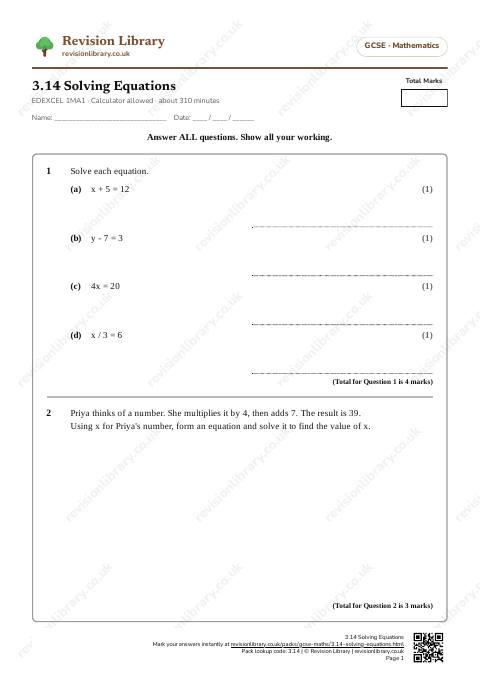
Revision Library
revisionlibrary.co.uk
GCSE · Mathematics
3.14 Solving Equations
EDEXCEL 1MA1 · Calculator allowed · about 310 minutes
Priya thinks of a number. She multiplies it by 4, then adds 7. The result is 39. Using x for Priya's number, form an equation and solve it to find the value of x.
(Total for Question 2 is 3 marks)
3
Solve each equation. Show your working.
(a)2x + 3 = 11(2)
(b)3x - 4 = 11(2)
(c)5x + 1 = -14(2)
(d)4x - 7 = 1(2)
(Total for Question 3 is 8 marks)
4
Solve each equation. Show your working.
(a)x / 2 + 3 = 7(2)
(b)(x + 4) / 3 = 5(2)
(c)-2x + 5 = 13(2)
(Total for Question 4 is 6 marks)
5
Solve each equation.
(a)0.5x + 3 = 7.5(2)
(b)2.5x - 4 = 6(2)
(Total for Question 5 is 4 marks)
6
Solve x + 7 = 12
(Total for Question 6 is 1 mark)
7
Solve x - 5 = 9
(Total for Question 7 is 1 mark)
8
Solve 3x = 18
(Total for Question 8 is 1 mark)
9
Solve x / 4 = 6
(Total for Question 9 is 1 mark)
10
Solve 8 + x = 15
(Total for Question 10 is 1 mark)
11
Solve 20 - x = 6
(Total for Question 11 is 1 mark)
12
Solve 36 = 4x
(Total for Question 12 is 1 mark)
13
Solve 8 = x / 7
(Total for Question 13 is 1 mark)
14
Solve the equation. Show your method. 6 = 3x + 9
(Total for Question 14 is 3 marks)
15
A rectangle has length (3x - 2) cm and width (x + 4) cm. The perimeter of the rectangle is 60 cm.
Diagram NOT accurately drawn
(a)Form an equation in x and solve it to find the value of x.(3)
(b)Work out the area of the rectangle.(2)
(Total for Question 15 is 5 marks)
16
Solve each equation. Give both values of x.
(a)x2 = 49(2)
(b)x2 - 5 = 20(2)
(Total for Question 16 is 4 marks)
17
Sam and Priya share out some money. Sam receives (3x + 5) pounds. Priya receives (x + 15) pounds. They both receive the same amount of money.
(a)Form an equation in x and solve it to find the value of x.(3)
(b)Work out how much money Sam receives.(2)
(Total for Question 17 is 5 marks)
18
Solve each equation. Show your working.
(a)3(x + 2) = 21(2)
(b)5(2x - 1) = 35(3)
(c)2(x + 5) - 3 = 17(3)
(Total for Question 18 is 8 marks)
19
Solve each equation. Show your working.
(a)5x + 3 = 2x + 18(3)
(b)7x - 4 = 3x + 20(3)
(c)4x + 9 = 20 - x(3)
(Total for Question 19 is 9 marks)
20
Jess solves the equation 4x - 5 = 11. Her working is shown below. 4x = 11 - 5 4x = 6 x = 1.5 Jess's answer is wrong.
(a)Identify the error in Jess's working.(1)
(b)Work out the correct value of x.(2)
(Total for Question 20 is 3 marks)
21
The three angles of a triangle are 3x degrees, (2x + 10) degrees and (x + 20) degrees. Work out the value of x.
Diagram NOT accurately drawn
(Total for Question 21 is 3 marks)
22
Solve 3(2x - 1) = 15 Show your working.
(Total for Question 22 is 2 marks)
23
Solve 2x + 5 = 17 Show your working.
(Total for Question 23 is 2 marks)
24
Solve 3x - 7 = 14 Show your working.
(Total for Question 24 is 2 marks)
25
Solve 5x + 2 = 2x + 14 Show your working.
(Total for Question 25 is 2 marks)
26
Solve 4x - 3 = 2x + 9 Show your working.
(Total for Question 26 is 2 marks)
27
Solve 2(x + 3) = 16 Show your working.
(Total for Question 27 is 2 marks)
28
Solve 5(x - 2) = 25 Show your working.
(Total for Question 28 is 2 marks)
29
Solve 4(3x + 1) = 28 Show your working.
(Total for Question 29 is 2 marks)
30
A function machine multiplies a number by 3, then adds 4. The output is 19. Work out the input number.
(Total for Question 30 is 2 marks)
31
Solve 4x + 3 = 23 Show your working.
(Total for Question 31 is 2 marks)
32
Solve 6x - 5 = 19 Show your working.
(Total for Question 32 is 2 marks)
33
Solve 3x + 8 = x + 20 Show your working.
(Total for Question 33 is 2 marks)
34
Solve 7x - 4 = 3x + 24 Show your working.
(Total for Question 34 is 2 marks)
35
Solve 5x - 7 = 3x + 9.
(Total for Question 35 is 2 marks)
36
Solve (2x + 1) / 3 = (x + 5) / 2 Show your working.
(Total for Question 36 is 3 marks)
37
Solve 3(x - 2) / 4 = 6 Show your working.
(Total for Question 37 is 3 marks)
38
Solve each equation. Show your working.
(a)3(x + 4) = 2(x + 9)(3)
(b)4(2x - 3) = 3(x + 5)(3)
(Total for Question 38 is 6 marks)
39
Solve (x + 6) / 4 = 3 Show your working.
(Total for Question 39 is 2 marks)
40
Solve 5 - 2x = 1 Show your working.
(Total for Question 40 is 2 marks)
41
Solve 7 - x = 2x + 1 Show your working.
(Total for Question 41 is 2 marks)
42
Solve x / 3 + 4 = 9 Show your working.
(Total for Question 42 is 2 marks)
43
Solve (x - 9) / 5 = 4 Show your working.
(Total for Question 43 is 2 marks)
44
Solve 9 - 4x = -7 Show your working.
(Total for Question 44 is 2 marks)
45
Solve 12 - 3x = 4x - 9 Show your working.
(Total for Question 45 is 2 marks)
46
Solve x / 4 - 3 = 2 Show your working.
(Total for Question 46 is 2 marks)
47
Three consecutive integers have a sum of 72. Using n for the smallest integer, form an equation and solve it to find the three integers.
(Total for Question 47 is 3 marks)
48
Yusuf is solving the equation 3(x - 4) = 21. His working is shown below. 3x - 4 = 21 3x = 25 x = 25 / 3
(a)Identify the error in Yusuf's working.(1)
(b)Write out a correct solution to the equation.(2)
(Total for Question 48 is 3 marks)
49
Solve the equation (2x + 3)/4 = x - 1.
(Total for Question 49 is 4 marks)
50
Solve each quadratic equation by factorising.
(a)x2 + 5x + 6 = 0(3)
(b)x2 - 2x - 15 = 0(3)
(Total for Question 50 is 6 marks)
51
Solve the simultaneous equations x + y = 10 x - y = 4 Show clear algebraic working.
(Total for Question 51 is 4 marks)
52
Solve 2(x - 5) = 3(x - 8) Show your working.
(Total for Question 52 is 3 marks)
53
Solve 4(x + 1) - 2(x - 3) = 20 Show your working.
(Total for Question 53 is 3 marks)
54
A rectangle has length (2x + 5) cm and width (x + 3) cm. The perimeter of the rectangle is 46 cm.
Diagram NOT accurately drawn
(a)Show that 6x + 16 = 46(2)
(b)Solve the equation to find the value of x.(2)
(c)Work out the length and the width of the rectangle.(2)
(Total for Question 54 is 6 marks)
55
The angles (2x + 20) degrees, (3x + 10) degrees and (x + 30) degrees lie on a straight line.
(a)Form an equation in x and solve it to find the value of x.(3)
(b)Work out the size of each of the three angles, and state which one is the largest.(3)
(Total for Question 55 is 6 marks)
56
Ben is x years old. His sister Priya is 4 years older than Ben. Their mother's age is 8 years less than three times the sum of Ben's and Priya's ages. Their mother is 52 years old. Form an equation in x and solve it to find Ben's age.
(Total for Question 56 is 4 marks)
57
Solve 5(x + 3) = 2(x + 12) Show your working.
(Total for Question 57 is 3 marks)
58
Solve 6(2x - 1) - 4(x - 3) = 22 Show your working.
(Total for Question 58 is 3 marks)
59
The diagram shows a triangle with its three interior angles marked in terms of x.
Diagram NOT accurately drawn
(a)Form an equation in x using the fact that the angles in a triangle sum to 180 degrees, and solve it to find the value of x.(3)
(b)Work out the size of each of the three angles, and state whether the triangle is acute-angled, right-angled or obtuse-angled.(3)
(Total for Question 59 is 6 marks)
60
The diagram shows a rectangular photo frame. The perimeter of the frame is 50 cm.
Diagram NOT accurately drawn
(a)Show that 8x + 2 = 50(2)
(b)Solve the equation to find the value of x.(2)
(c)Work out the length and the width of the frame, and state whether the frame is in landscape or portrait orientation.(2)
(Total for Question 60 is 6 marks)
61
A mobile phone company offers two data plans. Plan A costs a fixed £15 per month plus £2 per gigabyte (GB) of data used. Plan B costs a fixed £9 per month plus £3.50 per GB of data used. Let g be the number of GB used in a month.
(a)Write an expression for the total monthly cost of Plan A, and an expression for the total monthly cost of Plan B.(2)
(b)Form an equation and solve it to find the value of g for which the two plans cost the same amount.(3)
(c)Work out the monthly cost when the two plans cost the same amount.(1)
(Total for Question 61 is 6 marks)
62
Solve (2x - 1) / 3 + (x + 1) / 2 = 6 Show your working.
(Total for Question 62 is 3 marks)
63
Solve (x - 4) / 2 = (2x + 1) / 5 Show your working.
(Total for Question 63 is 3 marks)
64
Amara thinks of a number and calls it x. She multiplies it by 4, then subtracts 7. Her result is the same as when she adds 5 to the number and then doubles it. Form an equation in x and solve it to find the number Amara is thinking of.
(Total for Question 64 is 3 marks)
65
Solve (3x + 2) / 4 - (x - 1) / 3 = 2 Show your working.
(Total for Question 65 is 3 marks)
66
Solve (5x - 3) / 4 = (3x + 1) / 2 Show your working.
(Total for Question 66 is 3 marks)
67
Solve the equation 2(3 - t) = t2 - 5t + 6. Show all steps and give exact answers.
(a)Rearrange the equation to write it in the form f(t) = 0.(3)
(b)Factorise and solve the equation fully, giving exact values of t.(3)
(c)Check whether both roots satisfy the original equation and state your conclusion.(1)
(Total for Question 67 is 7 marks)
68
Solve 3 / (x + 2) = 2 / (x - 1) Show your working.
(Total for Question 68 is 3 marks)
69
Show that the equation 6(x + 2) - 2x = 4(x + 5) has no solutions.
(Total for Question 69 is 3 marks)
70
Find the value of k for which the equation 3(x + 4) = kx + 12 has an infinite number of solutions.
(Total for Question 70 is 3 marks)
71
Show that the equation (2x + 1) / 3 = (2x - 5) / 3 + 4 has no solutions.
expands both sides and collects terms, 3x - 3 = 2x + 4 leading to x = 7 (dep)dM1
x = 7 caoA1
Answer: x = 7
Question 69
expands the left-hand side correctly, 6x + 12 - 2x = 4x + 12 oeM1
expands the right-hand side correctly, 4(x + 5) = 4x + 20 oeM1
correct conclusion with valid reason (dep on both M marks), e.g. '4x + 12 = 4x + 20 gives 12 = 20, which is false for every value of x, so the equation has no solutions' oeB1
Answer: The equation has no solutions, since simplifying gives 12 = 20, which is never true.
Question 70
expands the left-hand side correctly, 3x + 12 = kx + 12 oeM1
recognises the constant terms already match (12 = 12), so the x-coefficients must also be equal for the equation to hold for every x (dep)M1
k = 3 cao, with a correct supporting reasonA1
Answer: k = 3
Question 71
combines the right-hand side into a single fraction, (2x - 5) / 3 + 4 = (2x + 7) / 3 oeM1
equates numerators over the common denominator, 2x + 1 = 2x + 7 oeM1
correct conclusion with valid reason (dep on both M marks), e.g. '2x + 1 = 2x + 7 gives 1 = 7, which is false for every value of x, so the equation has no solutions' oeB1
Answer: The equation has no solutions, since simplifying gives 1 = 7, which is never true.
Put this topic and others into one printable pack.
Open the Pack Builder
Worksheets are written for Revision Library and come with a full mark scheme; a few English packs quote an out-of-copyright text, and name it on the page. Exam board names and specification codes say which qualification a pack suits: we are not affiliated with, endorsed by or approved by any exam board, and no past-paper question is reproduced here. Rights queries: hello@revisionlibrary.co.uk