An inequality is a statement comparing two expressions with greater than, less than, or their or-equal-to versions, rather than stating they are exactly equal. In GCSE Algebra, students solve linear inequalities using the same steps as for equations, show solution sets on a number line, and list integer solutions, remembering to reverse the sign when multiplying or dividing by a negative number.
Treat the inequality like an equation: do the same operation (add, subtract, multiply, divide) to both sides to isolate the letter.
If you multiply or divide both sides by a negative number, reverse the direction of the inequality sign.
To solve a double inequality, such as -3 < 2x + 1 ≤ 9, apply each operation to all three parts at once.
To list integer solutions, write out the whole numbers that satisfy the inequality, checking carefully whether the boundary values are included (≤, ≥) or excluded (<, >).
To show a solution on a number line, use an open circle for < or > since the boundary is not included, and a filled circle for ≤ or ≥ since it is included, then draw a line or arrow in the direction of the solutions.
Check your answer by substituting a value from your solution set back into the original inequality.
Worked example
Solve the inequality 3(x - 2) ≥ 2x + 4.
Expand the bracket: 3x - 6 ≥ 2x + 4.
Subtract 2x from both sides: x - 6 ≥ 4.
Add 6 to both sides: x ≥ 10.
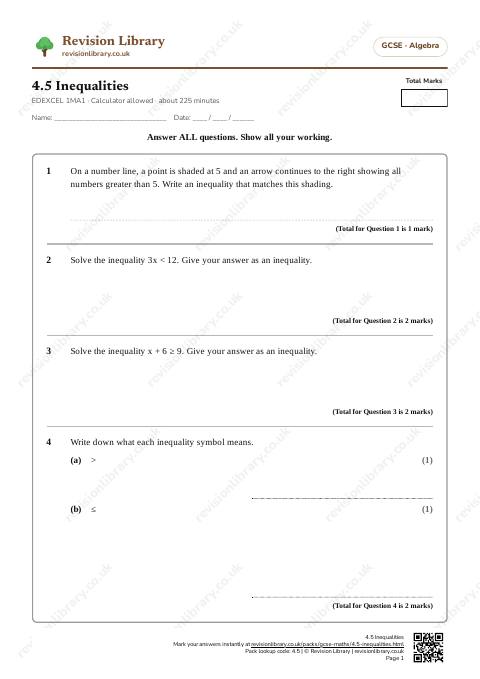
Revision Library
revisionlibrary.co.uk
GCSE · Algebra
4.5 Inequalities
EDEXCEL 1MA1 · Calculator allowed · about 225 minutes
On a number line, a point is shaded at 5 and an arrow continues to the right showing all numbers greater than 5. Write an inequality that matches this shading.
(Total for Question 1 is 1 mark)
2
Solve the inequality 3x < 12. Give your answer as an inequality.
(Total for Question 2 is 2 marks)
3
Solve the inequality x + 6 ≥ 9. Give your answer as an inequality.
(Total for Question 3 is 2 marks)
4
Write down what each inequality symbol means.
(a)>(1)
(b)≤(1)
(Total for Question 4 is 2 marks)
5
The diagram shows two number lines, A and B.
(a)Write down the inequality shown by number line A.(1)
(b)Write down the inequality shown by number line B.(1)
(Total for Question 5 is 2 marks)
6
n is an integer such that -3 < n ≤ 2. List all the possible values of n.
(Total for Question 6 is 2 marks)
7
Solve x + 5 < 12
(Total for Question 7 is 1 mark)
8
Solve x - 3 > 7
(Total for Question 8 is 1 mark)
9
Solve 2x < 16
(Total for Question 9 is 1 mark)
10
Solve x / 3 ≥ 4
(Total for Question 10 is 1 mark)
11
Solve the inequality 2x - 1 ≤ 7. Give your answer in simplest form.
(Total for Question 11 is 2 marks)
12
Solve the inequality -x < 5. Give your answer as an inequality and explain any change of direction of the inequality sign.
(Total for Question 12 is 3 marks)
13
This question has two parts.
(a)Solve x - 3 > -5.(1)
(b)Show the solution set on the number line.(2)
(Total for Question 13 is 3 marks)
14
Anjali has p pounds. She has more than £15 but no more than £40. Write down an inequality, in terms of p, to show this information.
(Total for Question 14 is 2 marks)
15
Tom thinks of a number, x. He multiplies it by 3, then subtracts 7. The result is greater than 14.
(a)Write an inequality, in terms of x, to show this information.(1)
(b)Solve your inequality to find the possible values of x.(2)
(Total for Question 15 is 3 marks)
16
Which of the following is the solution to 2x + 1 ≥ x - 4?
A) x ≥ -5
B) x ≤ -5
C) x ≥ -3
D) x ≤ 5
(Total for Question 16 is 1 mark)
17
Priya is designing a rectangular garden. It has length x metres and width 6 metres. The perimeter of the garden must be at least 30 metres. Form an inequality in x and solve it to find the possible values of x.
Diagram NOT accurately drawn
(Total for Question 17 is 3 marks)
18
Solve the inequality 7 - 2x > 1.
(Total for Question 18 is 2 marks)
19
Solve the inequality 3 - 5x ≤ 18.
(Total for Question 19 is 2 marks)
20
Solve the inequality -3 < 2x + 1 ≤ 9. Show the solution set on the number line below.
(Total for Question 20 is 4 marks)
21
Solve 4t + 6 ≤ 30
(Total for Question 21 is 2 marks)
22
Solve 5 - 5t < -15
(Total for Question 22 is 3 marks)
23
n is an integer. Write down all the values of n that satisfy -6 < 4n - 1 ≤ 14
(Total for Question 23 is 3 marks)
24
On a number line there is an open circle at -5 and an open circle at 0, with the line between them drawn thick. Write down the inequality, in terms of y, that this number line shows.
(Total for Question 24 is 2 marks)
25
Solve 4m + 9 < 3m + 14
(Total for Question 25 is 3 marks)
26
Solve 4t - 3 > -3
(Total for Question 26 is 2 marks)
27
Solve 3n - 9 < 2n - 8
(Total for Question 27 is 3 marks)
28
On a number line there is an open circle at -2 and a closed circle at 5, with the line between them drawn thick. Write down the inequality, in terms of n, that this number line shows.
(Total for Question 28 is 2 marks)
29
On a number line there is an open circle at -6 and a closed circle at -5, with the line between them drawn thick. Write down the inequality, in terms of y, that this number line shows.
(Total for Question 29 is 2 marks)
30
Solve the inequalities.
(a)x + 6 < 10(1)
(b)5x ≥ 20(1)
(Total for Question 30 is 2 marks)
31
Solve the inequality 2x + 5 < 17.
(Total for Question 31 is 2 marks)
32
Solve the inequality 3x - 4 ≥ 11.
(Total for Question 32 is 2 marks)
33
n is an integer such that -2 ≤ n < 5.
(a)List all the possible values of n.(2)
(b)Write down the smallest possible value of n.(1)
(Total for Question 33 is 3 marks)
34
Solve the inequality 5x + 2 ≤ 3x + 10.
(Total for Question 34 is 3 marks)
35
Solve the inequality 4(x - 1) > 2x + 6.
(Total for Question 35 is 3 marks)
36
Write down all the integer values of x that satisfy -3 < x ≤ 2.
(Total for Question 36 is 2 marks)
37
On the number line below, show the inequality x > -2.
(Total for Question 37 is 1 mark)
38
Solve 3x + 2 ≤ 17 Show your working.
(Total for Question 38 is 2 marks)
39
Solve 5x - 4 > 21 Show your working.
(Total for Question 39 is 2 marks)
40
Solve 4 - x < 9 Show your working.
(Total for Question 40 is 2 marks)
41
Solve 12 - 2x ≥ 4 Show your working.
(Total for Question 41 is 2 marks)
42
Write down the largest integer value of x that satisfies x < 7.
(Total for Question 42 is 1 mark)
43
Solve the inequality 5 - 3x < 2. Give your answer as an inequality and justify any sign change.
(Total for Question 43 is 5 marks)
44
Write down the inequality shown on this number line. A filled circle at -2 and an arrow to the right from -2 to infinity.
(Total for Question 44 is 1 mark)
45
Solve the inequality 3x - 5 < 10. Show all steps.
(Total for Question 45 is 2 marks)
46
Solve the inequality 3(x - 2) ≥ 5(x + 4), giving your answer in the form x ≤ k, where k is an integer.
(Total for Question 46 is 3 marks)
47
Jamal measures the length of a plank of wood, l cm, as 8 cm, correct to the nearest centimetre. Write down the error interval for l.
(Total for Question 47 is 2 marks)
48
On the grid, shade the region R that satisfies all three of these inequalities: x ≥ 1, y > 2, x + y ≤ 6. Label your region R.
(Total for Question 48 is 3 marks)
49
n is an integer. Show that n = 3 is the only value of n that satisfies both 3n - 1 < 11 and 2n + 3 ≥ 9.
(Total for Question 49 is 4 marks)
50
On the number line below, show the inequality -1 ≤ x < 4.
(Total for Question 50 is 2 marks)
51
The diagram below shows a number line. There is an open circle at x = 3, with shading and an arrow extending to the left. Write down the inequality that is shown.
(Total for Question 51 is 1 mark)
52
Solve 3(x - 2) < 15 Show your working.
(Total for Question 52 is 2 marks)
53
Solve the compound inequality 1 ≤ 2x + 1 < 7. Show working and give the final range for x.
(Total for Question 53 is 5 marks)
54
Solve the pair of inequalities and give the solution as a single inequality: 2x + 1 ≥ 5 and x - 4 < 3.
(Total for Question 54 is 2 marks)
55
Solve the inequality 4 - 2x ≤ 10. Give your answer in the form x ≥ or x ≤.
(Total for Question 55 is 3 marks)
56
This question has two parts.
(a)Solve the inequality 2x + 5 < 4x - 3.(2)
(b)Show the solution set on the number line below.(1)
(Total for Question 56 is 3 marks)
57
n is an integer such that -4 < 2n ≤ 10. List all the possible values of n.
(Total for Question 57 is 2 marks)
58
Solve the inequality 5 - 3x ≤ 2x - 5, giving your answer using set notation. Show your working.
(Total for Question 58 is 3 marks)
59
Solve the quadratic inequality x2 - 5x + 6 < 0. Show how you find the critical values and give the solution in interval notation.
(Total for Question 59 is 4 marks)
60
Solve the inequality 3(2x - 1) ≥ x + 8, giving your answer using set notation. Show your working.
(Total for Question 60 is 4 marks)
61
A rectangle has length (2x + 3) cm and width x cm. The perimeter of the rectangle is less than 46 cm. Form an inequality in x and solve it to find the range of possible values of x.
Diagram NOT accurately drawn
(Total for Question 61 is 4 marks)
62
On the grid below, shade the region R that satisfies all three of these inequalities: x ≥ 1, y < 4, y ≥ x. Label your region R.
(Total for Question 62 is 4 marks)
63
Sam has s sweets, where s is a positive integer. Tom has more than 3 times as many sweets as Sam. The total number of sweets that Tom and Sam have together is less than 60. Find the maximum possible value of s.
(Total for Question 63 is 4 marks)
64
Find the set of values of x that satisfy both of these inequalities: 3x - 2 < 10 x + 4 > 6 Show your working.
(Total for Question 64 is 3 marks)
65
Solve the inequality (x+1)/(x-2) ≥ 0. State clearly any values excluded from the solution and give the final solution as a single inequality or union of intervals.
(Total for Question 65 is 5 marks)
66
Solve the inequality x2 < 49.
(Total for Question 66 is 2 marks)
67
Solve the inequality x2 - 5x - 6 > 0, giving your answer using set notation. Show your working.
(Total for Question 67 is 4 marks)
Mark scheme · 4.5 Inequalities
Question 1
x ≥ 5 or x ≥ 5 cao (closed dot at 5)B1
Answer: x ≥ 5
Question 2
divide both sides by 3 or show equivalent method 3x/3 < 12/3M1
x < 4 caoA1
Answer: x < 4
Question 3
subtract 6 from both sides or show method x ≥ 9 - 6M1
x ≥ 3 caoA1
Answer: x ≥ 3
Question 4
(a) greater than oeB1
(a) Answer: greater than
(b) less than or equal to oeB1
(b) Answer: less than or equal to
Question 5
(a) x > 3 oe caoB1
(a) Answer: x > 3
(b) x ≤ -2 oe caoB1
(b) Answer: x ≤ -2
Question 6
-3 correctly excluded and 2 correctly included, at least 3 correct values shownM1
-2, -1, 0, 1, 2 oe cao, no extra or missing valuesA1
Answer: -2, -1, 0, 1, 2
Question 7
x < 7 oe caoB1
Answer: x < 7
Question 8
x > 10 oe caoB1
Answer: x > 10
Question 9
x < 8 oe caoB1
Answer: x < 8
Question 10
x ≥ 12 oe caoB1
Answer: x ≥ 12
Question 11
add 1 then divide by 2 shown, e.g. 2x ≤ 8 then x ≤ 4M1
x ≤ 4 caoA1
Answer: x ≤ 4
Question 12
multiply or divide by -1 to get x > -5, or show rearrangement -x < 5 -> x > -5M1
x > -5 caoA1
states reason: inequality direction changes when multiplying/dividing by a negative number oeB1
Answer: x > -5; the inequality reverses because we divide by -1
Question 13
(a) x > -2 oe caoB1
(a) Answer: x > -2
(b) open circle drawn at -2, ft from their answer to part (a)B1
(b) correct shading/arrow extending to the right from -2, ft from their answer to part (a)B1
(b) Answer: Open circle at -2 with shading/arrow to the right
Question 14
15 < p oe or p ≤ 40 oe, one boundary correctly representedM1
15 < p ≤ 40 oe cao, both boundaries correct with correct strict/non-strict signsA1
Answer: 15 < p ≤ 40
Question 15
(a) 3x - 7 > 14 oe caoB1
(a) Answer: 3x - 7 > 14
(b) 3x > 21 oe, ft from their inequality in part (a)M1
(b) x > 7 oe caoA1
(b) Answer: x > 7
Question 16
A caoB1
Answer: A) x ≥ -5
Question 17
2(x + 6) ≥ 30 oe, correct inequality formed for the perimeterM1
x + 6 ≥ 15 oe, dependent on a correct inequality being formedM1
x ≥ 9 oe caoA1
Answer: x ≥ 9
Question 18
-2x > -6 oe, correct rearrangement shownM1
x < 3 oe cao, inequality sign correctly reversed when dividing by a negative numberA1
Answer: x < 3
Question 19
-5x ≤ 15 oe, correct rearrangement shownM1
x ≥ -3 oe cao, inequality sign correctly reversed when dividing by a negative numberA1
Answer: x ≥ -3
Question 20
1 subtracted from all three parts, -4 < 2x ≤ 8 oeM1
all three parts divided by 2, dependent on the previous method mark, -2 < x ≤ 4 oedM1
-2 < x ≤ 4 oe caoA1
correct number line: open circle at -2, closed circle at 4, line joining the two, ft from their algebraic answerB1
Answer: -2 < x ≤ 4
Question 21
4t ≤ 24 or equivalentM1
t ≤ 6A1
Answer: t ≤ 6
Question 22
-5t < -20 or 5 + 15 < 5tM1
divides by the negative coefficient and reverses the inequality or equivalentM1
t > 4A1
Answer: t > 4
Question 23
solves one side, e.g. 4n > -5M1
solves the other sideM1
n = -1, 0, 1, 2, 3A1
Answer: n = -1, 0, 1, 2, 3
Question 24
-5 < yB1
y < 0B1
Answer: -5 < y < 0
Question 25
collects the letter terms on one sideM1
collects the numbers on the other sideM1
m < 5A1
Answer: m < 5
Question 26
4t > 0 or equivalentM1
t > 0A1
Answer: t > 0
Question 27
collects the letter terms on one sideM1
collects the numbers on the other sideM1
n < 1A1
Answer: n < 1
Question 28
-2 < nB1
n ≤ 5B1
Answer: -2 < n ≤ 5
Question 29
-6 < yB1
y ≤ -5B1
Answer: -6 < y ≤ -5
Question 30
(a) x < 4 oe caoB1
(a) Answer: x < 4
(b) x ≥ 4 oe caoB1
(b) Answer: x ≥ 4
Question 31
2x < 12 oe, correct rearrangement shownM1
x < 6 oe caoA1
Answer: x < 6
Question 32
3x ≥ 15 oe, correct rearrangement shownM1
x ≥ 5 oe caoA1
Answer: x ≥ 5
Question 33
(a) -2 correctly included and 5 correctly excluded, at least 5 correct values shownM1
(a) -2, -1, 0, 1, 2, 3, 4 oe cao, no extra or missing valuesA1
(a) Answer: -2, -1, 0, 1, 2, 3, 4
(b) -2 cao, ft from their list in part (a)B1
(b) Answer: -2
Question 34
terms in x collected on one side, e.g. 2x + 2 ≤ 10 oeM1
2x ≤ 8 oe, dependent on correct collection of termsM1
x ≤ 4 oe caoA1
Answer: x ≤ 4
Question 35
bracket expanded correctly, 4x - 4 > 2x + 6M1
2x > 10 oe, dependent on correct expansion and collection of termsM1
x > 5 oe caoA1
Answer: x > 5
Question 36
-3 correctly excluded and 2 correctly included, at least 3 correct values shownM1
-2, -1, 0, 1, 2 oe cao, no extra or missing valuesA1
Answer: -2, -1, 0, 1, 2
Question 37
open circle drawn at -2, with shading/arrow extending to the right (all correct)B1
Answer: Open circle at -2 with shading/arrow to the right
Question 38
3x ≤ 15 oe (correct rearrangement)M1
x ≤ 5 caoA1
Answer: x ≤ 5
Question 39
5x > 25 oe (correct rearrangement)M1
x > 5 caoA1
Answer: x > 5
Question 40
4 < 9 + x oe, or -x < 5 oe (correct rearrangement)M1
x > -5 caoA1
Answer: x > -5
Question 41
8 ≥ 2x oe (correct rearrangement)M1
x ≤ 4 caoA1
Answer: x ≤ 4
Question 42
x = 6 caoB1
Answer: x = 6
Question 43
subtract 5 from both sides to get -3x < -3M1
divide both sides by -3 and reverse inequality to get x > 1M1
x > 1 caoA1
states reason: dividing by a negative number reverses the inequalityB1
example check: x = 2 satisfies 5 - 3x < 2 (gives -1 < 2) or equivalentB1
-2x ≥ 26 oe, dependent on correct expansion, terms in x and constants correctly collecteddM1
x ≤ -13 cao, inequality sign correctly reversed when dividing by a negative numberA1
Answer: x ≤ -13
Question 47
7.5 identified as the lower boundB1
7.5 ≤ l < 8.5 oe cao, correct inequality signs used (lower bound included, upper bound excluded)B1
Answer: 7.5 ≤ l < 8.5
Question 48
solid vertical line x = 1 drawn correctly with the region to the right (x ≥ 1) indicatedB1
dashed horizontal line y = 2 drawn correctly with the region above (y > 2) indicatedB1
solid line x + y = 6 drawn correctly, and the triangular region satisfying all three inequalities simultaneously shaded and labelled RB1
Answer: Triangular region with vertices at (1, 2) [open at this corner], (1, 5) and (4, 2); solid boundaries on x = 1 and x + y = 6, dashed boundary on y = 2
Question 49
3n - 1 < 11 solved correctly, n < 4M1
2n + 3 ≥ 9 solved correctly, n ≥ 3M1
both inequalities combined correctly, 3 ≤ n < 4 oeA1
cso, n = 3 stated as the only integer satisfying 3 ≤ n < 4, so n = 3 is the only value (answer printed)A1
Answer: n = 3
Question 50
closed circle drawn at -1B1
open circle drawn at 4, with a line segment correctly joining the two circles (no arrows beyond either end)B1
Answer: Closed circle at -1, open circle at 4, with a line segment joining them
Question 51
x < 3 oe caoB1
Answer: x < 3
Question 52
3x - 6 < 15 oe (expand the bracket correctly)M1
x < 7 caoA1
Answer: x < 7
Question 53
subtract 1 across: 0 ≤ 2x < 6M1
divide by 2 across: 0 ≤ x < 3M1
0 ≤ x < 3 caoA1
states integer examples or checks, e.g. x = 0 and x = 2 satisfy the inequalityB1
notes that x = 3 is not allowed (shows strict inequality at upper end)B1
Answer: 0 ≤ x < 3
Question 54
solve each: 2x ≥ 4 -> x ≥ 2; x < 7 (method for each inequality)M1
2 ≤ x < 7 caoA1
Answer: 2 ≤ x < 7
Question 55
subtract 4 from both sides: -2x ≤ 6 (method)M1
divide both sides by -2 and reverse the inequality sign (method)M1
0 < x < 20/3 oe, stating the additional constraint x > 0 since x is a lengthB1
Answer: 0 < x < 20/3 (cm)
Question 62
solid vertical line x = 1 drawn correctly, with the region to the right (x ≥ 1) indicatedB1
dashed horizontal line y = 4 drawn correctly, with the region below (y < 4) indicatedB1
solid line y = x drawn correctly, with the region above/left (y ≥ x) indicatedB1
correct triangular region satisfying all three inequalities simultaneously shaded and labelled RB1
Answer: Triangular region with vertices at (1, 1), (1, 4) [open at this vertex] and (4, 4); solid boundaries on x = 1 and y = x, dashed boundary on y = 4
Question 63
t > 3s oe, where t is the number of sweets Tom has (correctly represents 'more than 3 times as many')B1
s + t < 60 oe (correctly represents the total being less than 60)B1
4s < 60 oe, dependent on both previous marks (correctly combines the two inequalities, e.g. substituting 3s for t)M1
s = 14 cao, with valid reasoning that s must be a positive integer less than 15A1
Answer: s = 14
Question 64
x < 4 oe (first inequality solved correctly)M1
x > 2 oe (second inequality solved correctly)M1
2 < x < 4 oe caoA1
Answer: 2 < x < 4
Question 65
identify critical points x = -1 (numerator zero) and x = 2 (denominator zero) and state x = 2 is excludedM1
write the sign intervals: (-infinity, -1), {-1}, (-1,2), (2, infinity) or equivalent interval partitionM1
test signs or use multiplicative signs to determine where (x+1)(x-2) is ≥ 0M1
decide whether x = -1 is included since numerator zero gives value 0, and x = 2 is excludedM1
final solution: (-infinity, -1] U (2, infinity) cao, with x = 2 excludedA1
Answer: x ≤ -1 or x > 2 (i.e. (-infinity, -1] U (2, infinity)), with x = 2 excluded
Question 66
critical values x = 7 and x = -7 identified, e.g. from √49 = 7M1
-7 < x < 7 oe caoA1
Answer: -7 < x < 7
Question 67
(x - 6)(x + 1) oe (correct factorisation)M1
critical values x = 6 and x = -1 identifiedA1
correct method to identify the regions satisfying the inequality, dependent on correct critical values, e.g. sign analysis or a sketch of the upward paraboladM1
x < -1 or x > 6 oe cao (accept {x : x < -1} union {x : x > 6}); condone omission of 'or' only if both regions are clearly givenA1
Put this topic and others into one printable pack.
Open the Pack Builder
Worksheets are written for Revision Library and come with a full mark scheme; a few English packs quote an out-of-copyright text, and name it on the page. Exam board names and specification codes say which qualification a pack suits: we are not affiliated with, endorsed by or approved by any exam board, and no past-paper question is reproduced here. Rights queries: hello@revisionlibrary.co.uk