Circle theorems are angle facts that apply to circles, covering angles at the centre and circumference, angles in semicircles, cyclic quadrilaterals, tangents and the alternate segment theorem, each letting an unknown angle be calculated from given information without measuring, as long as the theorem justifying the step is stated. Exam questions almost always require a reason with each answer.
Learn the vocabulary first: radius, chord, tangent, segment, sector, arc and cyclic quadrilateral, since exam questions use this language.
Identify which circle theorem applies by looking for key features in the diagram, such as a diameter, a tangent meeting a radius at right angles, or four points on the circumference.
Use the theorem to write an equation or calculation linking the angles or lengths involved.
Solve for the unknown angle or length.
Always state the name of the theorem you used as your reason; a correct answer without a reason usually loses marks.
Where more than one theorem is needed, work through the diagram in stages, labelling each new angle as you find it.
Worked example
A, B and C are points on the circumference of a circle with centre O. Angle AOB = 100 degrees, where angle AOB and angle ACB stand on the same arc AB. Work out the size of angle ACB, giving a reason for your answer.
Angle AOB is the angle at the centre, and angle ACB is the angle at the circumference, standing on the same arc AB.
The angle at the centre theorem states the angle at the centre is twice the angle at the circumference.
So angle ACB = angle AOB divided by 2 = 100 / 2 = 50 degrees.
Angle ACB = 50 degrees, because the angle at the centre is twice the angle at the circumference subtending the same arc.
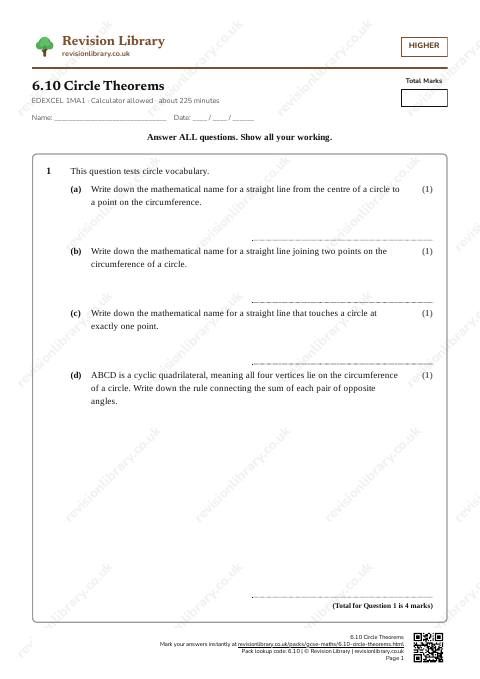
Revision Library
revisionlibrary.co.uk
HIGHER
6.10 Circle Theorems
EDEXCEL 1MA1 · Calculator allowed · about 225 minutes
(a)Write down the mathematical name for a straight line from the centre of a circle to a point on the circumference.(1)
(b)Write down the mathematical name for a straight line joining two points on the circumference of a circle.(1)
(c)Write down the mathematical name for a straight line that touches a circle at exactly one point.(1)
(d)ABCD is a cyclic quadrilateral, meaning all four vertices lie on the circumference of a circle. Write down the rule connecting the sum of each pair of opposite angles.(1)
(Total for Question 1 is 4 marks)
2
AB is a diameter of a circle with centre O. C is a point on the circumference. Angle ABC = 26 degrees.
Diagram NOT accurately drawn
(a)Write down the size of angle ACB. Give a reason for your answer.(2)
(b)Work out the size of angle BAC.(2)
(Total for Question 2 is 4 marks)
3
A, B and C are points on the circumference of a circle with centre O. Angle AOB = 130 degrees, where angle AOB is the angle at the centre standing on the same arc AB as angle ACB.
Diagram NOT accurately drawn
(a)Work out the size of angle ACB.(2)
(b)Give a reason for your answer to part (a).(1)
(Total for Question 3 is 3 marks)
4
AB is a diameter of a circle with centre O. C is a point on the circumference. Angle CAB = 34 degrees.
Diagram NOT accurately drawn
(a)Write down the size of angle ACB. Give a reason for your answer.(2)
(b)Work out the size of angle ABC.(2)
(Total for Question 4 is 4 marks)
5
A, B, C and D are points on the circumference of a circle. C and D are on the same side of the chord AB, so angle ACB and angle ADB are angles in the same segment. Angle ADB = 42 degrees.
Diagram NOT accurately drawn
(a)Work out the size of angle ACB.(2)
(b)State the circle theorem used in part (a).(1)
(Total for Question 5 is 3 marks)
6
X, Y and Z are points on the circumference of a circle with centre O. Angle XOY = 96 degrees, where angle XOY is the angle at the centre standing on the same arc XY as angle XZY. Work out the size of angle XZY, giving a reason for your answer.
Diagram NOT accurately drawn
(Total for Question 6 is 3 marks)
7
O is the centre of a circle. P and Q are points on the circumference, so OP and OQ are radii. Angle POQ = 68 degrees.
Diagram NOT accurately drawn
(a)Explain why triangle OPQ is isosceles.(1)
(b)Work out the size of angle OPQ.(2)
(Total for Question 7 is 3 marks)
8
A, B, C and D are points on the circumference of a circle. C and D are on the same side of the chord AB, so angle ACB and angle ADB are angles in the same segment. Angle ADB = 37 degrees. Write down the size of angle ACB, giving a reason for your answer.
Diagram NOT accurately drawn
(Total for Question 8 is 2 marks)
9
TP is a tangent to a circle with centre O, touching the circle at T. OT = 9 cm and OP = 41 cm.
Diagram NOT accurately drawn
(a)State the size of angle OTP. Give a reason for your answer.(1)
(b)Work out the length TP.(2)
(Total for Question 9 is 3 marks)
10
A chord AB of a circle with centre O has length 16 cm. The radius of the circle is 10 cm. M is the midpoint of AB, and OM is drawn perpendicular to AB.
Diagram NOT accurately drawn
(a)Explain why AM = 8 cm.(1)
(b)Work out the length OM.(2)
(Total for Question 10 is 3 marks)
11
AB is a diameter of a circle with centre O. C is a point on the circumference. Angle CAB = 22 degrees. Work out the size of angle ABC. Give reasons for your working.
(Total for Question 11 is 3 marks)
12
A, B and C are points on the circumference of a circle with centre O. C is on the major arc AB. Angle ACB = 59 degrees. Work out the size of angle AOB. Give a reason for your answer.
(Total for Question 12 is 2 marks)
13
T and A are points on a circle. The tangent at T makes an angle of 60 degrees with the chord TA. B is a point on the major arc TA. Work out the size of angle TBA. Give a reason for your answer.
(Total for Question 13 is 2 marks)
14
A, B, C and D are points on a circle, in that order, so that ABCD is a cyclic quadrilateral. Angle BAD = 127 degrees. Work out the size of angle BCD. Give a reason for your answer.
(Total for Question 14 is 2 marks)
15
AB is a diameter of a circle with centre O. C is a point on the circumference. Angle CAB = 68 degrees. Work out the size of angle ABC. Give reasons for your working.
(Total for Question 15 is 3 marks)
16
PA and PB are tangents from the point P to a circle with centre O, touching the circle at A and B. Angle APB = 138 degrees. Work out the size of angle AOB.
(Total for Question 16 is 3 marks)
17
PT is a tangent to a circle with centre O at the point T. P is outside the circle. Angle TPO = 51 degrees. Work out the size of angle POT. Give reasons for your working.
(Total for Question 17 is 3 marks)
18
A, B and C are points on the circumference of a circle with centre O. C is on the major arc AB. Angle AOB = 160 degrees. Work out the size of angle ACB. Give a reason for your answer.
(Total for Question 18 is 2 marks)
19
T and A are points on a circle. The tangent at T makes an angle of 74 degrees with the chord TA. B is a point on the major arc TA. Work out the size of angle TBA. Give a reason for your answer.
(Total for Question 19 is 2 marks)
20
AB is a diameter of a circle with centre O. C is a point on the circumference. Angle CAB = 60 degrees. Work out the size of angle ABC. Give reasons for your working.
(Total for Question 20 is 3 marks)
21
PT is a tangent to a circle with centre O at the point T. P is outside the circle. Angle TPO = 50 degrees. Work out the size of angle POT. Give reasons for your working.
(Total for Question 21 is 3 marks)
22
PA and PB are tangents from the point P to a circle with centre O, touching the circle at A and B. Angle APB = 116 degrees. Work out the size of angle AOB.
(Total for Question 22 is 3 marks)
23
AB is a diameter of a circle with centre O. C is a point on the circumference. Angle CAB = 34 degrees. Work out the size of angle ABC. Give reasons for your working.
(Total for Question 23 is 3 marks)
24
A, B and C are points on the circumference of a circle with centre O. C is on the major arc AB. Angle ACB = 30 degrees. Work out the size of angle AOB. Give a reason for your answer.
(Total for Question 24 is 2 marks)
25
PT is a tangent to a circle with centre O at the point T. P is outside the circle. Angle TPO = 35 degrees. Work out the size of angle POT. Give reasons for your working.
(Total for Question 25 is 3 marks)
26
T and A are points on a circle. The tangent at T makes an angle of 36 degrees with the chord TA. B is a point on the major arc TA. Work out the size of angle TBA. Give a reason for your answer.
(Total for Question 26 is 2 marks)
27
A, B, C and D are points on a circle, in that order, so that ABCD is a cyclic quadrilateral. Angle ABC = 74 degrees. Work out the size of angle ADC. Give a reason for your answer.
(Total for Question 27 is 2 marks)
28
A, B and C are points on the circumference of a circle with centre O. C is on the major arc AB. Angle AOB = 80 degrees. Work out the size of angle ACB. Give a reason for your answer.
(Total for Question 28 is 2 marks)
29
PT is a tangent to a circle with centre O at the point T. P is outside the circle. Angle TPO = 60 degrees. Work out the size of angle POT. Give reasons for your working.
(Total for Question 29 is 3 marks)
30
PA and PB are tangents from the point P to a circle with centre O, touching the circle at A and B. Angle APB = 108 degrees. Work out the size of angle AOB.
(Total for Question 30 is 3 marks)
31
PT is a tangent to a circle with centre O at the point T. P is outside the circle. Angle TPO = 41 degrees. Work out the size of angle POT. Give reasons for your working.
(Total for Question 31 is 3 marks)
32
A, B, C and D are points on a circle, in that order, so that ABCD is a cyclic quadrilateral. Angle ABC = 82 degrees. Work out the size of angle ADC. Give a reason for your answer.
(Total for Question 32 is 2 marks)
33
T and A are points on a circle with centre O. The tangent at T makes an angle of 44 degrees with the chord TA. Work out the size of angle TOA. Give reasons for your working.
(Total for Question 33 is 3 marks)
34
ABCD is a cyclic quadrilateral. Side AB is extended to a point E, so that angle CBE is the exterior angle of the quadrilateral at B. Angle CBE = 115 degrees.
Diagram NOT accurately drawn
(a)Work out the size of angle ADC. Give a reason for your answer.(2)
(b)Work out the size of angle ABC.(2)
(Total for Question 34 is 4 marks)
35
TP is a tangent to a circle with centre O, touching the circle at T. OT = 5 cm and OP = 13 cm. Since OT is a radius and TP is a tangent at T, angle OTP = 90 degrees.
Diagram NOT accurately drawn
(a)Work out the length TP.(2)
(b)Work out the size of angle TPO. Give your answer correct to 1 decimal place.(2)
(Total for Question 35 is 4 marks)
36
PA and PB are tangents to a circle with centre O, touching the circle at A and B respectively. Angle APB = 50 degrees.
Diagram NOT accurately drawn
(a)Work out the size of angle AOB.(3)
(b)Work out the size of angle OAB.(2)
(Total for Question 36 is 5 marks)
37
TA is a tangent to a circle at the point A. AB is a chord of the circle, and C is a point on the circle in the alternate segment. The angle between the tangent TA and the chord AB is 58 degrees. Write down the size of angle ACB, giving a reason for your answer.
Diagram NOT accurately drawn
(Total for Question 37 is 2 marks)
38
A chord PQ of a circle with centre O has length 24 cm. The radius of the circle is 13 cm. M is the midpoint of PQ, and OM is drawn perpendicular to PQ.
Diagram NOT accurately drawn
(a)Explain why PM = 12 cm.(1)
(b)Work out the length OM.(2)
(Total for Question 38 is 3 marks)
39
O is the centre of a circle of radius 7 cm. P is a point outside the circle with OP = 25 cm. PT is a tangent to the circle, touching it at T. Show that PT = 24 cm.
Diagram NOT accurately drawn
(Total for Question 39 is 3 marks)
40
ABCD is a cyclic quadrilateral. Angle A = (4x - 5) degrees and angle C = (2x + 35) degrees.
Diagram NOT accurately drawn
(a)Explain why angle A + angle C = 180 degrees.(1)
(b)Work out the value of x.(2)
(c)Work out the size of angle A and the size of angle C.(2)
(Total for Question 40 is 5 marks)
41
ABCD is a cyclic quadrilateral. Side AB is extended to a point E, so that angle CBE is the exterior angle of the quadrilateral at B. Angle CBE = 108 degrees.
Diagram NOT accurately drawn
(a)Work out the size of angle ADC. Give a reason for your answer.(2)
(b)Work out the size of angle ABC.(2)
(Total for Question 41 is 4 marks)
42
A, B and C are points on the circumference of a circle with centre O. B lies on the minor arc AC. The reflex angle AOC = 250 degrees. Work out the size of angle ABC.
Diagram NOT accurately drawn
(Total for Question 42 is 3 marks)
43
PA and PB are tangents to a circle with centre O, touching the circle at A and B. Angle APB = (3x + 10) degrees and angle AOB = (2x + 20) degrees.
Diagram NOT accurately drawn
(a)Show that angle APB + angle AOB = 180 degrees.(2)
(b)Work out the value of x.(2)
(c)Work out the size of angle APB.(1)
(Total for Question 43 is 5 marks)
44
TA is a tangent to a circle at the point A. AB and AC are chords of the circle. The angle between the tangent and the chord AB is (2x + 5) degrees. The angle in the alternate segment, angle ACB, is (3x - 15) degrees.
Diagram NOT accurately drawn
(a)Use the alternate segment theorem to form an equation in x, and solve it to find the value of x.(2)
(b)Work out the size of angle ACB.(1)
(Total for Question 44 is 3 marks)
45
A, B, C and D are points on a circle, with AC a diameter of the circle. B and D lie on opposite sides of AC. Angle ACB = 45 degrees and angle CAD = 32 degrees. Work out the size of angle BAD and the size of angle BCD, giving reasons at each stage of your working.
Diagram NOT accurately drawn
(Total for Question 45 is 6 marks)
46
AB is a diameter of a circle with centre O. C is a point on the circumference, and OC is drawn. Angle OCB = 33 degrees. Work out the size of angle BAC, giving reasons at each stage of your working.
Diagram NOT accurately drawn
(Total for Question 46 is 4 marks)
47
A, B and C are points on the circumference of a circle with centre O. B lies on the minor arc AC. The reflex angle AOC = 264 degrees.
Diagram NOT accurately drawn
(a)Work out the size of the non-reflex angle AOC.(1)
(b)Work out the size of angle ABC.(3)
(Total for Question 47 is 4 marks)
48
TA is a tangent to a circle at the point A. AB and AC are chords of the circle. The angle between the tangent and the chord AB is (3x + 8) degrees. The angle in the alternate segment, angle ACB, is (5x - 32) degrees.
Diagram NOT accurately drawn
(a)Use the alternate segment theorem to form an equation in x, and solve it to find the value of x.(2)
(b)Work out the size of angle ACB.(1)
(Total for Question 48 is 3 marks)
49
AB is a diameter of a circle, centre O. C is a point on the circle. The tangent to the circle at C meets the line AB extended beyond B at the point T. Angle CAB = 35 degrees. Work out the size of angle CTB, giving reasons at each stage of your working.
Diagram NOT accurately drawn
(Total for Question 49 is 6 marks)
50
A, B, C and D are points on a circle, with AC a diameter of the circle. B and D lie on opposite sides of AC. Angle ACB = 52 degrees and angle CAD = 24 degrees. Work out the size of angle BAD and the size of angle BCD, giving reasons at each stage of your working.
Diagram NOT accurately drawn
(Total for Question 50 is 6 marks)
51
AB is a diameter of a circle, centre O. D is a point on the circle. The tangent to the circle at D meets the line BA extended beyond A at the point T. Angle DBA = 41 degrees. Work out the size of angle DTA, giving reasons at each stage of your working.
Diagram NOT accurately drawn
(Total for Question 51 is 6 marks)
Mark scheme · 6.10 Circle Theorems
Question 1
(a) radius caoB1
(a) Answer: Radius
(b) chord caoB1
(b) Answer: Chord
(c) tangent caoB1
(c) Answer: Tangent
(d) opposite angles sum to 180 degrees oeB1
(d) Answer: Each pair of opposite angles sums to 180 degrees.
Question 2
(a) 90 degrees caoB1
(a) reason: the angle in a semicircle is 90 degrees oeB1
(a) Answer: 90 degrees, because the angle in a semicircle is a right angle.
(b) 180 - 90 - 26 oeM1
(b) 64 degrees caoA1
(b) Answer: 64 degrees
Question 3
(a) 130 / 2 oeM1
(a) 65 degrees caoA1
(a) Answer: 65 degrees
(b) the angle at the centre is twice the angle at the circumference, subtended by the same arc oeB1
(b) Answer: The angle at the centre is twice the angle at the circumference standing on the same arc.
Question 4
(a) 90 degrees caoB1
(a) reason: the angle in a semicircle is 90 degrees oeB1
(a) Answer: 90 degrees, because the angle in a semicircle is a right angle.
Put this topic and others into one printable pack.
Open the Pack Builder
Worksheets are written for Revision Library and come with a full mark scheme; a few English packs quote an out-of-copyright text, and name it on the page. Exam board names and specification codes say which qualification a pack suits: we are not affiliated with, endorsed by or approved by any exam board, and no past-paper question is reproduced here. Rights queries: hello@revisionlibrary.co.uk