Factorising Harder Quadratics - Worksheets, Questions and Revision
58 original exam-style questions - 13 pages of questions with a full mark scheme - free printable PDF.
Factorising Harder Quadratics revision guideMore GCSE Maths practiceMock exams
This topic is chapter 10 of GCSE Maths Higher Topic Workbook 2 and chapter 4 of GCSE Maths Grade 8-9 Booster 1.

Factorising harder quadratics means writing an expression such as ax2 + bx + c, where a is greater than 1, or a difference of two squares, as a product of two brackets. This builds on simple quadratic factorising and is needed throughout GCSE Higher algebra to solve equations, simplify algebraic fractions and sketch graphs.
- Check for a common factor first and take it outside a bracket if one exists.
- If a = 1 (e.g. x2 + bx + c), find two numbers that multiply to give c and add to give b, then write (x + p)(x + q).
- If a > 1 (e.g. ax2 + bx + c), find two numbers that multiply to give a x c and add to give b, then split the middle term and factorise by grouping.
- Check for a difference of two squares, a2 - b2 = (a - b)(a + b), which has no middle term.
- Once factorised, set each bracket equal to zero to solve the equation if required.
- Expand your brackets back out mentally to check they match the original expression.
Worked example
Factorise fully 3x2 + 5x - 2.
- Since a = 3 is greater than 1, find two numbers that multiply to give a x c = 3 x (-2) = -6 and add to give b = 5: these are 6 and -1.
- Split the middle term: 3x2 + 6x - x - 2.
- Group into pairs and factorise each: 3x(x + 2) - 1(x + 2).
- Take out the common bracket: (3x - 1)(x + 2).
- Check by expanding: (3x - 1)(x + 2) = 3x2 + 6x - x - 2 = 3x2 + 5x - 2, which matches.
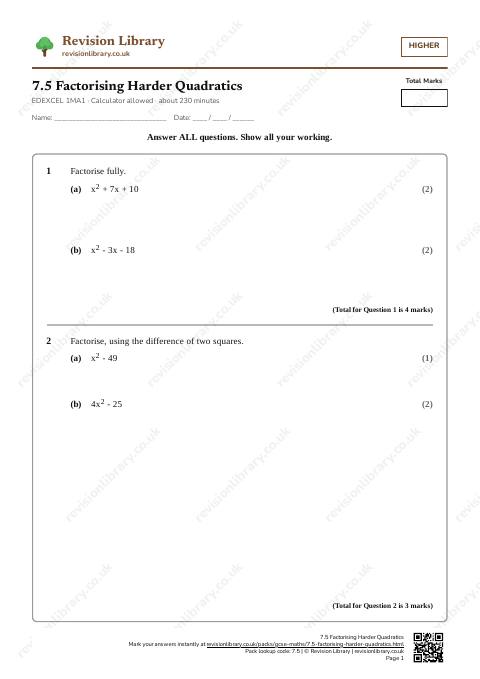
7.5 Factorising Harder Quadratics
A correct answer earns full marks unless the question asks for working, a method, proof or explanation.
Question 1
- (a) identifies a pair of numbers with sum 7 and product 10 (2 and 5), or one correct bracket seenM1
- (a) (x + 2)(x + 5) caoA1
- (a) Answer: (x + 2)(x + 5)
- (b) identifies a pair of numbers with sum -3 and product -18 (-6 and 3), or one correct bracket seenM1
- (b) (x - 6)(x + 3) caoA1
- (b) Answer: (x - 6)(x + 3)
Question 2
- (a) (x - 7)(x + 7) caoB1
- (a) Answer: (x - 7)(x + 7)
- (b) recognises √4x2 = 2x and √25 = 5, one correct bracket seenM1
- (b) (2x - 5)(2x + 5) caoA1
- (b) Answer: (2x - 5)(2x + 5)
Question 3
- (a) identifies repeated factor 5 (sum 10, product 25)M1
- (a) (x + 5)2 oe e.g. (x + 5)(x + 5)A1
- (a) Answer: (x + 5)2
- (b) identifies a pair of numbers with sum -9 and product 20 (-4 and -5)M1
- (b) (x - 4)(x - 5) = 0 seen, or ft their factorisationM1
- (b) x = 4 and x = 5 oe, both values requiredA1
- (b) Answer: x = 4 or x = 5
Question 4
- rearranges to x2 - 8x + 15 = 0M1
- (x - 3)(x - 5) = 0 seen, or ft their rearrangementM1
- x = 3 and x = 5 oe, both values requiredA1
- Answer: x = 3 or x = 5
Question 5
- takes out common factor of 6: 6(x2 - 4)M1
- 6(x - 2)(x + 2) cao, fully factorisedA1
- Answer: 6(x - 2)(x + 2)
Question 6
- common factor or difference of two squares identifiedM1
- difference of two squares factorisedM1
- 8(x - 1)(x + 1)A1
- Answer: 8(x - 1)(x + 1)
Question 7
- takes out common factor 2M1
- factorises the quadraticM1
- 2(2x + 5)(3x + 7)A1
- Answer: 2(2x + 5)(3x + 7)
Question 8
- factorises correctlyM1
- one correct solutionA1
- x = -5/2 or x = -2/3A1
- Answer: x = -5/2 or x = -2/3
Question 9
- (ax + p)(bx + q) with two of the three terms correct when expandedM1
- (x - 2)(2x + 7)A1
- Answer: (x - 2)(2x + 7)
Question 10
- rearranges to 4x2 + 3x - 7 = 0M1
- factorises correctlyM1
- one correct solutionA1
- x = -7/4 or x = 1A1
- Answer: x = -7/4 or x = 1
Question 11
- factorises correctlyM1
- one correct solutionA1
- x = -7/3 or x = 1/4A1
- Answer: x = -7/3 or x = 1/4
Question 12
- (ax + p)(bx + q) with two of the three terms correct when expandedM1
- (2x + 3)(3x + 7)A1
- Answer: (2x + 3)(3x + 7)
Question 13
- takes out common factor 2M1
- factorises the quadraticM1
- 2(x + 6)(3x - 7)A1
- Answer: 2(x + 6)(3x - 7)
Question 14
- common factor or difference of two squares identifiedM1
- difference of two squares factorisedM1
- 8(2x - 1)(2x + 1)A1
- Answer: 8(2x - 1)(2x + 1)
Question 15
- (ax + p)(bx + q) with two of the three terms correct when expandedM1
- (2x + 5)(4x - 5)A1
- Answer: (2x + 5)(4x - 5)
Question 16
- factorises correctlyM1
- one correct solutionA1
- x = -3/2 or x = 4/3A1
- Answer: x = -3/2 or x = 4/3
Question 17
- common factor or difference of two squares identifiedM1
- difference of two squares factorisedM1
- 3(4x - 1)(4x + 1)A1
- Answer: 3(4x - 1)(4x + 1)
Question 18
- (ax + p)(bx + q) with two of the three terms correct when expandedM1
- (x - 4)(2x + 7)A1
- Answer: (x - 4)(2x + 7)
Question 19
- factorises correctlyM1
- one correct solutionA1
- x = -1/4 or x = 7/3A1
- Answer: x = -1/4 or x = 7/3
Question 20
- takes out common factor 3M1
- factorises the quadraticM1
- 3(x + 6)(3x + 5)A1
- Answer: 3(x + 6)(3x + 5)
Question 21
- (ax + p)(bx + q) with two of the three terms correct when expandedM1
- (3x - 7)(4x - 5)A1
- Answer: (3x - 7)(4x - 5)
Question 22
- (a) splits middle term correctly, e.g. 2x2 + 6x + x + 3, or one correct bracket seenM1
- (a) (2x + 1)(x + 3) caoA1
- (a) Answer: (2x + 1)(x + 3)
- (b) splits middle term correctly, e.g. 3x2 - 6x + x - 2, or one correct bracket seenM1
- (b) (3x + 1)(x - 2) caoA1
- (b) Answer: (3x + 1)(x - 2)
Question 23
- common factor or difference of two squares identifiedM1
- difference of two squares factorisedM1
- 5(x - 9)(x + 9)A1
- Answer: 5(x - 9)(x + 9)
Question 24
- factorises correctlyM1
- one correct solutionA1
- x = -4/3 or x = 2/3A1
- Answer: x = -4/3 or x = 2/3
Question 25
- rearranges to 3x2 - 13x + 12 = 0M1
- factorises correctlyM1
- one correct solutionA1
- x = 4/3 or x = 3A1
- Answer: x = 4/3 or x = 3
Question 26
- common factor or difference of two squares identifiedM1
- difference of two squares factorisedM1
- 2(5x - 7)(5x + 7)A1
- Answer: 2(5x - 7)(5x + 7)
Question 27
- factorises correctlyM1
- one correct solutionA1
- x = -5/2 or x = 5/4A1
- Answer: x = -5/2 or x = 5/4
Question 28
- common factor or difference of two squares identifiedM1
- difference of two squares factorisedM1
- 20(2x - 1)(2x + 1)A1
- Answer: 20(2x - 1)(2x + 1)
Question 29
- factorises correctlyM1
- one correct solutionA1
- x = 1/2 or x = 7/4A1
- Answer: x = 1/2 or x = 7/4
Question 30
- common factor or difference of two squares identifiedM1
- difference of two squares factorisedM1
- 5(5x - 8)(5x + 8)A1
- Answer: 5(5x - 8)(5x + 8)
Question 31
- factorises correctlyM1
- one correct solutionA1
- x = -5/2 or x = -3/2A1
- Answer: x = -5/2 or x = -3/2
Question 32
- (a) finds two numbers with product 36 (6 x 6) and sum 13 (9 and 4)M1
- (a) splits middle term correctly, e.g. 6x2 + 9x + 4x + 6, and groups into two pairsM1
- (a) (2x + 3)(3x + 2) caoA1
- (a) Answer: (2x + 3)(3x + 2)
- (b) recognises perfect square, √4x2=2x, √9=3M1
- (b) (2x - 3)2 oeA1
- (b) Answer: (2x - 3)2
Question 33
- factorises numerator: (x - 2)(x + 2)M1
- factorises denominator: (x + 2)(x + 3)M1
- cancels common factor (x + 2), ft from their factorisationsM1
- (x - 2) / (x + 3) caoA1
- Answer: (x - 2) / (x + 3)
Question 34
- takes out common factor of 3: 3(x2 + 2x - 15)M1
- identifies a pair of numbers with sum 2 and product -15 (5 and -3)M1
- 3(x + 5)(x - 3) cao, fully factorisedA1
- Answer: 3(x + 5)(x - 3)
Question 35
- recognises √9x2=3x and √16=4, one correct bracket seenM1
- (3x - 4)(3x + 4) caoA1
- Answer: (3x - 4)(3x + 4)
Question 36
- identifies a pair of numbers with product -36 and sum -5 (4 and -9), or one correct bracket seenM1
- (3x + 4)(x - 3) caoA1
- Answer: (3x + 4)(x - 3)
Question 37
- identifies a pair of numbers with product -12 and sum 4 (6 and -2), or one correct bracket seenM1
- (2x + 3)(2x - 1) caoA1
- Answer: (2x + 3)(2x - 1)
Question 38
- identifies a pair of numbers with product -24 and sum 2 (6 and -4), or one correct bracket seenM1
- (4x + 3)(2x - 1) caoA1
- Answer: (4x + 3)(2x - 1)
Question 39
- identifies a pair of numbers with product -40 and sum -3 (5 and -8), or one correct bracket seenM1
- (5x - 4)(2x + 1) caoA1
- Answer: (5x - 4)(2x + 1)
Question 40
- identifies a pair of numbers with product 6 and sum 7 (6 and 1), leading to (2x + 1)(x + 3)M1
- (2x + 1)(x + 3) = 0 seen, or ft their factorisation, with an attempt to solveM1
- x = -1/2 and x = -3 oe, both values requiredA1
- Answer: x = -1/2 or x = -3
Question 41
- identifies a pair of numbers with product 6 and sum 5 (2 and 3), or one correct bracket seenM1
- (2x + 3)(x + 1) caoA1
- Answer: (2x + 3)(x + 1)
Question 42
- identifies a pair of numbers with product 6 and sum -7 (-6 and -1), or one correct bracket seenM1
- (2x - 1)(x - 3) caoA1
- Answer: (2x - 1)(x - 3)
Question 43
- identifies a pair of numbers with product 9 and sum 10 (9 and 1), or one correct bracket seenM1
- (3x + 1)(x + 3) caoA1
- Answer: (3x + 1)(x + 3)
Question 44
- identifies a pair of numbers with product -30 and sum -13 (-15 and 2), or one correct bracket seenM1
- (5x + 2)(x - 3) caoA1
- Answer: (5x + 2)(x - 3)
Question 45
- recognises √4x2 = 2x and √9 = 3, one correct bracket seenM1
- (2x - 3)(2x + 3) caoA1
- Answer: (2x - 3)(2x + 3)
Question 46
- recognises √9x2 = 3x and √25 = 5, one correct bracket seenM1
- (3x - 5)(3x + 5) caoA1
- Answer: (3x - 5)(3x + 5)
Question 47
- identifies a pair of numbers with product -18 and sum 7 (9 and -2), or one correct bracket seenM1
- (3x - 1)(2x + 3) caoA1
- Answer: (3x - 1)(2x + 3)
Question 48
- identifies a pair of numbers with product -30 and sum -1 (5 and -6), or one correct bracket seenM1
- (2x + 5)(x - 3) caoA1
- Answer: (2x + 5)(x - 3)
Question 49
- factorises numerator: (2x - 1)(x + 3)M1
- factorises denominator: (x - 3)(x + 3)M1
- cancels common factor (x + 3), ft from their factorisationsM1
- (2x - 1) / (x - 3) caoA1
- Answer: (2x - 1) / (x - 3)
Question 50
- finds two numbers with product -36 (6 x -6) and sum -5 (-9 and 4)M1
- (3x + 2)(2x - 3) = 0 seen, or ft their factorisationM1
- x = -2/3 and x = 3/2 oe, both values requiredA1
- Answer: x = -2/3 or x = 3/2
Question 51
- (a) sets up area = x(2x + 3) = 90M1
- (a) cso: correctly rearranges to 2x2 + 3x - 90 = 0, no errors seenA1
- (a) Answer: 2x2 + 3x - 90 = 0 (shown)
- (b) finds two numbers with product -180 (2 x -90) and sum 3 (15 and -12)M1
- (b) (2x + 15)(x - 6) = 0 seen, or ft their factorisationM1
- (b) rejects x = -7.5 as width cannot be negative, dependent on previous M markdM1
- (b) width = 6 cm and length = 15 cm, both values required with unitsA1
- (b) Answer: x = 6; width = 6 cm, length = 15 cm
Question 52
- recognises √4x2=2x and √9y2=3y, one correct bracket seenM1
- (2x - 3y)(2x + 3y) caoA1
- Answer: (2x - 3y)(2x + 3y)
Question 53
- rearranges to (2x - 3)2 - 25 = 0 and writes as difference of two squares [(2x-3)-5][(2x-3)+5] = 0M1
- simplifies to (2x - 8)(2x + 2) = 0, or ft equivalentM1
- x = 4 and x = -1 oe, both values requiredA1
- Answer: x = 4 or x = -1
Question 54
- takes out common factor of 3: 3(2x2 + 5x + 2)M1
- identifies a pair of numbers with product 4 and sum 5 (4 and 1), or one correct bracket seenM1
- 3(2x + 1)(x + 2) cao, fully factorisedA1
- Answer: 3(2x + 1)(x + 2)
Question 55
- identifies a pair of numbers with product -12 and sum -11 (-12 and 1), leading to (3x + 1)(x - 4)M1
- (3x + 1)(x - 4) = 0 seen, or ft their factorisation, with an attempt to solveM1
- x = -1/3 and x = 4 oe, both values requiredA1
- Answer: x = -1/3 or x = 4
Question 56
- rearranges to 3x2 - 13x + 4 = 0 oeM1
- identifies a pair of numbers with product 12 and sum -13 (-12 and -1), leading to (3x - 1)(x - 4)M1
- x = 4 caoA1
- x = 1/3 oe, ft from a correctly factorised bracketA1
- Answer: x = 4 or x = 1/3
Question 57
- finds two numbers with product -40 (10 x -4) and sum -3 (5 and -8)M1
- (5x - 4)(2x + 1) = 0 seen, or ft their factorisationM1
- x = 4/5 and x = -1/2 oe, both values requiredA1
- Answer: x = 4/5 or x = -1/2
Question 58
- factorises using difference of two squares: (x - y)(x + y) = 45M1
- substitutes x - y = 5 to obtain 5(x + y) = 45, so x + y = 9M1
- solves the pair of linear equations x - y = 5 and x + y = 9 simultaneouslyM1
- x = 7 and y = 2, both values requiredA1
- Answer: x = 7, y = 2
Mark your answers
Check answers without an account. Some answers can be checked automatically; use the mark scheme to mark the rest.