A quadratic inequality compares a quadratic expression to zero using less than, greater than, or their 'or equal to' versions, and its solution is a range or ranges of x-values rather than a single number. GCSE Higher papers expect the critical values to be found by solving the corresponding quadratic equation, then the shape of the graph used to decide which region satisfies the inequality.
Rearrange the inequality so that one side is zero, keeping the quadratic expression on the other side.
Solve the corresponding quadratic equation, setting the expression equal to zero, by factorising or using the quadratic formula to find the critical values.
Picture the graph of the quadratic: it is a u-shaped curve if the coefficient of x2 is positive, or an n-shaped curve if it is negative.
Identify which parts of the graph are above the x-axis (positive) and which are below (negative), using the critical values as boundaries.
Match the required region to the inequality sign: less than zero means the region between the roots for a u-shaped curve, greater than zero means the regions outside the roots.
Write the final answer as a single inequality or two separate inequalities, using strict or non-strict signs to match the original question.
Worked example
Solve the inequality x2 - 2x - 15 < 0.
Solve the equation x2 - 2x - 15 = 0 to find the critical values.
Factorise: (x - 5)(x + 3) = 0, so x = 5 or x = -3.
Since the coefficient of x2 is positive, the graph is u-shaped, so the expression is negative between the roots.
The inequality x2 - 2x - 15 < 0 is satisfied where the graph is below the x-axis, between x = -3 and x = 5.
Final answer: -3 < x < 5.
Revision Library
revisionlibrary.co.uk
HIGHER
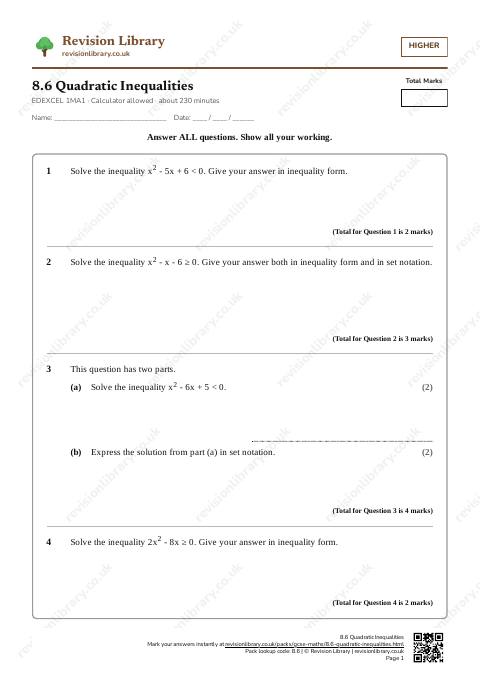
8.6 Quadratic Inequalities
EDEXCEL 1MA1 · Calculator allowed · about 230 minutes
Solve the inequality x2 - 5x + 6 < 0. Give your answer in inequality form.
(Total for Question 1 is 2 marks)
2
Solve the inequality x2 - x - 6 ≥ 0. Give your answer both in inequality form and in set notation.
(Total for Question 2 is 3 marks)
3
This question has two parts.
(a)Solve the inequality x2 - 6x + 5 < 0.(2)
(b)Express the solution from part (a) in set notation.(2)
(Total for Question 3 is 4 marks)
4
Solve the inequality 2x2 - 8x ≥ 0. Give your answer in inequality form.
(Total for Question 4 is 2 marks)
5
Solve the inequality -x2 + 4x < 0. Give your answer in inequality form.
(Total for Question 5 is 2 marks)
6
Solve the inequality (x-1)(x+2) ≥ 0. Give your answer both in inequality form and in set notation.
(Total for Question 6 is 3 marks)
7
Solve the inequality x2 - 4x + 4 ≤ 0. Give your answer in inequality form.
(Total for Question 7 is 2 marks)
8
Solve the inequality (1/2)x2 - (3/2)x < 0. Give your answer in inequality form.
(Total for Question 8 is 2 marks)
9
Solve the inequality x2 ≤ 25.
(Total for Question 9 is 2 marks)
10
Solve the inequality x2 - 9 > 0.
(Total for Question 10 is 3 marks)
11
Solve the inequality x2 - 16 ≥ 0.
(Total for Question 11 is 3 marks)
12
Solve the inequality x2 + x - 6 ≤ 0.
(Total for Question 12 is 3 marks)
13
Solve the inequality -(2x2 - 5x - 3) > 0. Give your answer in inequality form.
(Total for Question 13 is 3 marks)
14
Solve the inequality (x-2)(2x+3) > 0. Give your answer in inequality form.
(Total for Question 14 is 2 marks)
15
Solve the inequality -x2 + 6x - 8 ≥ 0. Give your answer in inequality form.
(Total for Question 15 is 3 marks)
16
Solve the inequality 3x2 + x - 4 ≤ 0. Give your answer in inequality form.
(Total for Question 16 is 3 marks)
17
Solve the inequality x2 - 2x - 15 > 0, giving your answer in set notation.
(Total for Question 17 is 3 marks)
18
Solve the inequality x(x - 3) ≤ 10.
(Total for Question 18 is 4 marks)
19
A rectangular lawn has length (x + 4) metres and width x metres, where x > 0. The area of the lawn must be greater than 45 m². Form an inequality in x and solve it to find the possible values of x.
Diagram NOT accurately drawn
(Total for Question 19 is 5 marks)
20
Given that x > 0, solve the inequality 4 < x2 < 25.
(Total for Question 20 is 4 marks)
21
Solve the inequality 4x2 - 1 ≤ 0.
(Total for Question 21 is 3 marks)
22
The equation x2 + kx + 9 = 0 has no real roots. Find the range of possible values of k.
(Total for Question 22 is 4 marks)
23
Write down all the integer values of x that satisfy x2 - 10x + 21 < 0
(Total for Question 23 is 3 marks)
24
Solve x2 < 196
(Total for Question 24 is 2 marks)
25
Solve x2 + 6x - 16 < 0
(Total for Question 25 is 3 marks)
26
Solve x2 > 81
(Total for Question 26 is 2 marks)
27
Write down all the integer values of x that satisfy x2 + 2x - 35 < 0
(Total for Question 27 is 3 marks)
28
Solve -x2 + 2x + 15 > 0
(Total for Question 28 is 4 marks)
29
Solve x2 - 2x - 8 < 0
(Total for Question 29 is 3 marks)
30
Solve x2 ≤ 100
(Total for Question 30 is 2 marks)
31
Solve x2 ≥ -6x - 8
(Total for Question 31 is 4 marks)
32
Solve x2 < 9
(Total for Question 32 is 2 marks)
33
Solve x2 - 4 < 0
(Total for Question 33 is 3 marks)
34
Solve 4x2 + 4x - 35 > 0
(Total for Question 34 is 3 marks)
35
Write down all the integer values of x that satisfy x2 - x - 6 ≤ 0
(Total for Question 35 is 3 marks)
36
Solve x2 + x - 20 ≤ 0
(Total for Question 36 is 3 marks)
37
Solve -x2 - 2x < 0
(Total for Question 37 is 4 marks)
38
Solve x2 + 7x + 6 < 0
(Total for Question 38 is 3 marks)
39
Solve x2 - 3x + 2 < 0
(Total for Question 39 is 3 marks)
40
Solve 3x2 - 14x + 15 < 0
(Total for Question 40 is 3 marks)
41
Solve -x2 - 7x - 6 < 0
(Total for Question 41 is 4 marks)
42
Solve x2 > -12x - 35
(Total for Question 42 is 4 marks)
43
Solve 4x2 - 49 > 0
(Total for Question 43 is 3 marks)
44
Solve -x2 - 5x + 6 < 0
(Total for Question 44 is 4 marks)
45
Solve x2 < 4x + 21
(Total for Question 45 is 4 marks)
46
Solve -x2 - 11x - 30 < 0
(Total for Question 46 is 4 marks)
47
Solve the inequality x2 - 4x - 5 < 0. Represent your solution set on the number line below, using open circles to show the boundary values and shading (or hatching) the region that satisfies the inequality.
(Total for Question 47 is 4 marks)
48
Solve the inequality 2x2 - 7x - 4 ≥ 0.
(Total for Question 48 is 4 marks)
49
Solve the inequality 3x2 + x - 2 < 0.
(Total for Question 49 is 4 marks)
50
Solve the inequality x2 - 5x + 6 < x - 1. Give your answer in inequality form.
(Total for Question 50 is 3 marks)
51
Solve the inequality x2 - 4x - 7 > 0, using the quadratic formula. Give your answer correct to 2 decimal places.
(Total for Question 51 is 5 marks)
52
Find the set of values of x for which x2 - x - 12 ≤ 0 and x2 - 9 > 0.
(Total for Question 52 is 5 marks)
53
Find the set of values of x for which x2 - 5x + 6 > 0 and 2x - 3 < 7.
(Total for Question 53 is 5 marks)
Mark scheme · 8.6 Quadratic Inequalities
Question 1
factorise to (x-2)(x-3) or identify roots x=2,3M1
2 < x < 3 caoA1
Answer: 2 < x < 3 (inequality form: 2 < x < 3)
Question 2
factorise to (x-3)(x+2) and identify roots -2 and 3M1
decide sign: x ≤ -2 or x ≥ 3M1
set notation: (-infty, -2] U [3, +infty) caoA1
Answer: Inequality form: x ≤ -2 or x ≥ 3. Set notation: (-infty, -2] U [3, +infty)
Question 3
(a) factorise to (x-1)(x-5) or identify roots 1 and 5M1
(a) 1 < x < 5 caoA1
(a) Answer: 1 < x < 5
(b) convert interval to set notationM1
(b) (1, 5) caoA1
(b) Answer: (1, 5)
Question 4
factorise to 2x(x-4) and identify roots x=0 and x=4M1
x ≤ 0 or x ≥ 4 caoA1
Answer: x ≤ 0 or x ≥ 4
Question 5
rearrange or factorise, e.g. -x(x-4) < 0 or multiply by -1 giving x2 -4x > 0M1
x < 0 or x > 4 caoA1
Answer: x < 0 or x > 4
Question 6
identify roots x = 1 and x = -2 and sign on intervalsM1
state inequality form x ≤ -2 or x ≥ 1M1
set notation: (-infty, -2] U [1, +infty) caoA1
Answer: Inequality form: x ≤ -2 or x ≥ 1. Set notation: (-infty, -2] U [1, +infty)
Question 7
recognise (x-2)2 ≤ 0 so repeated root x=2M1
x = 2 caoA1
Answer: x = 2
Question 8
multiply by 2 to get x2 - 3x < 0 and factor to x(x-3)<0M1
0 < x < 3 caoA1
Answer: 0 < x < 3
Question 9
identifies critical values x = 5 and x = -5M1
-5 ≤ x ≤ 5 oeA1
Answer: -5 ≤ x ≤ 5
Question 10
factorises (x-3)(x+3) or finds critical values x = 3, x = -3M1
critical values x = 3 and x = -3 statedA1
x < -3 or x > 3 oeA1
Answer: x < -3 or x > 3
Question 11
factorises (x-4)(x+4) or finds critical values x = 4, x = -4M1
critical values x = 4 and x = -4 statedA1
x ≤ -4 or x ≥ 4 oeA1
Answer: x ≤ -4 or x ≥ 4
Question 12
factorises (x+3)(x-2)M1
critical values x = -3 and x = 2 statedA1
-3 ≤ x ≤ 2 oe caoA1
Answer: -3 ≤ x ≤ 2
Question 13
multiply by -1 (flip inequality) to get 2x2 - 5x - 3 < 0 and find rootsM1
calculate roots x = -1/2 and x = 3M1
-1/2 < x < 3 caoA1
Answer: -1/2 < x < 3
Question 14
find roots x = 2 and x = -3/2 and test sign regionsM1
x < -3/2 or x > 2 caoA1
Answer: x < -3/2 or x > 2
Question 15
multiply by -1 (flip inequality) to get x2 -6x +8 ≤ 0 and factor to (x-2)(x-4)M1
identify interval between rootsM1
2 ≤ x ≤ 4 caoA1
Answer: 2 ≤ x ≤ 4
Question 16
use quadratic formula or factorisation to find roots x = 1 and x = -4/3M1
order the roots and decide region where quadratic ≤ 0 (parabola up)M1
-4/3 ≤ x ≤ 1 caoA1
Answer: -4/3 ≤ x ≤ 1
Question 17
factorises (x-5)(x+3) or finds critical values x = -3, x = 5M1
x < -3 or x > 5 oeA1
correct set notation {x : x < -3} u {x : x > 5} (ft)B1
Answer: {x : x < -3} u {x : x > 5}
Question 18
expands to x2 - 3x ≤ 10M1
rearranges to x2 - 3x - 10 ≤ 0M1
factorises (x-5)(x+2)M1
-2 ≤ x ≤ 5 oeA1
Answer: -2 ≤ x ≤ 5
Question 19
forms the inequality x(x+4) > 45 oeM1
rearranges and attempts to factorise x2 + 4x - 45M1
(x+9)(x-5) or critical values x = -9, x = 5A1
x < -9 or x > 5A1
applies the constraint x > 0 to give the final answer x > 5 (ft)B1
Answer: x > 5
Question 20
solves x2 > 4 to find critical value x = 2M1
x > 2, using x > 0 oeA1
solves x2 < 25 to find critical value x = 5M1
2 < x < 5 (final answer, ft)A1
Answer: 2 < x < 5
Question 21
factorises as a difference of two squares (2x-1)(2x+1) or finds critical values x = 1/2, x = -1/2M1
critical values x = -1/2 and x = 1/2 statedA1
-1/2 ≤ x ≤ 1/2 oe (accept -0.5 ≤ x ≤ 0.5)A1
Answer: -1/2 ≤ x ≤ 1/2
Question 22
writes the discriminant k2 - 4(1)(9) oeM1
sets discriminant < 0, i.e. k2 - 36 < 0M1
factorises (k-6)(k+6) < 0 or finds critical values k = -6, k = 6M1
-6 < k < 6 oeA1
Answer: -6 < k < 6
Question 23
finds critical valuesM1
correct range identifiedM1
4, 5, 6A1
Answer: 4, 5, 6
Question 24
critical values x = 14 and x = -14M1
-14 < x < 14A1
Answer: -14 < x < 14
Question 25
factorises or solves to find critical values -8 and 2M1
sketch or sign analysis for a quadratic with a positive x2 termM1
-8 < x < 2A1
Answer: -8 < x < 2
Question 26
critical values x = 9 and x = -9M1
x < -9 or x > 9A1
Answer: x < -9 or x > 9
Question 27
finds critical valuesM1
correct range identifiedM1
-6, -5, -4, -3, -2, -1, 0, 1, 2, 3, 4A1
Answer: -6, -5, -4, -3, -2, -1, 0, 1, 2, 3, 4
Question 28
multiplies by -1 and reverses the inequality or factorises as -(x + 3)(x - 5)M1
finds critical valuesM1
uses an n-shaped sketchM1
-3 < x < 5A1
Answer: -3 < x < 5
Question 29
factorises or solves to find critical values -2 and 4M1
sketch or sign analysis for a quadratic with a positive x2 termM1
-2 < x < 4A1
Answer: -2 < x < 4
Question 30
critical values x = 10 and x = -10M1
-10 ≤ x ≤ 10A1
Answer: -10 ≤ x ≤ 10
Question 31
rearranges to x2 + 6x + 8 ≥ 0M1
finds critical valuesM1
correct region identifiedM1
x ≤ -4 or x ≥ -2A1
Answer: x ≤ -4 or x ≥ -2
Question 32
critical values x = 3 and x = -3M1
-3 < x < 3A1
Answer: -3 < x < 3
Question 33
factorises or solves to find critical values -2 and 2M1
sketch or sign analysis for a quadratic with a positive x2 termM1
-2 < x < 2A1
Answer: -2 < x < 2
Question 34
factorises or uses the quadratic formulaM1
critical values -7/2 and 5/2M1
x < -7/2 or x > 5/2A1
Answer: x < -7/2 or x > 5/2
Question 35
finds critical valuesM1
correct range identifiedM1
-2, -1, 0, 1, 2, 3A1
Answer: -2, -1, 0, 1, 2, 3
Question 36
factorises or solves to find critical values -5 and 4M1
sketch or sign analysis for a quadratic with a positive x2 termM1
-5 ≤ x ≤ 4A1
Answer: -5 ≤ x ≤ 4
Question 37
multiplies by -1 and reverses the inequality or factorises as -x(x + 2)M1
finds critical valuesM1
uses an n-shaped sketchM1
x < -2 or x > 0A1
Answer: x < -2 or x > 0
Question 38
factorises or solves to find critical values -6 and -1M1
sketch or sign analysis for a quadratic with a positive x2 termM1
-6 < x < -1A1
Answer: -6 < x < -1
Question 39
factorises or solves to find critical values 1 and 2M1
sketch or sign analysis for a quadratic with a positive x2 termM1
1 < x < 2A1
Answer: 1 < x < 2
Question 40
factorises or uses the quadratic formulaM1
critical values 5/3 and 3M1
5/3 < x < 3A1
Answer: 5/3 < x < 3
Question 41
multiplies by -1 and reverses the inequality or factorises as -(x + 6)(x + 1)M1
finds critical valuesM1
uses an n-shaped sketchM1
x < -6 or x > -1A1
Answer: x < -6 or x > -1
Question 42
rearranges to x2 + 12x + 35 > 0M1
finds critical valuesM1
correct region identifiedM1
x < -7 or x > -5A1
Answer: x < -7 or x > -5
Question 43
factorises or uses the quadratic formulaM1
critical values -7/2 and 7/2M1
x < -7/2 or x > 7/2A1
Answer: x < -7/2 or x > 7/2
Question 44
multiplies by -1 and reverses the inequality or factorises as -(x + 6)(x - 1)M1
finds critical valuesM1
uses an n-shaped sketchM1
x < -6 or x > 1A1
Answer: x < -6 or x > 1
Question 45
rearranges to x2 - 4x - 21 < 0M1
finds critical valuesM1
correct region identifiedM1
-3 < x < 7A1
Answer: -3 < x < 7
Question 46
multiplies by -1 and reverses the inequality or factorises as -(x + 6)(x + 5)M1
finds critical valuesM1
uses an n-shaped sketchM1
x < -6 or x > -5A1
Answer: x < -6 or x > -5
Question 47
factorises (x-5)(x+1)M1
critical values x = -1 and x = 5 statedA1
open circles drawn at -1 and 5 on the number line (ft)B1
correct region between -1 and 5 shaded or hatched (ft)B1
Answer: -1 < x < 5, with open circles at -1 and 5 and the region between them shaded
Question 48
attempts to factorise 2x2 - 7x - 4M1
(2x+1)(x-4) or critical values x = -1/2, x = 4A1
identifies correct regions outside the roots (coefficient of x2 positive, expression ≥ 0)M1
x ≤ -1/2 or x ≥ 4 oeA1
Answer: x ≤ -1/2 or x ≥ 4
Question 49
attempts to factorise 3x2 + x - 2M1
(3x-2)(x+1) or critical values x = -1, x = 2/3A1
identifies correct region between the roots (expression < 0)M1
-1 < x < 2/3 oeA1
Answer: -1 < x < 2/3
Question 50
bring all terms to LHS to form x2 -6x +7 < 0 and use quadratic formula to find rootsM1
compute roots x = 3 ± √2 and identify interval between rootsM1
3 - √2 < x < 3 + √2 caoA1
Answer: 3 - √2 < x < 3 + √2
Question 51
substitutes a=1, b=-4, c=-7 into the quadratic formula correctlyM1
simplifies to x = 2 ± √11 or decimal equivalentsM1
critical values awrt x = 5.32 and x = -1.32A1
identifies correct regions outside the roots (coefficient of x2 positive, expression > 0)M1
x < -1.32 or x > 5.32 awrt 2dpA1
Answer: x < -1.32 or x > 5.32 (2dp)
Question 52
factorises (x-4)(x+3) or finds critical values -3, 4 for the first inequalityM1
-3 ≤ x ≤ 4A1
factorises (x-3)(x+3) or finds critical values -3, 3 for the second inequalityM1
x < -3 or x > 3A1
correctly combines both solution sets to give 3 < x ≤ 4A1
Answer: 3 < x ≤ 4
Question 53
factorises (x-2)(x-3) or finds critical values 2, 3 for the quadratic inequalityM1
x < 2 or x > 3A1
solves the linear inequality 2x - 3 < 7M1
x < 5A1
correctly combines both solution sets to give x < 2 or 3 < x < 5A1
Put this topic and others into one printable pack.
Open the Pack Builder
Worksheets are written for Revision Library and come with a full mark scheme; a few English packs quote an out-of-copyright text, and name it on the page. Exam board names and specification codes say which qualification a pack suits: we are not affiliated with, endorsed by or approved by any exam board, and no past-paper question is reproduced here. Rights queries: hello@revisionlibrary.co.uk