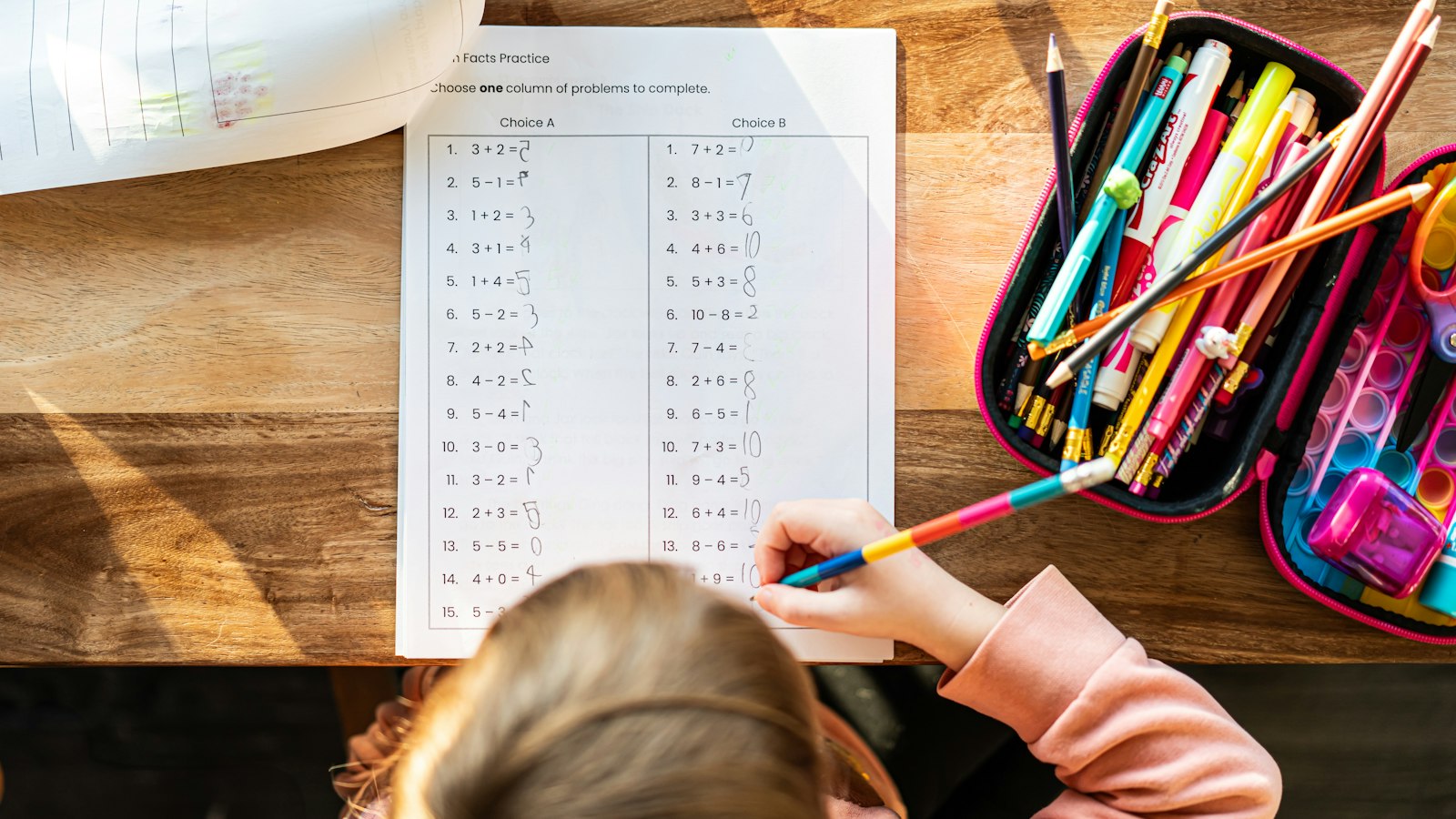
The arithmetic is familiar, but the decisions are harder
The hard part of an 11+ maths question often arrives before the calculation. A school exercise may tell a child which operation or method to use, while an 11+ question can hide that decision in a sentence about money, a journey, a recipe, a shape or a group of objects. The child has to identify the relevant information, decide what to do first and carry an answer into the next step.
The Four Operations (Worded) guide captures this central shift: the task is to translate everyday language into addition, subtraction, multiplication or division, sometimes more than one. Multi-Step Reasoning Challenge then links two or more calculations, so a correct first step matters because it feeds the next one.
Multiple-choice papers add another decision. The Sutton SET route file describes five answer options and an answer sheet, while its maths notes describe using elimination as well as calculation. A child therefore needs a reliable estimate and a way to reject impossible options, not just a method that works when there is plenty of space and time.
The topic areas to recognise
The 11+ maths guides cover number and place value, the four operations, fractions, decimals and percentages, ratio and proportion, averages and data, money, time, measures, geometry, sequences, early algebra and logic or puzzle problems. These strands overlap in real questions: a money problem can involve percentages, a timetable can need unit conversion, and a shape question can require perimeter before area.
Geometry and Measures Depth is a clear example of combined thinking. It brings angles, shape properties, perimeter, area and unit conversion into one problem rather than treating each as a separate lesson. Speed Drills: Mixed Mental Methods shows a different challenge, where the next skill is deliberately unpredictable and the child must switch method quickly.
The exact mix and delivery still belong to the route. The files here describe Sutton SET Mathematics as multiple choice, Sutton boys' second-stage Mathematics as written, and Nonsuch and Wallington second-stage Mathematics as written. Their specifications show variation, not a promise that one named format applies to every school.
Build the method before the speed
Begin with untimed questions and ask the child to say what the problem is asking before calculating. Can they name the quantities, the units and the first operation? If not, more speed will usually make the same misunderstanding happen faster.
Use one topic at a time for the first few sessions. The maths topic-practice library sits below the overview, so a child can work on worded operations, fractions, measures or reasoning with a mark scheme. Once a method is secure, mix two related areas and ask the child to choose the route independently.
Only then add a time limit or answer-sheet practice. The 11+ maths practice-paper collection provides fixed papers, while the 11+ mock-paper area and Sutton route papers fit once a child's target format is known. Mark the paper by error type: calculation, reading, method choice, careless transfer or pace.
Our own resource
Revision Library
Best for free printable practice with mark schemesWhen a child needs one maths weakness isolated, the 11+ Maths library gives free printable practice across the topic areas, with mark schemes to show what went wrong. It is designed for the stage before a child needs a long mixed paper: choose a skill, read the guide, try a set and use the result to choose the next exercise.
For example, start with Four Operations (Worded) if the child struggles to turn a sentence into a calculation, or use Multi-Step Reasoning Challenge when one-step work is secure. Geometry and Measures Depth is a good next choice for questions that combine shape facts and units, while Speed Drills: Mixed Mental Methods belongs later, when the child can switch between familiar methods.
The printable 11+ maths practice guide focuses on finding sheets to print. The 11+ explained guide puts maths beside the other papers, and 11+ practice websites compares wider resource choices. This page stays focused on what makes 11+ maths different and how to begin.
Worked capacity case: A workshop has 137 ceramic tiles to pack into cartons that each hold up to 25 tiles. Every tile must be packed, and each carton must be a whole carton. What is the least number of cartons needed?
Divide 137 by 25: 25 goes into 137 five times, with 12 tiles left over, so 137 / 25 = 5 remainder 12. Five cartons hold only 125 tiles, leaving 12 unpacked; one more carton is needed, so the least whole number required is 6 cartons.
Rounding 137 / 25 = 5.48 to the nearest whole number gives 5, which would leave tiles unpacked. Check the capacity: 6 x 25 = 150 spaces, enough for all 137 tiles, with 150 - 137 = 13 spaces unused.
Browse 11+ Maths practiceIn the numbers
- packs
- 218
- question pages
- 3,716
11+ Maths printable worksheet packs in the library, with mark schemes
How to choose
Start with the reason for the mistake. If the child chose the wrong operation, use worded problems; if the method was right but the arithmetic failed, revisit number facts or written calculation; if the answer is in the wrong unit, practise measures and conversion.
Use the 11+ topic guides to introduce one area, then move to the maths topic-practice library for a printable set. Topic-by-topic work makes it easier to see whether a child needs fractions, ratio, geometry, data or problem-solving practice.
Check the target route before spending weeks on a particular format. The grammar school library and the school's own information should decide whether answer-choice technique, written working or a particular style of mock deserves priority.
Add mixed and timed papers after the child can explain a method calmly. A sensible progression is one topic, two related topics, an unfamiliar mix, then a full paper with a review of every missed question.
Frequently asked questions
Is 11+ maths harder than Year 5 and Year 6 maths?
Do children need a calculator for 11+ maths?
Which 11+ maths topics should we practise first?
Are 11+ maths papers multiple choice?
Revision Library resources in this article
How we wrote this
For the maths examples, I read the 172 guide definitions in the site's 11+ topic collection, the English and maths strand descriptions in the worksheet library, the listed practice papers and the 11+ mock-paper route. I then compared the named maths papers in the Sutton SET, Sutton boys' second-stage and Nonsuch and Wallington second-stage specifications; a target school remains the authority for its own paper.