Revision Library
Choose a subject
Menu
Science
Need a new topic?
Missing a topic, found a bug, or want something added?

IGCSE Chemistry Topic Workbooks

IGCSE Chemistry Topic Workbook

States of Matter and Changes of State, Atomic Structure, Isotopes and Relative Atomic Mass, Periodic Table: Organisation and Predicting Properties and 7 more

Level
IGCSE · Edexcel 4CH1
Series
IGCSE Chemistry Topic Workbooks
Suitable for
Edexcel International 4BI1 / 4CH1 / 4PH1
FreePDF download · 2027 edition · 69 A4 pages
  • One file, prints straight to A4
  • No account, no password

Workbooks like this one, with 10 topics, 136 questions and mark schemes at the back, are usually printed and sold by publishers. This one is one of 558 free PDFs on the shelf.

Pages
69 A4 pages
Chapters
10 worksheet chapters
Questions
136 · 340 marks
Answers
From page 52
Working time
About 6h 35m

What is inside

10 chapters · answers from p52

Each chapter starts with a page showing its marks and a suggested time, followed by the questions. The mark schemes for all 10 chapters are at the back, so the book works for homework, a timed test or revision.

  1. 01States of Matter and Changes of State14 questions · 31 marks · about 35 min Topic guide: States of Matter and Changes of Statep3
  2. 02Atomic Structure, Isotopes and Relative Atomic Mass15 questions · 30 marks · about 35 min Topic guide: Atomic Structure, Isotopes and Relative Atomic Massp9
  3. 03Periodic Table: Organisation and Predicting Properties15 questions · 31 marks · about 35 min Topic guide: Periodic Table: Organisation and Predicting Propertiesp14
  4. 04Ionic Bonding and Properties of Ionic Compounds13 questions · 35 marks · about 40 min Topic guide: Ionic Bonding and Properties of Ionic Compoundsp19
  5. 05Covalent Bonding: Simple Molecules and Giant Structures11 questions · 34 marks · about 40 min Topic guide: Covalent Bonding: Simple Molecules and Giant Structuresp23
  6. 06Metallic Bonding, Alloys and Properties of Metals15 questions · 31 marks · about 35 min Topic guide: Metallic Bonding, Alloys and Properties of Metalsp27
  7. 07Moles, Formulae and Reacting Mass Calculations13 questions · 33 marks · about 40 min Topic guide: Moles, Formulae and Reacting Mass Calculationsp32
  8. 08Electrolysis of Molten and Aqueous Compounds10 questions · 30 marks · about 35 min Topic guide: Electrolysis of Molten and Aqueous Compoundsp36
  9. 09Moles, Molar Mass and Empirical Formula Calculations15 questions · 43 marks · about 50 min Topic guide: Moles, Molar Mass and Empirical Formula Calculationsp40
  10. 10Rates of Reaction: Collision Theory and Measuring Rate15 questions · 42 marks · about 50 min Topic guide: Rates of Reaction: Collision Theory and Measuring Ratep45
  11. AnswersMark schemes for every chapterp52

Each chapter is drawn from one of our worksheet packs. Follow a chapter title for the full pack on its own page, or browse every IGCSE Science pack. Every book on the shelf is a complete printable workbook of up to 120 A4 pages.

Explore this volume

IGCSE Chemistry Topic Workbook includes States of Matter and Changes of State (from page 3); Atomic Structure, Isotopes and Relative Atomic Mass (from page 9); Periodic Table: Organisation and Predicting Properties (from page 14); Ionic Bonding and Properties of Ionic Compounds (from page 19); Covalent Bonding: Simple Molecules and Giant Structures (from page 23); Metallic Bonding, Alloys and Properties of Metals (from page 27); Moles, Formulae and Reacting Mass Calculations (from page 32); Electrolysis of Molten and Aqueous Compounds (from page 36); Moles, Molar Mass and Empirical Formula Calculations (from page 40); Rates of Reaction: Collision Theory and Measuring Rate (from page 45).

Worked question 15 - Moles, Molar Mass and Empirical Formula Calculations

Open the included worksheet

A hydrated salt is analysed and found to have formula CuSO4.xH2O. A 2.50 g sample of the hydrated salt was heated to remove water and produced 1.60 g of anhydrous CuSO4. Determine the value of x. Use Ar: Cu = 63.5, S = 32.1, O = 16.0, H = 1.01. Show all steps converting masses to moles and finding whole number x.

Answer and mark scheme

Question 15

CreditAnswer or working
M1finds mass of water lost = 2.50 - 1.60 = 0.90 g and converts to moles of water: 0.90 / 18.02
M1calculates Mr CuSO4 = 63.5 + 32.1 + 4(16.0) = 159.6 and converts mass anhydrous to moles: 1.60 / 159.6
M1computes numerical mole values correctly
M1divides moles H2O by moles CuSO4 to find x and rounds to nearest whole number
A1gives integer value x = 5 cao
  • Answer: Mass H2O = 0.90 g -> moles H2O = 0.90 / 18.02 = 0.04995 mol; Mr CuSO4 = 159.6, moles CuSO4 = 1.60 / 159.6 = 0.01003 mol; x = 0.04995 / 0.01003 = 4.98 approx 5 so x = 5
Question 13 - Moles, Molar Mass and Empirical Formula Calculations

Open the included worksheet

A student combusts 0.500 g of an unknown metal and obtains 0.644 g of the metal oxide product. The mass of oxygen combined is therefore 0.144 g. Using Ar: O = 16.0, and a metal Ar of 27.0, determine the empirical formula of the oxide. Show all steps converting masses to moles and finding simplest ratio.

Answer and mark scheme

Question 13

CreditAnswer or working
M1finds mass of metal and oxygen combined into moles: moles metal = 0.500 / 27.0, moles O = 0.144 / 16.0
M1calculates numerical mole values correctly
M1divides both mole values by the smallest to get simplest ratio
M1adjusts ratio to whole numbers if necessary and states the simplest whole number ratio
A1gives empirical formula M2O, consistent with the calculated 2:1 metal to oxygen ratio, cao
A1final empirical formula stated correctly with correct subscripts
  • Answer: Moles metal = 0.500 / 27.0 = 0.01852 mol; moles O = 0.144 / 16.0 = 0.00900 mol; ratio metal:O = 0.01852:0.00900 = 2.058:1 -> approx 2:1 so empirical formula M2O

Question 11 - Moles, Molar Mass and Empirical Formula Calculations

Open the included worksheet

An organic compound is analysed and found to contain 40.0% carbon, 6.71% hydrogen and 53.29% oxygen by mass. Determine the empirical formula of the compound. Show working: assume 100 g sample, convert to moles, find simplest whole number ratio and give empirical formula.

Answer and mark scheme

Question 11

CreditAnswer or working
M1assumes 100 g: masses C 40.0 g, H 6.71 g, O 53.29 g and converts to moles using Ar 12.0, 1.01, 16.0
M1calculates moles: C = 40.0/12.0, H = 6.71/1.01, O = 53.29/16.0
M1divides by smallest mole value and finds simplest whole number ratio
A1gives empirical formula CH2O cao
  • Answer: Moles: C = 40.0/12.0 = 3.333; H = 6.71/1.01 = 6.644; O = 53.29/16.0 = 3.330. Ratio C:H:O = 3.333:6.644:3.330 -> divide by 3.330 -> 1.001:1.996:1 -> approx 1:2:1 so empirical formula CH2O

Question 11 - Moles, Formulae and Reacting Mass Calculations

Open the included worksheet

Copper(II) oxide, CuO, reacts with hydrogen gas to produce copper and water: CuO + H2 -> Cu + H2O. If 7.95 g of CuO are reduced and hydrogen is in excess, calculate the mass of copper produced. Use Ar: Cu = 63.5, O = 16 and show your working.

Answer and mark scheme

Question 11

CreditAnswer or working
M1calculates Mr(CuO) = 63.5 + 16 = 79.5 and moles CuO = 7.95 / 79.5
M1uses mole ratio 1:1 so moles Cu = moles CuO = 7.95 / 79.5 = 0.1000 mol ecf
A1mass Cu = moles x Ar(Cu) = 0.1000 x 63.5 = 6.35 g cao
  • Answer: 6.35 g Cu

Question 13 - Moles, Formulae and Reacting Mass Calculations

Open the included worksheet

A 100.0 g sample of hydrated copper(II) sulfate contains 25.0 g of water and 75.0 g of anhydrous CuSO4. Determine the formula of the hydrate, CuSO4.xH2O. Use Ar: Cu = 63.5, S = 32, O = 16 and show your working.

Answer and mark scheme

Question 13

CreditAnswer or working
M1calculates moles H2O = 25.0 / 18 = 1.3889 and Mr CuSO4 = 63.5 + 32 + 4x16 = 159.5 then moles CuSO4 = 75.0 / 159.5 = 0.47022
M1calculates ratio H2O : CuSO4 = 1.3889 : 0.47022 = 2.955 and recognises this is about 3 : 1
A1gives formula CuSO4.3H2O cao
  • Answer: CuSO4.3H2O

Question 12 - Rates of Reaction: Collision Theory and Measuring Rate

Open the included worksheet

In the disappearing cross experiment, sodium thiosulfate reacts with hydrochloric acid to produce a cloudy mixture. Explain how the time taken for the cross to disappear depends on particle collisions, and suggest one way to make the reaction faster.

Answer and mark scheme

Question 12

CreditAnswer or working
B1disappearance time depends on rate at which reactant particles collide to form cloudy product so more frequent successful collisions give faster clouding
B1suggestion: increase temperature or increase concentration or use smaller particle size if solids present
B1link: increasing temperature or concentration raises collision frequency and energy so time is reduced
  • Answer: The cross disappears faster when particles collide more often or with more energy; increasing temperature or concentration will increase collision frequency and energy and so speed the reaction

Question 14 - Rates of Reaction: Collision Theory and Measuring Rate

Open the included worksheet

Explain how a catalyst increases the rate of a reaction, using collision theory language but do not draw an energy profile diagram.

Answer and mark scheme

Question 14

CreditAnswer or working
B1states that a catalyst provides an alternative reaction pathway
B1states that the alternative pathway has a lower activation energy so more collisions are successful
B1links to collision theory: with lower activation energy a larger proportion of collisions have sufficient energy to react
B1may state that the catalyst is not used up at the end of the reaction
  • Answer: A catalyst provides an alternative pathway with lower activation energy so a larger fraction of collisions are successful, increasing the rate; the catalyst is not consumed

More IGCSE books

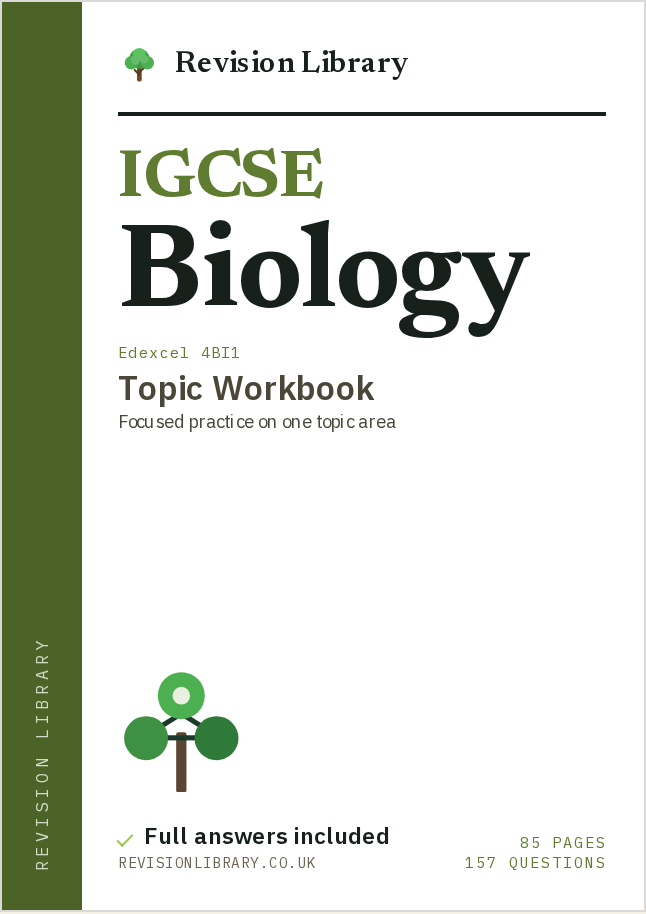
IGCSE Biology Topic Workbook

85 pp · 157 Qs

Sexual Reproduction in Flowering Plants, Asexual Reproduction and Its Comparison With Sexual Reproduction, Human Reproductive Systems and Fertilisation and 8 more

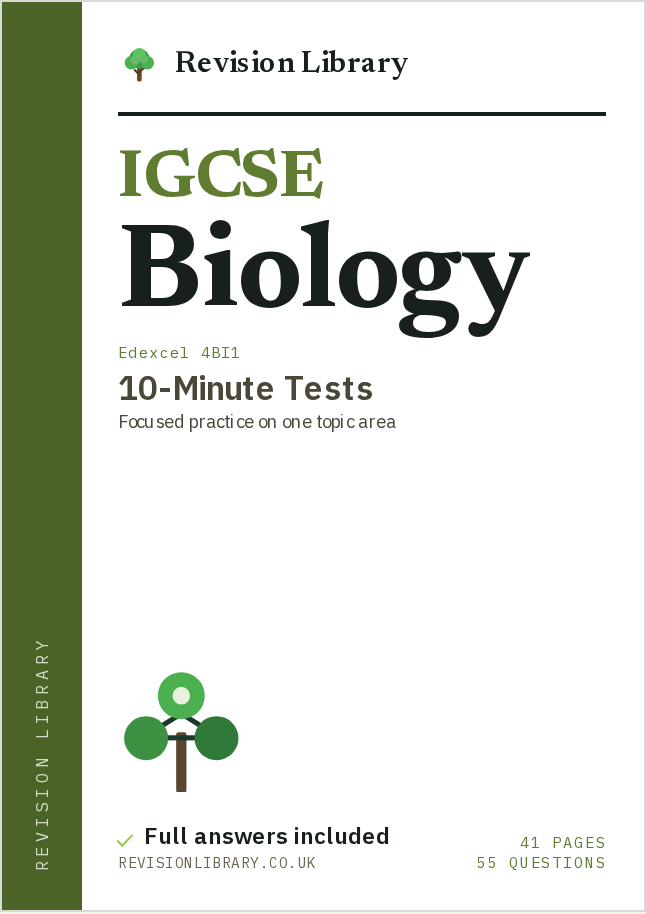
IGCSE Biology 10-Minute Tests

41 pp · 55 Qs

Asexual Reproduction and Its Comparison With Sexual Reproduction, Human Reproductive Systems and Fertilisation, Pregnancy, the Placenta and Fetal Development and 7 more

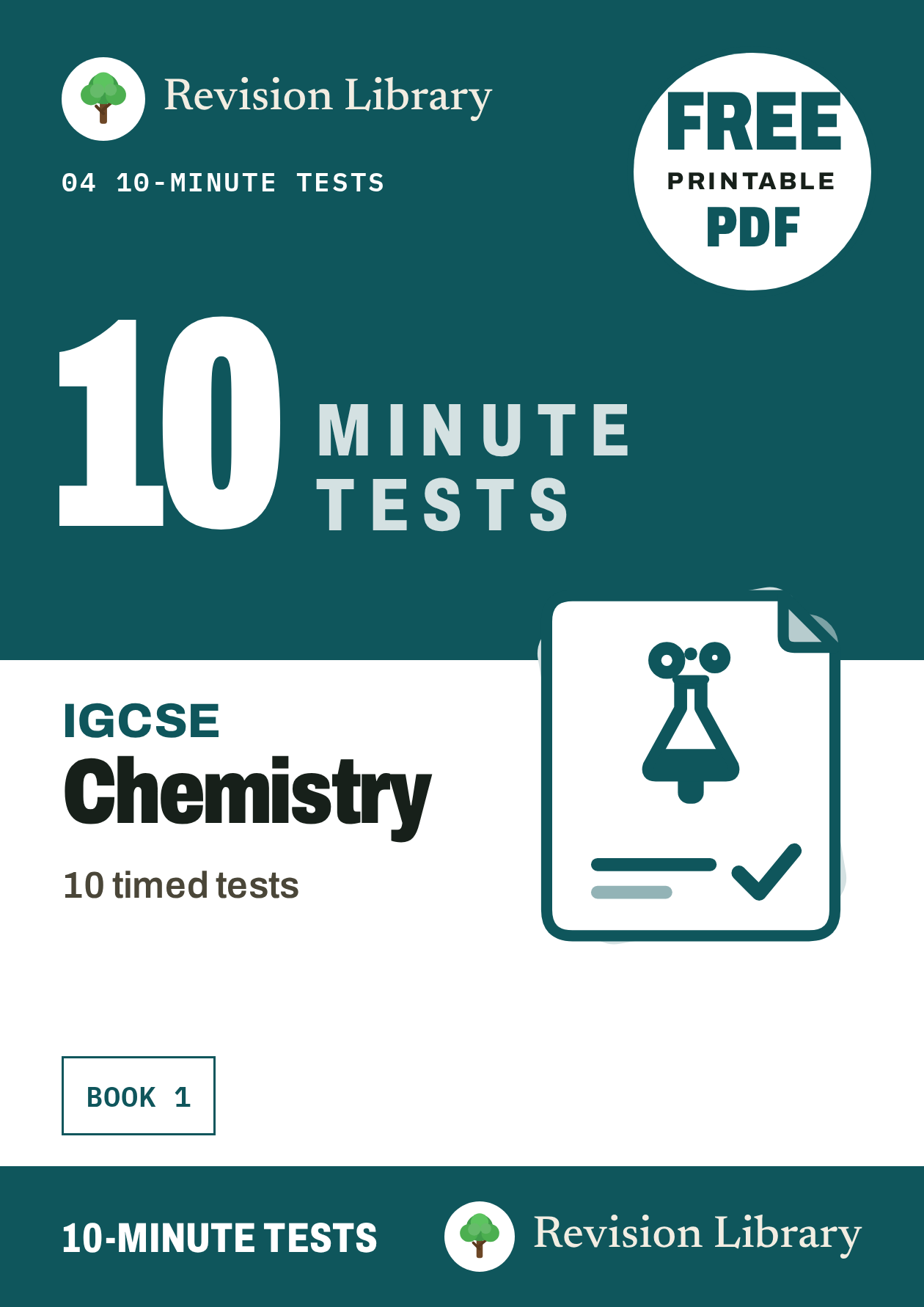
IGCSE Chemistry 10-Minute Tests

45 pp · 58 Qs

States of Matter and Changes of State, Atomic Structure, Isotopes and Relative Atomic Mass, Periodic Table: Organisation and Predicting Properties and 7 more

Want a different mix of topics?