Factors and multiples are two of the most basic building blocks of GCSE Number work: a factor of a number divides into it exactly with no remainder, while a multiple of a number is produced by multiplying it by a whole number, its times-table. The highest common factor (HCF) is the largest number that divides two numbers exactly, and the lowest common multiple (LCM) is the smallest number that appears in both times-tables.
List the factors of each number by working through pairs that multiply to give it (1 x n, 2 x n/2, and so on) until the pairs start repeating.
List the first several multiples of each number by counting up in that number's times-table.
To find the HCF, compare the factor lists and pick the largest number that appears in both.
To find the LCM, compare the multiple lists and pick the smallest number that appears in both.
For larger numbers, break each one into prime factors first using a factor tree; the HCF is the product of the primes common to both, and the LCM is the product of every prime that appears, using the highest power seen in either number.
Worked example
Find the HCF and LCM of 18 and 24.
Factors of 18: 1, 2, 3, 6, 9, 18.
Factors of 24: 1, 2, 3, 4, 6, 8, 12, 24.
The common factors are 1, 2, 3 and 6, so the HCF is 6.
Multiples of 18: 18, 36, 54, 72, 90...
Multiples of 24: 24, 48, 72, 96...
The smallest number in both lists is 72, so the LCM is 72.
Revision Library
revisionlibrary.co.uk
FOUNDATION
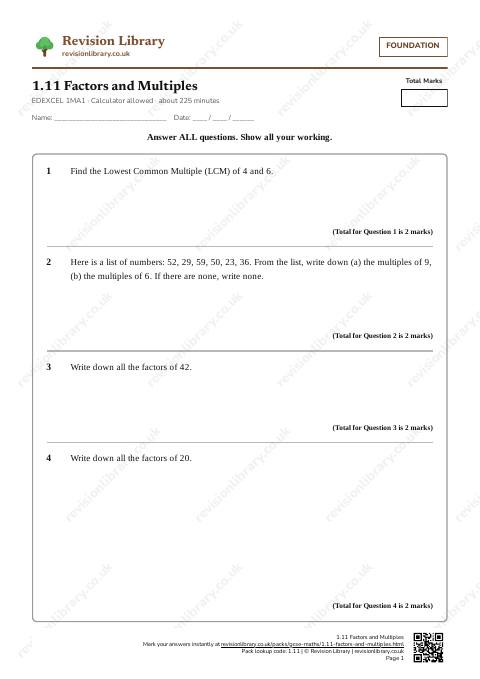
1.11 Factors and Multiples
EDEXCEL 1MA1 · Calculator allowed · about 225 minutes
Here is a list of numbers: 52, 29, 59, 50, 23, 36. From the list, write down (a) the multiples of 9, (b) the multiples of 6. If there are none, write none.
(Total for Question 2 is 2 marks)
3
Write down all the factors of 42.
(Total for Question 3 is 2 marks)
4
Write down all the factors of 20.
(Total for Question 4 is 2 marks)
5
Bus A leaves the station every 9 minutes. Bus B leaves the station every 4 minutes. They both leave at 9:00 am. After how many minutes do they next leave together?
(Total for Question 5 is 3 marks)
6
Write down all the prime numbers between 29 and 49 inclusive. If there is none, write none.
(Total for Question 6 is 2 marks)
7
Write down all the factors of 64.
(Total for Question 7 is 2 marks)
8
Here is a list of numbers: 12, 15, 31, 40, 14, 26. From the list, write down (a) the multiples of 9, (b) the multiples of 3. If there are none, write none.
(Total for Question 8 is 2 marks)
9
Bus A leaves the station every 5 minutes. Bus B leaves the station every 9 minutes. They both leave at 9:00 am. After how many minutes do they next leave together?
(Total for Question 9 is 3 marks)
10
Write down all the prime numbers between 28 and 41 inclusive. If there is none, write none.
(Total for Question 10 is 2 marks)
11
Write down all the factors of 56.
(Total for Question 11 is 2 marks)
12
Bus A leaves the station every 3 minutes. Bus B leaves the station every 5 minutes. They both leave at 9:00 am. After how many minutes do they next leave together?
(Total for Question 12 is 3 marks)
13
Here is a list of numbers: 45, 59, 18, 16, 44, 21. From the list, write down (a) the multiples of 4, (b) the multiples of 8. If there are none, write none.
(Total for Question 13 is 2 marks)
14
Write down all the factors of 40.
(Total for Question 14 is 2 marks)
15
Here is a list of numbers. 2, 3, 4, 5, 6, 7, 8, 9, 10, 11
(a)From the list, write down all the prime numbers.(2)
(b)From the list, write down all the square numbers.(1)
(Total for Question 15 is 3 marks)
16
Bus A leaves the station every 10 minutes. Bus B leaves the station every 6 minutes. They both leave at 9:00 am. After how many minutes do they next leave together?
(Total for Question 16 is 3 marks)
17
Here is a list of numbers: 31, 32, 48, 30, 36, 49. From the list, write down (a) the multiples of 10, (b) the multiples of 6. If there are none, write none.
(Total for Question 17 is 2 marks)
18
Write down all the factors of 30.
(Total for Question 18 is 2 marks)
19
Write down all the prime numbers between 32 and 47 inclusive. If there is none, write none.
(Total for Question 19 is 2 marks)
20
Bus A leaves the station every 8 minutes. Bus B leaves the station every 6 minutes. They both leave at 9:00 am. After how many minutes do they next leave together?
(Total for Question 20 is 3 marks)
21
Write down all the factors of 12.
(Total for Question 21 is 2 marks)
22
Here is a list of numbers: 16, 37, 34, 58, 33, 15. From the list, write down (a) the multiples of 4, (b) the multiples of 8. If there are none, write none.
(Total for Question 22 is 2 marks)
23
Write down all the factors of 36.
(Total for Question 23 is 2 marks)
24
Write down all the prime numbers between 59 and 76 inclusive. If there is none, write none.
(Total for Question 24 is 2 marks)
25
Which of these numbers is a multiple of 9?
A) 42
B) 54
C) 65
D) 80
(Total for Question 25 is 1 mark)
26
Bus A leaves the station every 15 minutes. Bus B leaves the station every 9 minutes. They both leave at 9:00 am. After how many minutes do they next leave together?
(Total for Question 26 is 3 marks)
27
Here is a list of numbers: 52, 14, 54, 27, 12, 33. From the list, write down (a) the multiples of 12, (b) the multiples of 2. If there are none, write none.
(Total for Question 27 is 2 marks)
28
Write down all the factors of 28.
(Total for Question 28 is 2 marks)
29
Write down all the prime numbers between 41 and 58 inclusive. If there is none, write none.
(Total for Question 29 is 2 marks)
30
Write down all the factors of 54.
(Total for Question 30 is 2 marks)
31
Write down all the prime numbers between 43 and 61 inclusive. If there is none, write none.
(Total for Question 31 is 2 marks)
32
Here is a list of numbers. 6, 8, 12, 15, 24, 30 Circle the two numbers in the list that are common multiples of 3 and 4.
(Total for Question 32 is 2 marks)
33
State whether each statement is True or False.
(a)3 is a factor of 27.(1)
(b)5 is a multiple of 20.(1)
(c)1 is a factor of every whole number.(1)
(d)9 is a prime number.(1)
(Total for Question 33 is 4 marks)
34
Complete the table below. Each row is missing one number.
(Total for Question 34 is 4 marks)
35
Find the Highest Common Factor (HCF) of 12 and 18.
(Total for Question 35 is 2 marks)
36
Here is a list of numbers. 14, 18, 21, 25, 28, 33, 36, 40 Write down all the multiples of 7 from the list.
(Total for Question 36 is 2 marks)
37
Write down all the factor pairs of 32.
(Total for Question 37 is 2 marks)
38
Here is a list of numbers. 1, 2, 4, 6, 8, 9, 11, 13, 16, 27
(a)From the list, write down all the prime numbers.(2)
(b)From the list, write down all the cube numbers.(1)
(Total for Question 38 is 3 marks)
39
Which of these numbers is a factor of 45?
A) 6
B) 9
C) 14
D) 20
(Total for Question 39 is 1 mark)
40
A list of numbers is shown below. 9, 15, 20, 30, 33, 40 Circle the two numbers that are common multiples of 3 and 5.
(Total for Question 40 is 2 marks)
41
9 and 12 are two numbers. Find their Lowest Common Multiple (LCM).
(Total for Question 41 is 2 marks)
42
Write down all the factors of 24.
(Total for Question 42 is 1 mark)
43
Decide whether 51 is prime or composite. Give a short reason.
(Total for Question 43 is 1 mark)
44
Write down the first five multiples of 7 that are less than 40.
(Total for Question 44 is 1 mark)
45
Is 29 a prime number? State your answer.
(Total for Question 45 is 1 mark)
46
Write down all the even factors of 60.
(Total for Question 46 is 1 mark)
47
Work out the smallest multiple of 11 that is greater than 100.
(Total for Question 47 is 1 mark)
48
Priya is making identical party bags. She has 16 chocolate bars and 24 packets of crisps. Every bag must contain the same number of chocolate bars and the same number of packets of crisps, with none left over. Work out the greatest number of party bags Priya can make.
(Total for Question 48 is 3 marks)
49
Two lighthouses flash together at 8:00 pm. Lighthouse A then flashes every 15 seconds. Lighthouse B then flashes every 20 seconds. Work out how many seconds after 8:00 pm the two lighthouses will next flash together.
(Total for Question 49 is 3 marks)
50
Find the Highest Common Factor (HCF) of 30, 45 and 60.
(Total for Question 50 is 3 marks)
51
Explain why 2 is the only even prime number.
(Total for Question 51 is 2 marks)
52
Show that 8 is a common factor of 56 and 72.
(Total for Question 52 is 2 marks)
53
Chidi is finding the Highest Common Factor of 16 and 40. His working is shown below. Factors of 16: 1, 2, 4, 8, 16 Factors of 40: 1, 2, 4, 5, 8, 10, 20, 40 Common factors: 1, 2, 4, 8 Chidi writes: 'The Highest Common Factor of 16 and 40 is 4.' Explain the mistake Chidi has made, and write down the correct Highest Common Factor.
(Total for Question 53 is 2 marks)
54
Neha runs a flower stall and has 42 tulips and 63 daffodils to arrange. She wants to make identical bunches, using every flower, with none left over. Work out the greatest number of identical bunches she can make.
(Total for Question 54 is 3 marks)
55
Anil waters his tomato plants every 18 days and waters his rose bushes every 24 days. He waters both on the same day today. Work out in how many days' time he will next water both the tomato plants and the rose bushes on the same day.
(Total for Question 55 is 3 marks)
56
Zara says, 'If a number is a factor of 20, it must also be a factor of 30.' Is Zara correct? Give a reason for your answer.
(Total for Question 56 is 2 marks)
57
Show that 123456 is divisible by 3.
(Total for Question 57 is 2 marks)
58
Work out the highest common factor (HCF) of 42 and 56.
(Total for Question 58 is 2 marks)
59
Work out the least common multiple (LCM) of 6 and 15.
(Total for Question 59 is 2 marks)
60
Given that the highest common factor (HCF) of 9 and 12 is 3, work out the lowest common multiple (LCM) of 9 and 12.
(Total for Question 60 is 2 marks)
61
Show that 108 = 22 x 33.
(Total for Question 61 is 2 marks)
62
List all the common factors of 48 and 72.
(Total for Question 62 is 2 marks)
63
Three bells ring together at 12:00 noon. Bell A rings every 6 minutes. Bell B rings every 8 minutes. Bell C rings every 10 minutes. Work out the next time after 12:00 noon that all three bells ring together.
(Total for Question 63 is 3 marks)
64
A whole number has these three properties: - it is a multiple of 6 - it is a factor of 90 - it is greater than 20 and less than 50 Find the number.
(Total for Question 64 is 3 marks)
65
Amara, Tomasz and Ffion go jogging together and set off at the same time from the start of a park route. Amara completes a lap every 8 minutes. Tomasz completes a lap every 12 minutes. Ffion completes a lap every 20 minutes. Work out how many minutes after setting off all three will next be at the start together.
(Total for Question 65 is 3 marks)
66
Work out the least common multiple of 14, 21 and 35.
(Total for Question 66 is 2 marks)
67
Work out the smallest 3-digit integer that is divisible by both 11 and 13.
(Total for Question 67 is 1 mark)
68
The Year 7 class has football training every 5 days and the Year 8 class every 7 days. If both classes have training on Monday, after how many days will they next have training on the same day?
(Total for Question 68 is 2 marks)
69
Work out the smallest positive integer that is a multiple of 4, 6 and 9.
(Total for Question 69 is 2 marks)
70
Sam and Aisha practise the same music piece in cycles. Sam repeats it every 8 days, Aisha every 12 days. If they both practise today, after how many days will they next practise together?
(Total for Question 70 is 2 marks)
71
Show that 41472 is divisible by 8.
(Total for Question 71 is 2 marks)
72
Paper cups are sold in packs of 15. Paper plates are sold in packs of 40. Priya wants to buy exactly the same number of cups as plates for a party, with none left over. Work out the smallest number of cups (and the smallest number of plates) she could buy.
(Total for Question 72 is 2 marks)
73
Three warning lights flash at regular intervals: the red light every 15 seconds, the amber light every 20 seconds and the green light every 24 seconds. All three flash together at exactly 9:00:00 am. Work out the time when all three will next flash together.
(Total for Question 73 is 2 marks)
74
A gardener has 96 tulip bulbs and 72 daffodil bulbs. She wants to plant them in rows, with the same number of bulbs in every row, using only one type of bulb per row and no bulbs left over. Work out the greatest possible number of bulbs in each row.
(Total for Question 74 is 2 marks)
75
Two positive integers have HCF 6 and LCM 84. Work out the product of the two integers.
(Total for Question 75 is 2 marks)
76
Two positive integers have HCF 8 and LCM 240. One of the integers is 48. Work out the other integer.
(Total for Question 76 is 3 marks)
77
How many positive integers less than 100 are divisible by at least one of 2, 3 or 5? Show your working.
(Total for Question 77 is 3 marks)
Mark scheme · 1.11 Factors and Multiples
A correct answer earns full marks unless the question asks for working, a method, proof or explanation.
Question 1
correct list of multiples of 4 (4,8,12,16,...) and 6 (6,12,18,...), or other correct methodM1
12 caoA1
Answer: 12
Question 2
multiples of 9 correctB1
multiples of 6 correctB1
Answer: multiples of 9: 36; multiples of 6: 36
Question 3
at least half of the factors listed, or factor pairs seenM1
all factors, no extrasA1
Answer: 1, 2, 3, 6, 7, 14, 21, 42
Question 4
at least 4 correct factors identifiedB1
fully correct set 1, 2, 4, 5, 10, 20 with no extra numbers, oe orderB1
Answer: 1, 2, 4, 5, 10, 20
Question 5
lists multiples of 9 and 4M1
identifies a common multipleM1
36 minutes caoA1
Answer: 36 minutes
Question 6
tests numbers for factors other than 1 and itselfM1
all primes and no othersA1
Answer: 29, 31, 37, 41, 43, 47
Question 7
at least half of the factors listed, or factor pairs seenM1
all factors, no extrasA1
Answer: 1, 2, 4, 8, 16, 32, 64
Question 8
multiples of 9 correctB1
multiples of 3 correctB1
Answer: multiples of 9: none; multiples of 3: 12, 15
Question 9
lists multiples of 5 and 9M1
identifies a common multipleM1
45 minutes caoA1
Answer: 45 minutes
Question 10
tests numbers for factors other than 1 and itselfM1
all primes and no othersA1
Answer: 29, 31, 37, 41
Question 11
at least half of the factors listed, or factor pairs seenM1
all factors, no extrasA1
Answer: 1, 2, 4, 7, 8, 14, 28, 56
Question 12
lists multiples of 3 and 5M1
identifies a common multipleM1
15 minutes caoA1
Answer: 15 minutes
Question 13
multiples of 4 correctB1
multiples of 8 correctB1
Answer: multiples of 4: 16, 44; multiples of 8: 16
Question 14
at least half of the factors listed, or factor pairs seenM1
all factors, no extrasA1
Answer: 1, 2, 4, 5, 8, 10, 20, 40
Question 15
(a) at least 3 correct primes with no more than 1 non-prime includedB1
(a) fully correct set 2, 3, 5, 7, 11 caoB1
(a) Answer: 2, 3, 5, 7, 11
(b) 4 and 9 cao, both values with no extrasB1
(b) Answer: 4, 9
Question 16
lists multiples of 10 and 6M1
identifies a common multipleM1
30 minutes caoA1
Answer: 30 minutes
Question 17
multiples of 10 correctB1
multiples of 6 correctB1
Answer: multiples of 10: 30; multiples of 6: 48, 30, 36
Question 18
at least half of the factors listed, or factor pairs seenM1
all factors, no extrasA1
Answer: 1, 2, 3, 5, 6, 10, 15, 30
Question 19
tests numbers for factors other than 1 and itselfM1
all primes and no othersA1
Answer: 37, 41, 43, 47
Question 20
lists multiples of 8 and 6M1
identifies a common multipleM1
24 minutes caoA1
Answer: 24 minutes
Question 21
at least half of the factors listed, or factor pairs seenM1
all factors, no extrasA1
Answer: 1, 2, 3, 4, 6, 12
Question 22
multiples of 4 correctB1
multiples of 8 correctB1
Answer: multiples of 4: 16; multiples of 8: 16
Question 23
at least half of the factors listed, or factor pairs seenM1
all factors, no extrasA1
Answer: 1, 2, 3, 4, 6, 9, 12, 18, 36
Question 24
tests numbers for factors other than 1 and itselfM1
all primes and no othersA1
Answer: 59, 61, 67, 71, 73
Question 25
B (54) caoB1
Answer: B) 54
Question 26
lists multiples of 15 and 9M1
identifies a common multipleM1
45 minutes caoA1
Answer: 45 minutes
Question 27
multiples of 12 correctB1
multiples of 2 correctB1
Answer: multiples of 12: 12; multiples of 2: 52, 14, 54, 12
Question 28
at least half of the factors listed, or factor pairs seenM1
all factors, no extrasA1
Answer: 1, 2, 4, 7, 14, 28
Question 29
tests numbers for factors other than 1 and itselfM1
all primes and no othersA1
Answer: 41, 43, 47, 53
Question 30
at least half of the factors listed, or factor pairs seenM1
all factors, no extrasA1
Answer: 1, 2, 3, 6, 9, 18, 27, 54
Question 31
tests numbers for factors other than 1 and itselfM1
all primes and no othersA1
Answer: 43, 47, 53, 59, 61
Question 32
12 identifiedB1
24 identified, with no incorrect extra numbers circledB1
Answer: 12 and 24
Question 33
(a) True cao, since 27 = 3 x 9B1
(a) Answer: True
(b) False cao, since 5 does not appear in the 20 times tableB1
(b) Answer: False
(c) True caoB1
(c) Answer: True
(d) False cao, since 9 = 3 x 3 has a factor other than 1 and itselfB1
(d) Answer: False
Question 34
27 cao (third multiple of 9)B1
4 cao (missing factor of 16)B1
33 cao (third multiple of 11)B1
4 cao (missing factor of 24)B1
Answer: 27, 4, 33, 4
Question 35
correct list of factors of 12 (1,2,3,4,6,12) and 18 (1,2,3,6,9,18), or other correct methodM1
6 caoA1
Answer: 6
Question 36
at least two correct multiples identified, with no more than one non-multiple includedB1
fully correct set 14, 21, 28 caoB1
Answer: 14, 21, 28
Question 37
at least 2 correct factor pairs identifiedB1
fully correct set (1,32), (2,16), (4,8) with no extra pairs, oe orderB1
Answer: (1, 32), (2, 16), (4, 8)
Question 38
(a) at least 2 correct primes with no more than 1 non-prime includedB1
(a) fully correct set 2, 11, 13 caoB1
(a) Answer: 2, 11, 13
(b) 1, 8 and 27 cao, all three values with no extrasB1
(b) Answer: 1, 8, 27
Question 39
B (9) caoB1
Answer: B) 9
Question 40
15 identifiedB1
30 identified, with no incorrect extra numbers circledB1
Answer: 15 and 30
Question 41
correct list of multiples of 9 (9,18,27,36,...) and 12 (12,24,36,...), or other correct methodM1
identifying that the HCF of 16 and 24 is requiredM1
correct factors of 16 (1,2,4,8,16) and 24 (1,2,3,4,6,8,12,24) or other valid methodM1
8 caoA1
Answer: 8 party bags
Question 49
identifying that the LCM of 15 and 20 is requiredM1
correct multiples of 15 (15,30,45,60) and 20 (20,40,60) or other valid methodM1
60 seconds cao (accept 1 minute)A1
Answer: 60 seconds
Question 50
correct factors of at least two of the three numbersM1
correct factors of all three numbers: 30 (1,2,3,5,6,10,15,30), 45 (1,3,5,9,15,45), 60 (1,2,3,4,5,6,10,12,15,20,30,60)M1
15 caoA1
Answer: 15
Question 51
recognising that every even number greater than 2 has 2 as a factor as well as 1 and itself, so it has more than two factorsB1
concluding that 2 itself only has the factors 1 and 2, so 2 is prime, oeB1
Answer: Every even number greater than 2 can be divided exactly by 2, so it has at least three factors (1, 2 and itself), meaning it cannot be prime. 2 itself has only the factors 1 and 2, so 2 is prime and is the only even prime number.
Question 52
56 / 8 = 7 (or 8 x 7 = 56) shownB1
72 / 8 = 9 (or 8 x 9 = 72) shown, csoB1
Answer: 8 is a common factor of 56 and 72 (56 = 8x7, 72 = 8x9)
Question 53
identifies that Chidi has not chosen the highest number from his own list of common factors (he wrote 4 instead of 8), oeB1
8 caoB1
Answer: Chidi's factors and common factors (1, 2, 4, 8) are correct, but he has not picked the highest of these - the Highest Common Factor is 8, not 4.
Question 54
identifying that the HCF of 42 and 63 is requiredM1
correct factors of 42 (1,2,3,6,7,14,21,42) and 63 (1,3,7,9,21,63) or other valid methodM1
21 caoA1
Answer: 21 bunches
Question 55
identifying that the LCM of 18 and 24 is requiredM1
correct multiples of 18 (18,36,54,72) and 24 (24,48,72) or other valid methodM1
72 days caoA1
Answer: 72 days
Question 56
No, Zara is not correctB1
valid counterexample given, e.g. 4 is a factor of 20 (20=4x5) but 4 is not a factor of 30 (30/4=7.5), oeB1
Answer: No, Zara is not correct
Question 57
Use digit sum method: 1+2+3+4+5+6 = 21M1
Therefore 123456 is divisible by 3 csoA1
Answer: Digits sum to 21 and 21 is divisible by 3, so 123456 is divisible by 3.
Question 58
Correct method: list common factors or prime factorisation (e.g. 42 = 2*3*7, 56 = 23*7) or explicit common factorsM1
14 caoA1
Answer: 14
Question 59
Correct method: prime factors or listing multiples (6 = 2*3, 15 = 3*5 so LCM = 2*3*5)M1
correctly identifies which of these are multiples of 6: 6, 18, 30, 90M1
30 caoA1
Answer: 30
Question 65
identifying that the LCM of 8, 12 and 20 is requiredM1
correct method leading to LCM=120, e.g. multiples of 8, 12 and 20 up to 120, or prime factors 8=23, 12=22x3, 20=22x5 giving 23x3x5=120M1
120 minutes caoA1
Answer: 120 minutes
Question 66
Correct method: prime factors (14 = 2*7, 21 = 3*7, 35 = 5*7) and combineM1
210 caoA1
Answer: 210
Question 67
143 caoB1
Answer: 143
Question 68
Find LCM of 5 and 7 (method shown)M1
35 days caoA1
Answer: 35 days
Question 69
Correct method: prime factors or pairwise LCMs (4 = 22, 6 = 2*3, 9 = 32 so LCM = 22 * 32)M1
36 caoA1
Answer: 36
Question 70
Find LCM of 8 and 12 (method shown)M1
24 days caoA1
Answer: 24 days
Question 71
Uses the divisibility test for 8: a number is divisible by 8 if its last three digits are divisible by 8, and identifies the last three digits as 472M1
472 = 8 x 59, so 41472 is divisible by 8 csoA1
Answer: 41472 is divisible by 8, since its last three digits (472) equal 8 x 59.
Question 72
Finds LCM of 15 and 40 (method shown)M1
120 caoA1
Answer: 120 cups and 120 plates
Question 73
Finds LCM of 15, 20 and 24 (method shown)M1
9:02:00 am cao (accept 120 seconds or 2 minutes after 9:00:00 am)A1
Answer: 9:02:00 am (120 seconds later)
Question 74
Correct method to find HCF of 96 and 72 (e.g. prime factors or repeated subtraction)M1
24 caoA1
Answer: 24 bulbs per row
Question 75
Use property: product = HCF * LCM for two integersM1
504 caoA1
Answer: 504
Question 76
Uses the property that the product of two integers equals HCF x LCM (oe)M1
Substitutes to find the other integer = (8 x 240) / 48 (oe)M1
Put this topic and others into one printable pack.
Open the Pack Builder
Worksheets are written for Revision Library and come with a full mark scheme; a few English packs quote an out-of-copyright text, and name it on the page. Exam board names and specification codes say which qualification a pack suits: we are not affiliated with, endorsed by or approved by any exam board, and no past-paper question is reproduced here. Rights queries: hello@revisionlibrary.co.uk