Calculation problems are worded, real-life questions that require combining several number skills, such as the four operations, rounding, ratio, fractions or percentages, in the right order to reach a final answer, testing whether a multi-step method can be planned rather than a single calculation performed. GCSE Foundation papers use contexts like shopping, travel and best value to assess this skill.
Read the question carefully and identify exactly what final quantity you need to find.
List the useful numbers and note what each one represents, such as a price, a length or a time.
Break the problem into smaller steps, deciding which calculation to do first.
Work through each step in order, writing down each intermediate answer clearly.
Check the final answer makes sense in context, using correct units, and round appropriately if the question asks for it.
Worked example
Farah buys 4 notebooks costing 1.45 pounds each and one pen costing 85p. She pays with a 10 pound note. Work out how much change she should get.
Work out the cost of the notebooks: 4 x 1.45 = 5.80 pounds.
Add the cost of the pen: 5.80 + 0.85 = 6.65 pounds.
Subtract the total from the amount paid: 10.00 - 6.65 = 3.35.
Final answer: 3.35 pounds change.
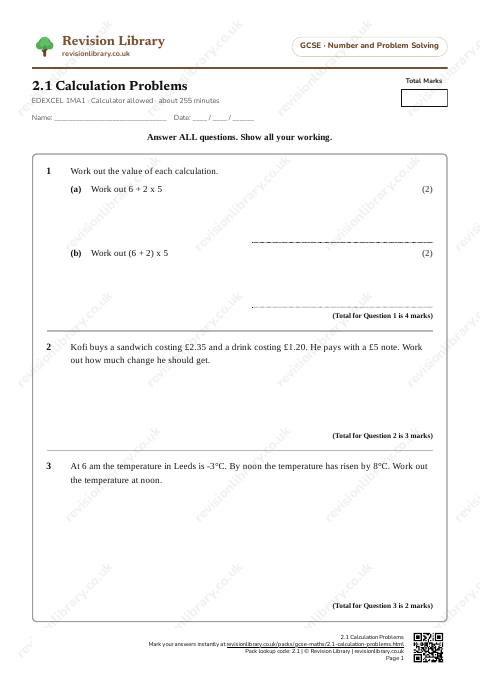
Revision Library
revisionlibrary.co.uk
GCSE · Number and Problem Solving
2.1 Calculation Problems
EDEXCEL 1MA1 · Calculator allowed · about 255 minutes
Kofi buys a sandwich costing £2.35 and a drink costing £1.20. He pays with a £5 note. Work out how much change he should get.
(Total for Question 2 is 3 marks)
3
At 6 am the temperature in Leeds is -3°C. By noon the temperature has risen by 8°C. Work out the temperature at noon.
(Total for Question 3 is 2 marks)
4
A minibus can carry 14 passengers. A school needs to transport 87 pupils on a trip, using only minibuses of this size. Work out the least number of minibuses needed.
(Total for Question 4 is 3 marks)
5
Work out the value of each calculation.
(a)Work out 3 x 4 - 22(2)
(b)Work out √25 + (7 - 3) x 2(2)
(Total for Question 5 is 4 marks)
6
Four friends, Leon, Zara, Josh and Aisha, share a taxi fare of £17.80 equally between them. Work out how much each friend pays.
(Total for Question 6 is 2 marks)
7
A market stall sells punnets of strawberries for £2.20 each. Ravi buys 4 punnets and pays with a £10 note. Work out how much change he should get.
(Total for Question 7 is 3 marks)
8
The temperature inside a freezer is 4°C. The freezer is switched to a colder setting, and the temperature falls by 3°C every 10 minutes. Work out the temperature inside the freezer after 30 minutes.
(Total for Question 8 is 3 marks)
9
Rounding and estimating.
(a)Round 0.0672 to 2 significant figures.(1)
(b)By rounding each number to 1 significant figure, work out an estimate for (68.2 - 23.5) x 4.9(2)
(Total for Question 9 is 3 marks)
10
Erin buys a sandwich for £2.15, a drink for £1.10 and a snack bar for £0.85. Work out the total amount Erin spends.
(Total for Question 10 is 1 mark)
11
A ribbon is 3.2 m long. Work out the length of the ribbon in centimetres.
(Total for Question 11 is 1 mark)
12
Priya buys 3 notebooks costing £1.85 each and 2 pens costing 65p each. She pays with two £5 notes. Work out how much change she should get.
(Total for Question 12 is 4 marks)
13
A cinema charges: Adult ticket £8.50, Child ticket £5.25, Family ticket (exactly 2 adults and 2 children) £24.00. A group of 3 adults and 5 children want to go to the cinema. Work out the cheapest total cost for the group's tickets, using one family ticket and buying the remaining tickets individually.
(Total for Question 13 is 4 marks)
14
Toothpaste is sold in two sizes: 75 ml for £1.35, and 125 ml for £2.10. Work out which size is the better value for money. You must show your working.
(Total for Question 14 is 4 marks)
15
A car travels 126 miles in 2 hours 15 minutes. Work out the average speed of the car in miles per hour.
(Total for Question 15 is 3 marks)
16
There are 30 students in a class.
(a)2/5 of the students walk to school. Work out the number of students who walk to school.(2)
(b)Of the students who do not walk to school, 1/3 travel by bus. Work out how many students travel by bus.(2)
(Total for Question 16 is 4 marks)
17
Tom's bank balance is -£45. He deposits £120 and then withdraws £68. Work out Tom's new balance.
(Total for Question 17 is 3 marks)
18
A restaurant bill is for 4 meals, each costing £11.95, plus a 10% service charge.
(a)By rounding the cost of each meal to the nearest pound, estimate the total bill.(2)
(b)Work out the exact total bill.(2)
(Total for Question 18 is 4 marks)
19
Two bus journeys are described below.
(a)A bus leaves Elmsworth at 09:15 and arrives at Deepdene at 10:52. Work out how long the journey takes, giving your answer in hours and minutes.(2)
(b)A different bus journey takes 1 hour 48 minutes. The bus leaves at 14:05. Work out the arrival time.(2)
(Total for Question 19 is 4 marks)
20
Rounding and estimating.
(a)Round 6.482 to 1 decimal place.(1)
(b)By rounding each number to 1 significant figure, work out an estimate for (39.2 x 5.1) / 9.8(2)
(Total for Question 20 is 3 marks)
21
A washing machine costs £340. In a sale it is reduced by 15%. Work out the sale price of the washing machine.
(Total for Question 21 is 3 marks)
22
Amelia and Ben share £84 in the ratio 3 : 4. Work out how much each person receives.
(Total for Question 22 is 4 marks)
23
A plank of wood is 2.4 metres long.
(a)Work out the length of the plank in centimetres.(1)
(b)Four planks, each 2.4 metres long, are laid end to end in a straight line. A gap of 5 cm is left at each of the 3 joins between the planks. Work out the total length, in metres, of the four planks and the gaps.(3)
(Total for Question 23 is 4 marks)
24
Emma says that 40% of 85 is greater than 3/8 of 90. Show that Emma is correct.
(Total for Question 24 is 3 marks)
25
Sara buys a book for £6.85 and a magazine for £2.40. She pays with a £10 note. Her working to find her change is shown below, but she has made one error.
6.85 + 2.40 = 8.25 10.00 - 8.25 = 1.75
Identify Sara's error, and work out the correct amount of change she should get.
(Total for Question 25 is 4 marks)
26
Fatima works 32 hours in a week at a rate of £9.50 per hour. She also works 4 hours of overtime, which is paid at 1.5 times her normal hourly rate. Work out her total pay for the week.
(Total for Question 26 is 4 marks)
27
A jacket normally costs £45. In a sale, the price is reduced by 1/5. Work out the sale price of the jacket.
(Total for Question 27 is 3 marks)
28
A car park charges £1.50 for the first hour, then 90p for each additional hour, up to a maximum charge of £8.00 for the whole day. Nadia parks her car for 6 hours. Work out how much she should pay.
(Total for Question 28 is 3 marks)
29
A train travels at an average speed of 75 mph. Work out how long, in minutes, the train takes to travel 60 miles.
(Total for Question 29 is 3 marks)
30
A train timetable is shown below.
Station
Train A
Train B
Carnforth
08:12
08:47
Lancaster
08:26
09:01
Preston
08:58
09:33
(a)Work out how long Train A takes to travel from Carnforth to Preston.(2)
(b)One morning, Train B leaves Carnforth 6 minutes late. Its journey from Carnforth to Lancaster still takes the same amount of time as shown in the timetable. Work out the actual time Train B arrives at Lancaster that morning.(3)
(Total for Question 30 is 5 marks)
31
A gym membership currently costs £32 per month. From January, the price will increase by 8%. Work out the new monthly cost.
(Total for Question 31 is 3 marks)
32
A recipe for a loaf of bread uses 750 g of flour.
(a)Work out 750 g in kilograms.(1)
(b)Sana has a 5 kg bag of flour and uses it only to make loaves using this recipe. Work out the greatest number of complete loaves she can make from the bag, and how many grams of flour would be left over.(3)
(Total for Question 32 is 4 marks)
33
A charity bake sale raises £90, which is shared between three classes, Class 7G, Class 8B and Class 9R, in the ratio 2 : 3 : 4. Work out how much money each class receives.
(Total for Question 33 is 4 marks)
34
A baker makes 50 cupcakes and packs them into boxes of 6. Work out how many full boxes the baker can make and how many cupcakes are left over.
(Total for Question 34 is 2 marks)
35
A school trip needs to transport 134 students. Each minibus can carry 15 students. Work out the least number of minibuses needed to transport all the students.
(Total for Question 35 is 2 marks)
36
A phone shop offers two deals for the same phone. Deal A: £28 per month for 24 months, plus a one-off upfront payment of £49. Deal B: £35 per month for 18 months, with no upfront payment. Work out which deal is cheaper overall, and by how much.
(Total for Question 36 is 5 marks)
37
A recipe for 8 people needs 480 g of flour and 4 eggs. Grace wants to make the recipe for 6 people.
(a)Work out how many grams of flour Grace needs.(2)
(b)Work out how many eggs Grace needs.(2)
(Total for Question 37 is 4 marks)
38
A garden path is a rectangle 8.5 m long and 1.2 m wide. Paving costs £24.50 per square metre. Work out the total cost of paving the path, giving your answer to the nearest pound.
Diagram NOT accurately drawn
(Total for Question 38 is 4 marks)
39
A school is organising a trip for 92 students and 6 teachers, so 98 people in total. Coach hire costs £315 per coach, and each coach seats 53 passengers. The entry ticket to the venue costs £7.40 per person, and there is a 20% discount off the total ticket cost because the group has more than 50 people. Work out a) the total cost of the trip, and b) the cost per student if this total cost is shared equally amongst the 92 students, giving your answer to the nearest penny.
(Total for Question 39 is 6 marks)
40
A cuboid water tank has length 1.2 m, width 0.8 m and height 1.5 m. Work out the capacity of the tank in litres. (1 cubic metre = 1000 litres)
Diagram NOT accurately drawn
(Total for Question 40 is 3 marks)
41
After a sale discount of 20%, a jumper costs £28. Work out the original price of the jumper before the discount.
(Total for Question 41 is 3 marks)
42
A supermarket sells rice in three bag sizes: 500 g for £1.10, 1 kg for £2.05, and 2.5 kg for £4.80. Work out which bag size gives the best value for money. You must show your working.
(Total for Question 42 is 5 marks)
43
Aaliyah invests £500 in a savings account that pays 4% interest per year, compounded annually. Work out the value of her investment after 2 years. Give your answer to the nearest penny.
(Total for Question 43 is 3 marks)
44
A school fete committee is organising a raffle and a cake stall. - Raffle tickets cost £0.50 each. They print 400 tickets and sell 85% of them. - The cake stall sells 60 cakes at £1.20 each, but a discount of 10% is applied to the total cake takings because it is the last hour of the fete. - Running the fete costs £45 for hall hire and £18 for materials. Work out the total profit made by the fete.
(Total for Question 44 is 6 marks)
45
A recipe uses 350 g of flour to make 4 portions. Work out how much flour is needed for 7 portions.
(Total for Question 45 is 3 marks)
46
Aisha and Ben each go for a run. The table shows the distance each of them ran and the time each of them took.
Runner
Distance (km)
Time (minutes)
Aisha
15
50
Ben
21
60
Work out which runner had the greater average speed. You must show your working.
(Total for Question 46 is 3 marks)
47
A photographer charges a base fee of £45 plus £12 per hour. Noah hires the photographer for 3.5 hours.
(a)Work out the total cost.(2)
(b)Work out the average cost per hour, correct to the nearest penny.(2)
(Total for Question 47 is 4 marks)
48
A jumper is reduced by 15% in a sale. The original price is £48. Work out the sale price of one jumper, then the total cost of buying 3 jumpers at the sale price.
(Total for Question 48 is 3 marks)
49
After a 12% pay rise, Priya's new weekly wage is £392. Work out her original weekly wage, before the rise.
(Total for Question 49 is 3 marks)
50
A rectangle has length 3 times its width. The perimeter of the rectangle is 96 cm.
Diagram NOT accurately drawn
(a)Find the width and the length.(2)
(b)Work out the area of the rectangle.(2)
(Total for Question 50 is 4 marks)
51
Callum's car uses 9 litres of fuel to travel 150 km. At this rate, how many litres will he use to travel 350 km? Then work out the cost of that fuel if fuel costs £1.45 per litre.
(Total for Question 51 is 4 marks)
52
Noah invests £2,500 in a savings account paying compound interest at 2.5% per year.
(a)Work out the value of his savings after 2 years.(3)
(b)Work out the total interest earned over the 2 years.(1)
(Total for Question 52 is 4 marks)
53
A school has a budget of £12,500. They spend 18% of the budget on books and £2,350 on equipment. The remaining money is to be shared equally between 5 departments. Work out how much each department receives.
(Total for Question 53 is 4 marks)
54
A cleaning fluid mixes chemical A and chemical B in the ratio 2:5 by volume. A batch of the fluid contains 7.5 litres more chemical B than chemical A. Work out the total volume of the batch.
(Total for Question 54 is 4 marks)
Mark scheme · 2.1 Calculation Problems
A correct answer earns full marks unless the question asks for working, a method, proof or explanation.
Question 1
(a) 2 x 5 (= 10) seenM1
(a) 16 caoA1
(a) Answer: 16
(b) 6 + 2 (= 8) seenM1
(b) 40 caoA1
(b) Answer: 40
Question 2
2.35 + 1.20 (= 3.55) seenM1
5.00 - 3.55 (dependent method, or ft their total)M1
£1.45 caoA1
Answer: £1.45
Question 3
-3 + 8 seen, or correct method combining the valuesM1
5°C caoA1
Answer: 5°C
Question 4
87 / 14 (= 6.21..) seen, or repeated addition/subtraction of 14 reaching at least 84M1
recognises that 6 minibuses are not enough (6 x 14 = 84, leaving 3 pupils), so rounds upM1
7 caoA1
Answer: 7 minibuses
Question 5
(a) 3 x 4 (= 12) or 22 (= 4) seenM1
(a) 8 caoA1
(a) Answer: 8
(b) √25 (= 5) or (7 - 3) x 2 (= 8) seenM1
(b) 13 caoA1
(b) Answer: 13
Question 6
17.80 / 4 seenM1
£4.45 caoA1
Answer: £4.45
Question 7
4 x 2.20 (= 8.80) seenM1
10.00 - their 8.80 (dependent method)M1
£1.20 caoA1
Answer: £1.20
Question 8
3 x 3 (= 9) seen, the number of 10-minute intervals multiplied by the fall per intervalM1
4 - their 9 (dependent method)M1
-5°C caoA1
Answer: -5°C
Question 9
(a) 0.067 caoB1
(a) Answer: 0.067
(b) 68.2, 23.5 and 4.9 rounded to 70, 20 and 5 respectivelyM1
finds the value of one part: 7.5 / 3 = 2.5 litresM1
finds the total number of parts: 2 + 5 = 7M1
17.5 litres cao (7 x 2.5)A1
Answer: 17.5 litres. Working check: 1 part = 7.5 / 3 = 2.5; chemical A = 2 x 2.5 = 5; chemical B = 5 x 2.5 = 12.5; total = 5 + 12.5 = 17.5; difference = 12.5 - 5 = 7.5 (matches the given information).
Put this topic and others into one printable pack.
Open the Pack Builder
Worksheets are written for Revision Library and come with a full mark scheme; a few English packs quote an out-of-copyright text, and name it on the page. Exam board names and specification codes say which qualification a pack suits: we are not affiliated with, endorsed by or approved by any exam board, and no past-paper question is reproduced here. Rights queries: hello@revisionlibrary.co.uk