Parallel lines are straight lines that never meet and stay the same distance apart; when a third line, called a transversal, crosses two parallel lines, it creates equal pairs of angles (corresponding and alternate) and pairs of angles that sum to 180 degrees (co-interior angles). This GCSE Geometry and Measure topic also draws on angle facts such as angles on a straight line and vertically opposite angles.
Identify whether the marked lines are parallel, shown by matching arrow marks on the diagram.
Look for an F-shape to spot corresponding angles, which are equal.
Look for a Z-shape to spot alternate angles, which are equal.
Look for a C or U-shape to spot co-interior (allied) angles, which sum to 180 degrees.
If the missing angle is not directly one of these types, use angles on a straight line (summing to 180 degrees) or vertically opposite angles (equal) to link it to one you can find.
Always state the angle fact you have used as a reason, since GCSE mark schemes usually award a mark for the correct reason as well as the correct value.
Worked example
Lines l and m are parallel and are crossed by a transversal. One of the angles between the transversal and l is 63 degrees. Angle p, between the transversal and m, is in the co-interior position to the 63 degree angle. Work out the size of angle p, giving a reason for your answer.
Co-interior (allied) angles between parallel lines sum to 180 degrees.
Set up the calculation: p = 180 - 63.
p = 117.
Revision Library
revisionlibrary.co.uk
GCSE · Geometry and Measures
4.10 Angles in Parallel Lines
EDEXCEL 1MA1 · Calculator allowed · about 230 minutes
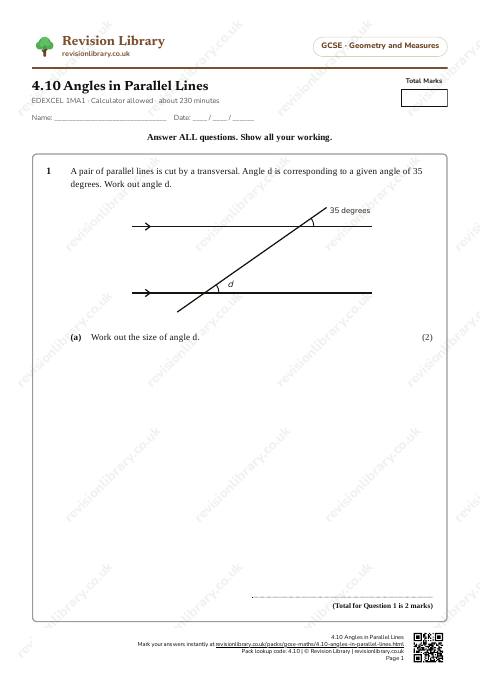
A pair of parallel lines is cut by a transversal. Angle d is corresponding to a given angle of 35 degrees. Work out angle d.
(a)Work out the size of angle d.(2)
(Total for Question 1 is 2 marks)
2
The diagram shows a Z-shape formed between two parallel lines: angle x and a 74 degree angle are alternate angles. Write down the size of angle x.
(Total for Question 2 is 1 mark)
3
Lines l and m are parallel. A transversal cuts them. An angle labelled b on line l is 110 degrees and is interior on the same side of the transversal as angle c on line m. Work out angle c.
(a)Work out the size of angle c. Give a brief reason.(3)
(Total for Question 3 is 3 marks)
4
Two parallel lines are cut by a transversal. At the upper intersection one acute angle is 48 degrees. Find the obtuse angle e at the lower intersection which is co-interior with the 48 degree angle.
(a)Work out the size of angle e. Give a short reason.(4)
(Total for Question 4 is 4 marks)
5
Two straight lines AB and CD cross at point O. Work out the size of angle x.
Diagram NOT accurately drawn
(Total for Question 5 is 1 mark)
6
P, Q and R lie on a straight line. Angle a and an angle of 118 degrees lie on the same side of the line at Q. Work out the size of angle a.
Diagram NOT accurately drawn
(Total for Question 6 is 1 mark)
7
Lines l and m are parallel. A transversal crosses l and m. At the intersection with l, one of the angles formed is 105 degrees. Angle b, at the intersection with m, is in the corresponding position to the 105 degree angle. Work out the size of angle b and give a reason for your answer.
(Total for Question 7 is 2 marks)
8
Lines l and m are parallel and are crossed by a straight transversal. Angle y is in the corresponding position to the 118 degree angle marked above line l. Work out the value of y. Give a reason for your answer.
(Total for Question 8 is 2 marks)
9
The diagram shows a C-shape (co-interior angles) formed between two parallel lines. One marked angle is 101 degrees. Write down the size of the other marked angle, x.
(Total for Question 9 is 1 mark)
10
Lines l and m are parallel and are crossed by a straight transversal. Angle y is in the alternate position to the 47 degree angle marked between l and m. Work out the value of y. Give a reason for your answer.
(Total for Question 10 is 2 marks)
11
A transversal crosses two parallel lines. At the top intersection, angle f lies above the top line and to the right of the transversal, and f = 130 degrees. At the lower intersection, angle g lies above the lower line and to the left of the transversal. The diagram is not drawn to scale.
(a)Work out the size of angle g.(3)
(b)Give a brief reason for your answer to part (a).(2)
(Total for Question 11 is 5 marks)
12
A transversal meets two parallel lines. Angle h at the top left intersection is 27 degrees. Angle j at the bottom right intersection is vertically opposite to an angle corresponding to h. Work out angle j.
(a)Work out the size of angle j. Show your reasoning in two short steps.(5)
(Total for Question 12 is 5 marks)
13
Lines l and m are parallel. A transversal crosses l at P and m at Q, and the angle between the transversal and l is 118 degrees. At Q, three further angles going all the way around the point are marked 90 degrees, 150 degrees and w, in addition to the angle co-interior to the 118 degree angle. Work out the size of angle w.
Diagram NOT accurately drawn
(Total for Question 13 is 3 marks)
14
The diagram shows two parallel lines cut by a transversal. At the intersection with line l, the four angles formed are labelled p, q, r, s (clockwise from top-left). At the intersection with line m, the four angles formed are labelled t, u, v, w (clockwise from top-left, in the same orientation). Identify which pair of angles are alternate angles.
A) r and v
B) s and t
C) r and t
D) p and r
(Total for Question 14 is 1 mark)
15
A car park has two straight rows of parking bays marked by parallel lines AB and CD. A diagonal walkway crosses AB at P and CD at Q. The angle between the walkway and AB, on the interior right of P, is 74 degrees.
Diagram NOT accurately drawn
(a)Work out the size of angle x. Give a reason for your answer.(2)
(b)Work out the size of angle y.(1)
(Total for Question 15 is 3 marks)
16
ABCD is a parallelogram, so AB is parallel to DC. The diagonal AC is drawn. Angle CAB = 38 degrees and angle ADC = 112 degrees. Work out the size of angle x.
Diagram NOT accurately drawn
(Total for Question 16 is 3 marks)
17
Lines l and m are parallel. A transversal crosses l at A, making an angle of 100 degrees with l, and meets m at point X. A second transversal crosses l at C and also meets m at X, making an angle of 55 degrees with m on the other side of X. Work out the size of angle z.
Diagram NOT accurately drawn
(Total for Question 17 is 3 marks)
18
Two parallel lines are crossed by a straight line. Angle a is 133 degrees. Angle b is a corresponding angle to angle a. Angle c is vertically opposite to angle b. Work out the size of angle c, giving reasons.
(Total for Question 18 is 2 marks)
19
Two parallel lines are crossed by a straight line. One of the angles made is 57 degrees. Another angle, y, is a co-interior angle with the 57 degree angle. Work out the size of angle y and give a reason for your answer.
(Total for Question 19 is 2 marks)
20
Two parallel lines are crossed by a straight line. Two of the angles made are alternate angles. They are (2x + 5) degrees and (5x - 91) degrees. Work out the value of x.
(Total for Question 20 is 3 marks)
21
In triangle PQR, the point S is on PQ and the point T is on PR so that ST is parallel to QR. Angle PST = 40 degrees and angle PRQ = 36 degrees. Work out the size of angle QPR. Give reasons for your answer.
(Total for Question 21 is 3 marks)
22
Two parallel lines are crossed by a straight line. One of the angles made is 147 degrees. Another angle, y, is a corresponding angle to the 147 degree angle. Work out the size of angle y and give a reason for your answer.
(Total for Question 22 is 2 marks)
23
Two parallel lines are crossed by a straight line. Angle a is 75 degrees. Angle b is an alternate angle to angle a. Angle c is next to, on a straight line with angle b. Work out the size of angle c, giving reasons.
(Total for Question 23 is 2 marks)
24
Two parallel lines are crossed by a straight line. One of the angles made is 62 degrees. Another angle, y, is a co-interior angle with the 62 degree angle. Work out the size of angle y and give a reason for your answer.
(Total for Question 24 is 2 marks)
25
In triangle ABC, the point D is on AB and the point E is on AC so that DE is parallel to BC. Angle ADE = 44 degrees and angle ACB = 85 degrees. Work out the size of angle BAC. Give reasons for your answer.
(Total for Question 25 is 3 marks)
26
Two parallel lines are crossed by a straight line. Angle a is 138 degrees. Angle b is an alternate angle to angle a. Angle c is next to, on a straight line with angle b. Work out the size of angle c, giving reasons.
(Total for Question 26 is 2 marks)
27
Two parallel lines are crossed by a straight line. One of the angles made is 53 degrees. Another angle, y, is an alternate angle to the 53 degree angle. Work out the size of angle y and give a reason for your answer.
(Total for Question 27 is 2 marks)
28
In triangle ABC, the point D is on AB and the point E is on AC so that DE is parallel to BC. Angle ADE = 57 degrees and angle ACB = 82 degrees. Work out the size of angle BAC. Give reasons for your answer.
(Total for Question 28 is 3 marks)
29
In triangle PQR, the point S is on PQ and the point T is on PR so that ST is parallel to QR. Angle PST = 42 degrees and angle PRQ = 71 degrees. Work out the size of angle QPR. Give reasons for your answer.
(Total for Question 29 is 3 marks)
30
Lines l and m are parallel and are crossed by a transversal. One of the angles between the transversal and l is 71 degrees. Angle x, between the transversal and m, is in the alternate position to the 71 degree angle. Work out the size of angle x and give a reason for your answer.
(Total for Question 30 is 2 marks)
31
Lines l and m are parallel and are crossed by a transversal. One of the angles between the transversal and l is 109 degrees. Angle y, between the transversal and m, is in the co-interior position to the 109 degree angle. Work out the size of angle y.
(Total for Question 31 is 2 marks)
32
Lines PQ and RS are parallel and are crossed by a transversal. One of the angles between the transversal and PQ is 118 degrees. Angle a, between the transversal and RS, is in the corresponding position to the 118 degree angle. Angle b, between the transversal and RS, is in the co-interior position to the 118 degree angle.
(a)Work out the size of angle a. Give a reason for your answer.(2)
(b)Work out the size of angle b. Give a reason for your answer.(2)
(Total for Question 32 is 4 marks)
33
The diagram shows two parallel lines crossed by a transversal. Two corresponding angles are marked (2x + 14) degrees and 74 degrees.
(a)Find the value of x.(2)
(b)Hence work out the size of the co-interior angle to the 74 degree angle.(1)
(Total for Question 33 is 3 marks)
34
AB and CD are parallel lines. P lies on AB and Q lies on CD. A straight line from Q also meets AB at point R, so that P, Q and R form a triangle, with points A, P and R lying in that order on line AB. Angle DQP = 122 degrees. Angle PRQ = 47 degrees. Work out the size of angle x.
Diagram NOT accurately drawn
(Total for Question 34 is 3 marks)
35
Three parallel lines, l, m and n, are all crossed by the same straight transversal. The angle between the transversal and l is 58 degrees. Angle y is in the corresponding position where the transversal crosses n. Work out y, giving a reason.
(Total for Question 35 is 2 marks)
36
Lines l and m are parallel and are crossed by a straight transversal. Angle y is co-interior (allied) with the 108 degree angle marked between l and m. Work out the value of y. Give a reason for your answer.
(Total for Question 36 is 2 marks)
37
Work out the value of x.
(Total for Question 37 is 2 marks)
38
In the diagram two parallel lines are cut by a transversal. Angle p at the top right is 62 degrees. At the lower intersection there are four labelled angles: r (lower left), s (lower right), t (upper right) and u (upper left).
(a)Work out the size of angle t. (2 marks)(2)
(b)Work out the sizes of r and s. Show the steps. (4 marks)(4)
(Total for Question 38 is 6 marks)
39
Two parallel lines l and m are cut by a transversal t. At one intersection, an acute angle is 58 degrees. Work out the size of the corresponding angle at the other intersection on line m.
Diagram NOT accurately drawn
(Total for Question 39 is 2 marks)
40
The diagram shows two parallel lines cut by a transversal. Two alternate angles are marked (5x - 12) degrees and (3x + 20) degrees.
(a)Find the value of x.(2)
(b)Work out the size of the co-interior angle to the (5x - 12) degree angle.(2)
(Total for Question 40 is 4 marks)
41
ABCD is a trapezium with AB parallel to DC. Angle DAB = (3x + 5) degrees and angle ADC = (2x + 25) degrees. Angle ABC = 95 degrees and angle BCD = y degrees.
Diagram NOT accurately drawn
(a)Use co-interior angles to find the value of x.(2)
(b)Work out the value of y.(2)
(Total for Question 41 is 4 marks)
42
Triangle ABC has a straight line DAE through vertex A, parallel to side BC (D on the same side as B, E on the same side as C). The angle between DAE and AB is 52 degrees; the angle between DAE and AC is 65 degrees. Work out the size of angle BAC. Show your reasoning.
Diagram NOT accurately drawn
(Total for Question 42 is 3 marks)
43
The diagram shows two parallel lines crossed by a straight transversal. The angle between the two lines, on the lower-right side of the upper intersection, is 108 degrees. Angle y is between the two lines, on the same (right) side at the lower intersection. Angle z is between the two lines, on the other side at the lower intersection. Work out the values of y and z. Give a reason for each answer.
(Total for Question 43 is 4 marks)
44
Lines AB and CD are parallel and are both crossed by a straight transversal EF, meeting AB at G and CD at H. Angle x, below CD on the right of the transversal, is 63 degrees. Angle z lies above CD, on the same (right) side of the transversal. Angle y lies above AB, on the right of the transversal, in the same relative position as angle z. Work out the value of y.
(Total for Question 44 is 3 marks)
45
Work out the value of x, then find the size of the smaller of the two angles.
(Total for Question 45 is 3 marks)
46
Work out the value of x, then find the size of each angle.
(Total for Question 46 is 3 marks)
47
A student is given the diagram of two parallel lines cut by a transversal. At the top intersection angle m is 44 degrees. At the lower intersection three angles are labelled: x (upper left), y (upper right) and z (lower right).
(a)Work out the size of x. Give a short reason. (6 marks)(6)
(b)Work out the sizes of y and z. Show each step clearly. (7 marks)(7)
(Total for Question 47 is 13 marks)
48
Line AB is parallel to line CD. A transversal meets them, creating interior angles on the same side of the transversal labelled 112 degrees and x degrees. Work out x.
Diagram NOT accurately drawn
(Total for Question 48 is 3 marks)
49
Two parallel lines are cut by a transversal. Two co-interior angles between the lines are (4x + 10) degrees and (2x + 20) degrees. Work out the value of x, then find the size of each angle.
(Total for Question 49 is 4 marks)
50
A pair of parallel lines are cut by a transversal. The angles at the two intersections, inside the parallel lines and on the same side of the transversal, are labelled (2x + 10) degrees and (3x - 5) degrees. Work out x and then find both angle sizes.
Diagram NOT accurately drawn
(Total for Question 50 is 4 marks)
51
Two parallel lines are cut by a single transversal. At point P, where the transversal crosses the top line, the angle between the transversal and the top line is 47 degrees. At point Q, where the transversal crosses the bottom line, y degrees is the co-interior (allied) angle to the 47 degree angle, on the same side of the transversal. Explain why y = 133 degrees, using properties of parallel lines cut by a transversal.
Diagram NOT accurately drawn
(Total for Question 51 is 4 marks)
52
Triangle ABC is isosceles with AB = AC. A straight line DAE passes through vertex A, parallel to BC (D on the same side as B, E on the same side as C). Angle DAB = 47 degrees. Work out the size of angle BAC. You must show your reasoning.
Diagram NOT accurately drawn
(Total for Question 52 is 4 marks)
53
Two parallel lines AB and CD are joined by a straight support strut EF, crossing AB at G and CD at H. Angle EGB = (2x + 15) degrees and angle GHD = (3x - 25) degrees; these two angles are corresponding angles. Work out the value of x, then find the size of angle EGB.
(Total for Question 53 is 4 marks)
54
Lines AB and CD are parallel and are crossed by a straight transversal EF at G (on AB) and H (on CD). Angle BGH = (3y + 10) degrees. Angle GHD is co-interior with angle BGH. Angle CHF is vertically opposite angle GHD, and angle CHF = (y + 50) degrees. Work out the value of y, and hence find the size of angle GHD.
(Total for Question 54 is 4 marks)
55
Triangle ABC has angle BAC = 70 degrees. A straight line DAE passes through vertex A, parallel to BC (D on the same side as B, E on the same side as C). Angle DAB = (2x + y) degrees and angle EAC = (3x - y) degrees. Given that angle ABC is 18 degrees greater than angle ACB, work out the values of x and y.
Diagram NOT accurately drawn
(Total for Question 55 is 6 marks)
Mark scheme · 4.10 Angles in Parallel Lines
Question 1
(a) identify corresponding angles are equal or state d = 35 degreesB1
(a) final answer 35 degrees caoB1
(a) Answer: 35 degrees
Question 2
x = 74 caoB1
Answer: x = 74 degrees
Question 3
(a) identify that co-interior angles sum to 180 degrees (supplementary) or state relationM1
(a) 70 degrees caoA1
(a) reason: co-interior angles sum to 180 degrees oeB1
(a) Answer: 70 degrees
Question 4
(a) identify co-interior angles sum to 180 degrees or state relationM1
(a) compute 180 - 48 = 132M1
(a) 132 degrees caoA1
(a) reason: co-interior angles on the same side of the transversal sum to 180 degrees oeB1
(a) Answer: 132 degrees
Question 5
x = 72 (vertically opposite angles are equal)B1
Answer: x = 72 degrees
Question 6
a = 62 caoB1
Answer: a = 62 degrees
Question 7
b = 105 caoB1
correct reason: corresponding angles are equal (oe, since l is parallel to m)B1
Answer: b = 105 degrees
Question 8
y = 118 caoB1
correct reason: corresponding angles are equal (l parallel to m)B1
Answer: y = 118 degrees
Question 9
x = 79 caoB1
Answer: x = 79 degrees
Question 10
y = 47 caoB1
correct reason: alternate angles are equal (l parallel to m)B1
Answer: y = 47 degrees
Question 11
(a) recognise that exterior angle 130 corresponds to an obtuse interior or use supplementary relation depending on positionM1
(a) compute 180 - 130 = 50 or identify equal alternate/corresponding relation as appropriateM1
(a) 50 degrees caoA1
(a) Answer: 50 degrees
(b) state that interior and exterior angles on a straight line sum to 180 degrees or that corresponding angles are equal, making g = 50 degreesB1
(b) final statement linking the two intersections via parallel lines (e.g. corresponding angles equal or co-interior supplementary)B1
(b) Answer: Angles on a straight line sum to 180 degrees, so the angle below f is 180 - 130 = 50 degrees; that angle and g are alternate angles between parallel lines, so g = 50 degrees.
Question 12
(a) identify that corresponding angle to h is equal to 27 degreesM1
(a) identify that j is vertically opposite to that corresponding angleM1
(a) state j = 27 degrees caoA1
(a) give short reasoning e.g. corresponding angles equal and vertically opposite angles equalB1
(a) final answer justified (explicit link: j = corresponding angle = h = 27 degrees)B1
(a) Answer: 27 degrees
Question 13
co-interior angle = 180 - 118 = 62M1
360 - 62 - 90 - 150 (angles around a point sum to 360)M1
w = 58 caoA1
Answer: w = 58 degrees
Question 14
C selectedB1
Answer: C) r and t
Question 15
(a) 180 - 74 oeM1
(a) x = 106 cao, with reason: co-interior angles sum to 180 degreesA1
(a) Answer: x = 106 degrees
(b) y = 74 ft (angles on a straight line with x, or alternate angle to the 74 degree angle)B1
(b) Answer: y = 74 degrees
Question 16
angle ACD = 38 (alternate angles are equal, since AB is parallel to DC)M1
180 - 38 - 112 (angle sum of triangle ACD)M1
x = 30 caoA1
Answer: x = 30 degrees
Question 17
alternate angle at X (to the 100 degree angle at A) = 100M1
180 - 100 - 55 (angles on a straight line at X, along m)M1
z = 25 caoA1
Answer: z = 25 degrees
Question 18
b = 133 (corresponding angles are equal)B1
c = 133 (vertically opposite angles are equal)B1
Answer: c = 133 degrees
Question 19
y = 123B1
correct reason: co-interior angles add up to 180 degreesB1
Answer: y = 123 degrees (co-interior angles add up to 180 degrees)
Question 20
2x + 5 = 5x - 91M1
collects terms and solvesM1
x = 32A1
Answer: x = 32
Question 21
angle PQR = 40 (corresponding angles)B1
180 - 40 - 36M1
104 degrees (angles in a triangle add up to 180 degrees)A1
Answer: 104 degrees
Question 22
y = 147B1
correct reason: corresponding angles are equalB1
Answer: y = 147 degrees (corresponding angles are equal)
Question 23
b = 75 (alternate angles are equal)B1
c = 105 (angles on a straight line add up to 180 degrees)B1
Answer: c = 105 degrees
Question 24
y = 118B1
correct reason: co-interior angles add up to 180 degreesB1
Answer: y = 118 degrees (co-interior angles add up to 180 degrees)
Question 25
angle ABC = 44 (corresponding angles)B1
180 - 44 - 85M1
51 degrees (angles in a triangle add up to 180 degrees)A1
Answer: 51 degrees
Question 26
b = 138 (alternate angles are equal)B1
c = 42 (angles on a straight line add up to 180 degrees)B1
Answer: c = 42 degrees
Question 27
y = 53B1
correct reason: alternate angles are equalB1
Answer: y = 53 degrees (alternate angles are equal)
Question 28
angle ABC = 57 (corresponding angles)B1
180 - 57 - 82M1
41 degrees (angles in a triangle add up to 180 degrees)A1
Answer: 41 degrees
Question 29
angle PQR = 42 (corresponding angles)B1
180 - 42 - 71M1
67 degrees (angles in a triangle add up to 180 degrees)A1
Answer: 67 degrees
Question 30
x = 71 caoB1
correct reason: alternate angles are equal (oe, l is parallel to m)B1
Answer: x = 71 degrees
Question 31
180 - 109 oeM1
y = 71 cao, with reason: co-interior (allied) angles sum to 180 degreesA1
Answer: y = 71 degrees
Question 32
(a) a = 118 caoB1
(a) correct reason: corresponding angles are equal (oe)B1
(a) Answer: a = 118 degrees
(b) 180 - 118 oeM1
(b) b = 62 cao, with reason: co-interior angles sum to 180 degreesA1
(a) identify that x is corresponding to m (or alternate depending on orientation) so equal to 44 degreesM1
(a) state equality: x = 44M1
(a) 44 degrees caoA1
(a) give reason: corresponding angles are equal when lines are parallelB1
(a) clarify link to the diagram (e.g. 'x is in the corresponding position to m')B1
(a) final clear statement x = 44 degreesB1
(a) Answer: 44 degrees
(b) identify that y is adjacent to x along the parallel line, so x and y are supplementaryM1
(b) compute y = 180 - 44 = 136 degreesM1
(b) identify that z is vertically opposite to x on the straight line at the lower intersectionM1
(b) compute z = 44 degrees (equal to x, vertically opposite)M1
(b) y = 136 degrees caoA1
(b) z = 44 degrees caoA1
(b) final statement linking steps clearly (e.g. 'x + y = 180 so y = 136, z is vertically opposite x so z = 44')B1
(b) Answer: y = 136 degrees, z = 44 degrees
Question 48
identify interior angles on same side sum to 180 degreesM1
form and rearrange 112 + x = 180 to x = 180 - 112M1
68 degrees caoA1
Answer: 68 degrees
Question 49
(4x + 10) + (2x + 20) = 180 oe, using co-interior angles sum to 180M1
6x + 30 = 180 (oe simplification)M1
x = 25 caoA1
angles = 110 degrees and 70 degrees, ft from their xA1
Answer: x = 25; angles = 110 degrees and 70 degrees
Question 50
equation 2x + 10 + 3x - 5 = 180 or equivalentM1
x = 35 caoA1
substitute x to find angles: 2x+10 = 80 and 3x-5 = 100 (or vice versa) oeM1
angles 80 degrees and 100 degrees caoA1
Answer: x = 35; angles are 80 degrees and 100 degrees
Question 51
identify that the angles at P and Q are co-interior (allied) angles, lying between the parallel lines on the same side of the transversalM1
state that co-interior (allied) angles between parallel lines sum to 180 degreesA1
form the equation y + 47 = 180M1
y = 133 degrees caoA1
Answer: 133 degrees; because the angle at P and y are co-interior (allied) angles between the parallel lines, so they sum to 180 degrees: y = 180 - 47 = 133
Question 52
angle ABC = 47 (alternate angles, DAE parallel to BC)M1
angle ACB = angle ABC = 47 (base angles of an isosceles triangle with AB = AC are equal)M1
angle BAC = 180 - 47 - 47 (angles in a triangle sum to 180)M1
Put this topic and others into one printable pack.
Open the Pack Builder
Worksheets are written for Revision Library and come with a full mark scheme; a few English packs quote an out-of-copyright text, and name it on the page. Exam board names and specification codes say which qualification a pack suits: we are not affiliated with, endorsed by or approved by any exam board, and no past-paper question is reproduced here. Rights queries: hello@revisionlibrary.co.uk