Surface area is the total area of every face of a 3D shape added together, measured in square units such as cm2 or m2. It is a key GCSE Geometry and Measures topic, testing whether all the faces of solids like cuboids, prisms, cylinders and spheres can be identified and their areas correctly added.
Identify every face of the solid and what shape each face is (rectangle, triangle, circle, and so on).
Work out the area of each different face using the correct 2D area formula.
Multiply by how many faces share that area, for example two identical triangular ends.
Add all the face areas together to get the total surface area.
Check the units are squared (cm2, m2) and round only the final answer if asked.
For curved surfaces on cylinders, cones and spheres, use the given formula rather than trying to unfold it yourself.
Worked example
A triangular prism has a right-angled triangular cross-section with shorter sides 6 cm and 8 cm and hypotenuse 10 cm. The prism is 15 cm long. Work out the total surface area of the prism.
The two triangular ends: area = 0.5 x 6 x 8 = 24 cm2 each, so 48 cm2 for both.
The three rectangular faces: 6 x 15 = 90 cm2, 8 x 15 = 120 cm2, 10 x 15 = 150 cm2.
Add the rectangles: 90 + 120 + 150 = 360 cm2.
Total surface area = 48 + 360.
Final answer: 408 cm2.
Revision Library
revisionlibrary.co.uk
GCSE · Geometry and Measures
4.12 Surface Area
EDEXCEL 1MA1 · Calculator allowed · about 225 minutes
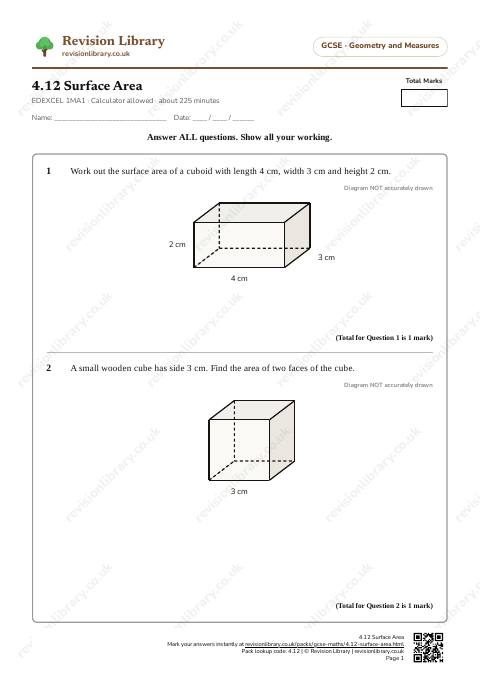
Work out the surface area of a cuboid with length 4 cm, width 3 cm and height 2 cm.
Diagram NOT accurately drawn
(Total for Question 1 is 1 mark)
2
A small wooden cube has side 3 cm. Find the area of two faces of the cube.
Diagram NOT accurately drawn
(Total for Question 2 is 1 mark)
3
A cuboid measures 12 cm by 5 cm by 3 cm. Calculate its surface area.
Diagram NOT accurately drawn
(Total for Question 3 is 2 marks)
4
A cube has side length 4 cm. Work out the total surface area of the cube.
Diagram NOT accurately drawn
(Total for Question 4 is 1 mark)
5
A rectangular prism measures 5 cm by 3 cm by 2 cm. Calculate its total surface area.
Diagram NOT accurately drawn
(Total for Question 5 is 2 marks)
6
The net of a cube is made up of six identical squares. Each square has side 5 cm. Work out the total surface area of the cube.
Diagram NOT accurately drawn
(Total for Question 6 is 1 mark)
7
The diagram shows a cuboid with length 9 cm, width 4 cm and height 3 cm. Work out the total surface area of the cuboid.
Diagram NOT accurately drawn
(Total for Question 7 is 3 marks)
8
Priya makes an open-topped rectangular planter (no lid) with length 120 cm, width 40 cm and height 50 cm. Work out the total surface area of the planter, including the base but not the open top.
Diagram NOT accurately drawn
(Total for Question 8 is 3 marks)
9
A rectangular block measures 1.2 m by 0.8 m by 0.5 m. Calculate its surface area in square metres. Give your answer to 2 decimal places.
(Total for Question 9 is 2 marks)
10
A triangular prism has triangular cross-section with sides 3 cm, 4 cm and 5 cm and length 12 cm. Calculate the total surface area of the prism.
Diagram NOT accurately drawn
(Total for Question 10 is 3 marks)
11
A cuboid has dimensions 8 m by 2 m by 1 m. Work out the total surface area of the cuboid.
Diagram NOT accurately drawn
(Total for Question 11 is 2 marks)
12
A box measures 2 cm by 3 cm by 4 cm. It is scaled up by a linear factor of 2 (all dimensions are multiplied by 2). Work out the total surface area of the larger box.
Diagram NOT accurately drawn
(Total for Question 12 is 2 marks)
13
A closed cylinder has radius 6 cm and height 15 cm. Show that the total surface area of the cylinder is 792 cm², correct to 3 significant figures.
Diagram NOT accurately drawn
(Total for Question 13 is 3 marks)
14
A prism has a trapezium cross-section with parallel sides 4 cm and 12 cm, perpendicular height 3 cm between the parallel sides, and the two sloping sides are each 5 cm. The prism has length 10 cm. Work out the total surface area of the prism.
Diagram NOT accurately drawn
(Total for Question 14 is 4 marks)
15
A garden shed (excluding floor and roof) is a cuboid measuring 3 m long, 2 m wide and 2.4 m high. Dan wants to paint the four external walls only (not the roof or floor). One tin of paint covers 5 m² and costs £12.50. Work out the total cost of the paint Dan needs to buy.
Diagram NOT accurately drawn
(Total for Question 15 is 5 marks)
16
A cube has volume 343 cm³. Work out the total surface area of the cube.
Diagram NOT accurately drawn
(Total for Question 16 is 3 marks)
17
A closed cylinder has radius 5 cm. The total surface area of the cylinder is 534 cm², correct to 3 significant figures. Work out the height of the cylinder.
Diagram NOT accurately drawn
(Total for Question 17 is 4 marks)
18
Cylinder A has total surface area 150 cm². Cylinder B is mathematically similar to Cylinder A, with all linear dimensions 3 times as large. Work out the total surface area of Cylinder B.
Diagram NOT accurately drawn
(Total for Question 18 is 4 marks)
19
A cube has a volume of 216 m³. Work out the total surface area of the cube.
Diagram NOT accurately drawn
(Total for Question 19 is 3 marks)
20
A cuboid has length 14 m, width 7 m and height 5 m. Work out the total surface area of the cuboid.
Diagram NOT accurately drawn
(Total for Question 20 is 3 marks)
21
A closed wooden box is a cuboid 22 cm by 29 cm by 33 cm. All of the outside is painted. One tin of paint covers 1000 cm². Work out the least number of tins of paint needed to paint the box.
Diagram NOT accurately drawn
(Total for Question 21 is 4 marks)
22
An open box has no lid. The base is 17 cm by 9 cm and the box is 4 cm high. Work out the total outside surface area of the box (including the base).
(Total for Question 22 is 3 marks)
23
A cuboid has length 5 cm, width 11 cm and height 2 cm. Work out the total surface area of the cuboid.
Diagram NOT accurately drawn
(Total for Question 23 is 3 marks)
24
A cube has a volume of 1000 cm³. Work out the total surface area of the cube.
Diagram NOT accurately drawn
(Total for Question 24 is 3 marks)
25
An open box has no lid. The base is 17 cm by 6 cm and the box is 4 cm high. Work out the total outside surface area of the box (including the base).
(Total for Question 25 is 3 marks)
26
A cuboid has length 3 m, width 9 m and height 9 m. Work out the total surface area of the cuboid.
Diagram NOT accurately drawn
(Total for Question 26 is 3 marks)
27
A closed wooden box is a cuboid 30 cm by 47 cm by 13 cm. All of the outside is painted. One tin of paint covers 1500 cm². Work out the least number of tins of paint needed to paint the box.
Diagram NOT accurately drawn
(Total for Question 27 is 4 marks)
28
A cube has a volume of 1728 cm³. Work out the total surface area of the cube.
Diagram NOT accurately drawn
(Total for Question 28 is 3 marks)
29
An open box has no lid. The base is 13 cm by 12 cm and the box is 4 cm high. Work out the total outside surface area of the box (including the base).
(Total for Question 29 is 3 marks)
30
A prism has a cross-section that is a right-angled triangle with perpendicular sides 8 cm and 15 cm. The length of the prism is 4 cm. Work out the total surface area of the prism.
Diagram NOT accurately drawn
(Total for Question 30 is 4 marks)
31
A cube has a volume of 1331 cm³. Work out the total surface area of the cube.
Diagram NOT accurately drawn
(Total for Question 31 is 3 marks)
32
A triangular prism has a right-angled triangular cross-section with shorter sides 3 cm and 4 cm and hypotenuse 5 cm. The length of the prism is 10 cm. Work out the total surface area of the prism.
Diagram NOT accurately drawn
(Total for Question 32 is 4 marks)
33
A closed cylinder has radius 4 cm and height 10 cm. Work out the total surface area of the cylinder. Give your answer correct to 3 significant figures.
Diagram NOT accurately drawn
(Total for Question 33 is 3 marks)
34
A cylindrical bucket, open at the top, has radius 15 cm and height 25 cm. Work out the total surface area of the bucket (curved surface and base only). Give your answer correct to 3 significant figures.
Diagram NOT accurately drawn
(Total for Question 34 is 3 marks)
35
A solid is made from two cuboids joined to form an L-shaped prism. The L-shaped cross-section fits inside a 10 cm by 8 cm bounding rectangle, with a 6 cm by 4 cm rectangular corner removed. The prism has a length of 8 cm. Work out the total surface area of the solid.
Diagram NOT accurately drawn
(Total for Question 35 is 5 marks)
36
An isosceles triangular prism has a cross-section with base 6 cm and two equal sides of 5 cm. The prism has length 12 cm.
Diagram NOT accurately drawn
(a)Show that the perpendicular height of the triangular cross-section is 4 cm.(2)
(b)Work out the total surface area of the prism.(3)
(Total for Question 36 is 5 marks)
37
A wooden crate measures 30 cm by 20 cm by 10 cm. The crate is to be painted on all outer faces except the bottom, which measures 30 cm by 20 cm (the crate sits on the ground). Calculate the painted surface area in square centimetres.
(Total for Question 37 is 3 marks)
38
A block measures 600 mm by 200 mm by 100 mm. Calculate its surface area in square metres. Give your answer to 2 decimal places.
(Total for Question 38 is 2 marks)
39
A cuboid of dimensions 8 cm by 4 cm by 4 cm is attached to a cube of side 4 cm so that the 4 cm by 4 cm faces are exactly joined. Work out the surface area of the composite solid.
Diagram NOT accurately drawn
(Total for Question 39 is 3 marks)
40
A rectangular prism has base 6 cm by 4 cm and height h cm. The total surface area is 188 cm². Work out h.
Diagram NOT accurately drawn
(Total for Question 40 is 3 marks)
41
Two identical cubes of side 3 cm are glued together on one face so they form a single solid. Find the total surface area of the combined solid.
Diagram NOT accurately drawn
(Total for Question 41 is 3 marks)
42
A triangular prism has a right-angled triangular cross section with base 3 cm and height 4 cm. The prism is 10 cm long. Calculate the total surface area of the prism (include both triangular ends and the three rectangular faces).
Diagram NOT accurately drawn
(Total for Question 42 is 4 marks)
43
A cube has side length 7 cm. Work out the total surface area of the cube.
Diagram NOT accurately drawn
(Total for Question 43 is 2 marks)
44
A cuboid measures 20 cm by 10 cm by 10 cm. A cylindrical hole of radius 3 cm is drilled completely through the cuboid, from the centre of one 10 cm by 10 cm face to the centre of the opposite 10 cm by 10 cm face. Work out the total surface area of the resulting solid. Give your answer correct to 3 significant figures.
Diagram NOT accurately drawn
(Total for Question 44 is 5 marks)
45
A sphere has radius 9 cm. Work out the total surface area of the sphere. Give your answer correct to 3 significant figures. (You may use the formula S = 4 x π x r2)
Diagram NOT accurately drawn
(Total for Question 45 is 2 marks)
46
A solid hemisphere has radius 6 cm. Work out the total surface area of the hemisphere (curved surface plus the flat circular face). Give your answer correct to 3 significant figures.
Diagram NOT accurately drawn
(Total for Question 46 is 3 marks)
47
A cone has base radius 5 cm and perpendicular height 12 cm.
Diagram NOT accurately drawn
(a)Work out the slant height, l, of the cone.(2)
(b)Work out the total surface area of the cone (curved surface plus base). Give your answer correct to 3 significant figures. (You may use the formula: curved surface area = π x r x l)(3)
(Total for Question 47 is 5 marks)
48
A cuboid has length 10 cm, width w cm and height 3 cm. The surface area of the cuboid is 190 cm². Work out w.
Diagram NOT accurately drawn
(Total for Question 48 is 3 marks)
49
A closed rectangular box has exterior dimensions 12 cm by 8 cm by 5 cm. Calculate the surface area of the box.
(Total for Question 49 is 3 marks)
50
A closed cylinder has radius 3 cm and height 10 cm. Work out the total surface area. Give your answer in terms of π.
Diagram NOT accurately drawn
(Total for Question 50 is 3 marks)
51
A house model is made by placing a triangular prism roof on top of a rectangular cuboid. The cuboid measures 12 cm by 8 cm by 6 cm. The roof is a triangular prism of length 12 cm where each triangular cross-section is isosceles with base 8 cm and height 5 cm. The roof sits centrally on the top of the cuboid so that a full rectangular face of the roof of area 12 cm by 8 cm is attached to the cuboid top. Calculate the total surface area of the complete model. Give your answer to 2 decimal places.
Diagram NOT accurately drawn
(Total for Question 51 is 4 marks)
52
A solid is made by attaching a right circular cone to one circular face of a closed cylinder so that their bases coincide. The cylinder has radius 4 cm and height 9 cm. The cone has the same radius 4 cm and sloping height (l) 5 cm. Calculate the total surface area of the solid (do not include the area of the circle where they join). Give your answer in terms of π.
Diagram NOT accurately drawn
(Total for Question 52 is 4 marks)
53
A triangular prism has triangular cross-section with sides 10 cm, 24 cm and 26 cm and length 14 cm. Calculate the total surface area of the prism.
Diagram NOT accurately drawn
(Total for Question 53 is 3 marks)
54
A closed cylinder has total surface area 154 π cm2 and radius 7 cm. Find its height. Give your answer in cm, correct to 1 decimal place if necessary.
Diagram NOT accurately drawn
(Total for Question 54 is 4 marks)
Mark scheme · 4.12 Surface Area
A correct answer earns full marks unless the question asks for working, a method, proof or explanation.
Question 1
52 cm² caoB1
Answer: 52 cm2
Question 2
18 cm² caoB1
Answer: 18 cm2
Question 3
correct method: 2(lw + lh + wh) or calculation of each pair of faces shownM1
222 cm² caoA1
Answer: 222 cm2
Question 4
96 cm² caoB1
Answer: 96 cm2
Question 5
correct method, e.g. 2(lw + lh + wh) or listing faces 5x3, 5x2, 3x2 and doublingM1
62 cm² caoA1
Answer: 62 cm2
Question 6
150 cm² caoB1
Answer: 150 cm2
Question 7
at least two correct face areas from 36, 27, 12M1
complete method, e.g. 2(36 + 27 + 12)M1
150 cm² caoA1
Answer: 150 cm2
Question 8
base area 120 x 40 (= 4800) seenM1
complete method for the four side faces, e.g. 2(120x50) + 2(40x50) (= 16000)M1
20800 cm² caoA1
Answer: 20800 cm2
Question 9
convert and apply SA = 2(lw + lh + wh) with l=1.2, w=0.8, h=0.5M1
3.92 m² awrt 2 dpA1
Answer: 3.92 m2
Question 10
area of triangle = 1/2 * 3 * 4 = 6 cm² and 2*area = 12 cm²M1
calculate total SA = 2(30*20 + 30*10 + 20*10) = 2200 cm²M1
subtract bottom area 30*20 = 600 cm²M1
painted area = 1600 cm² caoA1
Answer: 1600 cm2
Question 38
convert to metres 0.6, 0.2, 0.1 and apply SA = 2(lw + lh + wh)M1
0.40 m² caoA1
Answer: 0.40 m2
Question 39
calculate SA of cuboid 8x4x4: 2(8*4 + 8*4 + 4*4) = 160 cm² and cube SA 6*42 = 96 cm²M1
subtract the two joined faces (2*16 = 32 cm²) from the sumM1
160 + 96 - 32 = 224 cm² caoA1
Answer: 224 cm2
Question 40
form SA = 2(6*4 + 6h + 4h) = 188 => 48 + 20h = 188 or equivalentM1
solve 20h = 140 (show working)M1
h = 7 cm caoA1
Answer: 7 cm
Question 41
area of one cube = 6*32 = 54, two cubes give 108 or method for counting facesM1
subtract the two faces that become internal (2 * 9 = 18) or recognise shared face removes both facesM1
90 cm² caoA1
Answer: 90 cm2
Question 42
area of one triangle: 1/2 * 3 * 4 = 6 cm² or equivalentM1
rectangular faces areas: 3*10, 4*10 and hypotenuse*10 with hypotenuse 5 (3-4-5 triangle) giving 30, 40 and 50M1
add two triangular ends: 2 * 6 = 12 or include both ends in totalM1
132 cm² caoA1
Answer: 132 cm2
Question 43
method for surface area 6 x side2 or show 6 x 72M1
294 cm² caoA1
Answer: 294 cm2
Question 44
total surface area of the cuboid without the hole, 2(20x10)+2(20x10)+2(10x10) (= 1000)M1
area of the two circles removed, 2 x π x 32 (= 56.5)M1
curved surface area of the hole, 2 x π x 3 x 20 (= 377.0)M1
complete method, 1000 - 56.5 + 377.0M1
awrt 1320 cm²A1
Answer: 1320 cm2 (3 s.f.)
Question 45
4 x π x 92 (= 324pi or 1017.9) seenM1
awrt 1020 cm²A1
Answer: 1020 cm2 (3 s.f.)
Question 46
curved surface area 2 x π x 62 (= 72pi or 226.2) seenM1
flat circular face π x 62 (= 36pi or 113.1) seenM1
awrt 339 cm²A1
Answer: 339 cm2 (3 s.f.)
Question 47
(a) √52 + 122 oeM1
(a) 13 cm caoA1
(a) Answer: 13 cm
(b) π x 5 x 13 (= 65pi or 204.2) seenM1
(b) π x 52 (= 25pi or 78.5) seenM1
(b) awrt 283 cm²A1
(b) Answer: 283 cm2 (3 s.f.)
Question 48
form 2(lw + lh + wh) = 190 or simplify to 13w + 30 = 95 (showing steps)M1
solve 13w = 65 or equivalent algebra shownM1
w = 5 cm caoA1
Answer: 5 cm
Question 49
method: 2(ab + ac + bc) or substitution 2(12*8 + 12*5 + 8*5)M1
arithmetic for the three products summed (96 + 60 + 40 = 196) or equivalentM1
392 cm² caoA1
Answer: 392 cm2
Question 50
method: total area = 2(π r2) + 2(π r h) or substitute π*(2*r2 + 2*r*h)M1
substitute r=3, h=10 to get 2(π*9) + 2(π*3*10) = 18pi + 60piM1
78 π cm2 caoA1
Answer: 78 π cm2
Question 51
calculate SA of cuboid: 2(12*8 + 12*6 + 8*6) = 432 cm²M1
calculate SA of triangular prism: 2*area triangle where area = 1/2*8*5 = 20 => 40 and lateral = perimeter*length where perimeter = 8 + 2*√42+52 => compute lateralM1
subtract the two attached faces (top of cuboid 12*8 and the corresponding rectangular face of roof) from the sum of the two SAsM1
total SA = 529.67 cm² awrt 2 dpA1
Answer: 529.67 cm2
Question 52
identify surfaces: curved surface of cylinder 2 π r hcyl and curved surface of cone π r l, and one circular base of cylinderM1
Put this topic and others into one printable pack.
Open the Pack Builder
Worksheets are written for Revision Library and come with a full mark scheme; a few English packs quote an out-of-copyright text, and name it on the page. Exam board names and specification codes say which qualification a pack suits: we are not affiliated with, endorsed by or approved by any exam board, and no past-paper question is reproduced here. Rights queries: hello@revisionlibrary.co.uk