A cylinder is a 3D solid with two parallel circular ends joined by a curved surface, with its volume and surface area found using the formulas V = π x r2 x h, curved surface area = 2 x π x r x h, and total surface area = 2 x π x r x h + 2 x π x r2 for a closed cylinder. It is a GCSE Geometry and Measures topic that also involves rearranging these formulas to find a missing radius or height.
Identify the radius r and height h of the cylinder from the diagram or question.
For volume, use V = π x r2 x h.
For curved surface area, use 2 x π x r x h; for total surface area, add the two circular ends, 2 x π x r2.
Substitute the values into the formula and use the π button on your calculator for accuracy.
Round only your final answer to the accuracy asked for, such as 3 significant figures.
To find a missing radius or height, rearrange the formula before substituting the known values.
Worked example
A cylinder has radius 6 cm and height 11 cm. Work out the volume of the cylinder, giving your answer correct to 3 significant figures.
Radius = 6 cm, height = 11 cm identified.
Volume = π x 62 x 11 = π x 36 x 11 = 396pi.
396pi = 1244.07... (unrounded).
Final answer: 1240 cm3 (3 s.f.).
Revision Library
revisionlibrary.co.uk
GCSE · Geometry and Measures
4.14 Cylinders
EDEXCEL 1MA1 · Calculator allowed · about 230 minutes
Revision Library formulae reminder, styled on Edexcel 1MA1 formulae-sheet conventions; wording is original.
Volume of a cylinder = pi x r^2 x h
Curved surface area of a cylinder = 2 x pi x r x h
Total surface area of a cylinder = 2 x pi x r x h + 2 x pi x r^2 = 2 x pi x r x (h + r)
The cylinder volume formula follows from prism volume = cross-sectional area x length and circle area = pi x r^2. Derive surface areas from the curved surface and the required circular ends.
1
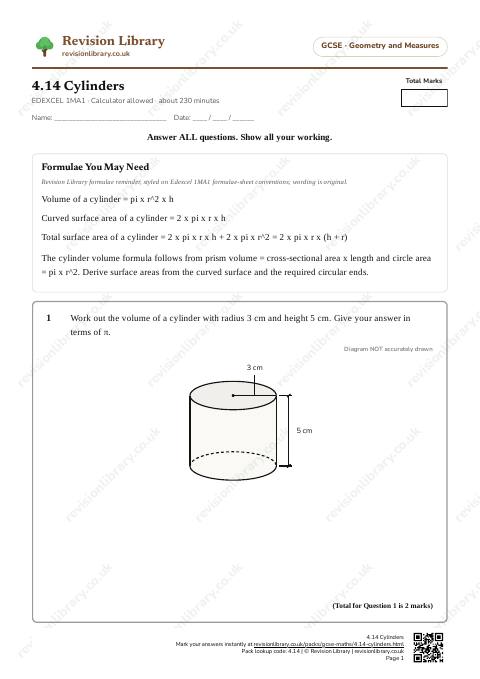
Work out the volume of a cylinder with radius 3 cm and height 5 cm. Give your answer in terms of π.
Diagram NOT accurately drawn
(Total for Question 1 is 2 marks)
2
A cylinder has radius 4 cm and height 10 cm. Work out the curved surface area of the cylinder. Give your answer in terms of π.
Diagram NOT accurately drawn
(Total for Question 2 is 2 marks)
3
Which of these is the correct formula for the volume of a cylinder with radius r and height h?
A) V = 2 x π x r x h
B) V = π x r2 x h
C) V = π x r x h2
D) V = 2 x π x r2 + 2 x π x r x h
(Total for Question 3 is 1 mark)
4
A cylinder has radius 4 cm and height 10 cm. Calculate the volume of the cylinder. Give your answer correct to 3 significant figures.
Diagram NOT accurately drawn
(Total for Question 4 is 2 marks)
5
A cylinder has radius 3 cm and height 12 cm. Calculate the curved surface area of the cylinder. Give your answer in terms of π.
Diagram NOT accurately drawn
(Total for Question 5 is 2 marks)
6
Work out the total surface area of a cylinder with radius 2.5 cm and height 8 cm. Give your answer in terms of π.
Diagram NOT accurately drawn
(Total for Question 6 is 3 marks)
7
A water tank is a cylinder with diameter 1.2 m and height 2 m. Work out the curved surface area of the tank in square metres. Give your answer correct to 3 significant figures.
Diagram NOT accurately drawn
(Total for Question 7 is 2 marks)
8
A cylinder has height 30 cm. The volume of the cylinder is 15000 cm³. Work out the radius of the cylinder. Give your answer correct to 1 decimal place.
Diagram NOT accurately drawn
(Total for Question 8 is 3 marks)
9
A trough is in the shape of a half-cylinder (a cylinder cut in half lengthways). The semicircular cross-section has radius 5 cm and the trough is 20 cm long. Work out the volume of the trough. Give your answer correct to 3 significant figures.
Diagram NOT accurately drawn
(Total for Question 9 is 3 marks)
10
A pipe is a hollow cylinder with outer radius 8 cm and inner radius 6 cm. The pipe is 50 cm long. Work out the volume of material used to make the pipe. Give your answer correct to 3 significant figures.
Diagram NOT accurately drawn
(Total for Question 10 is 4 marks)
11
Steel has a density of 7.8 g/cm3. A solid cylindrical steel rod has radius 2 cm and length 25 cm. Work out the mass of the rod, in kilograms. Give your answer correct to 3 significant figures.
Diagram NOT accurately drawn
(Total for Question 11 is 4 marks)
12
Water is poured from a full cylindrical jug of radius 7 cm and height 18 cm into an empty cylindrical glass of radius 5 cm. All of the water fits into the glass, with none left over. Work out the height of the water in the glass. Give your answer correct to 1 decimal place.
Diagram NOT accurately drawn
(Total for Question 12 is 4 marks)
13
A cylindrical can of soup has radius 3.5 cm and height 11 cm. The label covers the curved surface area only, with no overlap. Card for the label costs 0.8p per cm2. Work out the cost of the label. Give your answer to the nearest penny.
Diagram NOT accurately drawn
(Total for Question 13 is 3 marks)
14
A cylinder has radius 6 cm and volume 576 π cm3. Work out the height of the cylinder.
Diagram NOT accurately drawn
(Total for Question 14 is 3 marks)
15
A cylinder has radius 7 cm and height 9 cm. Work out the volume of the cylinder. Give your answer correct to 3 significant figures.
Diagram NOT accurately drawn
(Total for Question 15 is 3 marks)
16
A metal pipe is a hollow cylinder of length 30 cm. The outer radius is 12 cm and the inner radius is 3 cm. Work out the volume of metal used. Give your answer in terms of π.
Diagram NOT accurately drawn
(Total for Question 16 is 4 marks)
17
A cylinder has radius 4 cm and height 12 cm. Work out the total surface area of the cylinder. Give your answer in terms of π.
Diagram NOT accurately drawn
(Total for Question 17 is 3 marks)
18
A cylinder has radius 6 m and height 12 m. Work out the volume of the cylinder. Give your answer in terms of π.
Diagram NOT accurately drawn
(Total for Question 18 is 2 marks)
19
A cylinder has radius 7 cm and volume 343 π cm3. Work out the height of the cylinder.
Diagram NOT accurately drawn
(Total for Question 19 is 3 marks)
20
A metal pipe is a hollow cylinder of length 15 cm. The outer radius is 9 cm and the inner radius is 3 cm. Work out the volume of metal used. Give your answer in terms of π.
Diagram NOT accurately drawn
(Total for Question 20 is 4 marks)
21
A cylinder has radius 12 cm and height 7 cm. Work out the total surface area of the cylinder. Give your answer in terms of π.
Diagram NOT accurately drawn
(Total for Question 21 is 3 marks)
22
A cylinder has radius 3 cm and height 9 cm. Work out the volume of the cylinder. Give your answer in terms of π.
Diagram NOT accurately drawn
(Total for Question 22 is 2 marks)
23
A metal pipe is a hollow cylinder of length 15 cm. The outer radius is 7 cm and the inner radius is 2 cm. Work out the volume of metal used. Give your answer in terms of π.
Diagram NOT accurately drawn
(Total for Question 23 is 4 marks)
24
A cylindrical candle has diameter 8 cm and height 15 cm. Work out the total surface area of the candle. Give your answer correct to 1 decimal place.
Diagram NOT accurately drawn
(Total for Question 24 is 3 marks)
25
A cylinder has radius 4 cm and height 10 cm. Calculate the volume of the cylinder. Give your answer correct to 3 significant figures.
Diagram NOT accurately drawn
(Total for Question 25 is 2 marks)
26
A cylindrical candle has radius 3.5 cm and height 9 cm. Calculate the volume of wax needed to make the candle. Give your answer correct to 3 significant figures.
Diagram NOT accurately drawn
(Total for Question 26 is 2 marks)
27
A cylinder has diameter 10 cm and height 6 cm. Calculate the volume of the cylinder. Give your answer correct to 3 significant figures.
Diagram NOT accurately drawn
(Total for Question 27 is 2 marks)
28
A cylinder has height 10 cm and volume 1256 cm³. Work out the radius of the cylinder. Give your answer to 1 decimal place.
Diagram NOT accurately drawn
(Total for Question 28 is 3 marks)
29
A cylinder has diameter 10 cm. The total surface area of the cylinder is 314 cm². Work out the height of the cylinder.
Diagram NOT accurately drawn
(Total for Question 29 is 3 marks)
30
Work out the volume of a cylinder with radius 7 cm and height 10 cm. Give your answer in terms of π.
Diagram NOT accurately drawn
(Total for Question 30 is 2 marks)
31
A cylindrical water tank has radius 50 cm and height 1.4 m. The tank starts empty and is filled with water at a rate of 15000 cm³ per minute. Work out how long it takes to fill the tank completely. Give your answer in minutes, correct to the nearest minute.
Diagram NOT accurately drawn
(Total for Question 31 is 4 marks)
32
A cylindrical drum has diameter 1.4 m and height 2 m. Only the curved surface of the drum is to be painted. 1 litre of paint covers 6 m². Paint is sold only in 1 litre tins costing £12.50 each. Work out the total cost of the paint needed to paint the drum.
Diagram NOT accurately drawn
(Total for Question 32 is 4 marks)
33
A cylinder has radius 3 x √2 cm and height 5 cm. Calculate the exact volume of the cylinder. Give your answer in terms of π.
Diagram NOT accurately drawn
(Total for Question 33 is 3 marks)
34
A cylinder has radius 6 cm and height 14 cm. Calculate the total surface area of the cylinder. Give your answer correct to 3 significant figures.
Diagram NOT accurately drawn
(Total for Question 34 is 3 marks)
35
A cylinder has radius 3 cm and height 8 cm. Calculate the curved surface area of the cylinder. Give your answer correct to 3 significant figures.
Diagram NOT accurately drawn
(Total for Question 35 is 2 marks)
36
A cylinder has radius 2 cm and height 5 cm. Calculate the total surface area of the cylinder (the curved surface plus the two circular ends). Give your answer correct to 3 significant figures.
Diagram NOT accurately drawn
(Total for Question 36 is 3 marks)
37
A cylindrical tin has radius 5 cm and height 15 cm. Work out the volume of the tin. Give your answer in litres, correct to 3 significant figures (1000 cm³ = 1 litre).
Diagram NOT accurately drawn
(Total for Question 37 is 3 marks)
38
A hollow tube has outer radius 5 cm, inner radius 3 cm and height 10 cm. Work out the total curved surface area (sum of the inner and outer curved surfaces) of the tube. Give your answer in terms of π.
Diagram NOT accurately drawn
(Total for Question 38 is 3 marks)
39
Calculate the total surface area of a closed cylinder with radius 5 cm and height 12 cm. Give your answer in terms of π.
Diagram NOT accurately drawn
(Total for Question 39 is 3 marks)
40
A metal rod is made by drilling a cylindrical hole through the centre of a solid cylinder. The original cylinder has radius 8 cm and height 15 cm. The hole is a cylinder of radius 3 cm drilled along the full height. Work out the volume of metal remaining, giving your answer in terms of π.
Diagram NOT accurately drawn
(Total for Question 40 is 3 marks)
41
A composite solid is made from a cylinder of radius 4 cm and height 10 cm, with a cone of the same radius and height 6 cm attached on top. The volume of a cone = (1/3) x π x r2 x h. Work out the total volume of the solid. Give your answer correct to 3 significant figures.
Diagram NOT accurately drawn
(Total for Question 41 is 4 marks)
42
A cylinder has volume 2000 cm³ and height 25 cm. Work out the diameter of the cylinder. Give your answer correct to 3 significant figures.
Diagram NOT accurately drawn
(Total for Question 42 is 3 marks)
43
A cylinder has volume 500 cm³ and radius 4 cm. Rearrange V = π x r2 x h to make h the subject, then work out the height of the cylinder. Give your answer correct to 3 significant figures.
Diagram NOT accurately drawn
(Total for Question 43 is 3 marks)
44
A cylinder has volume 942 cm³ (to the nearest whole number) and height 12 cm. Rearrange V = π x r2 x h to make r the subject, then work out the radius of the cylinder. Give your answer correct to 1 decimal place.
Diagram NOT accurately drawn
(Total for Question 44 is 3 marks)
45
A cylinder has curved surface area 220 cm² and radius 5 cm. Rearrange CSA = 2 x π x r x h to make h the subject, then work out the height of the cylinder. Give your answer correct to 3 significant figures.
Diagram NOT accurately drawn
(Total for Question 45 is 3 marks)
46
A cylinder has height 20 cm and volume 8000 π cm3. Work out the radius of the cylinder.
Diagram NOT accurately drawn
(Total for Question 46 is 3 marks)
47
A cylindrical column has radius 0.4 m and height 2.5 m. Only the curved surface is to be painted. One litre of paint covers 6 m². Calculate how many litres of paint are needed. Give your answer to the nearest whole litre.
Diagram NOT accurately drawn
(Total for Question 47 is 3 marks)
48
A cylinder has total surface area 300 cm² and radius 4 cm. Work out the height of the cylinder. Give your answer correct to 3 significant figures.
Diagram NOT accurately drawn
(Total for Question 48 is 3 marks)
49
Cylinder A has radius 4 cm and height 9 cm. Cylinder B has radius 6 cm and height x cm. Cylinder A and Cylinder B have the same volume. Work out the value of x.
Diagram NOT accurately drawn
(Total for Question 49 is 3 marks)
50
Priya, a silversmith, melts down a solid cylindrical silver bar of radius 2 cm and height 9 cm. She recasts all of the silver into 6 identical smaller solid cylinders, each of radius 1 cm. Work out the height of each smaller cylinder.
Diagram NOT accurately drawn
(Total for Question 50 is 4 marks)
51
Leon needs to paint 10 identical cylindrical oil drums for use as planters. Each drum has radius 0.5 m and height 1.2 m, and needs painting all over (the curved surface and both circular ends). One tin of paint covers 4 m² and costs £6.50. Tins cannot be shared between jobs, so Leon must buy whole tins. Work out the total cost of the paint Leon needs to buy.
Diagram NOT accurately drawn
(Total for Question 51 is 5 marks)
52
Mr Jankowski is filling a cylindrical paddling pool in his garden. The pool has diameter 6 m and he fills it to a depth of 1.4 m. Water flows from his hose at a rate of 500 litres per minute. Work out how long it will take to fill the pool to this depth, giving your answer to the nearest minute.
Diagram NOT accurately drawn
(Total for Question 52 is 5 marks)
53
Declan's cylindrical water butt has radius 25 cm and currently holds water to a depth of 40 cm. He uses a cylindrical bucket of radius 10 cm and height 30 cm to empty the butt, filling the bucket completely each time. Work out the greatest number of full buckets Declan can fill, and work out how much water (in litres, to 3 significant figures) is left in the butt afterwards.
Diagram NOT accurately drawn
(Total for Question 53 is 5 marks)
54
A cylinder has radius r cm and height h cm, where r and h are both greater than zero. The curved surface area of the cylinder, in cm2, is numerically equal to the volume of the cylinder, in cm3. Show that r = 2, whatever the value of h.
Diagram NOT accurately drawn
(Total for Question 54 is 4 marks)
55
Two similar cylinders, cylinder P and cylinder Q, have volumes in the ratio 8:27 (P smaller, Q larger). The curved surface area of cylinder P is 40pi cm2. Work out the curved surface area of cylinder Q.
Diagram NOT accurately drawn
(Total for Question 55 is 4 marks)
Mark scheme · 4.14 Cylinders
Question 1
use V = π * r2 * h and substitute r = 3, h = 5M1
45pi cm3 caoA1
Answer: 45pi cm3
Question 2
use curved surface area = 2 * π * r * h and substitute r = 4, h = 10M1
80pi cm2 caoA1
Answer: 80pi cm2
Question 3
B caoB1
Answer: B
Question 4
π x 42 x 10 oe (= 160pi)M1
awrt 503 (units cm3)A1
Answer: 503 cm3 (3 s.f.)
Question 5
2 x π x 3 x 12 oeM1
72pi cao (units cm2)A1
Answer: 72pi cm2
Question 6
use total surface area = 2 * π * r * (r + h)M1
substitute r = 2.5, h = 8 to get 2 * π * 2.5 * 10.5 = 52.5piM1
52.5pi cm2 caoA1
Answer: 52.5pi cm2
Question 7
use curved surface area = 2 * π * r * h with r = 0.6, h = 2 so CSA = 2 * π * 0.6 * 2 = 2.4piM1
7.54 m² awrt (2.4pi = 7.5398... so 7.54 to 3 s.f.)A1
Answer: 7.54 m2
Question 8
r2 = V / (π x h) oe rearrangementM1
15000 / (π x 30) oe substitution, then square rootM1
awrt 12.6 (units cm)A1
Answer: 12.6 cm (1 d.p.)
Question 9
area of semicircle = 0.5 x π x 52 oeM1
their area x 20 (length) oeM1
awrt 785 (units cm3)A1
Answer: 785 cm3 (3 s.f.)
Question 10
82 - 62 (= 28), area of cross-section of the material oeM1
π x 28 oe (= 28pi)M1
their area x 50 oe (= 1400pi)M1
awrt 4400 (units cm3)A1
Answer: 4400 cm3 (3 s.f.)
Question 11
volume = π x 22 x 25 oe (= 100pi)M1
mass = 7.8 x their volume oeM1
convert grams to kilograms (divide by 1000)M1
awrt 2.45 (units kg)A1
Answer: 2.45 kg (3 s.f.)
Question 12
volume of jug = π x 72 x 18 oe (= 882pi)M1
h = volume / (π x 52) oe rearrangementM1
882pi / (π x 25) oe substitutionM1
awrt 35.3 (units cm)A1
Answer: 35.3 cm (1 d.p.)
Question 13
CSA = 2 x π x 3.5 x 11 oe (= 77pi)M1
cost = their CSA x 0.8 oeM1
awrt 194p (or £1.94), correctly rounded to the nearest pennyA1
Answer: 194p (£1.94)
Question 14
π x 62 x h = 576 πM1
576 / 36M1
16 cmA1
Answer: 16 cm
Question 15
π x 72M1
x 9M1
1390 cm³A1
Answer: 1390 cm3
Question 16
outer volume π x 122 x 30M1
inner volume π x 32 x 30M1
subtractsM1
4050 π cm3A1
Answer: 4050 π cm3
Question 17
curved surface 2 x π x 4 x 12 = 96 πM1
two circular ends 2 x π x 42 = 32 πM1
128 π cm2A1
Answer: 128 π cm2
Question 18
π x 62 x 12M1
432 π m3A1
Answer: 432 π m3
Question 19
π x 72 x h = 343 πM1
343 / 49M1
7 cmA1
Answer: 7 cm
Question 20
outer volume π x 92 x 15M1
inner volume π x 32 x 15M1
subtractsM1
1080 π cm3A1
Answer: 1080 π cm3
Question 21
curved surface 2 x π x 12 x 7 = 168 πM1
two circular ends 2 x π x 122 = 288 πM1
456 π cm2A1
Answer: 456 π cm2
Question 22
π x 32 x 9M1
81 π cm3A1
Answer: 81 π cm3
Question 23
outer volume π x 72 x 15M1
inner volume π x 22 x 15M1
subtractsM1
675 π cm3A1
Answer: 675 π cm3
Question 24
radius 4 identified, curved surface area 2 x π x 4 x 15 (= 120pi) oeM1
+ 2 x π x 42 (= 32pi) for the two circular ends oeM1
awrt 477.5 (units cm2)A1
Answer: 477.5 cm2 (1 d.p.)
Question 25
correct substitution into V = π x r2 x h, e.g. π x 42 x 10 (oe)M1
awrt 503 cm³ (cao)A1
Answer: 503 cm3 (3 s.f.)
Question 26
correct substitution into V = π x r2 x h, e.g. π x 3.52 x 9 (oe)M1
awrt 346 cm³ (cao)A1
Answer: 346 cm3 (3 s.f.)
Question 27
radius = 5 identified and correct substitution into V = π x r2 x h, e.g. π x 52 x 6 (oe)M1
awrt 471 cm³ (cao)A1
Answer: 471 cm3 (3 s.f.)
Question 28
use V = π * r2 * h so r2 = V / (π * h) and substitute V = 1256, h = 10M1
Put this topic and others into one printable pack.
Open the Pack Builder
Worksheets are written for Revision Library and come with a full mark scheme; a few English packs quote an out-of-copyright text, and name it on the page. Exam board names and specification codes say which qualification a pack suits: we are not affiliated with, endorsed by or approved by any exam board, and no past-paper question is reproduced here. Rights queries: hello@revisionlibrary.co.uk