Probability at GCSE is measured on a scale from 0 (impossible) to 1 (certain), as a fraction, decimal or percentage, showing how likely an event is to happen. This GCSE Probability topic covers single and combined events using sample space diagrams, tree diagrams, two-way tables and Venn diagrams, since all probabilities in a situation must add up to 1.
Identify all the possible outcomes and check whether they are equally likely.
For a single event, probability = number of favourable outcomes divided by total number of outcomes.
Remember all probabilities for a set of mutually exclusive, exhaustive outcomes must add up to 1, so a missing probability can be found by subtracting the others from 1.
For combined events, use a sample space diagram, two-way table, tree diagram or Venn diagram to organise the outcomes systematically.
For independent events, multiply the probabilities along the branches of a tree diagram; for 'at least one', use 1 minus the probability of neither happening.
Check your final probability is between 0 and 1.
Worked example
A bag contains only red, blue and yellow counters. A counter is picked at random. P(red) = 0.3 and P(blue) = 0.45. There are 60 counters in the bag. Work out the number of yellow counters.
All probabilities must add up to 1, so P(yellow) = 1 - 0.3 - 0.45.
P(yellow) = 0.25.
Number of yellow counters = 0.25 x 60.
Final answer: 15 yellow counters.
Revision Library
revisionlibrary.co.uk
GCSE · Statistics and Probability
4.19 Probability (Higher)
EDEXCEL 1MA1 · Calculator allowed · about 275 minutes
A fair six-sided die is rolled once. What is the probability of rolling an odd number?
(Total for Question 1 is 1 mark)
2
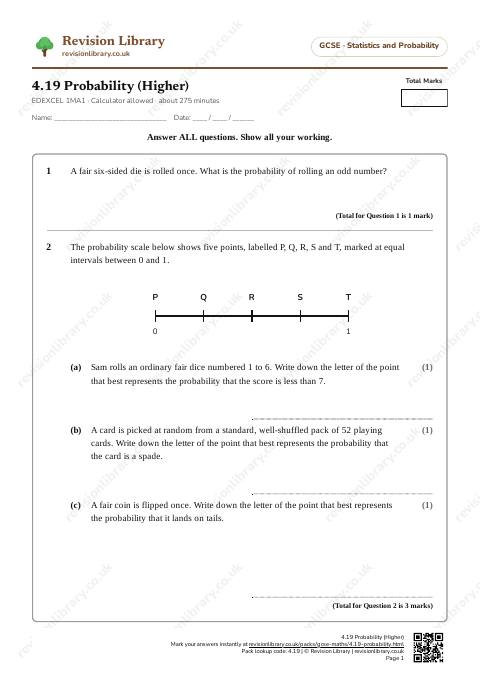
The probability scale below shows five points, labelled P, Q, R, S and T, marked at equal intervals between 0 and 1.
(a)Sam rolls an ordinary fair dice numbered 1 to 6. Write down the letter of the point that best represents the probability that the score is less than 7.(1)
(b)A card is picked at random from a standard, well-shuffled pack of 52 playing cards. Write down the letter of the point that best represents the probability that the card is a spade.(1)
(c)A fair coin is flipped once. Write down the letter of the point that best represents the probability that it lands on tails.(1)
(Total for Question 2 is 3 marks)
3
A bag contains 5 red counters and 3 blue counters. A counter is taken at random. Work out the probability the counter is blue.
(Total for Question 3 is 2 marks)
4
This question is about basic probability.
(a)An event is described as 'unlikely'. Which of these values could be the probability of this event?(1)
A) 0
B) 0.15
C) 0.6
D) 0.95
(b)A fair six-sided dice, with faces numbered 1 to 6, is rolled once. Write down the probability that the score is a multiple of 3.(1)
(c)Write down the probability that the score is not a multiple of 3.(1)
(Total for Question 4 is 3 marks)
5
A bag contains only red, blue and green counters. A counter is taken from the bag at random. P(red) = 0.25 and P(blue) = 0.45.
(a)Work out P(green).(2)
(b)There are 40 counters in the bag. Work out the number of green counters.(2)
(Total for Question 5 is 4 marks)
6
P(Idris wins a prize in the tombola) = 2/9. Write down the probability that Idris does not win a prize.
(Total for Question 6 is 1 mark)
7
A fair spinner is equally likely to land on each of the numbers 1, 2, 3, 4 and 5. Write down the probability that it lands on an odd number.
(Total for Question 7 is 1 mark)
8
The probability that a particular bus arrives on time is 0.71. Write down the probability that the bus does not arrive on time.
(Total for Question 8 is 1 mark)
9
Chloe has a bag containing only 6 lime sweets, 5 blackcurrant sweets and 9 orange sweets. She takes one sweet from the bag at random. Work out the probability that the sweet is lime or blackcurrant. Give your answer as a fraction in its simplest form.
(Total for Question 9 is 2 marks)
10
A coin is flipped twice. List all possible outcomes using H for heads and T for tails, and then write down the probability of getting exactly one head.
(a)List all possible outcomes.(1)
(b)Work out the probability of exactly one head.(2)
(Total for Question 10 is 3 marks)
11
A jar contains 3 strawberry sweets, 2 mint sweets and 5 lemon sweets. One sweet is taken at random. Work out the probability the sweet is strawberry or lemon.
(Total for Question 11 is 4 marks)
12
Two coins are different: one is a 1p coin and one is a 2p coin. Both are fair. They are flipped once. Find the probability that the total value of coins that land heads is 3p.
(Total for Question 12 is 3 marks)
13
The probability that Tom passes his maths test is 0.7. The probability that he passes his science test is 0.8. The two events are independent.
(a)Work out the probability that Tom passes both tests.(2)
(b)Work out the probability that Tom fails both tests.(2)
(Total for Question 13 is 4 marks)
14
Priya rolls an ordinary six-sided dice 150 times. It lands on a six 40 times.
(a)Calculate the experimental probability of getting a six.(1)
(b)Priya says, 'this shows the dice is definitely biased.' Comment on whether Priya is correct.(2)
(Total for Question 14 is 3 marks)
15
The Venn diagram shows information about 50 members of a leisure centre. G = members who use the gym. S = members who swim. Only gym = 22, only swim = 14, both gym and swim = 9, neither = 5.
(a)Write down n(G and S), the number of members in both G and S.(1)
(b)Write down P(G or S), the probability a member is in G or S (or both).(1)
(c)Write down P(G').(2)
(Total for Question 15 is 4 marks)
16
A spinner can land on red, blue, green or yellow. The table shows the probability of each colour in terms of x.
Colour
Red
Blue
Green
Yellow
Probability
2x
3x
x
4x
(a)Work out the value of x.(2)
(b)Work out P(blue).(1)
(c)The spinner is spun 300 times. Work out the expected number of times it lands on green.(2)
(Total for Question 16 is 5 marks)
17
Two fair, six-sided dice are rolled and the scores are added together.
(a)Show that there are 6 ways of getting a total of 7.(2)
(b)Find the probability that the total is at least 10.(2)
(Total for Question 17 is 4 marks)
18
The two-way table shows how 100 people travel to work.
(a)Write down the number of part-time workers who walk to work.(1)
(b)A person is picked at random from the 100 people. Find the probability that the person is full-time and travels by car.(2)
(c)Given that the person picked works full-time, find the probability that they travel by bus.(2)
(Total for Question 18 is 5 marks)
19
In a group of 90 students, P(studies Art) = 0.4, P(studies Music) = 0.3, and P(studies both Art and Music) = 0.1.
(a)Work out P(Art or Music).(2)
(b)Work out the number of students who study neither Art nor Music.(2)
(Total for Question 19 is 4 marks)
20
60 students were asked whether football or tennis is their favourite sport. The incomplete two-way table shows some of the results.
Football
Tennis
Total
Boys
18
16
34
Girls
20
?
26
Total
?
22
60
(a)Complete the two-way table.(2)
(b)One student is picked at random from all 60 students. Find the probability that the student is a girl who prefers football.(2)
(Total for Question 20 is 4 marks)
21
80 adults were asked whether they own a car and whether they own a bike. 45 of the adults own a car. Of the adults who own a car, 18 also own a bike. Of the adults who do not own a car, 21 own a bike.
(a)Complete the frequency tree to show this information.(3)
(b)Work out the probability that a randomly selected adult owns a bike.(2)
(Total for Question 21 is 5 marks)
22
In a class of 30 students, 14 study French, 16 study Spanish and 5 study both French and Spanish. Every student studies French, Spanish, both, or neither.
(a)Work out the number of students who study only French.(1)
(b)Work out the number of students who study neither French nor Spanish.(2)
(c)A student is picked at random from the class. Find the probability that the student studies both French and Spanish. Give your answer as a fraction in its simplest form.(2)
(Total for Question 22 is 5 marks)
23
100 students in Year 10 were asked whether they walk or take the bus to school. The incomplete two-way table shows some of the results.
(a)Complete the two-way table.(2)
(b)One student is picked at random from all 100 students. Find the probability that the student is a boy who takes the bus.(2)
(c)Given that the student picked walks to school, find the probability that the student is a girl.(2)
(Total for Question 23 is 6 marks)
24
The Venn diagram shows information about 60 members of a drama club. S = members who can sing. D = members who can dance. Only sing = 18, only dance = 12, both sing and dance = 15, neither = 15.
(a)Write down n(S and D).(1)
(b)Write down the number of members who can dance.(1)
(c)A member is picked at random. Find P(S or D)'.(2)
(d)Write down P(D and S').(2)
(Total for Question 24 is 6 marks)
25
A biased spinner has P(lands on blue) = 0.3. The spinner is spun twice. Find the probability that it lands on blue both times.
(Total for Question 25 is 2 marks)
26
A fair four-sided dice, with faces numbered 1 to 4, is rolled twice. The two scores are multiplied together. Find the probability that the product is 4.
(Total for Question 26 is 2 marks)
27
A fair spinner can land on amber, teal or violet. The table shows two of the probabilities.
Colour
Amber
Teal
Violet
Probability
0.28
y
0.39
Work out the value of y.
(Total for Question 27 is 2 marks)
28
Jakub spins a spinner 80 times. It lands on green 24 times.
(a)Calculate the relative frequency of green.(1)
(b)Jakub is going to spin the spinner a further 220 times. Estimate how many more times it will land on green.(2)
(Total for Question 28 is 3 marks)
29
Spinner X can land on red or green. Spinner Y can land on 1, 2 or 3. Both spinners are spun once. List all the possible outcomes.
(Total for Question 29 is 2 marks)
30
A fair coin is flipped once and, at the same time, a fair four-sided spinner numbered 1 to 4 is spun once. Find the probability of getting a head and a number greater than 2.
(Total for Question 30 is 2 marks)
31
At Freya's market stall, every customer chooses tea, coffee or water. These are the only three drinks available and each customer chooses exactly one. P(tea) = 0.34 and P(coffee) = 0.41.
(a)Work out P(water).(2)
(b)Work out P(tea or water).(1)
(Total for Question 31 is 3 marks)
32
A bag contains 6 red counters and 4 blue counters. Two counters are drawn at random without replacement. Work out the probability that both counters are red.
(Total for Question 32 is 5 marks)
33
A bag contains counters labelled 1, 2, 3 and 4. A counter is chosen at random and then replaced. Two independent draws are made. Work out the probability that the first draw is 3 and the second draw is less than 3.
(Total for Question 33 is 4 marks)
34
A fair spinner has three equal regions labelled A, B and C. Jamie spins the spinner twice. Work out the probability Jamie gets A both times.
(a)Work out the probability of getting A on one spin.(1)
(b)Work out the probability Jamie gets A on both spins. Show your method.(4)
(Total for Question 34 is 5 marks)
35
A single fair six-sided die is rolled once. Work out the probability that the result is an even number greater than 2.
(Total for Question 35 is 2 marks)
36
A box contains 5 red pens and 3 blue pens. Nadia takes a pen at random from the box and does not replace it. She then takes a second pen at random from the box.
(a)Complete the tree diagram to show the probabilities for both pens.(3)
(b)Work out the probability that Nadia takes two red pens.(2)
(c)Work out the probability that Nadia takes at least one blue pen.(3)
(Total for Question 36 is 8 marks)
37
A fair dice is numbered 1 to 20. It is rolled once. Find the probability that the number is a multiple of 5 or a multiple of 8.
(Total for Question 37 is 2 marks)
38
Meera has a biased spinner with P(lands on red) = 0.65 and P(lands on blue) = 0.35. She spins the spinner twice.
(a)Complete the tree diagram to show the probabilities for both spins.(2)
(b)Work out the probability that the spinner lands on the same colour both times.(3)
(Total for Question 38 is 5 marks)
39
A spinner is divided into three unequal regions. The probabilities of landing on X, Y and Z are 1/6, 1/3 and 1/2 respectively. The spinner is spun twice. Work out the probability that at least one spin lands on Z.
(Total for Question 39 is 5 marks)
40
A bag contains 4 green, 3 purple and 3 orange counters. Two counters are drawn at random without replacement. Work out the probability that the two counters are different colours.
(Total for Question 40 is 5 marks)
41
A bag contains 3 red counters, 5 blue counters and 2 green counters. Two counters are drawn at random without replacement. Work out the probability that both counters are blue. Give your answer as a fraction in simplest form.
(Total for Question 41 is 3 marks)
42
A fair coin is tossed 3 times. Work out the probability of getting exactly two heads. Show your method.
(Total for Question 42 is 5 marks)
43
The probability that Elena is late for school on any given day is 0.15. Assume this probability is the same and independent each day. Elena has school on each of the next 3 days. Work out the probability that she is late on at least one of these 3 days.
(Total for Question 43 is 3 marks)
44
A box contains 9 chocolates: 4 dark and 5 milk. Ben takes a chocolate at random from the box and eats it. He then takes a second chocolate at random from the box and eats it.
(a)Complete the tree diagram to show the probabilities for both chocolates.(3)
(b)Work out the probability that both chocolates are dark.(2)
(c)Work out the probability that exactly one of the two chocolates is dark.(3)
(Total for Question 44 is 8 marks)
45
A holiday company surveyed 120 travellers. 70 of the travellers were adults and the rest were children. 45 of the adults travelled by plane and the rest of the adults travelled by coach. Of the children, 28 travelled by coach and the rest travelled by plane.
(a)Use this information to draw and complete a two-way table showing adults and children against plane and coach.(4)
(b)One traveller is picked at random from all 120 travellers. Find the probability that the traveller is a child who travelled by plane.(2)
(Total for Question 45 is 6 marks)
46
A fair five-sided spinner is numbered 1, 2, 3, 4, 5. It is spun twice and the two scores are added together. Sara says, 'The probability of getting a total of 6 is the same as the probability of getting a total of 10.' Determine whether Sara is correct. You must show your working.
(Total for Question 46 is 4 marks)
47
A bag contains counters numbered 1 to 5. A counter is chosen at random. Find the probability that the number is a prime number or an even number. State clearly any numbers counted twice and show how you avoid double counting.
(Total for Question 47 is 6 marks)
48
A box contains 4 white balls and 6 black balls. Two balls are selected at random with replacement. Let X be the number of white balls selected.
(a)State the probability distribution for X (X can be 0, 1 or 2).(3)
(b)Find E(X), the expected number of white balls in the two draws.(3)
(Total for Question 48 is 6 marks)
49
In a survey of 100 office workers, some cycle to work (C) and some drive to work (D). The number who only cycle is 2x, the number who both cycle and drive is x, the number who only drive is 3x, and the number who do neither is 16.
(a)Form and solve an equation to find the value of x.(3)
(b)A worker is picked at random. Find the probability that the worker cycles to work (whether or not they also drive).(3)
(Total for Question 49 is 6 marks)
50
A bag contains 20 counters that are only red or yellow. Two red counters are removed from the bag and not replaced. There are now twice as many yellow counters as red counters left in the bag. Work out how many red counters were in the bag originally.
(Total for Question 50 is 4 marks)
51
A game gives a prize according to the following rule. A bag contains tokens labelled with values £1, £2 and £5. The probabilities of drawing each are proportional to 1, 2 and 1 respectively. A player draws one token at random and receives that amount. The player may then choose to redraw once: if they redraw they must accept the second token.
(a)Find the probability of drawing each value on a single draw.(2)
(b)Determine the expected winning with the strategy: keep first draw only if it is at least £2; otherwise redraw. Show working and give expected value to nearest pence.(5)
(c)Is this strategy better than always keeping the first draw? Justify with a comparison.(3)
(Total for Question 51 is 10 marks)
52
The probability that a biased coin lands on heads is p. The coin is flipped twice. The probability of getting two heads is 1/2 more than the probability of getting two tails.
(a)Form an equation in p, and simplify it using the difference of two squares.(2)
(b)Solve your equation to find the value of p.(2)
(Total for Question 52 is 4 marks)
Mark scheme · 4.19 Probability (Higher)
Question 1
3/6 or 1/2 caoB1
Answer: 1/2 (or 0.5 or 50%)
Question 2
(a) T caoB1
(a) Answer: T
(b) Q caoB1
(b) Answer: Q
(c) R caoB1
(c) Answer: R
Question 3
correct fraction method 3/(5+3) oeM1
3/8 caoA1
Answer: 3/8
Question 4
(a) B (0.15) selectedB1
(a) Answer: B) 0.15
(b) 1/3 oe (accept 2/6, 0.333, 33.3%)B1
(b) Answer: 1/3
(c) 2/3 oe, ft: 1 - (b)B1
(c) Answer: 2/3
Question 5
(a) 1 - 0.25 - 0.45 oeM1
(a) 0.3 caoA1
(a) Answer: 0.3
(b) 0.3 x 40 oe, ft their (a)M1
(b) 12 caoA1
(b) Answer: 12
Question 6
7/9 oeB1
Answer: 7/9
Question 7
3/5 oe (accept 0.6, 60%)B1
Answer: 3/5
Question 8
0.29 oeB1
Answer: 0.29
Question 9
(6+5)/20 oeM1
11/20 caoA1
Answer: 11/20
Question 10
(a) list: HH, HT, TH, TT (in any order) oeB1
(a) Answer: HH, HT, TH, TT
(b) 2 favourable outcomes (HT, TH) shown out of 4M1
(b) 1/2 caoA1
(b) Answer: 1/2
Question 11
identify favourable outcomes 3+5 and total 3+2+5 = 10M1
state the fraction 8/10 oeM1
show method to simplify 8/10 to 4/5M1
4/5 caoA1
Answer: 4/5
Question 12
list of all four equally likely outcomes for heads/tails on the two coins, e.g. (1p H,2p H), (1p H,2p T), (1p T,2p H), (1p T,2p T) or equivalentM1
identify favourable outcome(s): both coins heads gives total 3pM1
1/4 caoA1
Answer: 1/4
Question 13
(a) 0.7 x 0.8M1
(a) 0.56 caoA1
(a) Answer: 0.56
(b) 0.3 x 0.2M1
(b) 0.06 caoA1
(b) Answer: 0.06
Question 14
(a) 4/15 oe (accept awrt 0.27, 26.7%)B1
(a) Answer: 4/15
(b) states or uses the theoretical probability 1/6 (awrt 0.167) for comparisonC1
(b) valid conclusion with reason, e.g. 'No - the experimental probability is higher than 1/6, but 150 trials may not be enough to be certain the dice is biased' oeC1
(b) Answer: No, not definitely - more trials would be needed to be sure
Question 15
(a) 9 caoB1
(a) Answer: 9
(b) 9/10 oe (accept 45/50)B1
(b) Answer: 9/10
(c) 14 + 5 oe (= 19, not in G)M1
(c) 19/50 caoA1
(c) Answer: 19/50
Question 16
(a) 2x + 3x + x + 4x = 1 oeM1
(a) x = 0.1 caoA1
(a) Answer: x = 0.1
(b) 0.3 cao, ft their xB1
(b) Answer: 0.3
(c) 0.1 x 300 oe, ft their xM1
(c) 30 caoA1
(c) Answer: 30
Question 17
(a) at least 4 correct pairs listed, e.g. (1,6), (2,5), (3,4), (4,3)M1
(a) all six pairs listed with no repeats: (1,6), (2,5), (3,4), (4,3), (5,2), (6,1) csoA1
identifies the 2 successful outcomes (H,3) and (H,4) out of 8 equally likely outcomesM1
1/4 oe caoA1
Answer: 1/4
Question 31
(a) 1 - 0.34 - 0.41 oeM1
(a) 0.25 caoA1
(a) Answer: 0.25
(b) 0.59 oe, ft: 0.34 + their (a)B1
(b) Answer: 0.59
Question 32
P(first red) = 6/10 statedM1
P(second red after first red) = 5/9 statedM1
multiply probabilities: (6/10) x (5/9) shownM1
simplify product 30/90 shownM1
1/3 caoA1
Answer: 1/3
Question 33
P(first = 3) = 1/4 identifiedM1
P(second < 3) = 2/4 identifiedM1
multiply probabilities for independent events: (1/4) x (2/4) = 2/16 shownM1
1/8 caoA1
Answer: 1/8
Question 34
(a) 1/3 caoB1
(a) Answer: 1/3
(b) state independence and multiply: (1/3) x (1/3) oeM1
(b) multiply to give 1/9M1
(b) show product as fraction 1/9 oeM1
(b) 1/9 caoA1
(b) Answer: 1/9
Question 35
identify favourable outcomes 4 and 6 or method showing count 2/6M1
1/3 caoA1
Answer: 1/3
Question 36
(a) first branches 5/8 and 3/8B1
(a) second branches after Red: 4/7 and 3/7B1
(a) second branches after Blue: 5/7 and 2/7B1
(a) Answer: First: 5/8, 3/8. After Red: 4/7, 3/7. After Blue: 5/7, 2/7.
(b) 5/8 x 4/7M1
(b) 5/14 cao (oe 20/56)A1
(b) Answer: 5/14
(c) recognises P(at least one blue) = 1 - P(both red)M1
(c) 1 - their (b) correctly using a common denominatordM1
(c) 9/14 cao ftA1
(c) Answer: 9/14
Question 37
identifies 4 multiples of 5 (5, 10, 15, 20) and 2 multiples of 8 (8, 16), with no overlap between themM1
3/10 oe caoA1
Answer: 3/10
Question 38
(a) second-level branches after red: 0.65 and 0.35B1
(a) second-level branches after blue: 0.65 and 0.35B1
(a) Answer: 0.65 and 0.35 in each missing space
(b) 0.65 x 0.65 oeM1
(b) 0.35 x 0.35 oeM1
(b) 0.545 caoA1
(b) Answer: 0.545
Question 39
identify P(Z) = 1/2M1
calculate P(no Z in one spin) = 1 - 1/2 = 1/2 or state directly 1/2M1
compute P(no Z in two spins) = (1/2) x (1/2) = 1/4M1
use complement: 1 - 1/4 shownM1
3/4 caoA1
Answer: 3/4
Question 40
calculate total outcomes denominator 10 x 9, or work with probabilities sequentiallyM1
calculate probability both same colour: P(both green) = (4/10)*(3/9) and P(both purple) = (3/10)*(2/9) and P(both orange) = (3/10)*(2/9) or equivalentM1
Put this topic and others into one printable pack.
Open the Pack Builder
Worksheets are written for Revision Library and come with a full mark scheme; a few English packs quote an out-of-copyright text, and name it on the page. Exam board names and specification codes say which qualification a pack suits: we are not affiliated with, endorsed by or approved by any exam board, and no past-paper question is reproduced here. Rights queries: hello@revisionlibrary.co.uk