Writing a ratio as a fraction or linear function means converting a ratio such as a:b into the fraction b/a (or a/b), then into an equation such as y = kx that shows how the two quantities are related. It builds on simplifying ratios and appears in GCSE algebra and proportion questions that require one quantity to be expressed directly in terms of another.
Write the given ratio in its simplest form by dividing both parts by their highest common factor.
Decide which quantity you need as a fraction of which, then write that ratio as a fraction (numerator = the quantity you are describing, denominator = the quantity you are comparing it to).
To write one quantity as a linear function of the other, set up the equation (quantity)/(other quantity) = the fraction from the ratio, then rearrange to the form y = kx.
Check the constant k is fully simplified, as a fraction or a decimal.
Substitute any given value into the function to find an unknown quantity, showing your working.
Check your answer makes sense: if the ratio shows one quantity is bigger than the other, then k should be greater than 1, and vice versa.
Worked example
The ratio of Jamal's stickers to Aisha's stickers is J:A = 3:7. Write A as a linear function of J, and use it to find the number of Aisha's stickers when Jamal has 24 stickers.
Write A as a fraction of J using the ratio: A/J = 7/3.
Rearrange to make A the subject: A = 7/3 x J.
Substitute J = 24 into the function: A = 7/3 x 24.
Work out the calculation: A = (7 x 24)/3 = 168/3 = 56.
State the final answer: Aisha has 56 stickers.
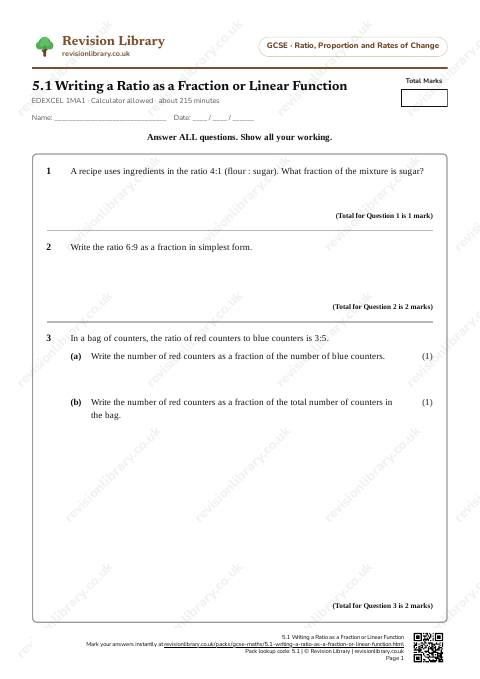
Revision Library
revisionlibrary.co.uk
GCSE · Ratio, Proportion and Rates of Change
5.1 Writing a Ratio as a Fraction or Linear Function
EDEXCEL 1MA1 · Calculator allowed · about 215 minutes
A recipe uses ingredients in the ratio 4:1 (flour : sugar). What fraction of the mixture is sugar?
(Total for Question 1 is 1 mark)
2
Write the ratio 6:9 as a fraction in simplest form.
(Total for Question 2 is 2 marks)
3
In a bag of counters, the ratio of red counters to blue counters is 3:5.
(a)Write the number of red counters as a fraction of the number of blue counters.(1)
(b)Write the number of red counters as a fraction of the total number of counters in the bag.(1)
(Total for Question 3 is 2 marks)
4
A ribbon is cut into two pieces so that the length of the first piece to the length of the second piece is in the ratio 2:7.
(a)Write the length of the first piece as a fraction of the length of the second piece.(1)
(b)What fraction of the whole ribbon is the second piece?(1)
(Total for Question 4 is 2 marks)
5
On a school trip, the ratio of adults to children on a coach is 4:9.
(a)Write the number of adults as a fraction of the number of children.(1)
(b)Write the number of children as a fraction of the total number of people on the coach.(1)
(Total for Question 5 is 2 marks)
6
A paint mix uses red : white in the ratio 7:3. Work out the fraction of the mix that is red and give the answer as a percentage.
(Total for Question 6 is 3 marks)
7
Write the relationship between x and y as a linear function y = kx when y is directly proportional to x with ratio 4:1 (y:x = 4:1). State the value of k.
(Total for Question 7 is 3 marks)
8
Priya mixes squash and water in the ratio 1:6 (squash : water). Let s be the amount of squash in litres and w the amount of water. Write w as a linear function of s in the form w = ks and give k.
(Total for Question 8 is 4 marks)
9
The ratio of the length of Path A to the length of Path B is 15:40.
(a)Simplify the ratio 15:40 fully.(1)
(b)Using your simplified ratio, write the length of Path A as a fraction of the length of Path B.(1)
(Total for Question 9 is 2 marks)
10
At a school, the ratio of teachers to students is 1:18.
(a)Write the number of teachers as a fraction of the number of students.(1)
(b)Write the number of teachers as a fraction of the total number of people (teachers plus students) at the school.(2)
(Total for Question 10 is 3 marks)
11
A ratio is 8:9. Write down the second quantity as a fraction of the first quantity, giving your fraction in its simplest form.
(Total for Question 11 is 1 mark)
12
The ratio of concrete to sand in a mixture is 3:11. Write the amount of sand as a fraction of the total amount of mixture.
(Total for Question 12 is 1 mark)
13
Given that x:y = 2:9, write down the value of each of the following fractions.
(a)x/y(1)
(b)y/x(1)
(Total for Question 13 is 2 marks)
14
Given that a:b = 5:1, write a as a fraction of the total a + b.
(Total for Question 14 is 1 mark)
15
In a cafe, the ratio of hot drinks sold that were tea to those that were coffee is 7:5. Write down the fraction of these hot drinks sold that were coffee.
(Total for Question 15 is 1 mark)
16
A map scale shows that 1 cm represents 3 km. Express the distance d in kilometres as a linear function of the map length m in centimetres in the form d = km. Give k.
(Total for Question 16 is 5 marks)
17
Oliwia buys pens and pencils in the ratio 4:3. She spends £21 in total. How much does one part represent, and how much did she spend on pens? Write your answer as a fraction of the total spent and as a decimal for the amount on pens.
(Total for Question 17 is 4 marks)
18
Sam and Erin split money in the ratio 3:2. If Sam receives x pounds, write an expression for the total amount of money T in pounds in terms of x.
(Total for Question 18 is 4 marks)
19
A recipe uses ingredients in the ratio 5:3:2 for flour:butter:sugar. Work out the fraction of the total mixture that is sugar.
(Total for Question 19 is 2 marks)
20
The lengths of three pieces of ribbon are in the ratio 7:4:9. The longest piece is 63 cm. Work out the length of the shortest piece.
(Total for Question 20 is 3 marks)
21
On a particular day, the exchange rate between £ (P) and euros (E) means that the ratio P:E is 4:5 (£4 is worth the same as 5 euros).
(a)Write E as a fraction of P.(1)
(b)Write E as a linear function of P.(1)
(c)Use your function to calculate the value in euros of £68.(2)
(Total for Question 21 is 4 marks)
22
There are 30 students in a class. The ratio of students who walk to school to students who do not walk to school is 2:3.
(a)What fraction of the class walks to school?(1)
(b)Work out how many students walk to school.(2)
(Total for Question 22 is 3 marks)
23
In a jar of sweets, the fraction of sweets that are strawberry flavoured is 3/7.
(a)Write the ratio of strawberry sweets to non-strawberry sweets in its simplest form.(2)
(b)Write the number of non-strawberry sweets, N, as a linear function of the number of strawberry sweets, S.(2)
(Total for Question 23 is 4 marks)
24
Two investments, A and B, are in the ratio A:B = 3:7. Investment A is worth £210.
(a)Write investment B as a fraction of investment A.(1)
(b)Write B as a linear function of A.(1)
(c)Calculate the value of investment B.(2)
(Total for Question 24 is 4 marks)
25
In a fun run, the ratio of the number of adults to the number of children taking part is 9:4.
(a)What fraction of the participants are children?(1)
(b)There are 351 participants in total. Work out how many of the participants are adults.(3)
(Total for Question 25 is 4 marks)
26
x and y are in the ratio 7:9. Write x as a linear function of y, in the form x = ky.
(Total for Question 26 is 2 marks)
27
The ratio of apples to pears is 3:1. Write the number of pears as a fraction of the total. Hence work out how many pears there are when the total is 12.
(Total for Question 27 is 3 marks)
28
The ratio of x to y is 4:3. Express y in terms of x.
(Total for Question 28 is 2 marks)
29
x and y are two quantities such that x:y = 3:8.
(a)Write y as a fraction of x.(1)
(b)Hence write y as a linear function of x, in the form y = ... x(2)
(Total for Question 29 is 3 marks)
30
a and b are two quantities such that a:b = 4:9.
(a)Write b as a fraction of a.(1)
(b)Hence write b in terms of a.(1)
(c)Given that a = 20, use your function from part (b) to work out the value of b.(2)
(Total for Question 30 is 4 marks)
31
A shade of grey paint is made by mixing white paint and black paint in the ratio 7:3.
(a)What fraction of the total mixture is black paint?(1)
(b)Write the amount of white paint, W litres, as a linear function of the amount of black paint, B litres.(2)
(Total for Question 31 is 3 marks)
32
Given that p:q = 9:2, write p in terms of q as a linear function in the form p = kq.
(Total for Question 32 is 1 mark)
33
A fraction of 3/7 of the plants in a garden are type A and the rest are type B.
(a)Write down the fraction of the plants that are type B.(1)
(b)Write the ratio of type A plants to type B plants in its simplest form.(1)
(Total for Question 33 is 2 marks)
34
In a school, 5/12 of the students are boys. Write the ratio of boys to girls in its simplest form.
(Total for Question 34 is 2 marks)
35
Given that y = 3/5 x, write down the ratio x:y in its simplest form.
(Total for Question 35 is 1 mark)
36
Given that y = 8/3 x, write down the ratio x:y using whole numbers.
(Total for Question 36 is 1 mark)
37
A bag contains only red counters and blue counters. The ratio of red counters to blue counters is 3:5. There are 40 counters in the bag altogether.
(a)Write the number of red counters as a fraction of the total number of counters.(1)
(b)Work out the number of red counters in the bag.(2)
(Total for Question 37 is 3 marks)
38
Given that m:n = 4:7, write n in terms of m as a linear function in the form n = km.
(Total for Question 38 is 1 mark)
39
A gardener uses compost and soil in the ratio 2:5. If the gardener uses x kg of compost, show that the total mixture M in kg can be written as M = 7/2 x, then simplify this expression to a single decimal.
(Total for Question 39 is 6 marks)
40
A chemist uses volumes in the ratio (x + 1):(2x - 5). For which value of x are the two volumes equal? By how much does the first volume exceed the second when x = 8?
(a)Find the value of x for which the two volumes are equal.(3)
(b)When x = 8 and the total volume is 660 ml, find how many ml the second volume exceeds the first by.(4)
(Total for Question 40 is 7 marks)
41
A cuboid has length l, width w and height h. The ratio l:w:h is 2:3:5.
(a)Write the width as a fraction of the height.(1)
(b)Write the height, h, as a linear function of the length, l.(2)
(c)The length of the cuboid is 8 cm. Work out the height.(2)
(Total for Question 41 is 5 marks)
42
A baker uses flour and sugar in the ratio flour:sugar = 5:2 to make a batch of biscuits.
(a)Write the amount of sugar, S grams, as a linear function of the amount of flour, F grams.(2)
(b)The baker has 750 g of flour and wants to use all of it. Calculate how much sugar is needed.(2)
(c)The baker only has 180 g of sugar. Work out the maximum amount of flour that can be used while keeping the ratio 5:2.(2)
(Total for Question 42 is 6 marks)
43
The ratio of the length to the width of a rectangle is 5:2. The width of the rectangle is 8 cm.
(a)Write the length of the rectangle as a fraction of its width.(1)
(b)Work out the length of the rectangle.(2)
(Total for Question 43 is 3 marks)
44
Salma and Tom share some money in the ratio 3:4. Salma receives £27.
(a)Write Tom's share as a fraction of Salma's share.(1)
(b)Work out the total amount of money shared between Salma and Tom.(3)
(Total for Question 44 is 4 marks)
45
A photographer sets the red and blue light intensities to be (2x + 1) units and (x - 1) units, so the ratio of red to blue is (2x + 1):(x - 1). The total intensity is fixed at 450 units. Given x > 1, find x and state the intensities of red and blue light.
(Total for Question 45 is 5 marks)
46
Write the function y = f(x) that gives the fraction of the total taken by the first part of the ratio x:(3x + 4). Simplify the function if possible, and state any value of x for which it is not defined.
(Total for Question 46 is 5 marks)
47
Two quantities m and n are in the ratio m:n = 7:4, so that m = kn for some constant k.
(a)State the value of k.(1)
(b)Given also that m - n = 18, find the value of n.(3)
(Total for Question 47 is 4 marks)
48
p and q are two quantities in the ratio p:q = 2:5. It is also known that p + 2q = 96.
(a)Write q as a linear function of p.(1)
(b)Find the value of p.(3)
(Total for Question 48 is 4 marks)
49
The ratio of two positive numbers x and y is 2:5. Given that x + y = 84, form and solve a linear equation to find the value of y.
(Total for Question 49 is 3 marks)
50
In a survey of 150 people, the ratio of people who prefer tea to those who prefer coffee to those who prefer neither is 5:3:2.
(a)Write the number of people who prefer coffee as a fraction of the number of people who do not prefer tea.(2)
(b)Work out how many more people prefer tea than prefer neither.(3)
(Total for Question 50 is 5 marks)
51
A town council divides its budget between parks and libraries in the ratio 5:(t + 3). The total budget is 1600 units. The council then changes the split so that the ratio of parks to libraries becomes 3:2, while keeping the total budget at 1600 units and keeping the actual amount allocated to parks exactly the same as before. Find t.
(Total for Question 51 is 8 marks)
Mark scheme · 5.1 Writing a Ratio as a Fraction or Linear Function
Question 1
1/5 caoB1
Answer: 1/5
Question 2
shows dividing both terms by common factor 3 or equivalent methodM1
2/3 caoA1
Answer: 2/3
Question 3
(a) 3/5 oeB1
(a) Answer: 3/5
(b) 3/8 oeB1
(b) Answer: 3/8
Question 4
(a) 2/7 oeB1
(a) Answer: 2/7
(b) 7/9 oeB1
(b) Answer: 7/9
Question 5
(a) 4/9 oeB1
(a) Answer: 4/9
(b) 9/13 oeB1
(b) Answer: 9/13
Question 6
writes fraction 7/(7+3) or 7/10M1
7/10 caoA1
70% caoA1
Answer: 7/10 and 70%
Question 7
recognises y/x = 4/1 so k = 4 or writes y = 4xM1
y = 4x caoA1
k = 4 stated explicitlyB1
Answer: y = 4x, k = 4
Question 8
uses ratio w/s = 6/1 or writes w = 6sM1
w = 6s caoA1
states k = 6B1
units or variable consistent (litres) or equivalent statementB1
Answer: w = 6s, k = 6
Question 9
(a) 3:8 caoB1
(a) Answer: 3:8
(b) 3/8 ft from (a)B1
(b) Answer: 3/8
Question 10
(a) 1/18 oeB1
(a) Answer: 1/18
(b) recognises total parts = 1 + 18 = 19M1
(b) 1/19 oeA1
(b) Answer: 1/19
Question 11
9/8 caoB1
Answer: 9/8
Question 12
11/14 oeB1
Answer: 11/14
Question 13
(a) 2/9 oeB1
(a) Answer: 2/9
(b) 9/2 oeB1
(b) Answer: 9/2
Question 14
5/6 oeB1
Answer: 5/6
Question 15
5/12 oeB1
Answer: 5/12
Question 16
identifies ratio d:m = 3:1 or d = 3 mM1
writes d = 3m with unitsM1
d = 3m caoA1
states k = 3B1
units consistent: d in km when m in cm or equivalentB1
Answer: d = 3m, k = 3
Question 17
uses total parts 4 + 3 = 7 and finds one part = 21/7 = 3M1
one part = £3 caoA1
calculates pens cost = 4 parts = 4 * 3 = 12M1
pens cost £12 and fraction 12/21 = 4/7 cao, decimal 12.00 or 12.0A1
Answer: One part = £3; spent on pens = £12, which is 12/21 = 4/7 of the total, amount £12.00
Question 18
recognises Sam's share is 3 parts so one part = x/3 or writes Erin = (2/3)xM1
adds shares to form total T = x + (2/3)x or equivalentM1
T = (5/3)x caoA1
alternatively T = 5 * (x/3) and equivalent simplified form statedB1
Answer: T = (5/3)x
Question 19
write fraction sugar = 2/(5+3+2) or equivalent methodM1
2/10 = 1/5 caoA1
Answer:1/5 (one fifth). Reason: sugar = 2 out of 10 total, so 2/10 = 1/5, cao. Working check: 5+3+2=10 so sugar fraction = 2/10 = 1/5.
Question 20
use scale factor: 63 corresponds to 9 (the largest part) so factor = 63/9 = 7M1
identify shortest part is 4 (smallest of 7, 4, 9) and multiply by factor: 4 * 7M1
28 cm caoA1
Answer:28 cm. Working check: scale factor = 63/9 = 7, shortest part is 4, shortest = 4 * 7 = 28.
(b) 351 divide 13 (= 27) oe, finding the value of one partM1
(b) 27 x 9 oe, multiplying by the adult shareM1
(b) 243 caoA1
(b) Answer: 243 adults
Question 26
x/7 = y/9 or 7y = 9x oeM1
x = 7y/9 oeA1
Answer: x = 7y/9
Question 27
1/4 oeM1
12 / 4 x 1 oeM1
3 caoA1
Answer: 3
Question 28
x/4 = y/3 or 4y = 3x oeM1
y = 3x/4 oeA1
Answer: y = 3x/4
Question 29
(a) 8/3 oeB1
(a) Answer: 8/3
(b) sets up y/x = 8/3 or equivalentM1
(b) y = 8/3 x oe (accept y = 2.67x awrt or y = 2.6 recurring x)A1
(b) Answer: y = 8/3 x (= 2.6666...x)
Question 30
(a) 9/4 oeB1
(a) Answer: 9/4
(b) b = 9/4 a ft from (a)B1
(b) Answer: b = 9/4 a (= 2.25a)
(c) substitutes a = 20 into b = 9/4 aM1
(c) b = 45 caoA1
(c) Answer: b = 45
Question 31
(a) 3/10 oeB1
(a) Answer: 3/10
(b) sets up W/B = 7/3M1
(b) W = 7/3 B oeA1
(b) Answer: W = 7/3 B (= 2.3333...B)
Question 32
p = 9/2 q oe (k = 9/2 or 4.5)B1
Answer: p = 9/2 q
Question 33
(a) 4/7 oeB1
(a) Answer: 4/7
(b) 3:4 cao ft from (a)B1
(b) Answer: 3:4
Question 34
recognises girls = 1 - 5/12 = 7/12B1
5:7 caoB1
Answer: 5:7
Question 35
5:3 caoB1
Answer: 5:3
Question 36
3:8 caoB1
Answer: 3:8
Question 37
(a) 3/8 oeB1
(a) Answer: 3/8
(b) 40 / 8 (= 5), ft their fraction from (a)M1
(b) 15 caoA1
(b) Answer: 15
Question 38
n = 7/4 m oe (k = 7/4)B1
Answer: n = 7/4 m
Question 39
uses ratio compost:soil = 2:5 so total parts = 7 and one part = x/2 (since compost is 2 parts = x)M1
writes total mixture as M = 7 * (x/2) or equivalentM1
shows M = 7/2 x caoA1
correct explanation that total parts = 7 so total = 7 times one part, and one part = x/2, so M = 7 * x/2 oeB1
converts 7/2 to a decimal: 7/2 = 3.5M1
simplifies to M = 3.5x caoA1
Answer: M = 7/2 x = 3.5x
Question 40
(a) set x+1 = 2x - 5 and form equationM1
(a) solve: -x = -6 so x = 6M1
(a) x = 6 caoA1
(a) Answer:x = 6. Working check: x+1 = 2x-5 gives x = 6.
(b) substitute x = 8 to get ratio parts 9 : 11M1
(b) total parts = 20 so part value = 660/20 = 33M1
(b) compute difference second - first = (11 - 9)*33 = 2*33M1
(b) 66 ml cao (second is 11*33 = 363, first is 9*33 = 297, so second exceeds first by 66 ml)A1
(b) Answer:66 ml. When x = 8 the ratio is 9:11, total parts 20 so unit = 33 ml. First = 297 ml, second = 363 ml, so the second exceeds the first by 66 ml. Working check: 660/20 = 33, 9*33 = 297, 11*33 = 363, difference = 66 ml.
Question 41
(a) 3/5 oeB1
(a) Answer: 3/5
(b) sets up h/l = 5/2M1
(b) h = 2.5l oe (accept h = 5/2 l)A1
(b) Answer: h = 2.5l
(c) substitutes l = 8 into h = 2.5lM1
(c) 20 cm cao ftA1
(c) Answer: 20 cm
Question 42
(a) sets up S/F = 2/5M1
(a) S = 2/5 F oe (accept S = 0.4F)A1
(a) Answer: S = 0.4F
(b) substitutes F = 750 into S = 0.4FM1
(b) 300 g cao ftA1
(b) Answer: 300 g
(c) rearranges to F = 5/2 S (or F = S divide 0.4) and substitutes S = 180M1
(c) 450 g cao ftA1
(c) Answer: 450 g
Question 43
(a) 5/2 oeB1
(a) Answer: 5/2
(b) 5/2 x 8, ft their fraction from (a)M1
(b) 20 cm caoA1
(b) Answer: 20 cm
Question 44
(a) 4/3 oeB1
(a) Answer: 4/3
(b) 27 / 3 (= 9), the value of one partM1
(b) 9 x (3 + 4), ft their value of one partM1
(b) £63 caoA1
(b) Answer: £63
Question 45
form equation using total intensity: (2x+1)+(x-1)=450M1
simplify to 3x = 450M1
solve x = 150M1
x = 150 caoA1
red = 2(150)+1 = 301 units, blue = 150-1 = 149 units caoA1
Answer:x = 150; red intensity = 301 units; blue intensity = 149 units. Working check: (2x+1)+(x-1)=3x=450 so x=150. Red=2(150)+1=301, blue=150-1=149. Red+blue=301+149=450, consistent.
Question 46
form fraction x/(x + 3x + 4) = x/(4x+4)M1
simplify to x/(4(x+1)) or 1/4 * x/(x+1)M1
express as y = (1/4) * x/(x+1) and note not defined at x = -1 (identify domain)M1
state simplified expression y = x/(4x+4) caoA1
state domain restriction x not equal to -1 and note function form; accept equivalent simplified forms caoA1
Answer:y = x/(4x + 4). Simplified form y = x/(4(x + 1)). Domain: x not equal to -1. Working check: total = x + (3x+4) = 4x+4 so fraction of x = x/(4x+4).
Question 47
(a) k = 7/4 oe (accept k = 1.75)B1
(a) Answer: k = 1.75
(b) substitutes m = 1.75n into m - n = 18 to get 0.75n = 18 oeM1
(b) correctly rearranges to find n (dependent on previous M1)dM1
(b) n = 24 caoA1
(b) Answer: n = 24
Question 48
(a) q = 2.5p oe (accept q = 5/2 p)B1
(a) Answer: q = 2.5p
(b) substitutes q = 2.5p into p + 2q = 96 to get p + 5p = 96 oeM1
(b) correctly simplifies and rearranges to 6p = 96 (dependent on previous M1)dM1
(b) p = 16 caoA1
(b) Answer: p = 16
Question 49
x = 2k and y = 5k (or equivalent single-variable expressions)M1
Answer:t = 1/3. Working check: total 1600 = 5p + (t+3)p = (t+8)p. New ratio 3:2 gives q = 320 and parks 3q = 960 so p = 960/5 = 192. Then t+8 = 1600/192 = 25/3 so t = 25/3 - 8 = 1/3.
Put this topic and others into one printable pack.
Open the Pack Builder
Worksheets are written for Revision Library and come with a full mark scheme; a few English packs quote an out-of-copyright text, and name it on the page. Exam board names and specification codes say which qualification a pack suits: we are not affiliated with, endorsed by or approved by any exam board, and no past-paper question is reproduced here. Rights queries: hello@revisionlibrary.co.uk