Speed and density are compound measures that combine two other quantities: speed is calculated as distance divided by time, and density is calculated as mass divided by volume. Both use a formula triangle for rearranging, and they appear throughout GCSE calculator and ratio questions involving units such as km/h, m/s and g/cm3.
Learn the two key formulae: speed = distance / time, and density = mass / volume.
Use a formula triangle (or rearrange algebraically) to find whichever quantity is missing: cover the one you want to find, and the triangle shows whether to multiply or divide the other two.
Make sure all quantities are in consistent units before calculating; convert times to hours or seconds, and lengths or masses to matching units, as needed.
Substitute the known values into the correct version of the formula and calculate.
Check the units of your answer match the units asked for in the question, converting again if necessary.
For problems involving mixtures or multiple stages, work out each part's mass or distance separately before combining them for an overall density or average speed.
Worked example
A block of copper has a mass of 356 g and a volume of 40 cm3. Work out the density of the copper, in g/cm3.
Recall the formula: density = mass / volume.
Substitute the values: density = 356 / 40.
Work out the calculation: density = 8.9.
State the final answer, with units: the density of the copper is 8.9 g/cm3.
Revision Library
revisionlibrary.co.uk
GCSE · Ratio, Proportion and Rates of Change - Compound Measures
5.5 Speed and Density
EDEXCEL 1MA1 · Calculator allowed · about 240 minutes
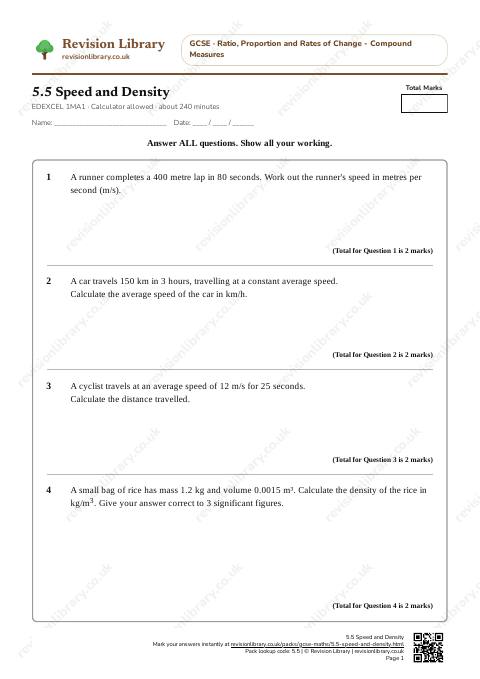
A runner completes a 400 metre lap in 80 seconds. Work out the runner's speed in metres per second (m/s).
(Total for Question 1 is 2 marks)
2
A car travels 150 km in 3 hours, travelling at a constant average speed. Calculate the average speed of the car in km/h.
(Total for Question 2 is 2 marks)
3
A cyclist travels at an average speed of 12 m/s for 25 seconds. Calculate the distance travelled.
(Total for Question 3 is 2 marks)
4
A small bag of rice has mass 1.2 kg and volume 0.0015 m³. Calculate the density of the rice in kg/m3. Give your answer correct to 3 significant figures.
(Total for Question 4 is 2 marks)
5
A car travels at a constant speed of 60 km/h.
(a)Work out the distance the car travels in 20 minutes.(1)
(b)Work out the average speed for the 150 km in 2.5 hours.(2)
(Total for Question 5 is 3 marks)
6
A jogger runs 18 km in 1.5 hours at a constant speed. Work out her average speed, in km/h.
(Total for Question 6 is 2 marks)
7
A block of cheese has a mass of 480 g and a volume of 320 cm³. Work out the density of the cheese, in g/cm3.
(Total for Question 7 is 2 marks)
8
A cyclist travels at a constant speed of 20 m/s. Work out this speed in km/h.
(Total for Question 8 is 2 marks)
9
A coach travels at an average speed of 56 km/h for 2 hours 30 minutes. Work out the distance travelled.
(Total for Question 9 is 3 marks)
10
A metal cube has a volume of 8 cm³ and a density of 7.9 g/cm3. Calculate the mass of the cube.
Diagram NOT accurately drawn
(Total for Question 10 is 2 marks)
11
Convert a speed of 20 m/s into km/h.
(Total for Question 11 is 2 marks)
12
A block of wood has mass 0.9 kg and density 600 kg/m3.
(a)Calculate the volume of the block in cubic metres (m3).(2)
(b)Give the volume in cm3.(1)
(Total for Question 12 is 3 marks)
13
A lorry travels 240 km in 3 hours.
(a)Work out the average speed.(2)
(b)Work out the extra distance covered in 2 hours at the same speed.(2)
(Total for Question 13 is 4 marks)
14
A metal cube has side length 10 cm. The density of the metal is 7800 kg/m3. Calculate the mass of the cube in kilograms. Give your answer correct to 3 significant figures.
Diagram NOT accurately drawn
(Total for Question 14 is 3 marks)
15
A driver covers 90 km in 1 hour 30 minutes.
(a)Work out the average speed in km/h.(2)
(b)How long to travel 150 km at this speed? Give your answer in hours and minutes.(2)
(c)How far would the driver travel in 20 minutes at this average speed?(1)
(Total for Question 15 is 5 marks)
16
A car travels 150 km in 2 hours 15 minutes. Work out the average speed of the car in km/h. Give your answer to 1 decimal place.
(Total for Question 16 is 2 marks)
17
Priya drives 90 km in 1 hour 12 minutes. She then drives a further 60 km in 48 minutes. Work out her average speed for the whole journey. Give your answer in km/h.
(Total for Question 17 is 4 marks)
18
The distance-time graph shows Amir's cycle ride from home to the library and back.
(a)Work out Amir's speed on the journey to the library. Give your answer in km/h.
(Total for Question 18a is 2 marks)(2)
(b)Write down what is happening to Amir's distance from home between 15 and 25 minutes.
(Total for Question 18b is 1 mark)(1)
(c)Work out Amir's speed on the journey back home. Give your answer in km/h.
(Total for Question 18c is 2 marks)(2)
(Total for Question 18 is 5 marks)
19
A cheetah runs at a constant speed of 28 m/s. Show that this speed is equivalent to 100.8 km/h.
(Total for Question 19 is 3 marks)
20
A container holds 300 cm³ of oil, density 0.92 g/cm3, floating on top of 500 cm³ of water, density 1 g/cm3. Work out the total mass of liquid in the container. Give your answer in kilograms.
(Total for Question 20 is 3 marks)
21
A shipping container holds gravel with a mass of 3.6 tonnes and a volume of 2.4 m³. Work out the density of the gravel in kg/m3.
(Total for Question 21 is 3 marks)
22
A ferry crosses a channel of length 32 km at an average speed of 24 km/h. It departs at 09:15. At what time does it arrive? Give your answer using the 24-hour clock.
(Total for Question 22 is 4 marks)
23
A car travels 195 miles at an average speed of 60 mph. Work out how long the journey takes. Give your answer in hours and minutes.
(Total for Question 23 is 3 marks)
24
The density of aluminium is 2.7 g/cm3. A block of aluminium has a mass of 189 g. Work out the volume of the block.
(Total for Question 24 is 2 marks)
25
A liquid has a density of 1.25 g/cm3. Work out the mass of 400 cm³ of the liquid. Give your answer in kilograms.
(Total for Question 25 is 3 marks)
26
The density of ice is 0.92 g/cm3. Work out this density in kg/m3.
(Total for Question 26 is 2 marks)
27
Water flows through a pipe into a cylindrical tank of radius 0.5 m and height 2 m, filling the tank completely in 40 minutes. The density of water is 1000 kg/m3. (Volume of a cylinder = π r2 h)
Diagram NOT accurately drawn
(a)Calculate the volume of the tank, in m3, giving your answer to 3 significant figures.(2)
(b)Work out the mass flow rate of the water, in kg per second, giving your answer to 3 significant figures.(3)
(Total for Question 27 is 5 marks)
28
The density of a liquid is given by the formula d = m / V, where m is mass and V is volume.
(a)Rearrange the formula to make V the subject.(1)
(b)A liquid has a density of 1.25 g/cm3. Find the volume of 250 g of the liquid.(2)
(Total for Question 28 is 3 marks)
29
A cuboid is made of a material with density 2.7 g/cm3. The cuboid has a mass of 486 g. The cuboid has a square cross-section of side length x cm and a length of 3x cm.
Diagram NOT accurately drawn
(a)Work out the volume of the cuboid.(2)
(b)Form an equation in x using the volume of the cuboid, and solve it to find the value of x. Give your answer to 3 significant figures.(4)
(Total for Question 29 is 6 marks)
30
A ship travels from Port A to Port B, a distance of 84 nautical miles, at a constant average speed of 14 knots (nautical miles per hour). The ship leaves Port A at 09:15. On the way, it stops at a checkpoint for 45 minutes. The ship must reach Port B by 15:30 the same day.
(a)Work out the clock time at which the ship arrives at Port B.(3)
(b)Determine, giving a reason, whether the ship reaches Port B on time.(1)
(Total for Question 30 is 4 marks)
31
A composite solid is made by joining a cylinder and a cone of the same radius, made from the same material throughout. The cylinder has radius 3 cm and height 10 cm. The cone has radius 3 cm and height 8 cm. The material has density 2.4 g/cm3. (Volume of a cylinder = π r2 h. Volume of a cone = (1/3) π r2 h)
Diagram NOT accurately drawn
(a)Calculate the total volume of the solid, giving your answer to 3 significant figures.(2)
(b)The solid is fully submerged in water, and displaces its own volume of water. The density of water is 1 g/cm3. Calculate the mass of water displaced, in kg, giving your answer to 3 significant figures.(2)
(c)State, with a reason, whether the solid would float or sink in water.(2)
(Total for Question 31 is 6 marks)
32
A liquid has a density of 0.92 g/cm3. Calculate the mass, in kg, of 5 litres of the liquid. (1 litre = 1000 cm³)
(Total for Question 32 is 3 marks)
33
Sara walks 3.6 km in 45 minutes, at a constant speed. Calculate her average speed in m/s. Give your answer to 3 significant figures.
(Total for Question 33 is 4 marks)
34
A gold bar is a cuboid with dimensions 20 cm by 8 cm by 4.5 cm. The density of the gold is 19.3 g/cm3.
Diagram NOT accurately drawn
(a)Work out the volume of the gold bar.(2)
(b)Work out the mass of the gold bar in kg.(2)
(Total for Question 34 is 4 marks)
35
A liquid has mass 250 g and occupies 200 cm³.
(a)Calculate the density in kg/m3.(3)
(b)Give the density in g/cm3.(1)
(c)What mass, in grams, of this liquid would fill 1.5 litres?(2)
(Total for Question 35 is 6 marks)
36
A cyclist rides for 30 minutes at 18 km/h, then for 20 minutes at 24 km/h. Work out the total distance travelled in kilometres. Give your answer as a fraction in simplest form.
(Total for Question 36 is 3 marks)
37
A sealed container with volume 2.5 m³ is filled with a liquid of density 920 kg/m3.
(a)Work out the mass of the liquid in the container in kilograms.(2)
(b)The liquid is poured into small bottles each of volume 250 cm³. How many whole bottles can be filled?(2)
(Total for Question 37 is 4 marks)
38
A snail moves at a constant speed of 0.048 km/h. Work out this speed in centimetres per minute.
(Total for Question 38 is 3 marks)
39
The speed limit on a stretch of road is 70 mph. A car travels 21 km in 10 minutes at a constant speed. Given that 5 miles is approximately equal to 8 km, determine whether the car is exceeding the speed limit. You must show your working.
(Total for Question 39 is 5 marks)
40
A brick exerts a pressure of 15 000 Pa on the ground. The brick has a mass of 6 kg. Take the gravitational field strength as g = 10 N/kg. Given that force = mass x g and pressure = force / area, work out the area of the brick in contact with the ground. Give your answer in cm2.
(Total for Question 40 is 4 marks)
41
Aisha and Priya both run a 400 m race. Aisha finishes the race in 58 seconds. Priya runs at an average speed of 6.7 m/s. Work out who is faster, and find the difference between their times for the race, giving your answer to the nearest second.
(Total for Question 41 is 5 marks)
42
The density of sea water is 1.03 g/cm3. A cube-shaped fish tank has a side length of 45 cm. Work out the mass of sea water, in kg, needed to fill the tank completely. Give your answer to 3 significant figures.
Diagram NOT accurately drawn
(Total for Question 42 is 4 marks)
43
A boat travels upstream against the river current for 2 hours and covers 30 km. It returns downstream along the same route in 1.2 hours.
(a)Find the speed of the boat in still water and the speed of the current in km/h.(4)
(b)Explain briefly why the downstream time is less than the upstream time.(1)
(Total for Question 43 is 5 marks)
44
A stone is lowered into a cylindrical measuring cylinder of radius 3 cm. The water level rises by 4.5 cm. The stone has a mass of 315 g. Work out the density of the stone. Give your answer correct to 3 significant figures. (Volume of a cylinder = π r2 h)
Diagram NOT accurately drawn
(Total for Question 44 is 4 marks)
45
Two cars start at the same time and travel towards each other from two towns 210 km apart. Car A travels at a constant speed of x km/h. Car B travels at a constant speed of (x + 15) km/h. The cars meet after 1 hour 24 minutes. Form and solve an equation to find the value of x.
(Total for Question 45 is 5 marks)
46
A car travels the first 50 km of a journey at an average speed of 40 km/h, then the next 100 km at an average speed of 55 km/h. Work out the average speed for the whole 150 km journey. Give your answer correct to 1 decimal place.
(Total for Question 46 is 4 marks)
47
A metal alloy is made by mixing 300 g of metal A, which has a density of 8.4 g/cm3, with 500 g of metal B, which has a density of 7.2 g/cm3. Assuming there is no change in total volume when the metals are mixed, calculate the density of the alloy. Give your answer to 3 significant figures.
(Total for Question 47 is 5 marks)
48
A solid metal sphere has radius 4.5 cm and density 11.3 g/cm3. (Volume of a sphere = (4/3) π r3) Calculate the mass of the sphere, in kg. Give your answer to 3 significant figures.
Diagram NOT accurately drawn
(Total for Question 48 is 5 marks)
49
A material has density ρ g/cm3 and is formed into a hollow spherical shell with outer radius R cm and inner radius r cm.
(a)Write an expression in terms of ρ, R and r for the mass of the shell in grams.(3)
(b)Given ρ = 2.7, R = 8 and r = 7, calculate the mass of the shell to the nearest gram.(3)
(Total for Question 49 is 6 marks)
Mark scheme · 5.5 Speed and Density
Question 1
use speed = distance/time, 400/80 or equivalentM1
5 m/s caoA1
Answer: 5 m/s
Question 2
speed = distance / time i.e. 150 / 3 oeM1
50 (km/h) caoA1
Answer: 50 km/h
Question 3
distance = speed x time i.e. 12 x 25 oeM1
300 (m) caoA1
Answer: 300 m
Question 4
use density = mass/volume, 1.2 / 0.0015M1
800 kg/m3 caoA1
Answer: 800 kg/m3
Question 5
(a) distance = 60 x (20/60) = 20 km caoB1
(a) Answer: 20 km
(b) use speed = distance/time, 150/2.5M1
(b) 60 km/h caoA1
(b) Answer: 60 km/h
Question 6
18 / 1.5 oeM1
12 (km/h) caoA1
Answer: 12 km/h
Question 7
480 / 320 oeM1
1.5 (g/cm3) caoA1
Answer: 1.5 g/cm3
Question 8
20 x 3.6 oe, e.g. 20 x 3600 / 1000M1
72 (km/h) caoA1
Answer: 72 km/h
Question 9
2 hours 30 minutes = 2.5 hours oeM1
56 x 2.5 (dep)M1
140 (km) caoA1
Answer: 140 km
Question 10
mass = density x volume i.e. 7.9 x 8 oeM1
63.2 (g) caoA1
Answer: 63.2 g
Question 11
20 x 3.6 oe, e.g. 20 x 3600 / 1000M1
72 (km/h) caoA1
Answer: 72 km/h
Question 12
(a) use volume = mass/density, 0.9 / 600M1
(a) 0.0015 m³ caoA1
(a) Answer: 0.0015 m3
(b) 1500 cm³ caoB1
(b) Answer: 1500 cm3
Question 13
(a) use speed = distance/time, 240/3M1
(a) 80 km/h caoA1
(a) Answer: 80 km/h
(b) distance = speed x time, 80 x 2M1
(b) 160 km caoA1
(b) Answer: 160 km
Question 14
convert 10 cm to 0.10 m and find volume = 0.103 = 0.001 m³ or equivalentM1
use mass = density x volume, 7800 x 0.001M1
7.80 kg caoA1
Answer: 7.80 kg
Question 15
(a) convert 1 h 30 min to 1.5 h and use speed = distance/time, 90/1.5M1
(a) 60 km/h caoA1
(a) Answer: 60 km/h
(b) use time = distance/speed, 150/60 = 2.5 hoursM1
(b) 2 hours 30 minutes caoA1
(b) Answer: 2 hours 30 minutes
(c) distance = 60 x (20/60) = 20 km caoB1
(c) Answer: 20 km
Question 16
Convert time to hours and divide: 150 / 2.25 or equivalent methodM1
66.7 km/h awrtA1
Answer: 66.7 km/h
Question 17
total distance = 90 + 60 = 150 (km)M1
total time = 72 + 48 = 120 minutes = 2 hours oeM1
150 / 2 (dep on both previous method marks)dM1
75 (km/h) caoA1
Answer: 75 km/h
Question 18
(a) 15 minutes = 0.25 hours oeM1
(a) 40 (km/h) caoA1
(a) Answer: 40 km/h
(b) Amir is stationary / at the library (not moving) oeB1
(b) Answer: Amir is stationary at the library.
(c) 25 minutes = 5/12 hour oe, e.g. 25/60M1
(c) 24 (km/h) caoA1
(c) Answer: 24 km/h
Question 19
28 x 60 x 60 (= 100800) oe, or 28 x 3.6M1
100800 / 1000 (dep), or equivalent single-step method giving km/hM1
100.8 (km/h) csoA1
Answer: 100.8 km/h (given, shown)
Question 20
300 x 0.92 (= 276) oeM1
500 x 1 (= 500) oeM1
0.776 (kg) cao, allow 776 (g)A1
Answer: 0.776 kg
Question 21
3.6 tonnes = 3600 kg oeM1
3600 / 2.4 (dep)M1
1500 (kg/m3) caoA1
Answer: 1500 kg/m3
Question 22
32 / 24 (= 4/3 or 1.333...) oeM1
1.333... hours converted to 1 hour 20 minutes (dep) oeM1
Put this topic and others into one printable pack.
Open the Pack Builder
Worksheets are written for Revision Library and come with a full mark scheme; a few English packs quote an out-of-copyright text, and name it on the page. Exam board names and specification codes say which qualification a pack suits: we are not affiliated with, endorsed by or approved by any exam board, and no past-paper question is reproduced here. Rights queries: hello@revisionlibrary.co.uk