Simultaneous equations are two (or more) equations sharing the same unknowns, such as x and y, that are solved together to find the one pair of values which satisfies both at once. At GCSE, linear simultaneous equations are solved by elimination or substitution, often within worded real-life problems.
Label the two equations (1) and (2), and check whether the coefficients of x or y already match.
If not, multiply one or both equations so that the coefficient of x or y is the same size in both equations.
Add or subtract the equations to eliminate that variable: subtract if the matching coefficients have the same sign, add if they have opposite signs.
Solve the resulting equation to find the first unknown.
Substitute this value back into either original equation to find the second unknown.
Check your solution by substituting both values into the other original equation to confirm it works.
Worked example
Solve the simultaneous equations: 2x + 3y = 19, x - y = 2.
Rearrange x - y = 2 to make x the subject: x = y + 2.
Substitute x = y + 2 into the first equation: 2(y + 2) + 3y = 19.
Expand and simplify: 2y + 4 + 3y = 19, so 5y = 15.
Solve for y: y = 3.
Substitute y = 3 back into x = y + 2 to find x = 5, so the final answer is x = 5, y = 3.
Revision Library
revisionlibrary.co.uk
GCSE · Algebra
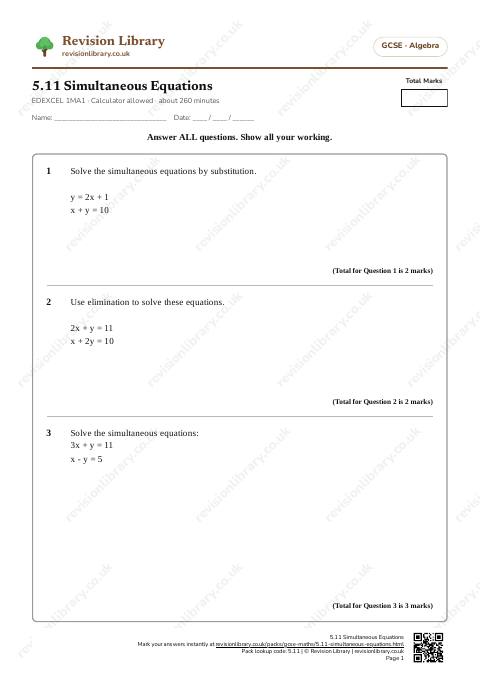
5.11 Simultaneous Equations
EDEXCEL 1MA1 · Calculator allowed · about 260 minutes
Tia and Ben go to the cinema on different days. Tia buys 2 adult tickets and 3 child tickets. She pays a total of £33.50. Ben buys 3 adult tickets and 1 child ticket. He pays a total of £31.00. Let a = the cost of an adult ticket in pounds and c = the cost of a child ticket in pounds.
(a)Write down a pair of simultaneous equations in terms of a and c.(2)
(b)Solve your equations to find the cost of an adult ticket and the cost of a child ticket.(3)
(Total for Question 8 is 5 marks)
9
Which pair of values satisfies both of the simultaneous equations 3x + y = 10 and x - y = 2?
(a)Circle the correct answer.(1)
A) x = 2, y = 4
B) x = 3, y = 1
C) x = 4, y = -2
D) x = 1, y = 7
(Total for Question 9 is 1 mark)
10
Show that x = 5, y = -2 satisfies both of the simultaneous equations: 3x + 2y = 11 2x - y = 12
(Total for Question 10 is 2 marks)
11
Solve the simultaneous equations: y = 3x - 2 2x + y = 13
(Total for Question 11 is 4 marks)
12
Show that x = 5, y = 4 is not a solution of the simultaneous equations: 3x + 2y = 17 x - y = 1
(Total for Question 12 is 3 marks)
13
A small theatre has tickets for adults and children. An adult ticket costs £7 and a child ticket costs £3.
On Monday the theatre sold 50 tickets and took £274.
Let a be the number of adult tickets and c the number of child tickets. Write the simultaneous equations and find a and c.
(Total for Question 13 is 5 marks)
14
Solve the simultaneous equations 2x + y = 7 and x - y = 1.
(Total for Question 14 is 3 marks)
15
The sum of two numbers is 17. Three times the larger number is 19 more than the smaller number. Let x = the larger number and y = the smaller number.
(a)Form a pair of simultaneous equations, using x for the larger number and y for the smaller number.(2)
(b)Solve your equations to find the two numbers.(2)
(Total for Question 15 is 4 marks)
16
The diagram shows a rectangle with length l cm and width w cm. The perimeter of the rectangle is 54 cm. The length is 3 cm more than twice the width.
(a)Form a pair of simultaneous equations in terms of l and w.(2)
(b)Solve your equations to find the length and width of the rectangle.(3)
(Total for Question 16 is 5 marks)
17
Solve the simultaneous equations: 1.5x + y = 9 0.5x + y = 5
(Total for Question 17 is 3 marks)
18
A student tries to solve the simultaneous equations: 2x + 3y = 6 4x + 6y = 15
(a)Explain why this pair of simultaneous equations has no solution.(2)
(Total for Question 18 is 2 marks)
19
Two mobile phone companies charge for calls as follows. Company A: a fixed monthly charge of £15 plus 5p per minute of calls. Company B: a fixed monthly charge of £9 plus 8p per minute of calls. Let C = the total monthly cost in pounds and m = the number of minutes of calls used in a month.
(a)Write down an equation for C in terms of m for each company.(2)
(b)Find the number of minutes of calls, m, for which both companies charge the same monthly amount, and state this common cost.(3)
(Total for Question 19 is 5 marks)
20
Solve the simultaneous equations: 4x + y = 5 2x - 3y = 13
(Total for Question 20 is 3 marks)
21
The graphs of y = 2x - 1 and x + y = 5 are drawn on the grid below.
(a)Write down the coordinates of the point where the two lines intersect.(1)
(b)Show algebraically that x = 2, y = 3 is the solution to the simultaneous equations y = 2x - 1 and x + y = 5.(2)
(Total for Question 21 is 3 marks)
22
Two pens and three pencils cost £2.20 in total. One pen and one pencil cost £0.90 in total.
(a)Using p for the cost of a pen in pounds and c for the cost of a pencil in pounds, write down a pair of simultaneous equations for this information.(2)
(b)Solve your equations to find the cost of a pen and the cost of a pencil.(3)
(Total for Question 22 is 5 marks)
23
Solve the simultaneous equations: 2x + 3y = 16 x + y = 6
Solve the simultaneous equations: 2x + y = -1 x - y = 4
(Total for Question 25 is 5 marks)
26
Solve these simultaneous equations by elimination. Show your working clearly.
4x + 3y = 25 2x - y = 4
(Total for Question 26 is 6 marks)
27
Solve the simultaneous equations 3x + 4y = 1 and 5x - 2y = 13.
(Total for Question 27 is 3 marks)
28
A school sells pencils and rulers. A packet of pencils and 2 rulers costs £5. Two packets of pencils and 3 rulers cost £8. Use simultaneous equations to find the cost of one packet of pencils and the cost of one ruler.
(Total for Question 28 is 4 marks)
29
A boat travels 36 km downstream in 2 hours. The same boat travels the same 36 km upstream in 3 hours. Let s = the speed of the boat in still water in km/h and w = the speed of the water current in km/h. (Downstream speed = s + w. Upstream speed = s - w.)
(a)Write down two equations connecting s and w.(2)
(b)Solve your equations to find the speed of the boat in still water and the speed of the current.(3)
(Total for Question 29 is 5 marks)
30
Solve the simultaneous equations: y = x + 2 y = x2 - 4x + 6 Give your answers as coordinate pairs (x, y).
(Total for Question 30 is 5 marks)
31
Solve the simultaneous equations: (x + y) / 2 = 5 2x - y = 2
(Total for Question 31 is 4 marks)
32
The sum of two numbers is 24. Three times the smaller number is 4 more than the larger number. Let x be the larger number and y be the smaller number. Form and solve a pair of simultaneous equations to find the two numbers.
Solve the simultaneous equations (1/2)x + (2/3)y = 7 and x - (3/2)y = -1. Give your answers as exact fractions or mixed numbers.
(Total for Question 35 is 4 marks)
36
Find the value(s) of m for which the pair of equations 2x + 3y = 5 and 4x + m y = 10 (a) has infinitely many solutions, (b) has no solution. Explain your answers.
(Total for Question 36 is 4 marks)
37
A circle has equation x2 + y2 = 25. A line has equation y = x + 1.
(a)Find the coordinates of the points where the line intersects the circle.(6)
(Total for Question 37 is 6 marks)
38
The sum of two numbers is 15. The sum of the squares of the two numbers is 113. Let x and y be the two numbers.
(a)Form a pair of simultaneous equations, using x and y for the two numbers.(2)
(b)Solve your equations to find the two numbers.(3)
(Total for Question 38 is 5 marks)
39
Five years ago, Kwame was three times as old as his daughter Ama. In eleven years' time, Kwame will be twice as old as Ama will be then. Let k = Kwame's present age and a = Ama's present age.
(a)Form a pair of simultaneous equations in terms of k and a.(2)
(b)Solve your equations to find Kwame's and Ama's present ages.(3)
(Total for Question 39 is 5 marks)
40
A rectangle has length x cm and width y cm. Its perimeter is 54 cm. The length is 3 cm more than twice the width.
Diagram NOT accurately drawn
(a)Write down a pair of simultaneous equations for this information.(2)
(b)Solve your equations to find the length and width of the rectangle.(3)
Solve the simultaneous equations y = x2 - 4 and y = x + 2. Give both solutions and find the corresponding y values.
(Total for Question 42 is 4 marks)
43
Solve the simultaneous equations: y = x + 2 x2 + y2 = 20 Give your answers as coordinate pairs.
(Total for Question 43 is 6 marks)
44
Solve the simultaneous equations: y = x2 - 2x + 1 y = 3x - 3
(Total for Question 44 is 6 marks)
45
Priya, Kwame and Omar share £120 between them. After Priya gives £10 to Kwame, Priya has twice as much money as Kwame has then. After Kwame gives £5 to Omar, Omar has as much money as Priya started with. Let P, K and O be their initial amounts.
(a)Write down three equations in P, K and O to represent the situation.(3)
(b)Solve the equations to find P, K and O.(6)
(Total for Question 45 is 9 marks)
Mark scheme · 5.11 Simultaneous Equations
Question 1
substitute y = 2x + 1 into x + y = 10 leading to x + 2x + 1 = 10 or 3x + 1 = 10M1
x = 3 cao; then y = 7 caoA1
Answer: x = 3, y = 7
Question 2
eliminate a variable, e.g. multiply first equation by 2 and subtract or subtract equations to get x or yM1
x = 4, y = 3 caoA1
Answer: x = 4, y = 3
Question 3
adds the two equations to eliminate y (or equivalent valid elimination)M1
x = 4 caoA1
y = -1 (ft from their x, both values required)A1
Answer: x = 4, y = -1
Question 4
substitutes y = x + 2 into the second equationM1
x = 3 caoA1
y = 5 (ft from their x)A1
Answer: x = 3, y = 5
Question 5
adds the two equations to eliminate y (or equivalent valid elimination method)M1
x = 9A1
y = 6 caoA1
Answer: x = 9, y = 6
Question 6
multiplies x + y = 6 by 2 (or equivalent) to match a coefficientM1
subtracts the equations correctly to eliminate a variableM1
x = 2 caoA1
y = 4 caoA1
Answer: x = 2, y = 4
Question 7
multiplies both equations to equate the coefficients of x or y (e.g. x3 and x2)M1
subtracts the equations correctly to eliminate a variableM1
x = 1 caoA1
y = 5 caoA1
Answer: x = 1, y = 5
Question 8
(a) 2a + 3c = 33.5 oeB1
(a) 3a + c = 31 oeB1
(a) Answer: 2a + 3c = 33.50 and 3a + c = 31.00
(b) multiplies 3a + c = 31 by 3 to match the coefficient of c, and eliminates cM1
substitutes into 3x + 2y and shows 3(5) + 2(-2) = 15 - 4 = 11B1
cso, substitutes into 2x - y and shows 2(5) - (-2) = 10 + 2 = 12B1
Answer: Both equations are satisfied (shown)
Question 11
substitutes y = 3x - 2 into the second equationM1
forms and simplifies a single linear equation in x, e.g. 5x - 2 = 13M1
x = 3A1
y = 7 caoA1
Answer: x = 3, y = 7
Question 12
shows x - y = 1 is satisfied (5 - 4 = 1)B1
substitutes into 3x + 2y to obtain 23B1
correct conclusion with reason, e.g. 'since 23 is not equal to 17, x = 5, y = 4 does not satisfy both equations, so it is not a solution'B1
Answer: x - y = 1 is satisfied, but 3x + 2y = 23, not 17, so x = 5, y = 4 is not a solution.
Question 13
form equations: a + c = 50 and 7a + 3c = 274M1
eliminate a or c, e.g. multiply first equation by 3 and subtract from second to get 4a = 274 - 150 = 124M1
a = 31 caoA1
substitute a = 31 into a + c = 50 to find cM1
c = 19 caoA1
Answer: a = 31, c = 19
Question 14
method to eliminate y, e.g. add the equations or substitute correctlyM1
x = 8/3 caoA1
y = 5/3 caoA1
Answer: x = 8/3, y = 5/3
Question 15
(a) x + y = 17 oeB1
(a) 3x = y + 19 oe (e.g. 3x - y = 19)B1
(a) Answer: x + y = 17 and 3x - y = 19
(b) adds the equations to eliminate yM1
(b) x = 9 and y = 8 (both values required, cao)A1
(b) Answer: x = 9, y = 8
Question 16
(a) l + w = 27 oe (from 2(l + w) = 54)B1
(a) l = 2w + 3 oeB1
(a) Answer: l + w = 27 and l = 2w + 3
(b) substitutes l = 2w + 3 into l + w = 27M1
(b) w = 8 caoA1
(b) l = 19 caoA1
(b) Answer: length = 19 cm, width = 8 cm
Question 17
subtracts the equations to eliminate yM1
x = 4 caoA1
y = 3 caoA1
Answer: x = 4, y = 3
Question 18
(a) multiplies the first equation by 2 to get 4x + 6y = 12 (or otherwise shows the coefficients of x and y are proportional)B1
(a) correct conclusion: since 4x + 6y cannot equal both 12 and 15, the equations are inconsistent (the lines are parallel), so there is no solutionB1
(a) Answer: No solution, because the equations are inconsistent (the lines are parallel)
Question 19
(a) C = 15 + 0.05m oeB1
(a) C = 9 + 0.08m oeB1
(a) Answer: C = 15 + 0.05m and C = 9 + 0.08m
(b) sets 15 + 0.05m = 9 + 0.08mM1
(b) rearranges correctly to solve for mM1
(b) m = 200 minutes and C = £25 (both required, cao)A1
(b) Answer: m = 200 minutes, common cost = £25
Question 20
rearranges y = 5 - 4x and substitutes into the second equation (or equivalent elimination)M1
x = 2 caoA1
y = -3 caoA1
Answer: x = 2, y = -3
Question 21
(a) (2, 3) caoB1
(a) Answer: (2, 3)
(b) substitutes x = 2 into both equationsM1
(b) cso, shows y = 2(2) - 1 = 3 and 2 + 3 = 5, so both equations are satisfiedA1
(b) Answer: Confirmed: y = 2(2) - 1 = 3 and 2 + 3 = 5
Question 22
(a) 2p + 3c = 2.20 oeB1
(a) p + c = 0.90 oeB1
(a) Answer: 2p + 3c = 2.20 and p + c = 0.90
(b) rearranges p + c = 0.90 to p = 0.90 - c (or equivalent elimination step)M1
(b) substitutes to form a single equation in one variable, e.g. 2(0.90 - c) + 3c = 2.20M1
(b) pen = £0.50 and pencil = £0.40 caoA1
(b) Answer: Pen = £0.50, pencil = £0.40
Question 23
multiplies x + y = 6 by 2 or 3 to match a coefficient, e.g. 3x + 3y = 18M1
subtracts the equations correctly to eliminate a variableM1
x = 2A1
y = 4 caoA1
Answer: x = 2, y = 4
Question 24
multiplies one equation to match a coefficient, e.g. first equation x3M1
multiplies the other equation to match the same coefficient, e.g. second equation x2M1
subtracts or adds correctly to eliminate one variableM1
x = 2A1
y = 5 caoA1
Answer: x = 2, y = 5
Question 25
adds the two equations to eliminate yM1
obtains 3x = 3M1
x = 1A1
y = -3 caoA1
correct check shown, e.g. 2(1) + (-3) = -1B1
Answer: x = 1, y = -3
Question 26
multiply second equation by 3 to align y: 6x - 3y = 12M1
add to first equation to eliminate y giving 10x = 37M1
x = 37/10 (or 3.7) caoA1
substitute x = 37/10 into 2x - y = 4 to find yM1
y = 17/5 caoA1
final answers x = 37/10, y = 17/5 caoA1
Answer: x = 37/10, y = 17/5
Question 27
method to eliminate one variable, e.g. multiply equations to eliminate y or xM1
x = 27/13 caoA1
y = -17/13 caoA1
Answer: x = 27/13, y = -17/13
Question 28
form two equations correctly, e.g. p + 2r = 5 and 2p + 3r = 8M1
eliminate one variable correctly, e.g. multiply first equation by 2 then subtractM1
p = 1 caoA1
r = £2 caoA1
Answer: packet of pencils = £1, ruler = £2
Question 29
(a) s + w = 18 oe (from 36 / 2)B1
(a) s - w = 12 oe (from 36 / 3)B1
(a) Answer: s + w = 18 and s - w = 12
(b) adds the two equations to eliminate wM1
(b) s = 15 caoA1
(b) w = 3 caoA1
(b) Answer: s = 15 km/h, w = 3 km/h
Question 30
sets x + 2 = x2 - 4x + 6M1
rearranges correctly to x2 - 5x + 4 = 0M1
factorises or otherwise solves to get x = 1 and x = 4M1
y = 3 and y = 6 (ft from their x values)A1
states both coordinate pairs correctly, (1, 3) and (4, 6)A1
Answer: (1, 3) and (4, 6)
Question 31
multiplies the first equation by 2 to get x + y = 10M1
adds the equations to eliminate yM1
x = 4 caoA1
y = 6 caoA1
Answer: x = 4, y = 6
Question 32
x + y = 24B1
3y = x + 4 oeB1
combines the equations to form a single equation in one variable, e.g. 3y = (24 - y) + 4M1
y = 7A1
x = 17 caoA1
Answer: Larger number = 17, smaller number = 7
Question 33
identifies that adding the equations eliminates yM1
adds the equations correctly to obtain 8x = 24M1
x = 3A1
y = 2 caoA1
correct check shown in both original equations (ft their x and y)B1
Answer: x = 3, y = 2
Question 34
multiplies each equation to match the coefficient of one variable, e.g. eq1 x2, eq2 x3M1
adds the resulting equations correctly to eliminate yM1
x = 4A1
y = 3 caoA1
correct check shown in the unused equationB1
Answer: x = 4, y = 3
Question 35
clear denominators correctly, e.g. multiply first by 6 and second by 2 to obtain 3x + 4y = 42 and 2x - 3y = -2M1
eliminate one variable correctly and solve for the otherM1
x = 118/17 caoA1
y = 90/17 caoA1
Answer: x = 118/17, y = 90/17
Question 36
recognise that for multiples the ratios of coefficients must match, compare 4/2 and m/3 and 10/5M1
for infinitely many solutions require 4/2 = m/3 = 10/5 leading to m = 6 caoA1
state condition for no solutions: coefficient ratios equal but constant ratio different, and check whether this is possible with the right-hand side fixed at 10M1
conclude no value of m gives no solutions: m = 6 makes every ratio equal (4/2 = m/3 = 10/5 = 2), giving infinitely many solutions rather than none, and any m ≠ 6 gives a unique solution caoA1
Answer: (a) m = 6 gives infinitely many solutions (4x + 6y = 10 is exactly twice 2x + 3y = 5). (b) No value of m gives no solutions: with the right-hand side fixed at 10, m = 6 makes the constant ratio match too (infinitely many solutions), and every other value of m gives a unique solution.
Question 37
(a) substitutes y = x + 1 into the circle equationM1
(a) correctly expands (x + 1)2 to get x2 + 2x + 1M1
(a) rearranges to a three-term quadratic equal to zero, x2 + x - 12 = 0 oeM1
(a) factorises or otherwise solves to get x = -4 and x = 3M1
(a) y = -3 and y = 4 (ft from their x values)A1
(a) states both coordinate pairs correctly, (-4, -3) and (3, 4)A1
(a) Answer: (-4, -3) and (3, 4)
Question 38
(a) x + y = 15 oeB1
(a) x2 + y2 = 113 oeB1
(a) Answer: x + y = 15 and x2 + y2 = 113
(b) rearranges to y = 15 - x and substitutes into the second equation, expanding correctlyM1
(b) rearranges to a three-term quadratic equal to zero, x2 - 15x + 56 = 0 oe, and solves to get x = 7 and x = 8M1
(b) states the two numbers are 7 and 8 (cao)A1
(b) Answer: 7 and 8
Question 39
(a) k - 5 = 3(a - 5) oe (e.g. k = 3a - 10)B1
(a) k + 11 = 2(a + 11) oe (e.g. k = 2a + 11)B1
(a) Answer: k - 5 = 3(a - 5) and k + 11 = 2(a + 11)
(b) rearranges both equations to make k the subject and sets them equal (or equivalent elimination)M1
(b) a = 21 caoA1
(b) k = 53 caoA1
(b) Answer: Kwame is 53, Ama is 21
Question 40
(a) x + y = 27 oe (accept 2x + 2y = 54)B1
(a) x = 2y + 3 oeB1
(a) Answer: x + y = 27 and x = 2y + 3
(b) substitutes x = 2y + 3 into x + y = 27M1
(b) simplifies to 3y + 3 = 27 and solves for yM1
(b) width = 8 cm and length = 19 cm caoA1
(b) Answer: Length = 19 cm, width = 8 cm
(c) 152 cm² (ft their length x width)B1
(c) Answer: 152 cm2
Question 41
multiplies the first equation by 6 to clear fractions, obtaining 3x + 2y = 42M1
multiplies the second equation by 6 to clear fractions, obtaining 2x + 3y = 48M1
multiplies to match a coefficient, e.g. first eq x3, second eq x2M1
eliminates correctly to obtain 5x = 30 (or equivalent)M1
x = 6A1
y = 12 caoA1
Answer: x = 6, y = 12
Question 42
substitute x + 2 for y to get x2 - 4 = x + 2 and rearrange to quadraticM1
factorise correctly to (x - 3)(x + 2) = 0M1
x = 3, x = -2 caoA1
corresponding y values y = 5 and y = 0 caoA1
Answer: x = 3, y = 5 and x = -2, y = 0
Question 43
substitutes y = x + 2 into x2 + y2 = 20M1
expands (x+2)2 correctly to x2 + 4x + 4M1
forms the 3-term quadratic 2x2 + 4x - 16 = 0 (or equivalent, e.g. x2 + 2x - 8 = 0)M1
factorises or uses the quadratic formula correctly, e.g. (x+4)(x-2) = 0M1
x = 2 and x = -4A1
y = 4 and y = -2 respectively, caoA1
Answer: (x, y) = (2, 4) or (x, y) = (-4, -2)
Question 44
sets x2 - 2x + 1 = 3x - 3M1
rearranges to form x2 - 5x + 4 = 0M1
factorises correctly, (x-1)(x-4) = 0M1
x = 1 and x = 4A1
y = 0 (when x = 1)A1
y = 9 (when x = 4) caoA1
Answer: (x, y) = (1, 0) or (x, y) = (4, 9)
Question 45
(a) P + K + O = 120B1
(a) P - 10 = 2(K + 10) or equivalent rearrangementB1
(a) P = O + 5 or O + 5 = P (from Kwame gives 5 to Omar)B1
(a) Answer: Equations: P + K + O = 120; P - 10 = 2(K + 10); P = O + 5
(b) substitute P = O + 5 into P - 10 = 2(K + 10) and rearrange to relate O and KM1
(b) use P + K + O = 120 with P = O + 5 to form a second equation in O and KM1
(b) solve the two linear equations to find K and OM1
Put this topic and others into one printable pack.
Open the Pack Builder
Worksheets are written for Revision Library and come with a full mark scheme; a few English packs quote an out-of-copyright text, and name it on the page. Exam board names and specification codes say which qualification a pack suits: we are not affiliated with, endorsed by or approved by any exam board, and no past-paper question is reproduced here. Rights queries: hello@revisionlibrary.co.uk