Solving simultaneous equations graphically means plotting two straight lines (or a line and a curve) on the same grid and reading off the coordinates of the point where they cross; this crossing point is the pair of values that satisfies both equations at once. It links straight-line graphs to the elimination method used elsewhere in GCSE algebra.
Rearrange each equation into the form y = mx + c if it is not already in that form.
Complete a table of values for each line, then plot both sets of points on the same grid.
Draw a single ruled straight line through each set of points, extending each line across the full width of the grid.
Find the point where the two lines cross and read off its x-coordinate and y-coordinate as accurately as you can.
State the solution as a pair of values, x = ... and y = ..., matching the coordinates of the intersection point.
Check your answer by substituting both values back into the original equations to confirm they both hold true.
Worked example
By drawing suitable straight lines on a grid, solve the simultaneous equations y = x + 1 and y = 3x - 3.
Complete a table for y = x + 1: when x = 0, y = 1; when x = 2, y = 3.
Complete a table for y = 3x - 3: when x = 0, y = -3; when x = 2, y = 3.
Plot and draw both straight lines on the same grid, extending each across the full grid.
Find where the two lines cross: both lines pass through the point (2, 3).
State the solution as the final answer: x = 2, y = 3.
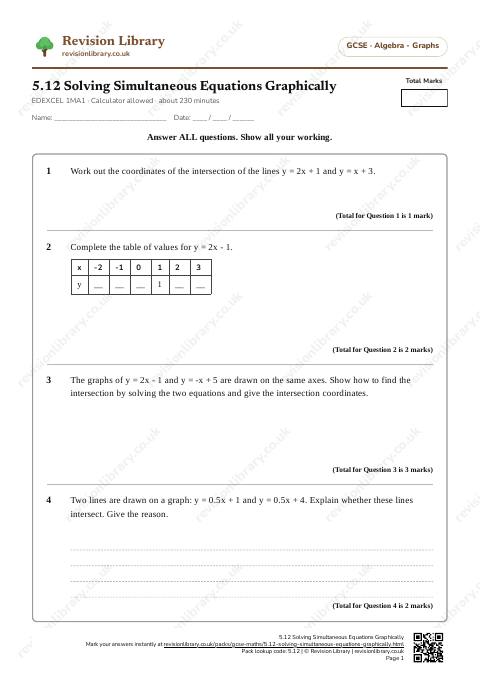
Revision Library
revisionlibrary.co.uk
GCSE · Algebra - Graphs
5.12 Solving Simultaneous Equations Graphically
EDEXCEL 1MA1 · Calculator allowed · about 230 minutes
Work out the coordinates of the intersection of the lines y = 2x + 1 and y = x + 3.
(Total for Question 1 is 1 mark)
2
Complete the table of values for y = 2x - 1.
x
-2
-1
0
1
2
3
y
__
__
__
1
__
__
(Total for Question 2 is 2 marks)
3
The graphs of y = 2x - 1 and y = -x + 5 are drawn on the same axes. Show how to find the intersection by solving the two equations and give the intersection coordinates.
(Total for Question 3 is 3 marks)
4
Two lines are drawn on a graph: y = 0.5x + 1 and y = 0.5x + 4. Explain whether these lines intersect. Give the reason.
(Total for Question 4 is 2 marks)
5
The lines y = 3x - 2 and y = x + 4 intersect. Work out the coordinates of the point of intersection.
(Total for Question 5 is 2 marks)
6
The lines y = 3x - 2 and y = 1 are already drawn on the grid. Write down the solution to the simultaneous equations shown by the two lines.
(Total for Question 6 is 1 mark)
7
The diagram shows two straight lines, l1 and l2, drawn on the same grid. l1 has equation y = 2x - 1 and l2 has equation y = -x + 5.
(a)Write down the coordinates of the point where l1 and l2 intersect.(1)
(b)Hence write down the solution to the simultaneous equations y = 2x - 1 and y = -x + 5.(2)
(Total for Question 7 is 3 marks)
8
The graphs of two straight lines intersect at the point (-2, 5). Which of the following is the solution to the pair of simultaneous equations represented by the lines?
A) x = 5, y = -2
B) x = -2, y = 5
C) x = 2, y = -5
D) x = -5, y = 2
(Total for Question 8 is 1 mark)
9
The graphs of y = -2x + 9 and y = 4x - 3 are drawn on the grid. Write down the solution of the simultaneous equations y = -2x + 9 and y = 4x - 3.
(Total for Question 9 is 2 marks)
10
The graphs of y = 2x - 6 and y = -x + 6 are drawn on the grid. Write down the solution of the simultaneous equations y = 2x - 6 and y = -x + 6.
(Total for Question 10 is 2 marks)
11
The graphs of y = x - 1 and y = -2x - 7 are drawn on the grid. Write down the solution of the simultaneous equations y = x - 1 and y = -2x - 7.
(Total for Question 11 is 2 marks)
12
The graphs of y = 1 and y = 3x - 5 are drawn on the grid. Write down the solution of the simultaneous equations y = 1 and y = 3x - 5.
(Total for Question 12 is 2 marks)
13
The graphs of two straight lines intersect at the point (-3, 4). Which of the following is the solution to the pair of simultaneous equations represented by the lines?
A) x = 4, y = -3
B) x = -3, y = 4
C) x = 3, y = -4
D) x = -4, y = -3
(Total for Question 13 is 1 mark)
14
Rearrange 3x + y = 9 to make y the subject, ready for plotting.
(Total for Question 14 is 1 mark)
15
A student draws two lines on graph paper: y = x + 2 and y = -2x + 8. They think the intersection is at x = 3. Use substitution to check whether x = 3 is correct and state the correct intersection coordinates.
(a)Substitute x = 3 into both equations and show whether the y-values are equal.(2)
(b)Solve algebraically to find the correct intersection coordinates.(2)
(Total for Question 15 is 4 marks)
16
Two straight lines are given by y = 2x - 3 and y = -x + 4. Work out the coordinates of their intersection point.
(Total for Question 16 is 2 marks)
17
A cinema sells adult tickets for x pounds and child tickets for y pounds. The graphs of 2x + y = 23 and x + 3y = 29 are drawn on the grid, where the axes show ticket price in pounds.
(a)Use the graph to find the price of an adult ticket and the price of a child ticket.(2)
(b)Find the total cost for a family of 2 adults and 2 children.(2)
(Total for Question 17 is 4 marks)
18
The lines y = 2x - 2 and -2x + y = 2 are drawn on the same grid. Explain what the graph shows about the solutions of the simultaneous equations.
(Total for Question 18 is 2 marks)
19
Two taxi firms charge as follows. Firm A: a fixed charge of £3 plus £9 per mile. Firm B: a fixed charge of £35 plus £5 per mile. Draw a graph of the cost against the number of miles for each firm on the same axes, and use it to find the number of miles for which the two firms charge the same, and what that charge is.
(Total for Question 19 is 3 marks)
20
On a grid, draw the graphs of y = 3x + 3 and y = -x + 3 for values of x from -5 to 7. Use your graphs to solve the simultaneous equations. (State the values of x and y where the lines cross.)
(Total for Question 20 is 3 marks)
21
On a grid, draw the graphs of y = 2x - 4 and y = 4x - 10 for values of x from -5 to 7. Use your graphs to solve the simultaneous equations. (State the values of x and y where the lines cross.)
(Total for Question 21 is 3 marks)
22
The straight lines 2x + 2y = 20 and y = 3x - 2 are drawn on the same grid. Draw both lines and use your graph to solve the simultaneous equations. Show how you found two points for each line.
(Total for Question 22 is 4 marks)
23
The lines y = 2x and y = 2x + 4 are drawn on the same grid. Explain what the graph shows about the solutions of the simultaneous equations.
(Total for Question 23 is 2 marks)
24
Two taxi firms charge as follows. Firm A: a fixed charge of £3 plus £4 per mile. Firm B: a fixed charge of £6 plus £3 per mile. Draw a graph of the cost against the number of miles for each firm on the same axes, and use it to find the number of miles for which the two firms charge the same, and what that charge is.
(Total for Question 24 is 3 marks)
25
Complete the table of values for y = 3x - 2, for x = -3, 0, 1, 5. Give the four y values in order.
(Total for Question 25 is 2 marks)
26
The straight lines 2x + 2y = 12 and x - 2y = -18 are drawn on the same grid. Draw both lines and use your graph to solve the simultaneous equations. Show how you found two points for each line.
(Total for Question 26 is 4 marks)
27
The lines y = 4x + 2 and -4x + y = -4 are drawn on the same grid. Explain what the graph shows about the solutions of the simultaneous equations.
(Total for Question 27 is 2 marks)
28
Two plumbers charge as follows. Firm A: a fixed charge of £5 plus £5 per hour. Firm B: a fixed charge of £25 plus £1 per hour. Draw a graph of the cost against the number of hours for each firm on the same axes, and use it to find the number of hours for which the two firms charge the same, and what that charge is.
(Total for Question 28 is 3 marks)
29
Complete the table of values for y = -3x - 2, for x = -3, -2, 0, 3. Give the four y values in order.
(Total for Question 29 is 2 marks)
30
Two taxi firms charge as follows. Firm A: a fixed charge of £4 plus £8 per mile. Firm B: a fixed charge of £20 plus £6 per mile. Draw a graph of the cost against the number of miles for each firm on the same axes, and use it to find the number of miles for which the two firms charge the same, and what that charge is.
(Total for Question 30 is 3 marks)
31
The lines y = 4x + 4 and -4x + y = -3 are drawn on the same grid. Explain what the graph shows about the solutions of the simultaneous equations.
(Total for Question 31 is 2 marks)
32
Two van hire firms charge as follows. Firm A: a fixed charge of £8 plus £9 per day. Firm B: a fixed charge of £32 plus £1 per day. Draw a graph of the cost against the number of days for each firm on the same axes, and use it to find the number of days for which the two firms charge the same, and what that charge is.
(Total for Question 32 is 3 marks)
33
Show that the point (2, 3) is the solution to the simultaneous equations y = x + 1 and y = -2x + 7.
(Total for Question 33 is 2 marks)
34
By drawing suitable straight lines on the grid, solve the simultaneous equations y = x + 3 and y = 2x + 1.
(Total for Question 34 is 4 marks)
35
This question has two parts.
(a)Rearrange 2x + y = 8 to make y the subject.(1)
(b)The line y = x - 1 is already drawn on the grid. By completing a table of values and drawing the graph of y = 8 - 2x on the same grid, solve the simultaneous equations 2x + y = 8 and y = x - 1.(4)
(Total for Question 35 is 5 marks)
36
The line y = 4 - x is already drawn on the grid. By drawing the graph of y = 2x - 5 on the same grid, solve the simultaneous equations y = 4 - x and y = 2x - 5.
(Total for Question 36 is 4 marks)
37
Two straight lines have equations y = 2x + 3 and y = 2x - 1.
(a)Without drawing the graphs, state whether the two lines are parallel. Give a reason for your answer.(2)
(b)Hence explain what this tells you about the solution to the simultaneous equations y = 2x + 3 and y = 2x - 1.(1)
(Total for Question 37 is 3 marks)
38
The graphs of y = 1/2 x + 1 and y = -x + 7 are drawn on the grid. Write down the solution of the simultaneous equations y = 1/2 x + 1 and y = -x + 7.
(Total for Question 38 is 2 marks)
39
Which pair of simultaneous equations below has no solution, because the two lines are parallel?
A) y = 2x + 5 and y = 5x + 2
B) 3x + y = 8 and y = 3x - 8
C) 2y = 4x + 6 and y = 2x - 1
D) y = x + 4 and 2x - y = 4
(Total for Question 39 is 1 mark)
40
Solve the simultaneous equations x + y = 7 and y = 2x - 2 by drawing suitable straight-line graphs.
(a)Rearrange x + y = 7 to make y the subject.(1)
(b)By drawing suitable graphs on the grid, solve the simultaneous equations x + y = 7 and y = 2x - 2.(4)
(Total for Question 40 is 5 marks)
41
Show that the point (3, -1) is the solution to the simultaneous equations y = 2x - 7 and y = -3x + 8.
(Total for Question 41 is 2 marks)
42
The lines y = 3x + 2 and y = 3x - 4 are shown on the grid. They never meet. What does this tell you about the solution of the simultaneous equations y = 3x + 2 and y = 3x - 4?
(Total for Question 42 is 1 mark)
43
A line with equation y = 0.5x + 1 and a parabola with equation y = x2 - 2x + 2 are drawn on the same axes. Work out the x-coordinates of their points of intersection.
(Total for Question 43 is 3 marks)
44
Sketch on the same axes the graphs of y = -x + 6 and y = x2 - 4x + 3 and use your sketch to estimate the x-coordinates of their intersections. Give your answers to 1 decimal place.
(Total for Question 44 is 3 marks)
45
Priya is comparing two mobile phone tariffs. Tariff A: monthly cost C (pounds) = 20 + 0.02m, where m is the number of minutes used. Tariff B: monthly cost C (pounds) = 8 + 0.06m. The graphs of Tariff A and Tariff B are shown on the grid for 0 ≤ m ≤ 500.
(a)Use the graph to write down the number of minutes for which the two tariffs cost the same amount.(1)
(b)A customer uses 150 minutes in a month. State which tariff is cheaper, and by how much.(3)
(c)Bilal uses more than 400 minutes a month. Which tariff should he choose? Give a reason using the graph.(2)
(Total for Question 45 is 6 marks)
46
Two straight lines are drawn on the same grid and cross at a single point. Explain why the point of intersection gives the solution to the pair of simultaneous equations.
(Total for Question 46 is 2 marks)
47
The diagram shows two straight lines drawn on a grid. Line 1 passes through (0, 6) and (4, -2). Line 2 passes through (0, -3) and (3, 3).
(a)Find the equation of Line 1 in the form y = mx + c.(2)
(b)Find the equation of Line 2 in the form y = mx + c.(2)
(c)Hence find the coordinates of the point of intersection of the two lines, showing your method.(3)
(Total for Question 47 is 7 marks)
48
This question has three parts.
(a)Rearrange 3x - 2y = 6 to make y the subject.(1)
(b)Rearrange x + y = 7 to make y the subject.(1)
(c)By drawing suitable graphs on the grid, solve the simultaneous equations 3x - 2y = 6 and x + y = 7.(4)
(Total for Question 48 is 6 marks)
49
The graphs of y = x2 - 1 and y = 3 are drawn on the same grid. How many points of intersection are there, and what does this tell you about the number of solutions to the equation x2 - 1 = 3?
A) 0 intersections, no solutions
B) 1 intersection, 1 solution
C) 2 intersections, 2 solutions
D) 3 intersections, 3 solutions
(Total for Question 49 is 1 mark)
50
Without drawing any graphs, show that the simultaneous equations y = 4x - 3 and 8x - 2y = 7 do not have a solution.
(Total for Question 50 is 3 marks)
51
The graph of y = kx + 2 meets the curve y = 3 - x2 at exactly one point. Find the value(s) of k.
(Total for Question 51 is 4 marks)
52
A straight line passes through the points where y = x2 - 5x + 4 crosses the x-axis. Find the equation of this straight line and hence find its intersections with the curve y = x2 - 5x + 4 again, confirming consistency.
(Total for Question 52 is 4 marks)
53
The curve y = x2 is drawn on the grid.
(a)On the same grid, draw the graph of y = x + 2.(2)
(b)Hence write down the two pairs of values (x, y) that solve the simultaneous equations y = x2 and y = x + 2.(2)
(Total for Question 53 is 4 marks)
54
The lines y = kx + 4 and y = 3x - 2 intersect at the point where x = 3.
(a)The lines y = kx + 4 and y = 3x - 2 intersect at the point where x = 3. Find the y-coordinate of the point of intersection.(1)
(b)Hence find the value of k.(2)
(Total for Question 54 is 3 marks)
55
Show that the graphs of y = 2x + 1 and y = -x2 + 5x - 1 intersect at x = 1 and x = 2. Then find the y-coordinates of the intersection points and give the coordinates.
(Total for Question 55 is 5 marks)
56
Consider the pair of equations y = 0.2x2 + x - 1 and y = 0.8x + 2. Use algebra to form the equation whose roots are the x-coordinates of the intersections. Then find those x-coordinates to 2 decimal places and give the intersection points.
(Total for Question 56 is 3 marks)
57
The straight line L has equation y = mx + 3 and is tangent to the curve y = x2 - 2x + 7 at x = a. Using the condition that the line and curve have equal gradients at the point of tangency and that they meet at x = a, express m in terms of a, and find the possible value(s) of a. Give the coordinates of the tangency point when a = 2.
(Total for Question 57 is 6 marks)
58
Two lines have equations y = kx + 2 and y = 3x + 2, where k is a constant and k is not equal to 3.
(a)Show that the point (0, 2) lies on both lines for every value of k.(2)
(b)Explain why (0, 2) must be the only point of intersection of the two lines when k is not equal to 3.(2)
(Total for Question 58 is 4 marks)
Mark scheme · 5.12 Solving Simultaneous Equations Graphically
Question 1
(2, 5) caoB1
Answer: (2, 5)
Question 2
at least 3 of the 5 missing values correctB1
all 5 missing values correct (cao)B1
Answer: x = -2, -1, 0, 1, 2, 3 gives y = -5, -3, -1, 1, 3, 5
Question 3
equate: 2x - 1 = -x + 5 or equivalentM1
solve: 3x = 6 or x = 2M1
(2, 3) caoA1
Answer: (2, 3)
Question 4
state: they are parallel so do not intersectB1
reason: same gradient 0.5 but different intercepts 1 and 4 oeB1
Answer: They do not intersect because both have gradient 0.5 but different y-intercepts, so the lines are parallel.
Question 5
equate 3x - 2 = x + 4 or equivalent methodM1
(3, 7) caoA1
Answer: (3, 7)
Question 6
x = 1, y = 1 (oe)B1
Answer: x = 1, y = 1
Question 7
(a) (2, 3)B1
(a) Answer: (2, 3)
(b) x = 2 (ft from (a))B1
(b) y = 3 (ft from (a))B1
(b) Answer: x = 2, y = 3
Question 8
BB1
Answer: B) x = -2, y = 5
Question 9
x = 2B1
y = 5 (oe as a coordinate pair)B1
Answer: x = 2, y = 5
Question 10
x = 4B1
y = 2 (oe as a coordinate pair)B1
Answer: x = 4, y = 2
Question 11
x = -2B1
y = -3 (oe as a coordinate pair)B1
Answer: x = -2, y = -3
Question 12
x = 2B1
y = 1 (oe as a coordinate pair)B1
Answer: x = 2, y = 1
Question 13
BB1
Answer: B) x = -3, y = 4
Question 14
y = 9 - 3x (oe)B1
Answer: y = 9 - 3x
Question 15
(a) y1 = 3 + 2 = 5 and y2 = -2*3 + 8 = 2 shownM1
(a) conclusion: not equal so x = 3 is incorrectA1
(a) Answer: Not equal; y1 = 5, y2 = 2, so x = 3 is incorrect.
(b) equate x + 2 = -2x + 8 and solve to get 3x = 6M1
(b) (2, 4) caoA1
(b) Answer: (2, 4)
Question 16
substitute or set 2x - 3 = -x + 4 and solve for xM1
x = 7/3, y = 5/3 caoA1
Answer:(7/3, 5/3) (Approximately (2.333, 1.667))
Question 17
(a) adult ticket = £8 (x = 8)B1
(a) child ticket = £7 (y = 7)B1
(a) Answer: Adult ticket = £8, child ticket = £7
(b) 2(8) + 2(7)M1
(b) £30 caoA1
(b) Answer: £30
Question 18
lines have the same gradientB1
lines never meet so there is no solutionB1
Answer: No solution because the lines are parallel
Question 19
line for Firm A drawn or equation C = 9x + 3M1
line for Firm B drawn or equation C = 5x + 35M1
8 miles, £75 caoA1
Answer: 8 miles, £75
Question 20
plots at least two correct points or a table for one lineM1
both lines drawn correctlyM1
x = 0, y = 3 caoA1
Answer: x = 0, y = 3
Question 21
plots at least two correct points or a table for one lineM1
both lines drawn correctlyM1
x = 3, y = 2 caoA1
Answer: x = 3, y = 2
Question 22
table or two points on first line found correctly (e.g. intercepts)M1
two points on second line found correctlyM1
both lines drawn and intersection identifiedM1
x = 3, y = 7 caoA1
Answer: x = 3, y = 7
Question 23
lines have the same gradientB1
lines never meet so there is no solutionB1
Answer: No solution because the lines are parallel
Question 24
line for Firm A drawn or equation C = 4x + 3M1
line for Firm B drawn or equation C = 3x + 6M1
3 miles, £15 caoA1
Answer: 3 miles, £15
Question 25
substitutes at least two x values correctlyM1
-11, -2, 1, 13 caoA1
Answer: -11, -2, 1, 13
Question 26
table or two points on first line found correctly (e.g. intercepts)M1
two points on second line found correctlyM1
both lines drawn and intersection identifiedM1
x = -2, y = 8 caoA1
Answer: x = -2, y = 8
Question 27
lines have the same gradientB1
lines never meet so there is no solutionB1
Answer: No solution because the lines are parallel
Question 28
line for Firm A drawn or equation C = 5x + 5M1
line for Firm B drawn or equation C = x + 25M1
5 hours, £30 caoA1
Answer: 5 hours, £30
Question 29
substitutes at least two x values correctlyM1
7, 4, -2, -11 caoA1
Answer: 7, 4, -2, -11
Question 30
line for Firm A drawn or equation C = 8x + 4M1
line for Firm B drawn or equation C = 6x + 20M1
8 miles, £68 caoA1
Answer: 8 miles, £68
Question 31
lines have the same gradientB1
lines never meet so there is no solutionB1
Answer: No solution because the lines are parallel
Question 32
line for Firm A drawn or equation C = 9x + 8M1
line for Firm B drawn or equation C = x + 32M1
3 days, £35 caoA1
Answer: 3 days, £35
Question 33
substitutes x = 2 into both equationsM1
shows y = 3 from both equations, cso, so (2,3) satisfies both equationsA1
Answer: y = 2 + 1 = 3 and y = -2(2) + 7 = 3, both give y = 3, so (2,3) satisfies both equations
Question 34
draws y = x + 3 correctly through at least 3 correct points, e.g. (0,3), (1,4), (-2,1)M1
draws y = 2x + 1 correctly through at least 3 correct points, e.g. (0,1), (1,3), (2,5)M1
identifies intersection point at (2,5)A1
states solution x = 2, y = 5 (ft from their graph)A1
Answer: x = 2, y = 5
Question 35
(a) y = 8 - 2x (oe)B1
(a) Answer: y = 8 - 2x
(b) table of at least 3 correct values for y = 8 - 2x, e.g. x=0,y=8; x=2,y=4; x=4,y=0M1
(b) correct line y = 8 - 2x drawn, ft from tableM1
(b) identifies intersection at (3,2)A1
(b) states solution x = 3, y = 2 (ft)A1
(b) Answer: x = 3, y = 2
Question 36
at least 3 correct points for y = 2x - 5, e.g. (0,-5), (2,-1), (3,1)M1
correct line y = 2x - 5 drawnA1
identifies intersection at (3,1)B1
states solution x = 3, y = 1 (ft)B1
Answer: x = 3, y = 1
Question 37
(a) yes, the lines are parallelB1
(a) reason: both lines have the same gradient (coefficient of x = 2)B1
(a) Answer: Yes, the lines are parallel because they both have gradient 2
(b) the equations have no solution because parallel lines with different y-intercepts never meetB1
(b) Answer: There is no solution, since the lines never intersect
Question 38
x = 4B1
y = 3 (oe as a coordinate pair)B1
Answer: x = 4, y = 3
Question 39
CB1
Answer: C) 2y = 4x + 6 and y = 2x - 1
Question 40
(a) y = 7 - x (oe)B1
(a) Answer: y = 7 - x
(b) at least 3 correct points for y = 7 - x, e.g. (0,7), (3,4), (6,1), ft from (a)M1
(b) at least 3 correct points for y = 2x - 2, e.g. (0,-2), (2,2), (4,6)M1
(b) both correct straight lines drawnA1
(b) states solution x = 3, y = 4 (ft from their graphs, intersection identified)B1
(b) Answer: x = 3, y = 4
Question 41
substitutes x = 3 into both equationsM1
shows y = -1 from both equations, cso, so (3,-1) satisfies both equationsA1
Answer: y = 2(3) - 7 = -1 and y = -3(3) + 8 = -1, both give y = -1, so (3,-1) satisfies both equations
Question 42
there is no solution, because the lines are parallel (same gradient, different y-intercepts) so they never intersectB1
Answer: No solution - the lines are parallel and never meet
Question 43
equate x2 - 2x + 2 = 0.5x + 1 to form quadratic x2 - 2.5x + 1 = 0M1
use quadratic formula or complete the square to find xM1
x = (2.5 ± √2.25)/2 = (2.5 ± 1.5)/2 so x = 2 or x = 0.5 caoA1
Answer:x = 2 and x = 0.5 (Points of intersection at x = 2 and x = 1/2)
Question 44
sketch showing both graphs with at least one intersection roughly located and correct axes scaleM1
identify two intersection x-values from sketch within reasonable accuracyM1
answers x approx -0.8 and x approx 3.8 to 1 dp (or equivalent to 1 dp) caoA1
Answer: x = -0.8 and x = 3.8 (to 1 decimal place)
Question 45
(a) 300 minutes (awrt 300, accept range 290 to 310)B1
(a) Answer: 300 minutes
(b) substitutes m = 150 into both C = 20 + 0.02m and C = 8 + 0.06mM1
(b) Tariff A = £23, Tariff B = £17A1
(b) Tariff B is cheaper by £6A1
(b) Answer: Tariff B is cheaper, by £6
(c) Tariff AB1
(c) reason: for m > 300, the graph of Tariff A lies below the graph of Tariff B, so Tariff A costs lessB1
(c) Answer: Tariff A, because for minutes above 300 its line is below Tariff B's line
Question 46
the point of intersection is the only point that lies on both linesB1
its coordinates satisfy both equations at the same time, so they give the solution to the pair of simultaneous equationsB1
Answer: The intersection point is the only point common to both lines, so its (x,y) coordinates are the solution that satisfies both equations simultaneously
Question 47
(a) gradient = (-2 - 6) / (4 - 0) = -2M1
(a) y = -2x + 6 (oe)A1
(a) Answer: y = -2x + 6
(b) gradient = (3 - (-3)) / (3 - 0) = 2M1
(b) y = 2x - 3 (oe)A1
(b) Answer: y = 2x - 3
(c) sets -2x + 6 = 2x - 3M1
(c) correctly solves for x: 9 = 4x, x = 2.25M1
(c) y = 1.5, coordinates (2.25, 1.5) caoA1
(c) Answer: (2.25, 1.5)
Question 48
(a) y = 1.5x - 3 (oe, e.g. y = (3x - 6) / 2)B1
(a) Answer: y = 1.5x - 3
(b) y = 7 - xB1
(b) Answer: y = 7 - x
(c) draws y = 1.5x - 3 correctly, ft from (a), e.g. through (0,-3), (2,0), (4,3)M1
(c) draws y = 7 - x correctly, ft from (b), e.g. through (0,7), (4,3), (7,0)M1
(c) identifies intersection at (4,3)A1
(c) states solution x = 4, y = 3 (ft)A1
(c) Answer: x = 4, y = 3
Question 49
CB1
Answer: C) 2 intersections, 2 solutions
Question 50
rearranges 8x - 2y = 7 to y = 4x - 3.5 (oe, e.g. y = 4x - 7/2)M1
compares gradients and states both lines have gradient 4A1
concludes the lines are parallel (different y-intercepts, -3 and -3.5) so the simultaneous equations have no solutionA1
Answer: No solution - the two lines are parallel (both gradient 4, different y-intercepts)
Question 51
set kx + 2 = 3 - x2 to form x2 + kx -1 = 0 and state condition for one root is discriminant = 0M1
compute discriminant: k2 - 4(1)(-1) = k2 + 4M1
set k2 + 4 = 0 and conclude no real k makes discriminant zero, or recognise discriminant always positiveM1
no real value of k gives exactly one real intersection; always two real intersections for real k caoA1
Answer: No real value of k. The discriminant k2 + 4 is always positive for real k, so the quadratic has two distinct real roots for every real k.
Question 52
find x-intercepts of curve: solve x2 - 5x + 4 = 0 giving x = 1 and x = 4M1
find equation of line through (1,0) and (4,0): recognise it is the x-axis y = 0M1
substitute y = 0 into curve to verify intersections at x = 1 and x = 4M1
equation y = 0 and intersections x = 1, 4 caoA1
Answer: Equation: y = 0. Intersections with the curve occur at x = 1 and x = 4 (points (1,0) and (4,0)).
Question 53
(a) at least 2 correct points, e.g. (0,2), (2,4)M1
(a) correct straight line drawnA1
(a) Answer: Straight line through (0,2) and (2,4)
(b) x = -1, y = 1B1
(b) x = 2, y = 4B1
(b) Answer: (-1, 1) and (2, 4)
Question 54
(a) y = 7B1
(a) Answer: y = 7
(b) substitutes the point (3, 7) into y = kx + 4M1
(b) k = 1 (ft from (a))A1
(b) Answer: k = 1
Question 55
equate 2x + 1 = -x2 + 5x - 1 to get x2 - 3x + 2 = 0 and show factor or algebraic manipulation leading to (x-1)(x-2)=0 or show substitution gives zeroM1
obtain x = 1 and x = 2 (show roots) oeM1
substitute x = 1 into y = 2x + 1 to get y = 3, and x = 2 gives y = 5M1
coordinates (1, 3) and (2, 5) caoA1
explicit statement 'hence' linking substitution to intersection coordinatesB1
Answer: Intersection points (1, 3) and (2, 5).
Question 56
equate 0.2x2 + x -1 = 0.8x + 2 to form 0.2x2 + 0.2x -3 = 0 or multiply to x2 + x -15 = 0M1
use quadratic formula to find x = [-1 ± √1 + 60]/2 = [-1 ± √61]/2M1
x approx ( -1 + 7.8102)/2 = 3.4051 -> 3.41 and x approx ( -1 - 7.8102)/2 = -4.4051 -> -4.41; intersection points (3.41, 4.72) and (-4.41, -1.52) cao (accept 4.73 and -1.53 if the rounded x-values are used)A1
Answer: x = ( -1 ± √61 )/2 approx 3.41 and -4.41. Intersection points approx (3.41, 0.8*3.4051 + 2 = 4.72) and (-4.41, 0.8*(-4.4051) + 2 = -1.52) to 2 dp.
Question 57
state gradient of curve dy/dx = 2x - 2 and set m = 2a - 2 for tangent at x = aM1
state point of contact satisfies a2 - 2a + 7 = m a + 3M1
substitute m = 2a - 2 into equation to get a2 - 2a + 7 = (2a - 2)a + 3 = 2a2 - 2a + 3M1
rearrange correctly to -a2 + 4 = 0, i.e. a2 = 4, giving a = 2 or a = -2M1
state a = 2 gives m = 2(2) - 2 = 2, and a = -2 gives m = 2(-2) - 2 = -6 caoA1
for given a = 2, compute coordinates: y = 22 - 2(2) + 7 = 7, so tangency point (2, 7), with working shown caoA1
Answer: m = 2a - 2; tangency occurs when a = 2 (m = 2) or a = -2 (m = -6). For a = 2 the tangency point is (2, 7).
Question 58
(a) substitutes x = 0 into both y = kx + 2 and y = 3x + 2M1
(a) shows both give y = 2 regardless of the value of k, cso, so (0,2) satisfies both equationsA1
(a) Answer: y = k(0) + 2 = 2 and y = 3(0) + 2 = 2, both give y = 2 for every k, so (0,2) lies on both lines
(b) since k is not equal to 3, the two lines have different gradients (k and 3), so they are not parallel and not identicalB1
(b) two distinct straight lines with different gradients intersect at exactly one point, and (a) shows this point is (0,2), so it must be the unique intersectionB1
(b) Answer: Because k does not equal 3 the lines have different gradients, so they are not parallel; two non-parallel lines meet at exactly one point, and that point must be (0,2)
Put this topic and others into one printable pack.
Open the Pack Builder
Worksheets are written for Revision Library and come with a full mark scheme; a few English packs quote an out-of-copyright text, and name it on the page. Exam board names and specification codes say which qualification a pack suits: we are not affiliated with, endorsed by or approved by any exam board, and no past-paper question is reproduced here. Rights queries: hello@revisionlibrary.co.uk