The equation of a straight line describes every point (x, y) that lies on it, most often written as y = mx + c, where m is the gradient and c is the y-intercept. GCSE questions require finding this equation from two known points, a gradient and a point, or a parallel or perpendicular condition.
Find the gradient m, either by using two known points with the formula (y2 - y1) / (x2 - x1), or by identifying it directly from a parallel or perpendicular condition.
If the line must be parallel to a given line, use the same gradient; if perpendicular, use the negative reciprocal of that gradient (multiply the two gradients to check they give -1).
Substitute the gradient and the coordinates of one known point into y = mx + c.
Solve the resulting equation to find the value of c.
Write the final equation in the form y = mx + c, using your values of m and c.
Check your equation by substituting the other known point into it and confirming both sides match.
Worked example
Find the equation of the straight line that passes through the points (1, 5) and (4, 14). Give your answer in the form y = mx + c.
Gradient = (14 - 5) / (4 - 1) = 9 / 3 = 3.
Substitute the point (1, 5) and m = 3 into y = mx + c: 5 = 3(1) + c.
Solve for c: 5 = 3 + c, so c = 2, giving the final answer y = 3x + 2.
Revision Library
revisionlibrary.co.uk
GCSE · Algebra: straight-line graphs
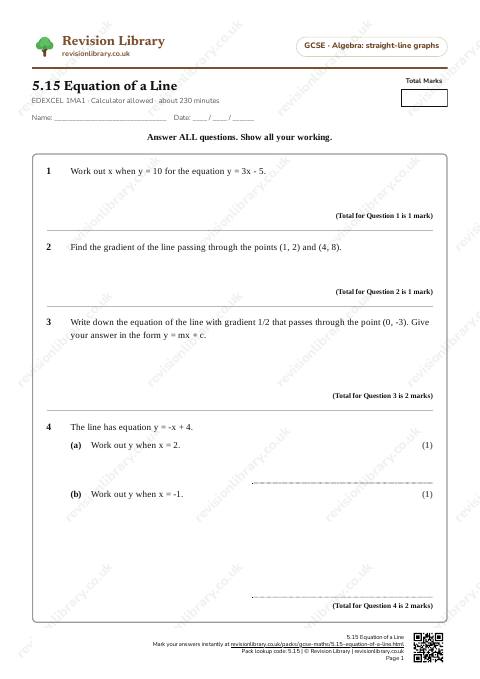
5.15 Equation of a Line
EDEXCEL 1MA1 · Calculator allowed · about 230 minutes
Work out x when y = 10 for the equation y = 3x - 5.
(Total for Question 1 is 1 mark)
2
Find the gradient of the line passing through the points (1, 2) and (4, 8).
(Total for Question 2 is 1 mark)
3
Write down the equation of the line with gradient 1/2 that passes through the point (0, -3). Give your answer in the form y = mx + c.
(Total for Question 3 is 2 marks)
4
The line has equation y = -x + 4.
(a)Work out y when x = 2.(1)
(b)Work out y when x = -1.(1)
(Total for Question 4 is 2 marks)
5
A straight line has equation y = 5x - 3.
(a)Write down the gradient of the line.(1)
(b)Write down the coordinates of the point where the line crosses the y-axis.(1)
(Total for Question 5 is 2 marks)
6
A line passes through the point (2, 5) and has a y-intercept of 1. Find the equation of the line in the form y = mx + c.
(Total for Question 6 is 2 marks)
7
A line has equation y = 4x - 7. State whether the point (3, 5) lies on this line. Show your working.
(Total for Question 7 is 2 marks)
8
Given y = 3x - 6, work out the x-intercept and the y-intercept of this line.
(Total for Question 8 is 2 marks)
9
The equation of a straight line is y = 3x + 7.
(a)Write down the gradient of the line.(1)
(b)Write down the coordinates of the point where the line crosses the y-axis.(1)
(Total for Question 9 is 2 marks)
10
A straight line has equation y = 5 - 2x.
(a)State the gradient of the line.(1)
(b)State the y-intercept of the line.(1)
(Total for Question 10 is 2 marks)
11
Point C has coordinates (2, 3) and point D has coordinates (8, 21). Find the gradient of the line CD.
(Total for Question 11 is 2 marks)
12
Which of these lines is parallel to the line with equation y = 4x - 1?
A) y = 4x + 5
B) y = -4x + 5
C) y = (1/4)x - 1
D) 4y = x - 8
(Total for Question 12 is 1 mark)
13
Find the gradient of the line joining the points A(2, 5) and B(6, 13).
(Total for Question 13 is 2 marks)
14
Find the equation of the line passing through the points (-1, 2) and (3, 10). Give your answer in the form y = mx + c.
(Total for Question 14 is 3 marks)
15
The line l has equation y = -1/2 x + 4. Find the equation of the line m that is parallel to l and passes through the point (4, 1). Give your answer in the form y = mx + c.
(Total for Question 15 is 2 marks)
16
Work out the gradient of the line joining the points (2, 3) and (5, 11).
(Total for Question 16 is 1 mark)
17
Find the equation of the line with gradient -2 that passes through the point (4, -1). Give your answer in the form y = mx + c.
(Total for Question 17 is 3 marks)
18
Line L1 has equation y = 2x + 3. Line L2 has equation 4x - 2y = 6. Determine whether L1 and L2 are the same line, are parallel but different lines, or are neither. Justify your answer.
(Total for Question 18 is 2 marks)
19
Find the equation of the straight line that is parallel to y = 4x - 3 and passes through the point (2, 1). Give your answer in the form y = mx + c.
(Total for Question 19 is 3 marks)
20
Line L has equation 3x + 2y = 12.
(a)Find the coordinates of the point where L crosses the x-axis.(2)
(b)Find the coordinates of the point where L crosses the y-axis.(2)
(Total for Question 20 is 4 marks)
21
A taxi firm uses the formula C = 2.50 + 1.20m to work out the cost, C pounds, of a journey of m miles. This formula is the equation of a straight line.
(a)State the gradient of the line and explain what it represents in this context.(2)
(b)State the y-intercept of the line and explain what it represents in this context.(2)
(Total for Question 21 is 4 marks)
22
Show that the point (4, 11) lies on the line with equation y = 3x - 1.
(Total for Question 22 is 2 marks)
23
Line L has equation 2x + 3y = 12. L crosses the positive x-axis at point A and the positive y-axis at point B. A triangle is formed by L and the positive x- and y-axes.
(a)Find the coordinates of A and the coordinates of B.(2)
(b)Find the area of the triangle formed by L and the positive x- and y-axes.(2)
(Total for Question 23 is 4 marks)
24
A straight line has gradient -1 and passes through the point (1, -8). Find an equation of the line.
(Total for Question 24 is 3 marks)
25
A taxi charges £2 plus £3 per mile. Write a formula for the total cost, C pounds, after m miles.
(Total for Question 25 is 2 marks)
26
The line y = 4x + k passes through the point (3, 20). Find the value of k, and the coordinates of the point where the line crosses the x-axis.
(Total for Question 26 is 3 marks)
27
A straight line passes through the points A(0, 1) and B(2, 9). Find an equation of the line.
(Total for Question 27 is 3 marks)
28
A straight line has gradient -1/2 and passes through the point (4, 2). Find an equation of the line.
(Total for Question 28 is 3 marks)
29
A straight line crosses the x-axis at (6, 0) and the y-axis at (0, -4). Find an equation of the line.
(Total for Question 29 is 3 marks)
30
A straight line has gradient 3 and passes through the point (1, 0). Find an equation of the line.
(Total for Question 30 is 3 marks)
31
A taxi charges £2 plus £8 per mile. Write a formula for the total cost, C pounds, after m miles.
(Total for Question 31 is 2 marks)
32
A straight line crosses the x-axis at (5, 0) and the y-axis at (0, -4). Find an equation of the line.
(Total for Question 32 is 3 marks)
33
Write -3x + 4y = -8 in the form y = mx + c.
(Total for Question 33 is 2 marks)
34
A straight line has gradient 1 and passes through the point (-2, -9). Find an equation of the line.
(Total for Question 34 is 3 marks)
35
A straight line crosses the x-axis at (3, 0) and the y-axis at (0, 5). Find an equation of the line.
(Total for Question 35 is 3 marks)
36
A straight line has gradient -1/2 and passes through the point (-6, -2). Find an equation of the line.
(Total for Question 36 is 3 marks)
37
Line L has equation 2y = 6x + 8. Write the equation of L in the form y = mx + c, and state the gradient and the y-intercept of L.
(Total for Question 37 is 3 marks)
38
Find the equation of the straight line with gradient 3 that passes through the point (2, 5). Give your answer in the form y = mx + c.
(Total for Question 38 is 3 marks)
39
A straight line passes through the points (1, 4) and (3, 10). Find the equation of the line, giving your answer in the form y = mx + c.
(Total for Question 39 is 4 marks)
40
Answer the following about horizontal and vertical lines.
(a)Write down the equation of the straight line that is parallel to the x-axis and passes through the point (0, -3).(1)
(b)Write down the equation of the straight line that is parallel to the y-axis and passes through the point (5, 2).(1)
(Total for Question 40 is 2 marks)
41
Find the coordinates of the midpoint of the line segment joining the points (-3, 7) and (5, -1).
(Total for Question 41 is 2 marks)
42
A straight line has gradient -2 and passes through the point (3, 1). Find the equation of the line, giving your answer in the form y = mx + c.
(Total for Question 42 is 3 marks)
43
A straight line passes through the points (2, 7) and (5, -2). Find the equation of the line, giving your answer in the form y = mx + c.
(Total for Question 43 is 3 marks)
44
A straight line has equation 2x + 5y = 20.
(a)Find the coordinates of the point where the line crosses the x-axis.(2)
(b)Find the coordinates of the point where the line crosses the y-axis.(1)
(Total for Question 44 is 3 marks)
45
The line L has equation 3x - 2y + 6 = 0.
(a)Work out the gradient of L.(1)
(b)Find the equation of the line through (2, 1) parallel to L. Give your answer in the form y = mx + c.(2)
(c)Find the equation of the line through (2, 1) perpendicular to L. Give your answer in the form y = mx + c.(1)
(Total for Question 45 is 4 marks)
46
Find the value of k for which the line y = kx + 3 is perpendicular to the line 2x + y - 5 = 0. Show your working.
(Total for Question 46 is 3 marks)
47
Find the equation of the straight line that is perpendicular to y = (1/2)x + 4 and passes through the point (3, -1). Give your answer in the form y = mx + c.
(Total for Question 47 is 4 marks)
48
A has coordinates (-2, 1) and B has coordinates (4, 5). Find the length of AB, giving your answer correct to 3 significant figures.
(Total for Question 48 is 3 marks)
49
Find the equation of the straight line that is parallel to y = 3x - 5 and passes through the point (-2, 4). Give your answer in the form y = mx + c.
(Total for Question 49 is 3 marks)
50
Determine whether the point (5, 12) lies on the line with equation y = 2x + 3. You must show your working.
(Total for Question 50 is 3 marks)
51
Show that the points A(1, 2), B(3, -2) and C(5, -6) are collinear. State the equation of the line containing them.
(Total for Question 51 is 4 marks)
52
Find the equation of the perpendicular bisector of the line segment joining (1, 1) and (5, 3). Give your answer in the form y = mx + c.
(Total for Question 52 is 5 marks)
53
Line L is perpendicular to the line with equation y = -(1/3)x + 2 and passes through the point A(-1, 5).
(a)Find the gradient of L.(2)
(b)Find the equation of L, giving your answer in the form y = mx + c.(2)
(c)L crosses the x-axis at point B. Find the coordinates of B.(2)
(d)Find the length of AB, giving your answer correct to 3 significant figures.(3)
(Total for Question 53 is 9 marks)
54
A line has gradient 2/5. Find the gradient of a line that is perpendicular to it.
(Total for Question 54 is 2 marks)
55
Line L has equation y = 2x - 1. Find the equation of the line that is perpendicular to L and passes through the point (4, 9). Give your answer in the form y = mx + c.
(Total for Question 55 is 4 marks)
56
Show that the points A(1, 1), B(3, 5) and C(6, 11) are collinear.
(Total for Question 56 is 4 marks)
57
R is the point (-4, 1) and S is the point (2, 9). Find the equation of the perpendicular bisector of RS. Give your answer in the form y = mx + c.
(Total for Question 57 is 5 marks)
58
The line L1 passes through the points A(-1, -2) and B(3, 6). The line L2 passes through the points B(3, 6) and D(7, 4).
(a)Find the gradient of L1.(2)
(b)Find the gradient of L2.(2)
(c)Hence show that L1 and L2 are perpendicular at the point B.(2)
(Total for Question 58 is 6 marks)
Mark scheme · 5.15 Equation of a Line
Question 1
x = 5 caoB1
Answer: 5
Question 2
gradient = 2 caoB1
Answer: 2
Question 3
substitute gradient and point into y = mx + c to find c, or state c = -3M1
y = 1/2 x - 3 caoA1
Answer: y = 1/2 x - 3
Question 4
(a) y = 2 caoB1
(a) Answer: 2
(b) y = 5 caoB1
(b) Answer: 5
Question 5
(a) 5 caoB1
(a) Answer: 5
(b) (0, -3) caoB1
(b) Answer: (0, -3)
Question 6
find gradient m = (5 - 1)/(2 - 0) = 2 or equivalent methodM1
y = 2x + 1 caoA1
Answer: y = 2x + 1
Question 7
substitute x = 3 into y = 4x - 7 to get y = 5M1
yes, (3, 5) lies on the line caoA1
Answer: Yes, (3, 5) lies on the line since y = 4(3) - 7 = 5.
Question 8
find x-intercept by setting y = 0 to get x = 2, or find y-intercept as c = -6M1
x-intercept (2, 0) and y-intercept (0, -6) caoA1
Answer: x-intercept (2, 0); y-intercept (0, -6)
Question 9
(a) 3 caoB1
(a) Answer: 3
(b) (0, 7) oeB1
(b) Answer: (0, 7)
Question 10
(a) -2 caoB1
(a) Answer: -2
(b) 5 oe, e.g. (0, 5)B1
(b) Answer: 5
Question 11
(21 - 3) / (8 - 2) oe correct substitution into the gradient formulaM1
3 caoA1
Answer: 3
Question 12
A caoB1
Answer: A) y = 4x + 5
Question 13
correct substitution into (y2 - y1)/(x2 - x1), e.g. (13-5)/(6-2)M1
2 caoA1
Answer: 2
Question 14
find gradient m = (10 - 2)/(3 - (-1)) = 8/4 = 2M1
substitute a point into y = 2x + c to find cM1
y = 2x + 4 caoA1
Answer: y = 2x + 4
Question 15
use same gradient -1/2 and substitute point to find cM1
y = -1/2 x + 3 caoA1
Answer: y = -1/2 x + 3
Question 16
8/3 caoB1
Answer: 8/3
Question 17
substitute point into y = -2x + c to form an equation for cM1
c = 7 caoA1
y = -2x + 7 caoA1
Answer: y = -2x + 7
Question 18
rearranges L2 to y = 2x - 3 oeM1
cao: states L1 and L2 are parallel but different lines, since both have gradient 2 but different y-intercepts (3 and -3)A1
Answer: Parallel but different lines (both have gradient 2, but y-intercepts are 3 and -3)
Question 19
gradient = 4, since parallel lines have equal gradientsB1
substitutes (2, 1) and m = 4 into y = mx + c (dep)M1
y = 4x - 7 oe caoA1
Answer: y = 4x - 7
Question 20
(a) sets y = 0 in 3x + 2y = 12M1
(a) (4, 0) caoA1
(a) Answer: (4, 0)
(b) sets x = 0 in 3x + 2y = 12M1
(b) (0, 6) caoA1
(b) Answer: (0, 6)
Question 21
(a) gradient = 1.20B1
(a) oe, e.g. the cost increases by £1.20 for each extra mile / the charge is £1.20 per mileB1
(a) Answer: Gradient = 1.20; it represents the cost, in pounds, charged per mile
(b) y-intercept = 2.50B1
(b) oe, e.g. the fixed charge before any miles are travelled / the cost when m = 0B1
(b) Answer: y-intercept = 2.50; it represents the fixed charge, in pounds, before any miles are travelled
Question 22
substitutes x = 4 into y = 3x - 1M1
cso: obtains y = 11, matching the given point, so (4, 11) lies on the lineA1
Answer: y = 3(4) - 1 = 11, so (4, 11) lies on the line
Question 23
(a) sets y = 0 to find A and x = 0 to find BM1
(a) A(6, 0) and B(0, 4), both correctA1
(a) Answer: A(6, 0), B(0, 4)
(b) uses area = (1/2) x base x height with base = 6 and height = 4, ft from part aM1
substitutes (4, 9) into y = -1/2 x + c (or uses y - 9 = -1/2(x - 4))M1
y = -1/2 x + 11 oe caoA1
Answer: y = -1/2 x + 11
Question 56
finds the gradient of ABM1
gradient of AB = 2A1
finds the gradient of BCM1
(dep on all previous marks) gradient of BC = 2; since gradient AB = gradient BC = 2 and B is a common point to both segments, A, B and C are collinearA1
Answer: Gradient AB = gradient BC = 2, and B is common to both, so A, B and C are collinear.
Question 57
finds the midpoint of RS, (-1, 5)M1
finds the gradient of RS, 4/3M1
finds the perpendicular gradient, -3/4M1
substitutes the midpoint into y = -3/4 x + c (or uses y - 5 = -3/4(x + 1))M1
y = -3/4 x + 17/4 oe caoA1
Answer: y = -3/4 x + 17/4 (or y = -0.75x + 4.25)
Question 58
(a) correct substitution, (6-(-2))/(3-(-1))M1
(a) 2 caoA1
(a) Answer: 2
(b) correct substitution, (4-6)/(7-3)M1
(b) -1/2 caoA1
(b) Answer: -1/2
(c) multiplies their two gradients together, ft their answers to (a) and (b)M1
(c) product = -1, so L1 and L2 are perpendicular at B, caoA1
(c) Answer: 2 x (-1/2) = -1, so L1 is perpendicular to L2 at B.
Put this topic and others into one printable pack.
Open the Pack Builder
Worksheets are written for Revision Library and come with a full mark scheme; a few English packs quote an out-of-copyright text, and name it on the page. Exam board names and specification codes say which qualification a pack suits: we are not affiliated with, endorsed by or approved by any exam board, and no past-paper question is reproduced here. Rights queries: hello@revisionlibrary.co.uk