Parallel and perpendicular lines are straight lines whose gradients follow fixed rules: parallel lines have equal gradients, while perpendicular lines have gradients that multiply to give -1, allowing the equation of a new line, in the form y = mx + c, to be found once it must be parallel or perpendicular to a given line through a stated point. It is a core Higher GCSE topic.
Find the gradient of the given line, rearranging its equation into the form y = mx + c if needed.
For a parallel line, use exactly the same gradient (m stays the same).
For a perpendicular line, find the negative reciprocal of the gradient (flip the fraction and change the sign, so the two gradients multiply to -1).
Substitute the new gradient and the coordinates of the given point into y - y1 = m(x - x1).
Rearrange your equation into the form y = mx + c, or ax + by = c if the question asks for integer coefficients.
Check your answer by substituting the given point back into your final equation.
Worked example
Find the equation of the line that is perpendicular to y = 2x + 3 and passes through the point (4, 1). Give your answer in the form y = mx + c.
The gradient of y = 2x + 3 is 2.
The perpendicular gradient is the negative reciprocal of 2, which is -1/2.
Substitute m = -1/2 and the point (4, 1) into y - y1 = m(x - x1): y - 1 = -1/2(x - 4).
Expand the brackets: y - 1 = -1/2 x + 2.
Rearrange to make y the subject: y = -1/2 x + 3.
Revision Library
revisionlibrary.co.uk
HIGHER
6.6 Parallel and Perpendicular Lines
EDEXCEL 1MA1 · Calculator allowed · about 225 minutes
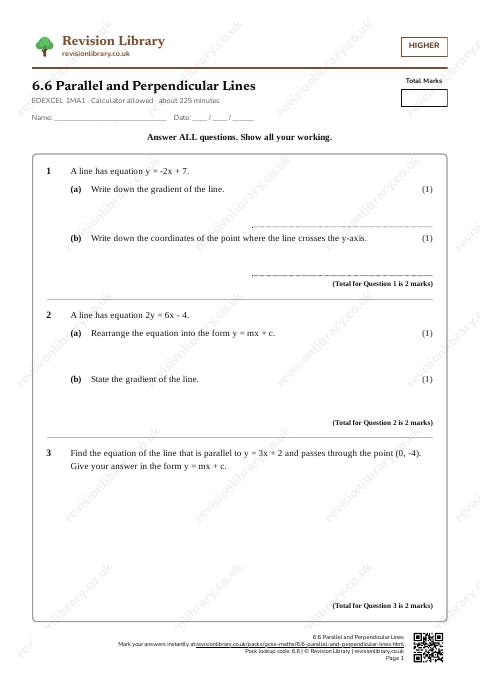
(b)Write down the coordinates of the point where the line crosses the y-axis.(1)
(Total for Question 1 is 2 marks)
2
A line has equation 2y = 6x - 4.
(a)Rearrange the equation into the form y = mx + c.(1)
(b)State the gradient of the line.(1)
(Total for Question 2 is 2 marks)
3
Find the equation of the line that is parallel to y = 3x + 2 and passes through the point (0, -4). Give your answer in the form y = mx + c.
(Total for Question 3 is 2 marks)
4
A straight line has equation y = 4x - 7
(a)Write down the gradient of the line.(1)
(b)Write down the coordinates of the point where the line crosses the y-axis.(1)
(c)Show that the point (3, 5) lies on the line.(2)
(Total for Question 4 is 4 marks)
5
Which of these lines is parallel to y = 5 - 3x?
A) y = 3x + 5
B) y = -3x + 2
C) y = (1/3)x - 5
D) y = 3x - 5
(Total for Question 5 is 1 mark)
6
For each pair of lines below, state whether the lines are parallel, perpendicular or neither, giving a reason based on their gradients.
(a)Line P has gradient 5. Line Q has gradient 5.(1)
(b)Line R has gradient 2. Line S has gradient -1/2.(1)
(c)Line T has gradient 3. Line U has gradient 1/3.(1)
(Total for Question 6 is 3 marks)
7
Find the equation of the line that is parallel to y = 2x - 1 and passes through the point (3, 10). Give your answer in the form y = mx + c.
(Total for Question 7 is 3 marks)
8
A straight line has equation y = -(2/5)x + 3
(a)State the gradient of a line that is perpendicular to this line.(1)
(b)Find the equation of the line perpendicular to y = -(2/5)x + 3 that passes through the point (-4, 1). Give your answer in the form y = mx + c(3)
(Total for Question 8 is 4 marks)
9
Three straight lines are given below. L1: y = 4x + 1 L2: 8x - 2y = 5 L3: x + 4y = 8
(a)Show that L1 and L2 are parallel.(2)
(b)Show that L1 and L3 are perpendicular.(2)
(c)State the relationship between L2 and L3, giving a reason for your answer.(2)
(Total for Question 9 is 6 marks)
10
P and Q are the points (1, 2) and (7, 6).
(a)Find the midpoint of PQ.(2)
(b)Find the gradient of PQ.(2)
(c)Find the equation of the perpendicular bisector of PQ. Give your answer in the form ax + by = c, where a, b and c are integers.(3)
(Total for Question 10 is 7 marks)
11
On a coordinate grid, distances are measured in kilometres from a fixed reference point. Road A passes through the villages at J(1, 2) and K(5, 10).
(a)Find the gradient of Road A.(2)
(b)A new road, Road B, is to be built through the junction at M(3, 4), parallel to Road A. Find the equation of Road B.(3)
(c)A third road, Road C, must be perpendicular to Road A and pass through the point N(9, 1). Find the equation of Road C, giving your answer in the form ax + by + c = 0, where a, b and c are integers.(4)
(Total for Question 11 is 9 marks)
12
The line L has equation x + 4y = 6. The line M has equation y = x/3 - 2. Show whether L and M are perpendicular.
(Total for Question 12 is 3 marks)
13
A is the point (-4, -4) and B is the point (0, -6). Find an equation of the perpendicular bisector of AB.
(Total for Question 13 is 4 marks)
14
Find an equation of the line that is parallel to -4x + 3y = 6 and passes through the point (9, 2).
(Total for Question 14 is 3 marks)
15
Write down the gradient of a line that is perpendicular to the line y = -3x.
(Total for Question 15 is 2 marks)
16
The line L has equation y = -x - 6. The line M has equation y = 3x - 1. Show whether L and M are perpendicular.
(Total for Question 16 is 3 marks)
17
Find an equation of the line that is perpendicular to y = 2x and passes through the point (-4, -4).
(Total for Question 17 is 4 marks)
18
A is the point (2, -2) and B is the point (8, 0). Find an equation of the perpendicular bisector of AB.
(Total for Question 18 is 4 marks)
19
Find an equation of the line that is parallel to 4x + 6y = 5 and passes through the point (0, 1).
(Total for Question 19 is 3 marks)
20
Find an equation of the line that is perpendicular to y = -x/2 - 6 and passes through the point (0, -2).
(Total for Question 20 is 4 marks)
21
Find an equation of the line that is parallel to y = 3x + 4 and passes through the point (-3, 1).
(Total for Question 21 is 3 marks)
22
A is the point (1, -2) and B is the point (5, 0). Find an equation of the perpendicular bisector of AB.
(Total for Question 22 is 4 marks)
23
Find an equation of the line that is parallel to y = 4x and passes through the point (4, -7).
(Total for Question 23 is 3 marks)
24
A is the point (0, 1) and B is the point (4, 3). Find an equation of the perpendicular bisector of AB.
(Total for Question 24 is 4 marks)
25
Find an equation of the line that is perpendicular to y = x/2 - 1 and passes through the point (-3, 8).
(Total for Question 25 is 4 marks)
26
A is the point (-2, -4) and B is the point (6, -2). Find an equation of the perpendicular bisector of AB.
(Total for Question 26 is 4 marks)
27
Find an equation of the line that is perpendicular to 4x + 3y = 5 and passes through the point (-8, 2).
(Total for Question 27 is 4 marks)
28
A is the point (-3, 2) and B is the point (5, 10). Find an equation of the perpendicular bisector of AB.
(Total for Question 28 is 4 marks)
29
A straight line passes through the points (-3, 7) and (5, -1). Find the equation of the line, giving your answer in the form y = mx + c
(Total for Question 29 is 3 marks)
30
Show that the line y = 2x - 5 is parallel to the line with equation 6x - 3y + 9 = 0
(Total for Question 30 is 3 marks)
31
A line has equation 4x + 2y = 10.
(a)Rearrange the equation into the form y = mx + c.(2)
(b)State the gradient of a line that is parallel to this line.(1)
(c)State the gradient of a line that is perpendicular to this line.(1)
(Total for Question 31 is 4 marks)
32
Points A(1, 2) and B(5, 10) lie on a straight line. Find the gradient of the line AB.
(Total for Question 32 is 2 marks)
33
A line has gradient 3/4. Find the gradient of a line that is perpendicular to it.
(Total for Question 33 is 2 marks)
34
Find the equation of the line perpendicular to y = 2x + 5 that passes through the point (4, 1). Give your answer in the form y = mx + c.
(Total for Question 34 is 4 marks)
35
Line L has equation 3x + y = 6. Find the gradient of a line that is perpendicular to L.
(Total for Question 35 is 3 marks)
36
Triangle ABC has vertices A(-2, -1), B(4, 1) and C(2, 7). Show that triangle ABC has a right angle at B.
(Total for Question 36 is 4 marks)
37
Quadrilateral WXYZ has vertices W(0, 1), X(4, 3), Y(6, 0) and Z(2, -2). Show that WXYZ is a parallelogram.
(Total for Question 37 is 5 marks)
38
Find the equation of the straight line that passes through the points (2, -1) and (6, 7). Give your answer in the form y = mx + c.
(Total for Question 38 is 4 marks)
39
C has coordinates (-2, 5) and D has coordinates (2, -3). Show that the line CD is perpendicular to the line with equation y = 1/2 x + 4.
(Total for Question 39 is 3 marks)
40
Line L1 has equation y = 2x - 3. Line L2 is perpendicular to L1 and passes through the point where L1 crosses the y-axis. Find the equation of L2, giving your answer in the form y = mx + c.
(Total for Question 40 is 4 marks)
41
The lines y = (2k - 1)x + 5 and y = 7x - 3 are parallel. Find the value of k.
(Total for Question 41 is 2 marks)
42
Line l1 has equation y = 2x - 1 Line l2 is perpendicular to l1 and passes through the point (6, 5).
(a)Find the equation of l2.(3)
(b)Find the coordinates of the point where l1 and l2 intersect.(2)
(Total for Question 42 is 5 marks)
43
A(1, 4) and B(7, -2) are the endpoints of a line segment AB.
(a)Find the coordinates of the midpoint M of AB.(2)
(b)Find the gradient of AB.(2)
(c)Find the equation of the perpendicular bisector of AB, giving your answer in the form y = mx + c.(3)
(Total for Question 43 is 7 marks)
44
Line L1 has equation kx + 3y = 12. Line L2 has equation 2x - y = 7. Given that L1 is perpendicular to L2, find the value of k.
(Total for Question 44 is 5 marks)
45
A circle has centre O(0, 0) and passes through the point P(6, 8). Find the equation of the tangent to the circle at the point P. Give your answer in the form y = mx + c.
(Total for Question 45 is 5 marks)
Mark scheme · 6.6 Parallel and Perpendicular Lines
Question 1
(a) -2 caoB1
(a) Answer: -2
(b) (0, 7) caoB1
(b) Answer: (0, 7)
Question 2
(a) y = 3x - 2 oeB1
(a) Answer: y = 3x - 2
(b) 3 ft from part (a)B1
(b) Answer: 3
Question 3
gradient = 3 stated or used (parallel lines have equal gradient)M1
y = 3x - 4 oe caoA1
Answer: y = 3x - 4
Question 4
(a) 4 (cao)B1
(a) Answer: 4
(b) (0, -7) (cao)B1
(b) Answer: (0, -7)
(c) substitutes x = 3 into y = 4x - 7M1
(c) correctly shows y = 5, matching the given point (cso)A1
(c) Answer: (3, 5) lies on the line since y = 4(3) - 7 = 5
Question 5
B selected (cao)B1
Answer: B (y = -3x + 2)
Question 6
(a) parallel, since the gradients are equal (cao)B1
(a) Answer: Parallel (equal gradients)
(b) perpendicular, since 2 x (-1/2) = -1 (cao)B1
(b) Answer: Perpendicular (gradients multiply to -1)
(c) neither, since the gradients are not equal and 3 x (1/3) = 1, not -1 (cao)B1
(c) Answer: Neither (gradients not equal, and product is 1, not -1)
Question 7
gradient = 2 identifiedM1
10 = 2(3) + c oe substitutedM1
y = 2x + 4 caoA1
Answer: y = 2x + 4
Question 8
(a) 5/2 (oe 2.5) (cao)B1
(a) Answer: 5/2
(b) uses the correct perpendicular gradient of 5/2, ft their part (a)M1
(b) correct method, e.g. y - 1 = (5/2)(x - (-4))M1
(b) y = (5/2)x + 11 (oe, e.g. y = 2.5x + 11) (cao)A1
(b) Answer: y = (5/2)x + 11
Question 9
(a) rearranges L2 into the form y = mx + c, y = 4x - 2.5 (oe)M1
(a) correct conclusion: both lines have gradient 4 and different y-intercepts, so L1 and L2 are parallel (cso)C1
(a) Answer: L1 and L2 are parallel (both have gradient 4)
(b) rearranges L3 into the form y = mx + c, y = -0.25x + 2 (oe), and multiplies gradientsM1
(b) correct conclusion: 4 x (-1/4) = -1, so L1 and L3 are perpendicular (cso)C1
(b) Answer: L1 and L3 are perpendicular (gradients multiply to -1)
(c) identifies gradient of L2 as 4 and gradient of L3 as -1/4, ft their parts (a) and (b)M1
(c) perpendicular, since 4 x (-1/4) = -1 (cao)A1
(c) Answer: L2 and L3 are perpendicular
Question 10
(a) correct method, e.g. ((1 + 7)/2, (2 + 6)/2)M1
(a) (4, 4) (cao)A1
(a) Answer: (4, 4)
(b) correct substitution, e.g. (6 - 2)/(7 - 1)M1
(b) 2/3 (oe) (cao)A1
(b) Answer: 2/3
(c) finds the perpendicular gradient -3/2, ft their part (b)M1
(c) correct method using the midpoint from part (a), e.g. y - 4 = -(3/2)(x - 4)M1
Put this topic and others into one printable pack.
Open the Pack Builder
Worksheets are written for Revision Library and come with a full mark scheme; a few English packs quote an out-of-copyright text, and name it on the page. Exam board names and specification codes say which qualification a pack suits: we are not affiliated with, endorsed by or approved by any exam board, and no past-paper question is reproduced here. Rights queries: hello@revisionlibrary.co.uk