Spheres and cones are curved 3D solids with standard formulae required for GCSE Higher tier: a sphere's volume is (4/3) x π x r3 and its surface area is 4 x π x r2, while a cone's volume is (1/3) x π x r2 x h and its curved surface area is π x r x l, where l is the slant height.
Identify the solid (sphere, hemisphere or cone) and note which measurements you are given: radius r, height h, or slant height l.
Recall the correct formula: sphere volume = (4/3) x π x r3, sphere surface area = 4 x π x r2; cone volume = (1/3) x π x r2 x h, cone curved surface area = π x r x l.
For a cone, if you are given the height but not the slant height (or vice versa), use Pythagoras' theorem with r, h and l, since l2 = r2 + h2.
Substitute the known values into the correct formula and calculate using your calculator's π button.
For a hemisphere, halve the sphere's volume formula, and remember its total surface area includes the flat circular face as well as the curved half-sphere.
Round your final answer as instructed, usually to 3 significant figures, and include the correct units (cm3 for volume, cm2 for surface area).
Worked example
A cone has base radius 5 cm and perpendicular height 12 cm. Calculate the volume of the cone, giving your answer correct to 3 significant figures.
Volume of a cone = (1/3) x π x r2 x h.
Substitute r = 5 and h = 12: volume = (1/3) x π x 52 x 12 = (1/3) x π x 25 x 12 = (1/3) x π x 300 = 100 x π.
Calculate 100 x π = 314.159..., so the final answer is 314 cm3 (3 sf).
Revision Library
revisionlibrary.co.uk
GCSE · Geometry and measures: volume and surface area
5.16 Spheres and Cones
EDEXCEL 1MA1 · Calculator allowed · about 225 minutes
Revision Library formulae reminder, styled on Edexcel 1MA1 formulae-sheet conventions; wording is original.
Volume of a sphere = (4/3) x pi x r^3
Surface area of a sphere = 4 x pi x r^2
Volume of a cone = (1/3) x pi x r^2 x h
Curved surface area of a cone = pi x r x l (l = slant height)
Volume of a hemisphere = (2/3) x pi x r^3
Total surface area of a solid hemisphere = 3 x pi x r^2
Note: the surface area formulae for spheres and cones are supplied in relevant Edexcel questions.
1
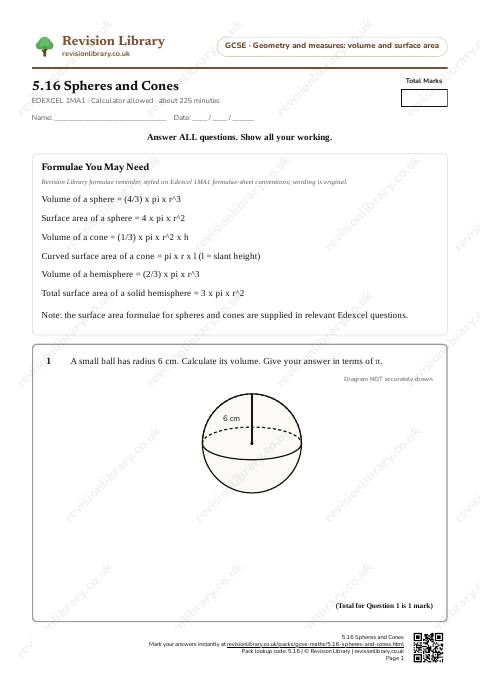
A small ball has radius 6 cm. Calculate its volume. Give your answer in terms of π.
Diagram NOT accurately drawn
(Total for Question 1 is 1 mark)
2
A solid sphere has radius 10 cm. Work out the volume of the sphere. Give your answer correct to 3 significant figures.
Diagram NOT accurately drawn
(Total for Question 2 is 2 marks)
3
The volume of a sphere is 36 π cm3. Work out its radius in cm. Give your answer in exact form.
Diagram NOT accurately drawn
(Total for Question 3 is 2 marks)
4
A sphere has radius 6 cm. Calculate the volume of the sphere. Give your answer correct to 3 significant figures.
Diagram NOT accurately drawn
(Total for Question 4 is 2 marks)
5
A cone has base radius 4 cm and perpendicular height 9 cm. Calculate the volume of the cone. Give your answer correct to 3 significant figures.
Diagram NOT accurately drawn
(Total for Question 5 is 2 marks)
6
A cone has base radius 7 cm and perpendicular height 15 cm. Work out the volume of the cone. Give your answer correct to 3 significant figures.
Diagram NOT accurately drawn
(Total for Question 6 is 2 marks)
7
A toy cone and a toy sphere are made from the same material. The cone has radius 4 cm and height 9 cm. The sphere has radius 6 cm. Which object has the larger volume and by how much? Give your answer to 1 decimal place.
Diagram NOT accurately drawn
(Total for Question 7 is 3 marks)
8
A right circular cone has sloping edge (the slant height) 13 cm and radius 5 cm. Calculate the height of the cone. Give your answer in cm.
Diagram NOT accurately drawn
(Total for Question 8 is 3 marks)
9
A hemisphere is half of a sphere. A hemisphere has radius 7 cm. Calculate its curved surface area (not including the base). Give your answer to 1 decimal place. Use the curved surface area of a sphere = 4 π r2, so hemisphere curved area = 2 π r2.
Diagram NOT accurately drawn
(Total for Question 9 is 4 marks)
10
Work out the volume of a sphere with radius 5 cm. Give your answer in terms of π.
Diagram NOT accurately drawn
(Total for Question 10 is 2 marks)
11
A metal ball has diameter 12 cm. Calculate the surface area of the ball. Give your answer in terms of π.
(Total for Question 11 is 2 marks)
12
A solid hemisphere has radius 7 cm. Calculate the total surface area of the hemisphere (the curved surface area plus the flat circular face). Give your answer correct to 3 significant figures.
Diagram NOT accurately drawn
(Total for Question 12 is 3 marks)
13
A toy is made from a cone of radius 6 cm and height 8 cm fixed on top of a hemisphere of radius 6 cm, so that the flat faces are joined together. Calculate the total volume of the toy. Give your answer correct to 3 significant figures.
Diagram NOT accurately drawn
(Total for Question 13 is 4 marks)
14
A cone has base radius 5 cm and volume 100 π cm3. Find the perpendicular height of the cone.
Diagram NOT accurately drawn
(Total for Question 14 is 3 marks)
15
A solid sphere of radius 4 cm is made from metal with density 8.9 g/cm3. Calculate the mass of the sphere in kilograms. Give your answer correct to 3 significant figures.
Diagram NOT accurately drawn
(Total for Question 15 is 3 marks)
16
A cone has base diameter 1.4 m and perpendicular height 90 cm. Calculate the volume of the cone in cubic metres. Give your answer correct to 3 significant figures.
Diagram NOT accurately drawn
(Total for Question 16 is 3 marks)
17
A cone has base radius 3 cm and perpendicular height 4 cm. Work out the area of the curved surface of the cone. Give your answer in terms of π.
Diagram NOT accurately drawn
(Total for Question 17 is 3 marks)
18
A solid hemisphere has radius 12 cm. Work out its volume. Give your answer in terms of π.
Diagram NOT accurately drawn
(Total for Question 18 is 2 marks)
19
A cone has base radius 9 cm and perpendicular height 12 cm. Work out the volume of the cone. Give your answer in terms of π.
Diagram NOT accurately drawn
(Total for Question 19 is 2 marks)
20
A solid hemisphere has radius 15 cm. Work out its volume. Give your answer in terms of π.
Diagram NOT accurately drawn
(Total for Question 20 is 2 marks)
21
A solid hemisphere has radius 15 cm. Work out the total surface area of the hemisphere. Give your answer in terms of π.
Diagram NOT accurately drawn
(Total for Question 21 is 3 marks)
22
A solid sphere has radius 3 cm. Work out its volume. Give your answer in terms of π.
Diagram NOT accurately drawn
(Total for Question 22 is 2 marks)
23
A cone has base radius 9 cm and slant height 15 cm. Work out the volume of the cone. Give your answer in terms of π.
Diagram NOT accurately drawn
(Total for Question 23 is 4 marks)
24
A cone has base radius 15 cm and perpendicular height 8 cm. Work out the area of the curved surface of the cone. Give your answer in terms of π.
Diagram NOT accurately drawn
(Total for Question 24 is 3 marks)
25
A cone has base radius 15 cm and slant height 17 cm. Work out the volume of the cone. Give your answer in terms of π.
Diagram NOT accurately drawn
(Total for Question 25 is 4 marks)
26
A cone has base radius 3 cm and slant height 8 cm. Calculate the curved surface area of the cone. Give your answer correct to 3 significant figures.
Diagram NOT accurately drawn
(Total for Question 26 is 2 marks)
27
A cone has base radius 6 cm and slant height 10 cm. Calculate the total surface area of the cone (the curved surface area plus the area of the circular base). Give your answer correct to 3 significant figures.
Diagram NOT accurately drawn
(Total for Question 27 is 3 marks)
28
A cone has base radius 9 cm and slant height 15 cm.
Diagram NOT accurately drawn
(a)Calculate the perpendicular height of the cone.(2)
(b)Hence calculate the volume of the cone. Give your answer correct to 3 significant figures.(2)
(Total for Question 28 is 4 marks)
29
A solid hemisphere has radius 9 cm. Calculate the volume of the hemisphere. Give your answer correct to 3 significant figures.
Diagram NOT accurately drawn
(Total for Question 29 is 2 marks)
30
A sphere has radius 3 cm. Work out the volume of the sphere. Give your answer as a multiple of π.
Diagram NOT accurately drawn
(Total for Question 30 is 2 marks)
31
A cone has base radius 5 cm and perpendicular height 8 cm. Calculate the curved surface area of the cone. Give your answer correct to 3 significant figures.
Diagram NOT accurately drawn
(Total for Question 31 is 3 marks)
32
A solid hemisphere has radius 11 cm. Work out the volume of the hemisphere. Give your answer correct to 3 significant figures.
Diagram NOT accurately drawn
(Total for Question 32 is 2 marks)
33
A cone has radius 3 cm and height 10 cm. Work out the volume of the cone. Give your answer in terms of π and then to 3 significant figures.
Diagram NOT accurately drawn
(Total for Question 33 is 3 marks)
34
A solid dome is made from a cone of radius 8 cm and perpendicular height 15 cm fixed on top of a hemisphere of radius 8 cm, with the flat faces joined together.
Diagram NOT accurately drawn
(a)Calculate the slant height of the cone.(2)
(b)Calculate the total area of the dome's surface that needs to be painted: the curved surface of the cone plus the curved surface of the hemisphere only (do not include the flat circle where the two solids join). Give your answer as a multiple of π.(3)
(c)Paint costs 2p per cm2. Work out the total cost of painting 50 of these dome solids. Give your answer in pounds, to the nearest penny.(3)
(Total for Question 34 is 8 marks)
35
Two similar spherical balloons have radii in the ratio 2:5. The volume of the smaller balloon is 32 cm³. Work out the volume of the larger balloon.
(Total for Question 35 is 3 marks)
36
A solid wooden hemisphere has radius 10 cm. A cone-shaped hole of radius 6 cm and depth 8 cm is drilled out of the flat face, with the apex of the cone pointing into the hemisphere. Work out the volume of wood remaining. Give your answer correct to 3 significant figures.
Diagram NOT accurately drawn
(Total for Question 36 is 4 marks)
37
A solid sphere has volume 1000 cm³. Work out the radius of the sphere. Give your answer correct to 3 significant figures.
Diagram NOT accurately drawn
(Total for Question 37 is 3 marks)
38
A cone has volume 250 cm³ and base radius 6 cm. Work out the perpendicular height of the cone. Give your answer correct to 3 significant figures.
Diagram NOT accurately drawn
(Total for Question 38 is 3 marks)
39
A cone has base radius 4 cm and perpendicular height 7 cm. Calculate the total surface area of the cone (the curved surface area plus the area of the circular base). Give your answer correct to 3 significant figures.
Diagram NOT accurately drawn
(Total for Question 39 is 3 marks)
40
A solid hemisphere has radius 12 cm. Calculate the total surface area of the hemisphere (the curved surface plus the flat circular face). Give your answer correct to 3 significant figures.
Diagram NOT accurately drawn
(Total for Question 40 is 2 marks)
41
A hemisphere of radius 4 cm is fixed on top of a right circular cylinder of radius 4 cm and height 6 cm. Calculate the total volume of the solid. Give your answer in terms of π and then to 3 significant figures.
Diagram NOT accurately drawn
(Total for Question 41 is 4 marks)
42
Two cones are similar. Cone A has height 9 cm and volume 216 cm³. Cone B has height 15 cm. Work out the volume of cone B.
Diagram NOT accurately drawn
(Total for Question 42 is 3 marks)
43
A large cone has base radius 10 cm and perpendicular height 15 cm. A smaller, similar cone of radius 4 cm and height 6 cm is removed from the vertex end, leaving a frustum. Work out the volume of the frustum. Give your answer correct to 3 significant figures.
Diagram NOT accurately drawn
(Total for Question 43 is 5 marks)
44
A solid toy is made from a cone joined to a hemisphere of the same radius, as shown. The cone has base radius 5 cm and perpendicular height 11 cm. The hemisphere also has radius 5 cm and is joined to the circular base of the cone, flat faces together.
Diagram NOT accurately drawn
(a)Work out the total volume of the solid toy. Give your answer correct to 3 significant figures.(4)
(b)Work out the total surface area of the solid toy. The toy has no flat faces on the outside, since the flat circular faces where the cone and hemisphere join are hidden inside the solid. Give your answer correct to 3 significant figures.(5)
(Total for Question 44 is 9 marks)
45
Elin is a jeweller. She casts a solid silver charm in the shape of a sphere with radius 2.2 cm. The density of the silver she uses is 10.49 g/cm3. Work out the mass of the charm. Give your answer correct to 3 significant figures.
Diagram NOT accurately drawn
(Total for Question 45 is 3 marks)
46
A spinning top is made from a cone joined to a hemisphere of the same radius. The hemisphere has radius 7 cm, and the total height of the spinning top (hemisphere plus cone) is 21 cm. Work out the total volume of the spinning top. Give your answer correct to 3 significant figures.
Diagram NOT accurately drawn
(Total for Question 46 is 4 marks)
47
A right cone has height 12 cm. Its volume is 432 π cm3. Find the radius of the base of the cone. Give your answer to 3 significant figures.
Diagram NOT accurately drawn
(Total for Question 47 is 3 marks)
48
Kwame, a metalworker, melts down a solid bronze cone with base radius 9 cm and perpendicular height 14 cm. He recasts all of the bronze as a solid sphere, with no bronze wasted. Work out the radius of the sphere. Give your answer correct to 3 significant figures.
Diagram NOT accurately drawn
(Total for Question 48 is 4 marks)
49
A sphere and a cone both have radius r. The volume of the sphere is exactly twice the volume of the cone. Show that the perpendicular height of the cone, h, satisfies h = 2r.
Diagram NOT accurately drawn
(Total for Question 49 is 3 marks)
50
A solid sphere has volume 500 cm³. Calculate the surface area of the sphere. Give your answer correct to 3 significant figures.
Diagram NOT accurately drawn
(Total for Question 50 is 4 marks)
51
Two spheres are mathematically similar. Their radii are in the ratio 2:3. The volume of the smaller sphere is 96 cm³. Work out the volume of the larger sphere.
Diagram NOT accurately drawn
(Total for Question 51 is 3 marks)
52
A frustum is formed by cutting the top from a right cone. The lower radius is 6 cm, the upper radius is 2 cm and the height of the frustum is 9 cm. Calculate the volume of the frustum. Give your answer in terms of π and then to 3 significant figures.
Diagram NOT accurately drawn
(Total for Question 52 is 4 marks)
53
A farm has two storage tanks. Tank A is a sphere with radius 2.5 m. Tank B is a cone with base radius 3 m and perpendicular height 5 m. Work out which tank has the greater volume, and by how much. Give your answer correct to 3 significant figures.
Diagram NOT accurately drawn
(Total for Question 53 is 5 marks)
Mark scheme · 5.16 Spheres and Cones
A correct answer earns full marks unless the question asks for working, a method, proof or explanation.
Question 1
288 π cm3 caoB1
Answer: 288 π cm3
Question 2
correct substitution into V = (4/3) x π x r3, e.g. (4/3) x π x 103 (oe)M1
awrt 4190 cm³ (cao)A1
Answer: 4190 cm3 (3 s.f.)
Question 3
use (4/3) π r3 = 36 π and cancel π then r3 = 27M1
r = 3 cm caoA1
Answer: 3 cm
Question 4
4/3 x π x 63 oe (288 π seen)M1
awrt 905A1
Answer: 905 cm3 (3 sf)
Question 5
1/3 x π x 42 x 9 oe (48 π seen)M1
awrt 151A1
Answer: 151 cm3 (3 sf)
Question 6
correct substitution into V = (1/3) x π x r2 x h, e.g. (1/3) x π x 72 x 15 (oe)M1
awrt 770 cm³ (cao)A1
Answer: 770 cm3 (3 s.f.)
Question 7
calculate cone volume: (1/3) π (42) * 9 = 48 πM1
calculate sphere volume: (4/3) π * 63 = 288 πM1
sphere larger by 240 π = 754.0 cm³ awrtA1
Answer: The sphere is larger by 754.0 cm3 (to 1 d.p.)
Question 8
use Pythagoras: height2 + 52 = 132M1
compute height2 = 169 - 25 = 144M1
height = 12 cm caoA1
Answer: 12 cm
Question 9
use hemisphere curved area = 2 π r2 with r=7M1
compute 2 * π * 49 = 98 πM1
convert to decimal using π: 98 * π = 307.87608...M1
307.9 cm² awrtA1
Answer: 307.9 cm2
Question 10
substitute into V = 4/3 π r3, showing 4/3 * π * 53 or equivalent methodM1
500/3 π cm3 caoA1
Answer: 500/3 π cm3 (approx 523.6 cm3)
Question 11
use A = 4 π r2 with r = 6 cm or equivalent methodM1
144 π cm2 caoA1
Answer: 144 π cm2 (approx 452.39 cm2)
Question 12
2 x π x 72 oe (curved surface area = 98 π)M1
π x 72 oe (flat face area = 49 π)M1
awrt 462A1
Answer: 462 cm2 (3 sf)
Question 13
1/3 x π x 62 x 8 oe (cone volume = 96 π)M1
2/3 x π x 63 oe (hemisphere volume = 144 π)M1
adds their two volumes (dep)M1
awrt 754A1
Answer: 754 cm3 (3 sf)
Question 14
sets 100 π = 1/3 x π x 52 x h and begins to rearrangeM1
h = 100 x 3 / 25 oe (dep)M1
h = 12 cm caoA1
Answer: h = 12 cm
Question 15
4/3 x π x 43 oe (volume = 268.08... cm3)M1
their volume x 8.9 (mass in grams, dep)M1
awrt 2.39 (kg), correctly converted from gramsA1
Answer: 2.39 kg (3 sf)
Question 16
consistent units used, e.g. radius = 0.7 m and height = 0.9 mB1
1/3 x π x 0.72 x 0.9 oe (0.147 π seen)M1
awrt 0.462A1
Answer: 0.462 m3 (3 sf)
Question 17
slant height √32 + 42M1
l = 5A1
15pi cm2 caoA1
Answer: 15pi cm2
Question 18
2/3 x π x 123 oeM1
1152pi cm3 caoA1
Answer: 1152pi cm3
Question 19
volume = 1/3 x π x r2 x h oeM1
324pi cm3 caoA1
Answer: 324pi cm3
Question 20
2/3 x π x 153 oeM1
2250pi cm3 caoA1
Answer: 2250pi cm3
Question 21
curved surface 2 x π x 152 oe or 4 x π x 152 / 2M1
adds flat circle π x 152M1
675pi cm2 caoA1
Answer: 675pi cm2
Question 22
4/3 x π x 33 oeM1
36pi cm3 caoA1
Answer: 36pi cm3
Question 23
Pythagoras to find the height: √l2 - r2M1
h = 12 seenA1
1/3 x π x 92 x 12M1
324pi cm3 caoA1
Answer: 324pi cm3
Question 24
slant height √152 + 82M1
l = 17A1
255pi cm2 caoA1
Answer: 255pi cm2
Question 25
Pythagoras to find the height: √l2 - r2M1
h = 8 seenA1
1/3 x π x 152 x 8M1
600pi cm3 caoA1
Answer: 600pi cm3
Question 26
π x 3 x 8 oe (24 π seen)M1
awrt 75.4A1
Answer: 75.4 cm2 (3 sf)
Question 27
π x 6 x 10 oe (curved surface area = 60 π)M1
π x 62 oe (base area = 36 π)M1
awrt 302A1
Answer: 302 cm2 (3 sf)
Question 28
(a) √152 - 92 oe (225 - 81 = 144 seen)M1
(a) 12 cm caoA1
(a) Answer: 12 cm
(b) 1/3 x π x 92 x their height (ft from part a)M1
(b) awrt 1020A1
(b) Answer: 1020 cm3 (3 sf)
Question 29
2/3 x π x 93 oe (486 π seen)M1
awrt 1530A1
Answer: 1530 cm3 (3 sf)
Question 30
correct substitution (4/3) x π x 33 (oe)M1
36 x π cm3 (oe, cao - exact value required, not a decimal)A1
Answer: 36 x π cm3 (exact)
Question 31
slant height l = √52 + 82 = √89 (Pythagoras)M1
correct substitution into CSA = π x r x l, e.g. π x 5 x √89 (oe, ft their l)M1
awrt 148 cm² (cao)A1
Answer: 148 cm2 (3 s.f.)
Question 32
correct substitution into V = (2/3) x π x r3, e.g. (2/3) x π x 113 (oe)M1
awrt 2790 cm³ (cao)A1
Answer: 2790 cm3 (3 s.f.)
Question 33
substitute into V = 1/3 π r2 h, showing 1/3 * π * 32 * 10 or equivalentM1
simplify to 30 πM1
30 π cm3; 94.2 cm³ to 3 s.f. caoA1
Answer: 30 π cm3 (approx 94.2 cm3)
Question 34
(a) √82 + 152 oe (64 + 225 = 289 seen)M1
(a) 17 cm caoA1
(a) Answer: 17 cm
(b) π x 8 x their 17 oe (cone curved surface area = 136 π, ft)M1
(b) 2 x π x 82 oe (hemisphere curved surface area = 128 π)M1
(b) 264 π cm2 oe caoA1
(b) Answer: 264 π cm2
(c) 264 π x 50 oe (total area for 50 domes, ft from part b, awrt 41500)M1
(c) their total area x 0.02 (converts 2p per cm2 correctly to pounds, dep)M1
(c) awrt 829.38 (pounds), ftA1
(c) Answer: £829.38
Question 35
cubes the length ratio, 23 : 53 oe (8:125 seen)M1
sets up 32 / 8 x 125 oe (dep)M1
500 cm³ caoA1
Answer: 500 cm3
Question 36
2/3 x π x 103 oe (hemisphere volume = 2000 π/3 cm³, approximately 2094.395 cm³)M1
1/3 x π x 62 x 8 oe (cone volume = 96 π, awrt 302)M1
subtracts cone volume from hemisphere volume (dep)M1
awrt 1790A1
Answer: 1790 cm3 (3 sf)
Question 37
rearranges V = (4/3) x π x r3 to r3 = 3V / (4 x π) (oe)M1
r3 = 3 x 1000 / (4 x π) = awrt 239 (or unrounded 238.7)M1
awrt 6.20 cm (cao)A1
Answer: 6.20 cm (3 s.f.)
Question 38
rearranges V = (1/3) x π x r2 x h to h = 3V / (π x r2) (oe)M1
h = 3 x 250 / (π x 62) (oe substitution)M1
awrt 6.63 cm (cao)A1
Answer: 6.63 cm (3 s.f.)
Question 39
slant height l = √42 + 72 = √65 (Pythagoras)M1
total SA = π x r x l + π x r2, e.g. π x 4 x √65 + π x 42 (oe, ft their l)M1
awrt 152 cm² (cao)A1
Answer: 152 cm2 (3 s.f.)
Question 40
correct substitution into total SA = 3 x π x r2, e.g. 3 x π x 122 (oe, or curved 2 x π x r2 + base π x r2 shown separately)M1
awrt 1360 cm² (cao)A1
Answer: 1360 cm2 (3 s.f.)
Question 41
calculate hemisphere volume = 1/2 * 4/3 π r3 = 2/3 π r3 with r = 4M1
calculate cylinder volume = π r2 h with r = 4, h = 6M1
Put this topic and others into one printable pack.
Open the Pack Builder
Worksheets are written for Revision Library and come with a full mark scheme; a few English packs quote an out-of-copyright text, and name it on the page. Exam board names and specification codes say which qualification a pack suits: we are not affiliated with, endorsed by or approved by any exam board, and no past-paper question is reproduced here. Rights queries: hello@revisionlibrary.co.uk