Similar shapes are shapes that have exactly the same angles, with every pair of corresponding sides in the same ratio, so that one shape is an enlargement of the other. This idea appears throughout GCSE geometry, where the scale factor between two similar shapes is used to find a missing length, a perimeter, or a distance on a map or scale drawing.
Check that the two shapes are similar, and identify which pairs of sides correspond to each other (matching angles tell you the correspondence).
Find the scale factor by dividing a known length in the second shape by the matching length in the first shape (new divided by old).
To find a missing length in the enlarged shape, multiply the corresponding length in the original shape by the scale factor.
To find a missing length in the original (smaller) shape, divide the corresponding length in the enlarged shape by the scale factor.
For perimeters, multiply (or divide) the whole perimeter by the same scale factor, since every side scales by the same amount.
If the missing length is given as an algebraic expression, set up an equation linking the two expressions using the scale factor, then solve it.
Worked example
Triangle ABC is similar to triangle DEF, with AB corresponding to DE and BC corresponding to EF. AB = 6 cm, DE = 15 cm and BC = 8 cm. Work out the length of EF.
Find the scale factor from triangle ABC to triangle DEF: scale factor = DE / AB = 15 / 6 = 2.5.
EF corresponds to BC, so multiply BC by the scale factor: EF = 8 x 2.5.
EF = 20 cm.
Revision Library
revisionlibrary.co.uk
GCSE · Geometry and Measures
5.18 Similar Shapes (Lengths)
EDEXCEL 1MA1 · Calculator allowed · about 230 minutes
Two similar triangles, triangle A and triangle B, have corresponding sides in the ratio 4:7. One side of triangle A is 10 cm. Work out the length of the corresponding side of triangle B.
(Total for Question 1 is 2 marks)
2
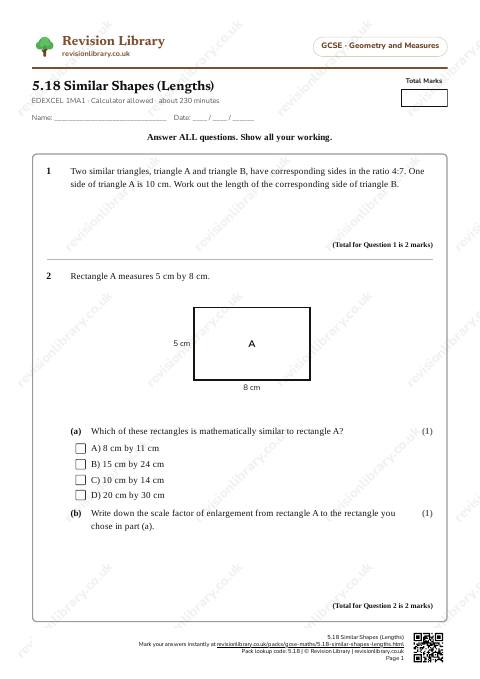
Rectangle A measures 5 cm by 8 cm.
(a)Which of these rectangles is mathematically similar to rectangle A?(1)
A) 8 cm by 11 cm
B) 15 cm by 24 cm
C) 10 cm by 14 cm
D) 20 cm by 30 cm
(b)Write down the scale factor of enlargement from rectangle A to the rectangle you chose in part (a).(1)
(Total for Question 2 is 2 marks)
3
Two rectangular photo frames are mathematically similar. Frame P measures 6 cm by 9 cm. Frame Q is similar to frame P and has a shorter side of length 10 cm. Work out the longer side of Frame Q.
Diagram NOT accurately drawn
(Total for Question 3 is 3 marks)
4
Shape A has a length of 5 cm. The corresponding length on a mathematically similar shape B is 20 cm. Write down the scale factor of enlargement from shape A to shape B.
(Total for Question 4 is 1 mark)
5
Rectangle C measures 6 cm by 4 cm. Rectangle D is mathematically similar to rectangle C, with a scale factor of enlargement of 2.5. Work out the dimensions of rectangle D.
(Total for Question 5 is 2 marks)
6
Shape P is similar to shape Q. On shape P a side measures 8 cm and the corresponding side on shape Q measures 12 cm.
(a)Find the scale factor from P to Q.(1)
(b)A different side on P measures 5 cm. Find the length of the corresponding side on Q.(1)
(Total for Question 6 is 2 marks)
7
Two similar isosceles triangles have corresponding equal sides 9 cm (small) and 12 cm (large). The base of the smaller triangle is 7 cm. Work out the length of the base of the larger triangle.
Diagram NOT accurately drawn
(Total for Question 7 is 3 marks)
8
Triangle ABC is similar to triangle XYZ, with AB corresponding to XY and BC corresponding to YZ. AB = 8 cm, XY = 12 cm and BC = 10 cm. Work out the length of YZ.
Diagram NOT accurately drawn
(Total for Question 8 is 3 marks)
9
Trapezium 1 has parallel sides of length 12 cm and 18 cm. Trapezium 2 is mathematically similar to trapezium 1. The side in trapezium 2 corresponding to the 18 cm side has length 9 cm. Work out the length of the side in trapezium 2 that corresponds to the 12 cm side.
Diagram NOT accurately drawn
(Total for Question 9 is 3 marks)
10
Two mathematically similar shapes have sides in the ratio 3 : 8. A side on the smaller shape has length 12 cm. Work out the corresponding side length on the larger shape.
(Total for Question 10 is 2 marks)
11
Two right-angled triangles are mathematically similar, with a scale factor of enlargement of 4. The hypotenuse of the smaller triangle is 13 cm. Work out the hypotenuse of the larger triangle.
Diagram NOT accurately drawn
(Total for Question 11 is 1 mark)
12
A photocopier enlarges a document using a scale factor of 1.4. The original document has a width of 21 cm. Calculate the width of the enlarged document.
(Total for Question 12 is 2 marks)
13
A shape is enlarged so that each length is 150% of its original length, creating a mathematically similar shape. A side on the original shape has length 8 cm. Work out the corresponding side length on the enlarged shape.
(Total for Question 13 is 2 marks)
14
Triangle ABC is similar to triangle PQR, with AB corresponding to PQ and BC corresponding to QR. AB = 6 cm, PQ = 9 cm and BC = 7 cm. Work out the length of QR.
Diagram NOT accurately drawn
(Total for Question 14 is 2 marks)
15
Two mathematically similar shapes have sides in the ratio 2 : 5. A side on the smaller shape has length 9 cm. Work out the corresponding length on the larger shape.
(Total for Question 15 is 2 marks)
16
Trapezium 1 has parallel sides of length 8 cm and 15 cm. Trapezium 2 is mathematically similar to trapezium 1. The side in trapezium 2 corresponding to the 8 cm side has length 5.6 cm. Work out the length of the side in trapezium 2 corresponding to the 15 cm side.
Diagram NOT accurately drawn
(Total for Question 16 is 2 marks)
17
Shape M and shape N are mathematically similar. The scale factor of enlargement from shape M to shape N is 3/4. A side on shape M has length 20 cm. Work out the corresponding side length on shape N.
(Total for Question 17 is 2 marks)
18
Shape 1 has sides of length 4.5 cm and 6 cm. Shape 2 is mathematically similar to shape 1. The side on shape 2 corresponding to the 4.5 cm side has length 3 cm. Work out the length of the side on shape 2 corresponding to the 6 cm side.
(Total for Question 18 is 2 marks)
19
Two similar right-angled triangles have corresponding shorter sides 7 cm (small triangle) and 14 cm (large triangle). The hypotenuse of the small triangle is 25 cm. Work out the hypotenuse of the large triangle.
Diagram NOT accurately drawn
(Total for Question 19 is 4 marks)
20
Two similar pentagons have corresponding side lengths in the ratio 5:8. The perimeter of the smaller pentagon is 55 cm. Work out the perimeter of the larger pentagon.
Diagram NOT accurately drawn
(Total for Question 20 is 3 marks)
21
Two similar rectangles have dimensions 6 cm by 10 cm and 9 cm by x cm (corresponding sides). Find x.
(Total for Question 21 is 4 marks)
22
A model car is similar to a real car. The model's length is 18 cm and the real car's length is 4.5 m.
(a)Find the scale factor from the model to the real car. (Write the factor as a ratio model : real.)(2)
(b)Using this scale factor, find the real car's width if the model's width is 5 cm.(2)
(Total for Question 22 is 4 marks)
23
Two similar triangles have corresponding sides in the ratio 5:8. A side of the smaller triangle is 15 cm. Work out the length of the corresponding side in the larger triangle.
(Total for Question 23 is 2 marks)
24
In the diagram, AB is parallel to DC. The straight lines AC and BD intersect at X. AX = 6 cm, XC = 9 cm and BX = 8 cm.
Diagram NOT accurately drawn
(a)Explain why triangle AXB is similar to triangle CXD.(1)
(b)Work out the length of XD.(3)
(Total for Question 24 is 4 marks)
25
A photograph measuring 10 cm by 15 cm is enlarged so that it fits exactly into a frame with a longer side of 45 cm. The enlarged photograph is mathematically similar to the original.
(a)Work out the scale factor of the enlargement.(1)
(b)Work out the length of the shorter side of the enlarged photograph.(2)
(Total for Question 25 is 3 marks)
26
Pentagon J and pentagon K are mathematically similar. The perimeter of pentagon J is 42 cm. The scale factor of enlargement from pentagon J to pentagon K is 2.5.
(a)Work out the perimeter of pentagon K.(2)
(b)One side of pentagon J has length 6 cm. Work out the length of the corresponding side of pentagon K.(2)
(Total for Question 26 is 4 marks)
27
Rectangle M has dimensions 4 cm by 7 cm. Rectangle N has dimensions 9 cm by 15 cm. Priya says, 'Rectangle N is an enlargement of rectangle M, so the two rectangles are mathematically similar.' Is Priya correct? Give reasons using the ratios of corresponding sides.
(Total for Question 27 is 3 marks)
28
Shape X and shape Y are mathematically similar. The scale factor of enlargement from shape X to shape Y is 3/5.
(a)A side of shape X has length 20 cm. Work out the length of the corresponding side of shape Y.(2)
(b)A different side of shape Y has length 21 cm. Work out the length of the corresponding side of shape X.(2)
(Total for Question 28 is 4 marks)
29
Triangle LMN is similar to triangle PQR, with LM corresponding to PQ and MN corresponding to QR. LM : PQ = 3 : 7. LM = 9 cm and MN = 15 cm.
Diagram NOT accurately drawn
(a)Work out the length of PQ.(2)
(b)Work out the length of QR.(2)
(c)The perimeter of triangle PQR is 84 cm. Work out the perimeter of triangle LMN.(2)
(Total for Question 29 is 6 marks)
30
A rectangular banner with width 18 cm and height 30 cm is enlarged so that the new width is 39 cm. The enlargement is similar to the original. Work out the new height.
(Total for Question 30 is 2 marks)
31
Shape P and shape Q are similar pentagons. A side of shape Q is 4 cm and the corresponding side of shape P is 6 cm. Another side of shape Q is 10 cm. Work out the length of the corresponding side of shape P.
Diagram NOT accurately drawn
(Total for Question 31 is 2 marks)
32
At the same time, a girl of height 180 cm casts a shadow 120 cm long and a tree casts a shadow 600 cm long. Work out the height of the tree, in centimetres.
(Total for Question 32 is 3 marks)
33
Shape P and shape Q are similar triangles. A side of shape Q is 12 cm and the corresponding side of shape P is 6 cm. Another side of shape Q is 8 cm. Work out the length of the corresponding side of shape P.
(Total for Question 33 is 2 marks)
34
A poster with width 15 cm and height 20 cm is enlarged so that the new width is 27 cm. The enlargement is similar to the original. Work out the new height.
(Total for Question 34 is 2 marks)
35
At the same time, a girl of height 150 cm casts a shadow 60 cm long and a tree casts a shadow 480 cm long. Work out the height of the tree, in centimetres.
(Total for Question 35 is 3 marks)
36
A map is drawn to a scale of 1 : 25000.
(a)The distance between two villages, Little Horden and Upper Sowerby, on the map is 8 cm. Work out the real distance between the villages. Give your answer in kilometres.(2)
(b)A straight road has a real length of 3 km. Work out the length of this road as it would be shown on the map. Give your answer in centimetres.(2)
(Total for Question 36 is 4 marks)
37
In triangle ABC, D lies on AB and E lies on AC, such that DE is parallel to BC. AD = 4 cm, DB = 6 cm and BC = 15 cm. Work out the length of DE.
Diagram NOT accurately drawn
(Total for Question 37 is 4 marks)
38
Quadrilateral ABCD is mathematically similar to quadrilateral PQRS, with AB corresponding to PQ, BC corresponding to QR, CD corresponding to RS, and DA corresponding to SP. AB = 6 cm and PQ = 15 cm.
Diagram NOT accurately drawn
(a)BC = 10 cm. Work out the length of QR.(2)
(b)RS = 21 cm. Work out the length of CD.(2)
(Total for Question 38 is 4 marks)
39
A model car is made using a scale of 1 : 24. The real car has a length of 4.8 m. Work out the length of the model car in cm.
(Total for Question 39 is 3 marks)
40
Triangle ABC is similar to triangle DEF, with AB corresponding to DE and BC corresponding to EF. AB = 8 cm, DE = 12 cm, BC = (x + 2) cm and EF = (2x - 1) cm.
Diagram NOT accurately drawn
(a)Work out the value of x.(3)
(b)Hence work out the length of BC.(2)
(Total for Question 40 is 5 marks)
41
Deepak measures the shadow of a tent pole of height 1.8 m and finds it is 2.4 m long. At the same moment, a nearby flagpole casts a shadow of length 6 m. The pole, the flagpole and their shadows form similar right-angled triangles. Calculate the height of the flagpole.
Diagram NOT accurately drawn
(Total for Question 41 is 3 marks)
42
Shape A has sides of length 4 cm and x cm. Shape B is mathematically similar to shape A, with corresponding sides of length 10 cm and 12 cm (10 cm corresponding to the 4 cm side). Work out the value of x.
(Total for Question 42 is 3 marks)
43
Triangle STU is similar to triangle VWX, with ST corresponding to VW and TU corresponding to WX. ST = 5 cm, VW = 15 cm, TU = 8 cm and WX = (3x + 3) cm. Work out the value of x.
Diagram NOT accurately drawn
(Total for Question 43 is 3 marks)
44
A scale drawing of a garden has scale 1 : 200. On the drawing a path is shown as 3.6 cm long. The actual path is to be extended by a similar path using the same scale.
(a)Work out the actual length of the drawn path in metres.(3)
(b)If the extended path on the drawing is 6.4 cm, what is the total actual length of both paths in metres?(3)
(Total for Question 44 is 6 marks)
45
Two similar ladders are drawn on plans. The smaller ladder on the plan is 4 cm long and represents a real ladder of 2 m. The larger ladder on the plan is 9 cm long.
(a)Find the scale factor from the plan to real life for the smaller ladder.(2)
(b)Use this scale to find the real length of the larger ladder in metres.(3)
(c)A third ladder is drawn on the plan at length 6 cm. Using the same scale, find its real length in metres and give the answer to 1 decimal place.(4)
(Total for Question 45 is 9 marks)
46
Triangle ABC is similar to triangle DEF. AB = 12 cm, BC = 18 cm, DE = 20 cm. Find EF. Give your answer correct to 1 decimal place.
(Total for Question 46 is 3 marks)
47
Rectangle A has sides of length 10 cm and (3x - 1) cm. Rectangle B is mathematically similar to rectangle A. The side of rectangle B corresponding to the 10 cm side has length 25 cm. The side of rectangle B corresponding to the (3x - 1) cm side has length (6x + 2) cm.
Diagram NOT accurately drawn
(a)Work out the value of x.(3)
(b)Hence work out the perimeter of rectangle A.(2)
(Total for Question 47 is 5 marks)
48
Three mathematically similar triangles, A, B and C, are such that triangle B is an enlargement of triangle A with scale factor 1.5, and triangle C is an enlargement of triangle B with scale factor 2. The shortest side of triangle A is 5 cm.
(a)Work out the length of the shortest side of triangle B.(1)
(b)Work out the length of the shortest side of triangle C.(2)
(c)Work out the overall scale factor of enlargement from triangle A to triangle C.(2)
(Total for Question 48 is 5 marks)
49
In triangle ABC, D lies on AB and E lies on AC, such that DE is parallel to BC. AD = 5 cm, DB = 7 cm and DE = 6 cm. Work out the length of BC.
Diagram NOT accurately drawn
(Total for Question 49 is 4 marks)
50
In the diagram, PQ is parallel to ST. The straight lines PT and QS intersect at M. PM = 8 cm, MT = 10 cm and QM = 12 cm.
Diagram NOT accurately drawn
(a)Explain why triangle PMQ is similar to triangle TMS.(1)
(b)Work out the length of MS.(3)
(Total for Question 50 is 4 marks)
51
Shape A is mathematically similar to shape B, with a scale factor of enlargement from A to B of 2. Shape B is mathematically similar to shape C, with a scale factor of enlargement from B to C of 1.5. A side on shape A has length 4 cm.
Diagram NOT accurately drawn
(a)Work out the (compound) scale factor of enlargement from shape A to shape C.(2)
(b)Hence work out the length of the corresponding side on shape C.(2)
(Total for Question 51 is 4 marks)
52
Two similar rectangles have one pair of corresponding sides in the ratio (x + 2) : (3x). This pair of sides has length 8 cm in the smaller rectangle and length 12 cm in the larger rectangle (so 8 cm corresponds to x + 2 and 12 cm corresponds to 3x). The smaller rectangle's other side is 10 cm. Work out x and the larger rectangle's side corresponding to the 10 cm side.
(a)Find x.(2)
(b)Find the length in the larger rectangle that corresponds to the smaller rectangle's 10 cm side. Give your answer in cm.(2)
(Total for Question 52 is 4 marks)
53
A right-angled triangle ABC (right angle at B) is enlarged from triangle ABC to triangle A'B'C' with centre of enlargement at B and scale factor k. The length BA = 7 cm and BC = 24 cm. After enlargement BA' = 21 cm.
(a)Find k.(1)
(b)Find B'C', the image of BC, and state whether triangle A'B'C' is still right-angled at B'. Explain briefly.(3)
(Total for Question 53 is 4 marks)
Mark scheme · 5.18 Similar Shapes (Lengths)
Question 1
use 10 x (7/4) or equivalent methodM1
17.5 cm caoA1
Answer:17.5 cm. Working check: 10 x 7/4 = 70/4 = 17.5.
Question 2
(a) B) 15 cm by 24 cmB1
(a) Answer: B
(b) 3 cao ft their (a)B1
(b) Answer: 3
Question 3
scale factor = 10/6 oe (= 5/3)M1
9 x their scale factorM1
15 (cm) caoA1
Answer: 15 cm
Question 4
4 caoB1
Answer: 4
Question 5
6 x 2.5 and 4 x 2.5 oe (both dimensions scaled by 2.5)M1
15 cm by 10 cm caoA1
Answer: 15 cm by 10 cm
Question 6
(a) scale factor 12/8 = 3/2 or 1.5 caoB1
(a) Answer: 3/2.
(b) 7.5 cm caoB1
(b) Answer: 7.5 cm.
Question 7
find scale factor 12/9 = 4/3 and apply to base: 7 x 4/3M1
calculate 28/3 or 9.333... (method shown)M1
28/3 cm or 9.33... cm awrtA1
Answer: 28/3 cm (9.33... cm awrt 9.33 cm).
Question 8
scale factor = 12/8 oe (= 1.5 or 3/2)M1
10 x their scale factorM1
15 (cm) caoA1
Answer: 15 cm
Question 9
scale factor = 9/18 oe (= 0.5 or 1/2)M1
12 x their scale factorM1
6 (cm) caoA1
Answer: 6 cm
Question 10
12 x 8/3 oeM1
32 (cm) caoA1
Answer: 32 cm
Question 11
52 (cm) caoB1
Answer: 52 cm
Question 12
21 x 1.4 oeM1
29.4 (cm) caoA1
Answer: 29.4 cm
Question 13
8 x 1.5 oe (150% = scale factor 1.5)M1
12 (cm) caoA1
Answer: 12 cm
Question 14
scale factor = 9/6 oe (= 1.5)M1
10.5 (cm) caoA1
Answer: 10.5 cm
Question 15
9 x 5/2 oeM1
22.5 (cm) caoA1
Answer: 22.5 cm
Question 16
scale factor = 5.6/8 oe (= 0.7)M1
10.5 (cm) caoA1
Answer: 10.5 cm
Question 17
20 x 3/4 oeM1
15 (cm) caoA1
Answer: 15 cm
Question 18
scale factor = 3/4.5 oe (= 2/3)M1
4 (cm) caoA1
Answer: 4 cm
Question 19
find scale factor 14/7 = 2 and apply to hypotenuse: 25 x 2M1
alternative: set up proportion 6/10 = 9/x and solve to get 15 cmB1
Answer: 15 cm.
Question 22
(a) convert 4.5 m to 450 cm and form ratio 18 : 450 or simplify 18/450M1
(a) 1 : 25 caoA1
(a) Answer: 1 : 25
(b) use scale factor 1:25 so width = 5 x 25M1
(b) 125 cm or 1.25 m caoA1
(b) Answer: 125 cm (1.25 m).
Question 23
multiply 15 by scale factor 8/5 or show equivalent methodM1
24 cm caoA1
Answer: 24 cm, because 15 x (8/5) = 24 (scale factor 8/5).
Question 24
(a) angle XAB = angle XCD and angle XBA = angle XDC (alternate angles, AB parallel to DC), and angle AXB = angle CXD (vertically opposite angles), so the triangles are similar (AA)B1
(a) Answer: Alternate angles (AB parallel to DC) and vertically opposite angles at X give two pairs of equal angles, so the triangles are similar (AA).
(b) AX/XC = BX/XD oe (correct ratio equation set up, e.g. 6/9 = 8/XD)M1
(b) XD = 8 x 9/6 oe (correct rearrangement)M1
(b) 12 (cm) caoA1
(b) Answer: 12 cm
Question 25
(a) 3 caoB1
(a) Answer: 3
(b) 10 x their scale factorM1
(b) 30 (cm) cao ft their (a)A1
(b) Answer: 30 cm
Question 26
(a) 42 x 2.5M1
(a) 105 (cm) caoA1
(a) Answer: 105 cm
(b) 6 x 2.5M1
(b) 15 (cm) caoA1
(b) Answer: 15 cm
Question 27
9/4 (= 2.25) or 4/9 (= 0.4444...) foundM1
15/7 (awrt 2.14) or 7/15 (awrt 0.467) foundM1
correct conclusion: No, Priya is not correct, because the ratios of corresponding sides are not equal (2.25 does not equal awrt 2.14), caoA1
Answer: No, Priya is not correct: 9/4 = 2.25 but 15/7 = awrt 2.14, so the ratios are not equal.
Question 28
(a) 20 x 3/5M1
(a) 12 (cm) caoA1
(a) Answer: 12 cm
(b) 21 divide by 3/5 oe (= 21 x 5/3)M1
(b) 35 (cm) caoA1
(b) Answer: 35 cm
Question 29
(a) 9 / 3 (= 3) (value of one ratio unit found), then x 7M1
(a) 21 (cm) caoA1
(a) Answer: 21 cm
(b) 15 x 7/3 oe (using the same scale factor as LM to PQ)M1
(b) 35 (cm) caoA1
(b) Answer: 35 cm
(c) 84 x 3/7 oe (dividing by the scale factor 7/3)M1
(c) 36 (cm) caoA1
(c) Answer: 36 cm
Question 30
39/18 or 30/18 x 39 oeM1
65 cm caoA1
Answer: 65 cm
Question 31
scale factor 4/6 = 2/3 oeM1
15 cm caoA1
Answer: 15 cm
Question 32
the triangles are similar, so uses a ratio such as 600/120M1
180 x 600 / 120 oeM1
900 cm caoA1
Answer: 900 cm
Question 33
scale factor 12/6 = 2 oeM1
4 cm caoA1
Answer: 4 cm
Question 34
27/15 or 20/15 x 27 oeM1
36 cm caoA1
Answer: 36 cm
Question 35
the triangles are similar, so uses a ratio such as 480/60M1
150 x 480 / 60 oeM1
1200 cm caoA1
Answer: 1200 cm
Question 36
(a) 8 x 25000 (= 200000) oe (real distance found in cm)M1
(a) 2 (km) caoA1
(a) Answer: 2 km
(b) 3 km converted to 300000 cm oeM1
(b) 12 (cm) caoA1
(b) Answer: 12 cm
Question 37
AB = 4 + 6 (= 10) (whole side AB found)M1
scale factor = 4/10 oe (= 0.4 or 2/5) (triangle ADE similar to triangle ABC since DE parallel to BC, AA)M1
15 x their scale factorM1
6 (cm) caoA1
Answer: 6 cm
Question 38
(a) scale factor = 15/6 oe (= 2.5 or 5/2)M1
(a) 25 (cm) caoA1
(a) Answer: 25 cm
(b) 21 / 2.5 oe (dividing by the scale factor)M1
(b) 8.4 (cm) caoA1
(b) Answer: 8.4 cm
Question 39
4.8 m converted to 480 cm oeM1
480 / 24M1
20 (cm) caoA1
Answer: 20 cm
Question 40
(a) scale factor = 12/8 oe (= 1.5)M1
(a) 2x - 1 = 1.5(x + 2) oe (correct equation formed and expanded, e.g. 2x - 1 = 1.5x + 3)M1
(a) x = 8 caoA1
(a) Answer: x = 8
(b) substitutes their x into (x + 2)M1
(b) 10 (cm) cao ft their (a)A1
(b) Answer: 10 cm
Question 41
scale factor = 6/2.4 oe (= 2.5)M1
1.8 x their 2.5M1
4.5 (m) caoA1
Answer: 4.5 m
Question 42
scale factor = 10/4 oe (= 2.5)M1
their 2.5 x x = 12 oe (correct equation formed)M1
x = 4.8 caoA1
Answer: x = 4.8
Question 43
scale factor = 15/5 oe (= 3)M1
3x + 3 = 8 x 3 oe, i.e. 3x + 3 = 24M1
x = 7 caoA1
Answer: x = 7
Question 44
(a) use scale 1:200 so actual length = 3.6 cm x 200 = 720 cmM1
(a) convert 720 cm to metres: 720/100 = 7.2 mM1
(a) 7.2 m caoA1
(a) Answer: 7.2 m
(b) find actual length of extended path: 6.4 x 200 = 1280 cm = 12.8 mM1
(b) add lengths: 7.2 + 12.8 = 20.0 mM1
(b) 20.0 m caoA1
(b) Answer: 20.0 m
Question 45
(a) convert 2 m to 200 cm and form ratio 4 cm : 200 cm or simplifyM1
(a) 1 : 50 cao (or plan:real = 1:50)A1
(a) Answer: 1 : 50
(b) scale 1:50 so real length = 9 x 50 = 450 cmM1
(b) convert 450 cm to metres: 450/100 = 4.5 mM1
(b) 4.5 m caoA1
(b) Answer: 4.5 m
(c) use scale 1:50 so real length = 6 x 50 = 300 cmM1
(c) convert 300 cm to metres = 3.0 mM1
(c) 3.0 m caoA1
(c) answer given to 1 d.p. as 3.0 mB1
(c) Answer: 3.0 m (to 1 d.p.)
Question 46
identify scale factor = DE/AB = 20/12 = 5/3 and apply to BC or set up proportion EF/BC = DE/ABM1
compute EF = 18 x (5/3) or equivalentM1
30.0 cm awrt to 1 dpA1
Answer: 30.0 cm
Question 47
(a) scale factor = 25/10 oe (= 2.5)M1
(a) 6x + 2 = 2.5(3x - 1) oe (correct equation formed and expanded, e.g. 6x + 2 = 7.5x - 2.5)M1
(a) x = 3 caoA1
(a) Answer: x = 3
(b) 3x - 1 = 8 (cm) found, and 2(10 + 8) oeM1
(b) 36 (cm) cao ft their (a)A1
(b) Answer: 36 cm
Question 48
(a) 7.5 (cm) caoB1
(a) Answer: 7.5 cm
(b) their (a) x 2 oe, or 5 x (1.5 x 2)M1
(b) 15 (cm) caoA1
(b) Answer: 15 cm
(c) 1.5 x 2M1
(c) 3 caoA1
(c) Answer: 3
Question 49
AB = 5 + 7 (= 12) (whole side AB found)M1
scale factor from ADE to ABC = 12/5 oe, or from ABC to ADE = 5/12 (triangles similar since DE parallel to BC, AA)M1
BC = 6 / their (5/12) oe, i.e. 6 x 12/5M1
14.4 (cm) caoA1
Answer: 14.4 cm
Question 50
(a) angle QPM = angle STM and angle PQM = angle TSM (alternate angles, PQ parallel to ST), and angle PMQ = angle SMT (vertically opposite angles), so the triangles are similar (AA)B1
(a) Answer: Alternate angles (PQ parallel to ST) and vertically opposite angles at M give two pairs of equal angles, so the triangles are similar (AA).
(b) PM/MT = QM/MS oe (correct ratio equation set up, e.g. 8/10 = 12/MS)M1
(b) MS = 12 x 10/8 oe (correct rearrangement)M1
(b) 15 (cm) caoA1
(b) Answer: 15 cm
Question 51
(a) 2 x 1.5 oe (compound scale factor)M1
(a) 3 caoA1
(a) Answer: 3
(b) 4 x their 3M1
(b) 12 (cm) cao ft their (a)A1
(b) Answer: 12 cm
Question 52
(a) form equation (x+2)/(3x) = 8/12 and simplify to (x+2)/(3x) = 2/3M1
(a) x = 2 caoA1
(a) Answer: x = 2
(b) use scale factor = 3x/(x+2) with x = 2, so scale factor = 6/4 = 3/2 (consistent with 12/8 = 3/2) and apply to 10M1
(b) 15 cm caoA1
(b) Answer: 15 cm
Question 53
(a) k = BA'/BA = 21/7 = 3B1
(a) Answer: k = 3
(b) use B'C' = k x BC = 3 x 24M1
(b) 72 cm cao for B'C'A1
(b) explain: enlargement from B preserves the angle at B so triangle A'B'C' is right-angled at B' oeB1
(b) Answer: B'C' = 72 cm; triangle A'B'C' is still right-angled at B' because an enlargement with centre at B preserves the angle at B (same rays), so the right angle is preserved.
Put this topic and others into one printable pack.
Open the Pack Builder
Worksheets are written for Revision Library and come with a full mark scheme; a few English packs quote an out-of-copyright text, and name it on the page. Exam board names and specification codes say which qualification a pack suits: we are not affiliated with, endorsed by or approved by any exam board, and no past-paper question is reproduced here. Rights queries: hello@revisionlibrary.co.uk