Expanding and factorising quadratics means multiplying out two linear brackets, such as (x + a)(x + b), to form a quadratic expression, or reversing this process to write a quadratic expression as a product of two brackets. It is a key GCSE algebra skill that underpins solving quadratic equations and simplifying algebraic fractions.
To expand two brackets, multiply every term in the first bracket by every term in the second bracket (First, Outer, Inner, Last), then collect like terms.
To factorise a quadratic x2 + bx + c, find two numbers that multiply to give c and add to give b, then write the brackets (x + first number)(x + second number).
If the quadratic has a coefficient greater than 1 in front of x2, such as ax2 + bx + c, find two numbers that multiply to give a x c and add to give b, then split the middle term and factorise in pairs.
Always check for a common factor across all terms first, and take it outside a bracket before factorising further.
Recognise the difference of two squares, x2 - a2, which always factorises as (x + a)(x - a).
Check your factorisation by expanding it back out to see if it matches the original expression.
Worked example
Factorise x2 + 3x - 40.
Find two numbers that multiply to give -40 and add to give 3: these are 8 and -5.
Write the two brackets using these numbers: (x + 8)(x - 5).
Check by expanding: x2 - 5x + 8x - 40 = x2 + 3x - 40, which matches.
State the final answer: (x + 8)(x - 5).
Revision Library
revisionlibrary.co.uk
GCSE · Algebra
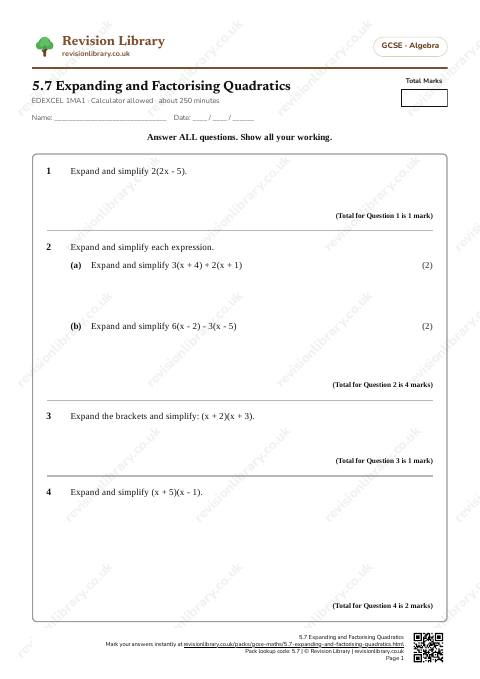
5.7 Expanding and Factorising Quadratics
EDEXCEL 1MA1 · Calculator allowed · about 250 minutes
A toy company sells k2 + 5k + 6 toys at a fair. They pack the toys into groups so the number of toys is (k + 2)(k + 3). Explain briefly why the two expressions are equal.
A rectangle has length (x + 2) cm and width (x - 1) cm. The area of the rectangle is 40 cm².
Diagram NOT accurately drawn
(a)Show that x2 + x - 42 = 0(3)
(b)Solve the equation to find the value of x, given that x > 0(3)
(Total for Question 20 is 6 marks)
21
Prove algebraically that (n + 1)2 - (n - 1)2 is always a multiple of 4, for any positive integer n.
(Total for Question 21 is 4 marks)
22
Which of these is the correct expansion of (x + 4)(x - 6)?
(a)Circle the correct answer.(1)
A) x2 - 2x - 24
B) x2 + 2x - 24
C) x2 - 10x - 24
D) x2 - 2x + 24
(Total for Question 22 is 1 mark)
23
Expand and simplify each expression.
(a)(x - 3)(x + 8)(2)
(b)(x - 5)(x - 9)(2)
(c)(2x + 3)(x - 4)(2)
(Total for Question 23 is 6 marks)
24
Expand and simplify each expression.
(a)(x + 7)(x - 7)(2)
(b)(x - 6)(x - 6)(3)
(Total for Question 24 is 5 marks)
25
Factorise each expression.
(a)Factorise x2 + 9x + 20(2)
(b)Factorise x2 + 2x - 15(2)
(Total for Question 25 is 4 marks)
26
Factorise each expression.
(a)Factorise x2 - 11x + 28(2)
(b)Factorise x2 - 6x - 27(2)
(Total for Question 26 is 4 marks)
27
Factorise each expression fully.
(a)Factorise fully 2x2 + 8x - 24(3)
(b)Factorise fully 3x2 - 27(3)
(Total for Question 27 is 6 marks)
28
Show that (x + 4)(x - 6) + 5 = x2 - 2x - 19
(Total for Question 28 is 2 marks)
29
Solve x2 + 2x - 24 = 0
(Total for Question 29 is 3 marks)
30
Solve x2 + 7x = 30
(Total for Question 30 is 4 marks)
31
Expand and simplify each expression.
(a)(x + 9)(x - 9)(2)
(b)(x - 7)(x - 7)(2)
(Total for Question 31 is 4 marks)
32
Factorise each expression.
(a)Factorise x2 - 5x - 24(2)
(b)Factorise x2 - 13x + 40(2)
(Total for Question 32 is 4 marks)
33
Factorise each expression.
(a)Factorise x2 - 49(2)
(b)Factorise x2 - 144(2)
(Total for Question 33 is 4 marks)
34
A rectangular flower bed has length (x + 3) metres and width (2x + 1) metres.
(a)Expand and simplify (x + 3)(2x + 1).(2)
(b)Factorise 2x2 + 7x + 3 to write it as a product of two linear brackets.(4)
(Total for Question 34 is 6 marks)
35
Expand and simplify 3(x - 2)(x + 1). Show all steps.
(Total for Question 35 is 4 marks)
36
Factorise fully: 6x2 - 13x - 5.
(Total for Question 36 is 3 marks)
37
Factorise each expression.
(a)Factorise 2x2 + 11x + 12(3)
(b)Factorise 3x2 + 11x + 6(3)
(Total for Question 37 is 6 marks)
38
Simplify fully (x2 - 9) / (x2 + 5x + 6)
(Total for Question 38 is 3 marks)
39
A square has side length (x + 3) cm. The area of the square is equal to the area of a rectangle with length (2x + 1) cm and width 5 cm.
Diagram NOT accurately drawn
(a)Work out the value of x(4)
(Total for Question 39 is 4 marks)
40
A rectangular lawn has length (x + 11) m and width (x - 2) m. The area of the lawn is 68 m².
(a)Show that x2 + 9x - 90 = 0(3)
(b)Solve the equation to find the value of x, given that x > 0(3)
(c)Hence work out the perimeter of the lawn.(2)
(Total for Question 40 is 8 marks)
41
Factorise each expression.
(a)Factorise 3x2 + 13x + 4(3)
(b)Factorise 4x2 + 4x - 3(3)
(Total for Question 41 is 6 marks)
42
Prove algebraically that (2n + 3)2 - (2n - 3)2 is always a multiple of 24, for any positive integer n.
(Total for Question 42 is 4 marks)
43
This question has two parts.
(a)Show that (x + 2)(x + k) expands to x2 + (k + 2)x + 2k.(1)
(b)Hence find the value of k if x2 + 7x + 10 = (x + 2)(x + k).(3)
(Total for Question 43 is 4 marks)
44
Three consecutive positive integers are such that the product of the smallest and the largest is 23 more than 5 times the middle integer. Find the three integers.
(Total for Question 44 is 6 marks)
45
Solve the equation 2x2 - 5x = 3 by completing the square. Give answers in exact form.
(Total for Question 45 is 6 marks)
46
Solve algebraically: (x + 4)(x - 3) = 2(x + 4) You must show your working.
(Total for Question 46 is 5 marks)
47
The expression x2 + kx + 36 can be factorised as (x + a)(x + b), where a and b are integers and k is negative. List all possible values of k.
(Total for Question 47 is 4 marks)
48
Prove algebraically that the difference between the squares of any two consecutive odd numbers is always a multiple of 8.
(Total for Question 48 is 4 marks)
Mark scheme · 5.7 Expanding and Factorising Quadratics
A correct answer earns full marks unless the question asks for working, a method, proof or explanation.
Question 1
4x - 10 caoB1
Answer: 4x - 10.
Question 2
(a) correct expansion of at least one bracket, 3x + 12 or 2x + 2M1
(a) 5x + 14 caoA1
(a) Answer: 5x + 14
(b) correct expansion of at least one bracket, 6x - 12 or -3x + 15M1
(b) 3x + 3 caoA1
(b) Answer: 3x + 3
Question 3
x2 + 5x + 6 caoB1
Answer: x2 + 5x + 6.
Question 4
multiply terms correctly, e.g. x*x, x*(-1), 5*x, 5*(-1) or show full FOILM1
x2 + 4x - 5 caoA1
Answer: x2 + 4x - 5.
Question 5
factor out common factor 2xM1
2x(x + 3) caoA1
Answer: 2x(x + 3).
Question 6
(a) 3x + 15 oeB1
(a) Answer: 3x + 15
(b) 8x - 12 oeB1
(b) Answer: 8x - 12
Question 7
(a) correct expansion of at least one bracket, 5x + 10 or 3x - 12M1
(a) 8x - 2 caoA1
(a) Answer: 8x - 2
(b) correct expansion of at least one bracket, 12x - 6 or -2x + 10M1
(b) 10x + 4 caoA1
(b) Answer: 10x + 4
Question 8
(a) at least 2 of x2, 11x (or 9x + 2x), 18 correctM1
(a) x2 + 11x + 18 caoA1
(a) Answer: x2 + 11x + 18
(b) at least 3 correct terms from x2, 6x, 6x, 36M1
(b) x2 + 12x + 36 caoA1
(b) Answer: x2 + 12x + 36
Question 9
(a) attempts expansion, e.g. x2 + 8x + 3x + 24M1
(a) x2 + 11x + 24 caoA1
(a) Answer: x2 + 11x + 24
(b) attempts expansion, e.g. x2 + 5x + 5x + 25M1
(b) x2 + 10x + 25 caoA1
(b) Answer: x2 + 10x + 25
Question 10
(a) attempts a factor pair of 12 that sums to 7, e.g. 3 and 4M1
(a) (x + 3)(x + 4) caoA1
(a) Answer: (x + 3)(x + 4)
(b) attempts a factor pair of -18 that sums to 3, e.g. 6 and -3M1
(b) (x + 6)(x - 3) caoA1
(b) Answer: (x + 6)(x - 3)
Question 11
identify two numbers that multiply to 10 and add to 7 (2 and 5) or show splitting the middle termM1
(x + 2)(x + 5) caoA1
correct checking statement e.g. expand to get x2 + 7x + 10 oeB1
Answer: (x + 2)(x + 5).
Question 12
identify two numbers that multiply to -12 and add to -4 ( -6 and 2 ) or show splitting the middle termM1
(x - 6)(x + 2) caoA1
correct check, e.g. expand to x2 - 4x - 12 oeB1
Answer: (x - 6)(x + 2).
Question 13
expand (k + 2)(k + 3) to show method, e.g. k2 + 2k + 3k + 6M1
correctly simplify to k2 + 5k + 6A1
conclude that this matches the given expression k2 + 5k + 6, so the two expressions are equal oeB1
Answer: Expanding gives (k + 2)(k + 3) = k2 + 2k + 3k + 6 = k2 + 5k + 6, which matches the given expression k2 + 5k + 6 exactly, so the two expressions are equal for all k.
Question 14
2x2 -10x +3x -15 simplified to 2x2 -7x -15 caoB1
Answer:2x2 - 7x - 15
(Alternatively shown steps with correct simplification.)
Question 15
expand both products correctly: (x2+5x+4) and (x2 + x -6) or equivalentM1
Put this topic and others into one printable pack.
Open the Pack Builder
Worksheets are written for Revision Library and come with a full mark scheme; a few English packs quote an out-of-copyright text, and name it on the page. Exam board names and specification codes say which qualification a pack suits: we are not affiliated with, endorsed by or approved by any exam board, and no past-paper question is reproduced here. Rights queries: hello@revisionlibrary.co.uk