Skip to the worksheet
Revision Library
Choose a subject

Solving Quadratics - Worksheets, Questions and Revision

49 original exam-style questions - 14 pages of questions with a full mark scheme - free printable PDF.

HigherGrades 5-6

This topic is chapter 7 of GCSE Maths Foundation Topic Workbook 3 and chapter 10 of GCSE Maths Higher Topic Workbook 1.

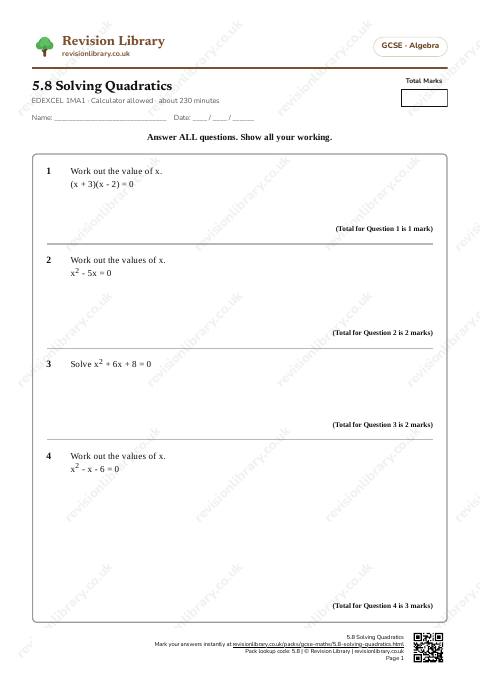
Page 1 of the Solving Quadratics worksheet: the cover details and the first questions

Solving quadratics means finding the value or values of x that make an equation of the form ax2 + bx + c = 0 true. GCSE questions expect solutions by factorising where possible, and by using the quadratic formula when a quadratic will not factorise neatly with whole numbers.

  1. Rearrange the equation so that one side equals zero, with all terms in the form ax2 + bx + c = 0.
  2. Try to factorise the quadratic into two brackets; if it factorises, set each bracket equal to zero and solve each mini-equation separately.
  3. If the equation only has an x2 term and a number (no x term), rearrange to x2 = number and take the square root of both sides, remembering both the positive and negative roots.
  4. If the equation will not factorise with whole numbers, use the quadratic formula x = (-b ± √b2 - 4ac) / (2a), substituting a, b and c carefully, including their signs.
  5. Give both solutions unless the context of the question rules one out, for example if x represents a length, reject any negative solution.
  6. Check each solution by substituting it back into the original equation.

Worked example

Solve x2 - 2x - 24 = 0.

  1. Find two numbers that multiply to give -24 and add to give -2: these are -6 and 4.
  2. Factorise: (x - 6)(x + 4) = 0.
  3. Set each bracket equal to zero: x - 6 = 0 or x + 4 = 0.
  4. Solve each equation: x = 6 or x = -4.
  5. State the final answer: x = 6 or x = -4.
Revision Library
revisionlibrary.co.uk
GCSE · Algebra

5.8 Solving Quadratics

EDEXCEL 1MA1 · Calculator allowed · about 230 minutes
Total Marks
Name: _______________________________    Date: ____ / ____ / ______
Answer ALL questions. Show all your working.
1
Work out the value of x.
(x + 3)(x - 2) = 0
(Total for Question 1 is 1 mark)
2
Work out the values of x.
x2 - 5x = 0
(Total for Question 2 is 2 marks)
3
Solve x2 + 6x + 8 = 0
(Total for Question 3 is 2 marks)
4
Work out the values of x.
x2 - x - 6 = 0
(Total for Question 4 is 3 marks)
5
Solve the equation.
3x2 - 12 = 0
(Total for Question 5 is 3 marks)
6
Solve x2 + 5x + 6 = 0
(Total for Question 6 is 3 marks)
7
Solve x2 - 49 = 0
(Total for Question 7 is 2 marks)
8
Solve 4x2 - 25 = 0, giving your answers as exact values.
(Total for Question 8 is 2 marks)
9
Solve x2 + 4x = 0
(Total for Question 9 is 2 marks)
10
Which value of x is a solution to x2 - 3x - 10 = 0?
(a)Circle the correct answer.(1)
  • A) x = 5
  • B) x = 4
  • C) x = -4
  • D) x = 3
(Total for Question 10 is 1 mark)
11
Solve x2 - 8x + 15 = 0
(Total for Question 11 is 2 marks)
12
Solve x2 + 9x = 0
(Total for Question 12 is 2 marks)
13
Priya is making a rectangular flowerbed. The length is 3 metres more than the width. The area is 70 m².
Let the width be x metres.
(a)Write down an equation in x.(1)
(b)Solve the equation and give the width of the flowerbed.(5)
(Total for Question 13 is 6 marks)
14
Work out x.
x2 + 4x + 4 = 0
(Total for Question 14 is 3 marks)
15
Solve the equation by factorising.
4x2 - 9 = 0
(Total for Question 15 is 4 marks)
16
Solve x2 = 2x + 3.
(Total for Question 16 is 3 marks)
17
Solve 3x2 - 5x - 1 = 0. Use the quadratic formula and give your answers correct to 3 significant figures.
(a)Solve 3x2 - 5x - 1 = 0, giving your answers correct to 3 significant figures(3)
(Total for Question 17 is 3 marks)
18
A rectangle has length (x + 5) cm and width x cm. The area of the rectangle is 84 cm².
Diagram NOT accurately drawn
(x + 5) cm x cm
(a)Show that x2 + 5x - 84 = 0(2)
(b)Solve the equation to find the value of x, given that x > 0(3)
(c)Hence find the length of the rectangle(1)
(Total for Question 18 is 6 marks)
19
The graph of y = x2 - 2x - 15 crosses the x-axis at the points A and B.
(a)Find the coordinates of A and B(3)
(Total for Question 19 is 3 marks)
20
Two consecutive positive integers have a product of 132. Let n be the smaller integer.
(a)Show that n2 + n - 132 = 0(2)
(b)Solve the equation to find the two consecutive integers(3)
(Total for Question 20 is 5 marks)
21
Solve (x + 2)(x - 1) = 18
(Total for Question 21 is 4 marks)
22
Solve x2 = 7x
(Total for Question 22 is 2 marks)
23
Solve 2x2 + 7x + 3 = 0
(Total for Question 23 is 3 marks)
24
Solve 3x2 - 11x - 4 = 0
(Total for Question 24 is 3 marks)
25
Solve x2 - 6x + 4 = 0. Use the quadratic formula and give your answers correct to 2 decimal places.
(a)Solve x2 - 6x + 4 = 0, giving your answers correct to 2 decimal places(3)
(Total for Question 25 is 3 marks)
26
Solve 3(x + 1)2 = 48
(Total for Question 26 is 3 marks)
27
A rectangular shed has length 4x metres and width (x + 2) metres. The area of the shed is 96 m².
Work out the value of x and then find the actual length and width of the shed.
(Total for Question 27 is 6 marks)
28
Solve the equation 2x2 - x - 6 = 0.
(Total for Question 28 is 3 marks)
29
A rectangle has sides of length x + 4 and x + 2. The area is 168 cm². Find the dimensions of the rectangle (give the positive solution for x).
Diagram NOT accurately drawn
x + 4x + 2
(Total for Question 29 is 3 marks)
30
f(x) = x2 - 6x + 11
(a)Express f(x) in the form (x - a)2 + b, where a and b are integers(2)
(b)Hence write down the minimum value of f(x) and the value of x at which it occurs(2)
(Total for Question 30 is 4 marks)
31
Solve x2 + 8x + 3 = 0 by completing the square. Leave your answer in surd form, giving each surd as simply as possible.
(a)Solve x2 + 8x + 3 = 0 by completing the square, leaving your answer in surd form(3)
(Total for Question 31 is 3 marks)
32
Solve x2 - 4x - 7 = 0. Give your answers in the form a ± √b, where a and b are integers.
(a)Solve x2 - 4x - 7 = 0, giving your answers in the form a ± √b(3)
(Total for Question 32 is 3 marks)
33
A ball is thrown into the air. Its height above the ground, h metres, after t seconds is given by h = 20t - 5t2
(a)Find the values of t when the ball is at ground level(3)
(b)Find the times at which the height of the ball is 15 metres(4)
(Total for Question 33 is 7 marks)
34
The diagram shows a right-angled triangle with sides x cm, (x + 7) cm and (x + 8) cm, where (x + 8) cm is the hypotenuse.
Diagram NOT accurately drawn
x cm (x + 7) cm (x + 8) cm
(a)Show that x2 - 2x - 15 = 0(3)
(b)Solve the equation to find x, and hence find the perimeter of the triangle(4)
(Total for Question 34 is 7 marks)
35
A rectangle has length (x + 6) cm and width (x - 1) cm. The area of the rectangle is 44 cm².
Diagram NOT accurately drawn
(x + 6) cm(x - 1) cm
(a)Show that x2 + 5x - 50 = 0(2)
(b)Solve the equation to find the value of x, given that x > 0(2)
(c)Hence find the width of the rectangle(1)
(Total for Question 35 is 5 marks)
36
Solve 3x2 + 11x + 6 = 0
(Total for Question 36 is 3 marks)
37
Solve 4x2 - 4x - 15 = 0
(Total for Question 37 is 3 marks)
38
Solve x2 + 4x - 3 = 0 using the quadratic formula. Give your answers in simplified surd form.
(Total for Question 38 is 3 marks)
39
Find the vertex (turning point) and minimum value of y = 2x2 - 8x + 5.
(Total for Question 39 is 3 marks)
40
Find the value of k such that the quadratic x2 + (k - 2)x + k has equal roots.
(Total for Question 40 is 3 marks)
41
Solve 1/2 x2 - 2x + 3/2 = 0. Give exact answers.
(Total for Question 41 is 3 marks)
42
Solve x2 - 10x + 3 = 0 by completing the square, leaving your answer in simplified surd form.
(Total for Question 42 is 3 marks)
43
Solve 2x2 - 3x - 4 = 0. Give your answers in the form (a ± √b) / c, where a, b and c are integers.
(Total for Question 43 is 3 marks)
44
Solve 3x2 + 2x - 5 = 0 giving exact answers in surd form.
(Total for Question 44 is 4 marks)
45
A firework is launched from a platform. Its height above the ground, h metres, after t seconds is modelled by h = -5t2 + 25t + 2. Find the times at which the firework is at a height of 22 metres.
(Total for Question 45 is 5 marks)
46
Solve the simultaneous equations:
y = x2 - x - 7
y = 3x - 2
(Total for Question 46 is 5 marks)
47
x2 + 2x - 24 is a quadratic expression.
(a)Factorise x2 + 2x - 24(2)
(b)Hence write down the solutions of x2 + 2x - 24 = 0(1)
(c)Hence, or otherwise, solve (x - 1)2 + 2(x - 1) - 24 = 0(3)
(Total for Question 47 is 6 marks)
48
For which values of m does the quadratic f(x) = x2 - 4x + m have two distinct real positive roots? Show your reasoning.
(Total for Question 48 is 5 marks)
49
By using the substitution u = x2, or otherwise, solve x4 - 13x2 + 36 = 0.
(Total for Question 49 is 5 marks)
Mark scheme · 5.8 Solving Quadratics

A correct answer earns full marks unless the question asks for working, a method, proof or explanation.

Question 1

  • x = -3 or x = 2 caoB1
  • Answer: x = -3 or x = 2

Question 2

  • factorise to x(x - 5) = 0 or equivalentM1
  • x = 0 and x = 5 caoA1
  • Answer: x = 0 and x = 5

Question 3

  • correct factorisation (x + 2)(x + 4) = 0 oeM1
  • x = -2 and x = -4 caoA1
  • Answer: x = -2 or x = -4

Question 4

  • factorise to (x - 3)(x + 2) = 0 or equivalentM1
  • x = 3 caoA1
  • x = -2 caoA1
  • Answer: x = 3 and x = -2

Question 5

  • rearrange to 3x2 = 12 and divide to x2 = 4 or equivalentM1
  • x = 2 caoA1
  • x = -2 caoA1
  • Answer: x = 2 and x = -2

Question 6

  • correctly factorises to (x + 2)(x + 3) = 0M1
  • x = -2A1
  • x = -3 (both values required, ft from correct factorisation)A1
  • Answer: x = -2 or x = -3

Question 7

  • rearranges to x2 = 49 oe, or factorises to (x - 7)(x + 7) = 0M1
  • x = 7 and x = -7 (both values required, cao)A1
  • Answer: x = 7 or x = -7

Question 8

  • rearranges to x2 = 25/4 oe, or factorises to (2x - 5)(2x + 5) = 0M1
  • x = 2.5 and x = -2.5 oe (both values required, cao)A1
  • Answer: x = 2.5 or x = -2.5

Question 9

  • factorises to x(x + 4) = 0M1
  • x = 0 and x = -4 (both values required, cao)A1
  • Answer: x = 0 or x = -4

Question 10

  • (a) A caoB1
  • (a) Answer: A

Question 11

  • correct factorisation (x - 3)(x - 5) = 0 oeM1
  • x = 3 and x = 5 caoA1
  • Answer: x = 3 or x = 5

Question 12

  • x(x + 9) = 0 oeM1
  • x = 0 and x = -9 caoA1
  • Answer: x = 0 or x = -9

Question 13

  • (a) equation x(x + 3) = 70 or equivalentM1
  • (a) Answer: x(x + 3) = 70
  • (b) expand to x2 + 3x - 70 = 0 or rearrange to standard formM1
  • (b) factorise to (x + 10)(x - 7) = 0 or equivalentM1
  • (b) state both roots x = 7 and x = -10 or show solving each factorM1
  • (b) x = 7 caoA1
  • (b) width = 7 m stated as the positive practical solutionA1
  • (b) Answer: x = 7 (width = 7 m)

Question 14

  • recognise perfect square: (x + 2)2 = 0 or factorise to (x + 2)(x + 2)M1
  • x = -2 caoA1
  • x = -2 given as the only (repeated) solution, dependent on the previous A1, iswA1
  • Answer: x = -2

Question 15

  • recognise difference of squares: (2x - 3)(2x + 3) = 0 or show correct factorisationM1
  • 2x - 3 = 0 gives x = 3/2 caoA1
  • 2x + 3 = 0 gives x = -3/2 caoA1
  • both solutions x = 3/2 and x = -3/2 stated as the final answer, dependent on correct factorisation, iswA1
  • Answer: x = 3/2 and x = -3/2

Question 16

  • rearrange to x2 - 2x - 3 = 0M1
  • factorise to (x - 3)(x + 1) oeM1
  • x = 3 or x = -1 caoA1
  • Answer: x = 3 or x = -1

Question 17

  • (a) correct substitution into the quadratic formula, x = (5 ± √25 + 12) / 6M1
  • (a) x = 1.85 awrtA1
  • (a) x = -0.180 awrt (both values required)A1
  • (a) Answer: x = 1.85 or x = -0.180 (3sf)

Question 18

  • (a) forms the equation x(x + 5) = 84M1
  • (a) cso, rearranges correctly to x2 + 5x - 84 = 0A1
  • (a) Answer: x2 + 5x - 84 = 0 (shown)
  • (b) correctly factorises to (x + 12)(x - 7) = 0M1
  • (b) identifies both roots x = 7 and x = -12A1
  • (b) (dep) selects x = 7, rejecting x = -12 since x > 0A1
  • (b) Answer: x = 7
  • (c) 12 cm, ft from x = 7 in part (b)B1
  • (c) Answer: 12 cm

Question 19

  • (a) correctly factorises to (x - 5)(x + 3) = 0, or sets y = 0 and uses the quadratic formulaM1
  • (a) (-3, 0)A1
  • (a) (5, 0) (both coordinate pairs required, either order)A1
  • (a) Answer: A = (-3, 0), B = (5, 0)

Question 20

  • (a) forms the equation n(n + 1) = 132M1
  • (a) cso, rearranges correctly to n2 + n - 132 = 0A1
  • (a) Answer: n2 + n - 132 = 0 (shown)
  • (b) correctly factorises to (n - 11)(n + 12) = 0M1
  • (b) (dep) n = 11, rejecting n = -12 since the integers are positiveA1
  • (b) states the integers are 11 and 12A1
  • (b) Answer: 11 and 12

Question 21

  • expands and rearranges to x2 + x - 20 = 0 (or equivalent three-term quadratic equal to zero)M1
  • correctly factorises to (x + 5)(x - 4) = 0M1
  • x = -5A1
  • x = 4 (both values required)A1
  • Answer: x = -5 or x = 4

Question 22

  • rearranges to x2 - 7x = 0 and factorises to x(x - 7) = 0 (dividing both sides by x loses a solution and does not score this mark)M1
  • x = 0 and x = 7 (both values required, cao)A1
  • Answer: x = 0 or x = 7

Question 23

  • correctly factorises to (2x + 1)(x + 3) = 0M1
  • x = -3A1
  • x = -0.5 oe (both values required, ft from correct factorisation)A1
  • Answer: x = -3 or x = -0.5

Question 24

  • correctly factorises to (3x + 1)(x - 4) = 0M1
  • x = 4A1
  • x = -1/3 oe (both values required, ft from correct factorisation)A1
  • Answer: x = 4 or x = -1/3

Question 25

  • (a) correct substitution into the quadratic formula, x = (6 ± √36 - 16) / 2M1
  • (a) x = 5.24 awrtA1
  • (a) x = 0.76 awrt (both values required)A1
  • (a) Answer: x = 5.24 or x = 0.76 (2dp)

Question 26

  • (x + 1)2 = 16 oeM1
  • x + 1 = ± 4M1
  • x = 3 and x = -5 both caoA1
  • Answer: x = 3 or x = -5

Question 27

  • form equation 4x(x + 2) = 96 or equivalentM1
  • simplify to 4x2 + 8x - 96 = 0 and divide by 4 to get x2 + 2x - 24 = 0M1
  • factorise to (x + 6)(x - 4) = 0 or equivalentM1
  • x = 4 caoA1
  • x = -6 caoA1
  • state length = 16 m and width = 6 m for the positive solutionA1
  • Answer: x = 4 (discard x = -6). Length = 4x = 16 m, width = x + 2 = 6 m. Working: 4x(x + 2) = 96 -> x2 + 2x - 24 = 0 -> (x + 6)(x - 4) = 0.

Question 28

  • correct factorisation or rearrangement shown, e.g. 2x2 +3x -4x -6 or (2x +3)(x -2)M1
  • obtain factors (2x +3)(x -2) oeM1
  • x = 2 or x = -3/2 caoA1
  • Answer: x = 2 or x = -3/2

Question 29

  • form equation (x + 4)(x + 2) = 168 and expand to x2 + 6x + 8 = 168M1
  • rearrange to x2 + 6x - 160 = 0 and solve by factorisation or formula to get x = 10 or x = -16M1
  • positive solution x = 10 giving dimensions 14 cm and 12 cm caoA1
  • Answer: Dimensions are 14 cm by 12 cm (x = 10)

Question 30

  • (a) (x - 3)2 seenM1
  • (a) (x - 3)2 + 2 caoA1
  • (a) Answer: (x - 3)2 + 2
  • (b) minimum value = 2, ft from part (a)B1
  • (b) occurs at x = 3, ft from part (a)B1
  • (b) Answer: minimum value 2 at x = 3

Question 31

  • (a) correctly completes the square, (x + 4)2 - 13 = 0M1
  • (a) rearranges to x + 4 = ± √13M1
  • (a) x = -4 + √13 or x = -4 - √13 oe (both terms required, cao)A1
  • (a) Answer: x = -4 + √13 or x = -4 - √13

Question 32

  • (a) correctly completes the square, (x - 2)2 - 11 = 0, or correct substitution into the quadratic formulaM1
  • (a) rearranges to x - 2 = ± √11 (or equivalent simplification of √44/2)M1
  • (a) x = 2 ± √11 caoA1
  • (a) Answer: x = 2 + √11 or x = 2 - √11

Question 33

  • (a) sets 20t - 5t2 = 0 and factorises to 5t(4 - t) = 0M1
  • (a) t = 0A1
  • (a) t = 4 (both values required)A1
  • (a) Answer: t = 0 or t = 4
  • (b) sets 20t - 5t2 = 15 and rearranges to t2 - 4t + 3 = 0 (or equivalent unsimplified form)M1
  • (b) correctly factorises to (t - 1)(t - 3) = 0M1
  • (b) t = 1A1
  • (b) t = 3 (both values required)A1
  • (b) Answer: t = 1 or t = 3

Question 34

  • (a) uses Pythagoras' theorem to form the equation (x + 7)2 + x2 = (x + 8)2M1
  • (a) correctly expands all three terms, x2 + 14x + 49 + x2 = x2 + 16x + 64M1
  • (a) cso, rearranges correctly to x2 - 2x - 15 = 0A1
  • (a) Answer: x2 - 2x - 15 = 0 (shown)
  • (b) correctly factorises to (x - 5)(x + 3) = 0M1
  • (b) (dep) selects x = 5, rejecting x = -3 since a length cannot be negativeA1
  • (b) finds all three side lengths, 5 cm, 12 cm and 13 cmM1
  • (b) perimeter = 30 cm caoA1
  • (b) Answer: x = 5, perimeter = 30 cm

Question 35

  • (a) expands (x + 6)(x - 1) to obtain x2 + 5x - 6M1
  • (a) sets the expansion equal to 44 and rearranges correctly to x2 + 5x - 50 = 0 (cso)A1
  • (a) Answer: x2 + 5x - 50 = 0
  • (b) correct factorisation (x + 10)(x - 5) = 0, or correct use of the quadratic formulaM1
  • (b) x = 5, rejecting x = -10 since x > 0A1
  • (b) Answer: x = 5
  • (c) width = 4 cm (ft their x, width = x - 1)B1
  • (c) Answer: 4 cm

Question 36

  • correct factorisation (3x + 2)(x + 3) = 0 oeM1
  • x = -2/3 oeA1
  • x = -3 caoA1
  • Answer: x = -2/3 or x = -3

Question 37

  • correct factorisation (2x + 3)(2x - 5) = 0 oeM1
  • x = -3/2 oeA1
  • x = 5/2 oeA1
  • Answer: x = -3/2 or x = 5/2

Question 38

  • correct substitution into the quadratic formula, x = (-4 ± √16 + 12) / 2 oeM1
  • simplifies √28 to 2*√7M1
  • x = -2 + √7 and x = -2 - √7 oe caoA1
  • Answer: x = -2 + √7 or x = -2 - √7

Question 39

  • complete the square: 2(x2 - 4x) + 5 = 2[(x - 2)2 - 4] + 5 or equivalentM1
  • simplify to 2(x - 2)2 - 3M1
  • vertex (2, -3) and minimum value -3 caoA1
  • Answer: Turning point at (2, -3); minimum value -3

Question 40

  • state discriminant = 0 for equal roots and form (k - 2)2 - 4*1*k = 0 or b2 - 4ac = 0M1
  • expand and simplify: k2 - 4k + 4 - 4k = 0 giving k2 - 8k + 4 = 0M1
  • solve k = [8 ± √64 - 16]/2 = [8 ± √48]/2 = 4 ± √12 oe; both values (k = 4 + 2√3 or k = 4 - 2√3) caoA1
  • Answer: k = 4 + 2√3 or k = 4 - 2√3

Question 41

  • multiply both sides by 2 to get x2 - 4x + 3 = 0 or use quadratic formulaM1
  • factorise or solve to get (x - 1)(x - 3) = 0M1
  • x = 1 or x = 3 caoA1
  • Answer: x = 1 or x = 3

Question 42

  • (x - 5)2 - 22 = 0 oe correct completed-square formM1
  • (x - 5)2 = 22 leading to x - 5 = ± √22M1
  • x = 5 + √22 and x = 5 - √22 both caoA1
  • Answer: x = 5 + √22 or x = 5 - √22

Question 43

  • correct substitution into the quadratic formula, x = (3 ± √9 + 32) / 4 oeM1
  • x = (3 + √41) / 4 oe caoA1
  • x = (3 - √41) / 4 oe caoA1
  • Answer: x = (3 + √41) / 4 or x = (3 - √41) / 4

Question 44

  • substitute into quadratic formula x = [-b ± √b2 - 4ac]/(2a) with a=3, b=2, c=-5M1
  • evaluate discriminant: b2 - 4ac = 4 + 60 = 64M1
  • √64 = 8 substituted correctlyA1
  • x = (-2 ± 8) / 6 giving x = 1 or x = -5/3 caoA1
  • Answer: x = 1 or x = -5/3

Question 45

  • sets up -5t2 + 25t + 2 = 22 oeM1
  • rearranges to -5t2 + 25t - 20 = 0 or t2 - 5t + 4 = 0 oeM1
  • correct factorisation (t - 1)(t - 4) = 0, or correct use of the quadratic formulaM1
  • t = 1A1
  • t = 4A1
  • Answer: t = 1 second and t = 4 seconds

Question 46

  • equates x2 - x - 7 = 3x - 2 oeM1
  • rearranges to a correct three-term quadratic x2 - 4x - 5 = 0 oe, dependent on the previous M1dM1
  • correct factorisation (x - 5)(x + 1) = 0, or correct use of the quadratic formulaM1
  • x = 5 and x = -1A1
  • y = 13 and y = -5 respectively, caoA1
  • Answer: (x, y) = (5, 13) or (x, y) = (-1, -5)

Question 47

  • (a) two brackets of the form (x + p)(x + q) with pq = -24 attemptedM1
  • (a) (x + 6)(x - 4) caoA1
  • (a) Answer: (x + 6)(x - 4)
  • (b) x = -6 and x = 4 both stated (ft from part (a))B1
  • (b) Answer: x = -6 or x = 4
  • (c) recognises the substitution u = x - 1 (or an equivalent direct approach) to give u2 + 2u - 24 = 0M1
  • (c) u = -6 or u = 4, following the factorisation pattern from part (a)M1
  • (c) x = -5 and x = 5 both caoA1
  • (c) Answer: x = -5 or x = 5

Question 48

  • state discriminant > 0 and compute: b2 - 4ac = 16 - 4m > 0 leading to m < 4M1
  • state product of roots = c/a = m must be > 0 for roots both positiveM1
  • note sum of roots = 4 which is > 0 so does not restrict further (state sum > 0)M1
  • combine conditions to 0 < m < 4 and justify distinctness by strict inequalitiesA1
  • final answer 0 < m < 4 caoA1
  • Answer: 0 < m < 4

Question 49

  • substitutes u = x2 to form u2 - 13u + 36 = 0 oeM1
  • correct factorisation (u - 9)(u - 4) = 0M1
  • u = 9 and u = 4A1
  • x = 3 and x = -3 (from u = 9)A1
  • x = 2 and x = -2 (from u = 4)A1
  • Answer: x = 3, x = -3, x = 2, x = -2

Mark your answers

Check answers without an account. Some answers can be checked automatically; use the mark scheme to mark the rest.

Question 1

1 mark
Did your answer earn the marks?

Question 2

2 marks

Question 3

2 marks
Did your answer earn the marks?

Question 4

3 marks

Question 5

3 marks

Question 6

3 marks
Did your answer earn the marks?

Question 7

2 marks
Did your answer earn the marks?

Question 8

2 marks
Did your answer earn the marks?

Question 9

2 marks
Did your answer earn the marks?

Question 10(a)

1 mark
Choose an answer

Question 11

2 marks
Did your answer earn the marks?

Question 12

2 marks
Did your answer earn the marks?

Question 13

6 marks
Did your answer earn the marks?

Question 14

3 marks

Question 15

4 marks

Question 16

3 marks
Did your answer earn the marks?

Question 17

3 marks
Did your answer earn the marks?

Question 18

6 marks
Did your answer earn the marks?

Question 19

3 marks
Did your answer earn the marks?

Question 20

5 marks
Did your answer earn the marks?

Question 21

4 marks
Did your answer earn the marks?

Question 22

2 marks
Did your answer earn the marks?

Question 23

3 marks
Did your answer earn the marks?

Question 24

3 marks
Did your answer earn the marks?

Question 25

3 marks
Did your answer earn the marks?

Question 26

3 marks
Did your answer earn the marks?

Question 27

6 marks
Did your answer earn the marks?

Question 28

3 marks
Did your answer earn the marks?

Question 29

3 marks
Did your answer earn the marks?

Question 30

4 marks
Did your answer earn the marks?

Question 31

3 marks
Did your answer earn the marks?

Question 32

3 marks
Did your answer earn the marks?

Question 33

7 marks
Did your answer earn the marks?

Question 34

7 marks
Did your answer earn the marks?

Question 35

5 marks
Did your answer earn the marks?

Question 36

3 marks
Did your answer earn the marks?

Question 37

3 marks
Did your answer earn the marks?

Question 38

3 marks
Did your answer earn the marks?

Question 39

3 marks
Did your answer earn the marks?

Question 40

3 marks
Did your answer earn the marks?

Question 41

3 marks
Did your answer earn the marks?

Question 42

3 marks
Did your answer earn the marks?

Question 43

3 marks
Did your answer earn the marks?

Question 44

4 marks
Did your answer earn the marks?

Question 45

5 marks
Did your answer earn the marks?

Question 46

5 marks
Did your answer earn the marks?

Question 47

6 marks
Did your answer earn the marks?

Question 48

5 marks

Question 49

5 marks
Did your answer earn the marks?
Mark my answers

Worksheets are written for Revision Library and come with a full mark scheme; a few English packs quote an out-of-copyright text, and name it on the page. Exam board names and specification codes say which qualification a pack suits: we are not affiliated with, endorsed by or approved by any exam board, and no past-paper question is reproduced here. Rights queries: hello@revisionlibrary.co.uk