The quadratic formula solves any equation of the form ax2 + bx + c = 0 for x, even when the expression will not factorise neatly. It states x = (-b plus or minus the square root of (b2 - 4ac)) all divided by 2a.
Rearrange the equation so it equals zero, in the form ax2 + bx + c = 0.
Write down the values of a, b and c, being careful with negative signs.
Substitute a, b and c into the formula x = (-b ± √b2 - 4ac) / (2a).
Work out b2 - 4ac first - this is called the discriminant. If it's negative, there are no real solutions.
Find both answers: one using +√... and one using -√..., then simplify or round as instructed.
Worked example
Solve 2x2 + 3x - 5 = 0 using the quadratic formula.
Here a = 2, b = 3 and c = -5.
Substitute into the formula: x = (-3 ± √32 - 4x2x(-5)) / (2x2).
Work out the discriminant: 32 - 4x2x(-5) = 9 + 40 = 49.
√49 = 7, so x = (-3 ± 7) / 4.
The two solutions are x = (-3 + 7)/4 = 1 and x = (-3 - 7)/4 = -2.5.
Revision Library
revisionlibrary.co.uk
HIGHER
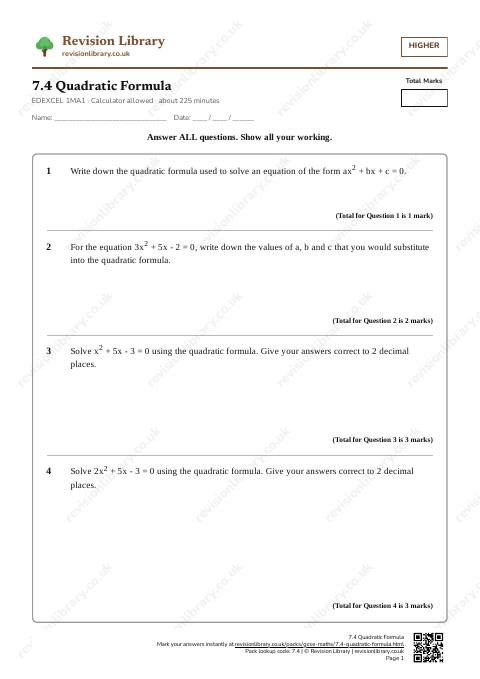
7.4 Quadratic Formula
EDEXCEL 1MA1 · Calculator allowed · about 225 minutes
Write down the quadratic formula used to solve an equation of the form ax2 + bx + c = 0.
(Total for Question 1 is 1 mark)
2
For the equation 3x2 + 5x - 2 = 0, write down the values of a, b and c that you would substitute into the quadratic formula.
(Total for Question 2 is 2 marks)
3
Solve x2 + 5x - 3 = 0 using the quadratic formula. Give your answers correct to 2 decimal places.
(Total for Question 3 is 3 marks)
4
Solve 2x2 + 5x - 3 = 0 using the quadratic formula. Give your answers correct to 2 decimal places.
(Total for Question 4 is 3 marks)
5
Calculate the value of the discriminant, b2 - 4ac, for the equation 2x2 - 5x + 1 = 0.
(Total for Question 5 is 2 marks)
6
Quadratic equations can be written in the form ax2 + bx + c = 0.
(a)Write down the values of a, b and c in the equation 4x2 - 7x + 2 = 0.(1)
(b)Rearrange the equation 5x2 = 3x + 8 into the form ax2 + bx + c = 0, and state the values of a, b and c.(2)
(Total for Question 6 is 3 marks)
7
The equation 2x2 - 3x - 4 = 0 is to be solved using the quadratic formula. Which of the following is the correct value of the discriminant, b2 - 4ac?
A) 41
B) -23
C) 9
D) 25
(Total for Question 7 is 1 mark)
8
Solve x2 + 3x - 5 = 0. Give your solutions correct to 2 decimal places.
(Total for Question 8 is 3 marks)
9
Solve x2 - 4x - 1 = 0. Give your solutions in surd form, simplified as far as possible.
(Total for Question 9 is 2 marks)
10
Solve 5x2 - 7x - 1 = 0 using the quadratic formula. Give your answers correct to 2 decimal places.
(Total for Question 10 is 3 marks)
11
Solve 2x2 - 3x - 6 = 0 using the quadratic formula. Give your answers correct to 2 decimal places.
(Total for Question 11 is 3 marks)
12
Solve x2 + 7x + 4 = 0 using the quadratic formula. Give your answers correct to 2 decimal places.
(Total for Question 12 is 3 marks)
13
A number x satisfies x2 - 5x = 9. Rearrange this equation into the form ax2 + bx + c = 0, then use the quadratic formula to find the two possible values of x, giving your answers correct to 2 decimal places.
(Total for Question 13 is 4 marks)
14
Two whole numbers differ by 3. The product of the two numbers is 88. By forming and solving a quadratic equation, find the two possible pairs of numbers.
(Total for Question 14 is 4 marks)
15
A quadratic equation has discriminant b2 - 4ac = -20. State how many real solutions the equation has, giving a reason for your answer.
(Total for Question 15 is 2 marks)
16
Solve x2 - 4x - 7 = 0 using the quadratic formula. Give your answers correct to 2 decimal places.
(Total for Question 16 is 3 marks)
17
Solve 4x2 + 4x - 15 = 0 using the quadratic formula. Give your answers as exact decimals.
(Total for Question 17 is 3 marks)
18
Solve x2 + 6x + 2 = 0 using the quadratic formula. Give your answers correct to 3 significant figures.
(Total for Question 18 is 3 marks)
19
Consider the equation 3x2 - 2x + 5 = 0.
(a)Calculate the value of the discriminant, b2 - 4ac.(1)
(b)Hence state, giving a reason, how many real solutions the equation has.(1)
(Total for Question 19 is 2 marks)
20
A rectangular garden has length (x + 4) metres and width x metres. The area of the garden is 35 m².
Diagram NOT accurately drawn
(a)Show that x2 + 4x - 35 = 0.(2)
(b)Hence solve the equation to find the width of the garden. Give your answer correct to 2 decimal places, and explain why the other solution of the equation is not a valid width.(4)
(Total for Question 20 is 6 marks)
21
A ball is thrown in the air. Its height, h metres, after t seconds is given by h = 20t - 5t2 + 1. Find the time(s) at which the ball is at a height of 15 metres, giving your answer(s) correct to 2 decimal places.
(Total for Question 21 is 4 marks)
22
The equation x2 + kx + 16 = 0 has equal roots, where k > 0. Find the value of k.
(Total for Question 22 is 3 marks)
23
A student attempts to solve 3x2 + 4x - 2 = 0 using the quadratic formula. Their working is shown below: x = (-4 ± √42 - 4x3x(-2)) / (2x3) x = (-4 ± √16 - 24) / 6 Identify the error made by the student, and find the correct solutions to the equation, giving your answers correct to 2 decimal places.
(Total for Question 23 is 4 marks)
24
Solve x + 3/x = 7. Give your solutions correct to 2 decimal places.
(Total for Question 24 is 4 marks)
25
Without solving them fully, compare the equations x2 + 4x + 7 = 0 and x2 + 4x - 7 = 0.
(a)State, giving a reason, how many real solutions x2 + 4x + 7 = 0 has.(1)
(b)State, giving a reason, how many real solutions x2 + 4x - 7 = 0 has.(1)
(Total for Question 25 is 2 marks)
26
Solve 4x2 + 7x = 4. Give your solutions correct to 2 decimal places.
(Total for Question 26 is 4 marks)
27
Solve 2x2 + 9x + 5 = 0. Give your solutions correct to 3 decimal places.
(Total for Question 27 is 3 marks)
28
Solve 4x2 - 6x = 6. Give your solutions correct to 2 decimal places.
(Total for Question 28 is 4 marks)
29
Show that x2 - 2x + 5 = 0 has no real solutions.
(Total for Question 29 is 2 marks)
30
Solve x2 - 2x - 4 = 0. Give your solutions in the form p + √q and p - √q, where p and q are integers.
(Total for Question 30 is 4 marks)
31
Show that 4x2 + 11 = 0 has no real solutions.
(Total for Question 31 is 2 marks)
32
Solve 4x2 - 6x - 7 = 0. Give your solutions correct to 3 decimal places.
(Total for Question 32 is 3 marks)
33
Solve 2x2 + 5x - 1 = 0. Give your solutions correct to 2 decimal places.
(Total for Question 33 is 3 marks)
34
Solve (x + 2)(x - 1) = 9. Give your solutions correct to 2 decimal places.
(Total for Question 34 is 4 marks)
35
Solve (2x - 1)(x + 3) = 6. Give your solutions correct to 3 significant figures.
(Total for Question 35 is 4 marks)
36
Solve 5x2 - 8x - 1 = 0. Give your solutions correct to 1 decimal place.
(Total for Question 36 is 3 marks)
37
For each equation, choose an efficient method (factorising or the quadratic formula) and solve it, showing your working clearly.
(a)x2 - 5x + 6 = 0(2)
(b)x2 - 5x + 2 = 0. Give your solutions correct to 2 decimal places.(3)
(Total for Question 37 is 5 marks)
38
A number x satisfies 2x2 + 3x = 7. Rearrange this equation into the form ax2 + bx + c = 0, then use the quadratic formula to find the two possible values of x, giving your answers correct to 2 decimal places.
(Total for Question 38 is 4 marks)
39
A stallholder at a craft market in Leeds models her daily profit, P pounds, from selling x greetings cards using P = -2x2 + 40x - 150.
(a)Show that when P = 30, the equation can be simplified to x2 - 20x + 90 = 0.(2)
(b)Solve x2 - 20x + 90 = 0 using the quadratic formula, giving your answers correct to 1 decimal place.(3)
(c)Hence state the two numbers of greetings cards, to the nearest whole card, for which the daily profit is £30.(1)
(Total for Question 39 is 6 marks)
40
Two students solve x2 - 6x + 4 = 0 using the quadratic formula.
(a)Use the quadratic formula to solve x2 - 6x + 4 = 0, giving your answers correct to 2 decimal places.(3)
(b)Verify one of your solutions by substituting it back into x2 - 6x + 4, and explain why the result is not exactly zero.(2)
(Total for Question 40 is 5 marks)
41
Solve x2 - 10x + 13 = 0. Give your answers in the form p ± q*√3, where p and q are integers.
(Total for Question 41 is 3 marks)
42
In a badminton tournament, every player plays every other player exactly once. If there are x players, the total number of matches played is (x(x - 1))/2. There are 66 matches played in total. Form an equation in x and use the quadratic formula to find the number of players, explaining why the other solution to your equation is not valid.
(Total for Question 42 is 4 marks)
43
A right-angled triangle has a shorter side of length x cm, a second shorter side of length (x + 3) cm, and a hypotenuse of length (x + 9) cm.
Diagram NOT accurately drawn
(a)Show that x2 - 12x - 72 = 0.(3)
(b)Hence find the length of the hypotenuse, giving your answer correct to 3 significant figures.(4)
(Total for Question 43 is 7 marks)
44
Show that the equation 2x2 - 3x + 5 = 0 has no real solutions.
(Total for Question 44 is 3 marks)
45
The equation x2 + px + 12 = 0 has two distinct real roots, where p is a positive integer. Find the smallest possible value of p.
(Total for Question 45 is 3 marks)
46
Starting from the general quadratic equation ax2 + bx + c = 0 (a not equal to 0), show, by completing the square, that x = (-b ± √b2 - 4ac) / (2a) You must show each step of your working.
(Total for Question 46 is 5 marks)
47
A group of x students are going on a school trip. The total cost of hiring a coach is £240, shared equally between the students. If 4 more students join the trip, the cost per student decreases by £2. Form an equation in x and solve it using the quadratic formula to find the original number of students.
(Total for Question 47 is 4 marks)
48
A cyclist travels 40 km at a steady speed of x km/h. On her return journey, a strong headwind reduces her speed by 2 km/h, and the return journey takes 1/3 of an hour (20 minutes) longer than the outward journey. Form an equation in x and solve it using the quadratic formula to find her outward speed, giving your answer correct to 1 decimal place.
(Total for Question 48 is 4 marks)
49
Solve the equation 3/(x + 1) + 2/(x - 2) = 1, where x is not equal to -1 and x is not equal to 2, giving your answers correct to 2 decimal places.
(Total for Question 49 is 5 marks)
Mark scheme · 7.4 Quadratic Formula
A correct answer earns full marks unless the question asks for working, a method, proof or explanation.
Question 1
x = (-b ± √b2 - 4ac) / (2a) oe, fully correctB1
Answer: x = (-b ± √b2 - 4ac) / (2a)
Question 2
a = 3 and c = -2, both correctB1
b = 5B1
Answer: a = 3, b = 5, c = -2
Question 3
correct substitution with a = 1, b = 5, c = -3, e.g. x = (-5 ± √52 - 4(1)(-3)) / (2(1))M1
x = 0.54 (awrt 0.54)A1
x = -5.54 (awrt -5.54)A1
Answer: x = 0.54 or x = -5.54
Question 4
correct substitution with a = 2, b = 5, c = -3M1
x = 0.5 (accept 0.50) caoA1
x = -3 (accept -3.00) caoA1
Answer: x = 0.5 or x = -3 (0.50 and -3.00 to 2 decimal places)
Question 5
(-5)2 - 4(2)(1) seen, i.e. 25 - 8M1
17 caoA1
Answer: 17
Question 6
(a) a = 4, b = -7, c = 2, all correctB1
(a) Answer: a = 4, b = -7, c = 2
(b) 5x2 - 3x - 8 = 0 oe (correct rearrangement)M1
(b) a = 5, b = -3, c = -8, all correctA1
(b) Answer: 5x2 - 3x - 8 = 0; a = 5, b = -3, c = -8
Question 7
A (41) caoB1
Answer: A) 41
Question 8
correct substitution into the formula with a = 1, b = 3, c = -5, e.g. x = (-3 ± √32 - 4(1)(-5))/(2(1))M1
x = 1.19 (awrt 1.19)A1
x = -4.19 (awrt -4.19)A1
Answer: x = 1.19 or x = -4.19
Question 9
correct substitution with a = 1, b = -4, c = -1, leading to √20 or 2√5 seenM1
x = 2 + √5 or x = 2 - √5, both, simplified oeA1
Answer: x = 2 + √5 or x = 2 - √5
Question 10
correct substitution with a = 5, b = -7, c = -1M1
x = 1.53 (awrt 1.53)A1
x = -0.13 (awrt -0.13)A1
Answer: x = 1.53 or x = -0.13
Question 11
correct substitution with a = 2, b = -3, c = -6M1
x = 2.64 (awrt 2.64)A1
x = -1.14 (awrt -1.14)A1
Answer: x = 2.64 or x = -1.14
Question 12
correct substitution with a = 1, b = 7, c = 4M1
x = -0.63 (awrt -0.63)A1
x = -6.37 (awrt -6.37)A1
Answer: x = -0.63 or x = -6.37
Question 13
rearranges to x2 - 5x - 9 = 0 oeM1
correct substitution with a = 1, b = -5, c = -9 (ft)M1
x = 6.41 (awrt 6.41)A1
x = -1.41 (awrt -1.41)A1
Answer: x = 6.41 or x = -1.41
Question 14
forms the equation x(x + 3) = 88 oe, e.g. x2 + 3x - 88 = 0M1
correct substitution into the quadratic formula with a = 1, b = 3, c = -88 (ft)M1
x = 8 or x = -11, both caoA1
states both pairs: 8 and 11, or -11 and -8A1
Answer: 8 and 11, or -11 and -8
Question 15
0 (no real solutions)B1
reason: the discriminant is negative, so √b2 - 4ac is not a real numberB1
Answer: 0 real solutions, since the discriminant is negative
Question 16
correct substitution with a = 1, b = -4, c = -7M1
x = 5.32 (awrt 5.32)A1
x = -1.32 (awrt -1.32)A1
Answer: x = 5.32 or x = -1.32
Question 17
correct substitution with a = 4, b = 4, c = -15M1
x = 1.5 oe (e.g. 3/2), caoA1
x = -2.5 oe (e.g. -5/2), caoA1
Answer: x = 1.5 or x = -2.5
Question 18
correct substitution with a = 1, b = 6, c = 2M1
x = -0.354 (awrt -0.354)A1
x = -5.65 (awrt -5.65)A1
Answer: x = -0.354 or x = -5.65
Question 19
(a) -56 caoB1
(a) Answer: -56
(b) 0 (no real solutions), since the discriminant is negative (ft from part a)B1
Put this topic and others into one printable pack.
Open the Pack Builder
Worksheets are written for Revision Library and come with a full mark scheme; a few English packs quote an out-of-copyright text, and name it on the page. Exam board names and specification codes say which qualification a pack suits: we are not affiliated with, endorsed by or approved by any exam board, and no past-paper question is reproduced here. Rights queries: hello@revisionlibrary.co.uk