Revision Library
Choose a subject
Menu
Computer Science
Need a new topic?
Missing a topic, found a bug, or want something added?

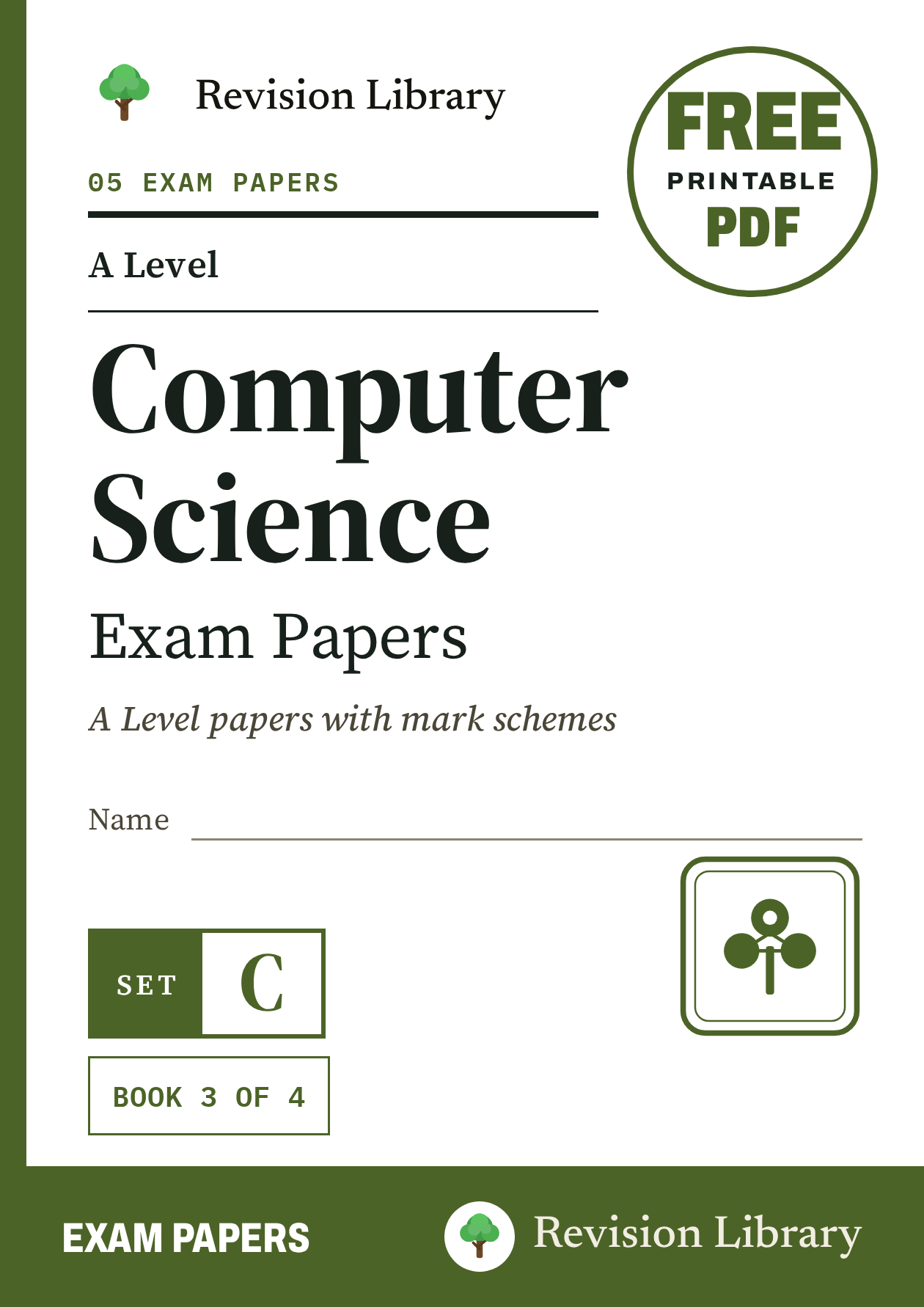
Book 3 of 4

A Level Computer Science Exam Papers Set C

A Level Paper 1: Algorithms and Data Structures, A Level Paper 2: Programming Theory and A Level Paper 3: Computer Systems

Level
A Level · AQA 7517 · OCR H446
Series
A Level Computer Science Exam Papers, book 3 of 4
Suitable for
Years 12-13, AQA / OCR
FreePDF download · 2027 edition · 59 A4 pages
  • One file, prints straight to A4
  • No account, no password

3 papers, mark schemes at the back. This set is one of 558 free PDFs on the shelf.

Pages
59 A4 pages
Papers
3 papers
Questions
48 · 180 marks
Answers
From page 44

What is inside

3 papers · answers from p44

Each paper starts with a page showing its marks and a suggested time, followed by the questions. The mark schemes for all 3 papers are at the back, so you can sit each paper as a mock and mark it afterwards.

  1. 01A Level Paper 1: Algorithms and Data Structures13 questions · 60 marksp3
  2. 02A Level Paper 2: Programming Theory15 questions · 60 marksp16
  3. 03A Level Paper 3: Computer Systems20 questions · 60 marksp29
  4. AnswersMark schemes for every paperp44

Each paper is drawn from one of our worksheet packs. Follow a paper title for the full pack on its own page, or browse every A Level Computer Science pack. Every book on the shelf is a complete printable workbook of up to 120 A4 pages.

Explore this volume

A Level Computer Science Exam Papers Set C includes A Level Paper 1: Algorithms and Data Structures (from page 3); A Level Paper 2: Programming Theory (from page 16); A Level Paper 3: Computer Systems (from page 29).

Worked question 5 - A Level Paper 1: Algorithms and Data Structures

A recursive function to compute factorial(n) calls itself n times before returning, with each call adding a new stack frame.

An iterative version uses a single loop and one accumulator variable.

State the space complexity of each version, in terms of n, and explain the difference. Use auxiliary space, assume fixed-size arithmetic, and assume recursive stack frames are retained without tail-call elimination.

Answer

Recursive: O(n) because each call adds a stack frame; iterative: O(1) because it reuses the same variables

Mark scheme

B1for stating the recursive version has space complexity O(n)
B1for explaining this is because each recursive call adds a stack frame that remains until the call returns
B1for stating the iterative version has space complexity O(1)
B1for explaining this is because it reuses the same variables on each loop iteration rather than growing the call stack

Question 3 - A Level Paper 1: Algorithms and Data Structures

4 marks

A circular queue uses an array of fixed capacity, with front identifying the next item to remove and rear identifying the next position for insertion. The indices wrap modulo capacity; no separate count, empty flag or reserved unused slot is used.

Explain why the condition front = rear is ambiguous in this implementation, and explain how keeping a separate count variable resolves the ambiguity.

Answer

With rear as the next insertion position, equal indices can mean empty or full after wrapping. A separate count tracks stored items: empty when count=0, full when count=capacity.

Mark scheme

B1for equal front and rear representing an empty queue under the printed next-insertion convention
B1for also representing a full queue after a complete wrap.
B1for count tracking the number of stored items
B1for empty at count=0 and full at count=capacity. Accept equivalent correct explanations.

Question 4 - A Level Paper 1: Algorithms and Data Structures

4 marks

A directed graph has vertices P, Q, R, S with directed edges P->Q, Q->R, R->P, R->S.

State the in-degree and out-degree of vertex R, where in-degree is the number of edges pointing into a vertex and out-degree is the number of edges pointing out of it.

Answer

In-degree 1; out-degree 2.

Mark scheme

B1for correctly identifying the incoming count as the in-degree
B1for its value 1. Award both marks for in-degree 1 alone.
B1for correctly identifying the outgoing count as the out-degree
B1for its value 2. Award both marks for out-degree 2 alone. Award all 4 marks for in-degree 1 and out-degree 2 alone. Naming edges is optional evidence; accept equivalent valid notation.

Question 8 - A Level Paper 1: Algorithms and Data Structures

5 marks

A sorting algorithm that creates a brand new array to hold the sorted result, the same size as the input, requires extra space proportional to n. A sorting algorithm that rearranges elements within the original array needs only a small, fixed number of extra variables.

State the space complexity of each approach, in terms of n, using Big O notation, and give the name of one sorting algorithm that typically needs an additional array rather than sorting in place.

Answer

New-array approach: O(n); in-place approach: O(1); merge sort is a common example needing an additional array

Mark scheme

B1for stating the new-array approach has auxiliary space complexity O(n); no reason is required This row begins a shared allocation of 2 marks for the same requested result or explanation.
B1for mark 2 of the same 2-mark allocation above. A complete response meeting that allocation earns every mark in the group; this row adds no separate requirement. Retain the partial-credit guidance stated in the first row of the group.
B1for stating the fixed-variable approach has auxiliary space complexity O(1); no reason is required This row begins a shared allocation of 2 marks for the same requested result or explanation.
B1for mark 2 of the same 2-mark allocation above. A complete response meeting that allocation earns every mark in the group; this row adds no separate requirement. Retain the partial-credit guidance stated in the first row of the group.
B1for a valid sorting algorithm typically needing an additional array, such as standard array merge sort

Question 13 - A Level Paper 2: Programming Theory

6 marks

A simple Turing machine has a tape of cells, each holding a 0, 1 or blank symbol, and a read/write head that can move left or right one cell at a time.

The machine starts in state A, positioned on the leftmost cell of the tape 1 0 1 blank.

Its rules are: in state A, if it reads 1, write 1, move right, stay in state A; if it reads 0, write 1, move right, go to state B. In state B, if it reads any symbol, write 0, move right, halt.

Trace the machine's execution and state the final contents of the tape.

Answer

Final tape: 1, 1, 0, blank

Mark scheme

M1for reading the first cell (1) in state A, writing 1 (no change) and moving right, remaining in state A
M1for reading the second cell (0) in state A, writing 1 and moving right
A1for transitioning to state B at this point
M1for reading the third cell (1) in state B and writing 0
A1for moving right and halting
A1for the final tape contents 1, 1, 0, blank

Question 8 - A Level Paper 2: Programming Theory

4 marks

A subclass Cat overrides a speak() method inherited from a superclass Animal, giving its own implementation.

A separate class Calculator has two methods both named add: one taking two integer parameters, and one taking three integer parameters.

Explain the difference between method overriding and method overloading, using these two examples.

Answer

Overriding (Cat's speak()) redefines an inherited method with the same signature; overloading (Calculator's two add methods) gives multiple methods the same name with different parameters

Mark scheme

B1for explaining overriding: a subclass redefines a method it inherits from its superclass, keeping the same method signature
B1for identifying Cat's speak() as overriding, since it replaces Animal's version when called on a Cat object
B1for explaining overloading: a class defines multiple methods with the same name but different parameters (a different signature)
B1for identifying Calculator's two add methods as overloading, since the correct one is chosen based on how many arguments are passed

Question 5 - A Level Paper 2: Programming Theory

3 marks

A program contains the following pseudocode, where n is the length of list:

FOR i = 1 TO n

FOR j = 1 TO n

total = total + list[i] * list[j]

NEXT j

NEXT i

State the time complexity of this code in Big O notation, and explain how the nested loops lead to this complexity.

Answer

O(n^2)

Mark scheme

M1for recognising the inner loop runs n times for each iteration of the outer loop
M1for recognising the total number of iterations is n multiplied by n
A1for O(n^2)

Question 6 - A Level Paper 3: Computer Systems

3 marks

A database table Student has columns StudentID, FirstName, LastName and YearGroup.

Write an SQL statement to update the YearGroup to 13 for the student whose StudentID is 1042.

Answer

UPDATE Student SET YearGroup = 13 WHERE StudentID = 1042;

Mark scheme

M1for UPDATE Student
M1for SET YearGroup = 13
A1for restricting the update with WHERE StudentID = 1042 or an equivalent predicate

Question 14 - A Level Paper 3: Computer Systems

5 marks

A school wants to list every student's FirstName and LastName, together with their CourseName if they are enrolled on one, but the list should still include students who are not enrolled on any course.

Explain why a LEFT JOIN (from Student to Enrolment) should be used here rather than an INNER JOIN, and write the SQL statement.

Answer

LEFT JOIN retains every Student row and supplies NULL CourseName for no match; INNER JOIN omits those students. If the linking columns are both StudentID: SELECT s.FirstName, s.LastName, e.CourseName FROM Student s LEFT JOIN Enrolment e ON s.StudentID = e.StudentID;

Mark scheme

B1for explaining INNER JOIN excludes students without matching enrolments
B1for explaining LEFT JOIN retains those students, with NULL course values where unmatched
M1for selecting the requested student names and course field
M1for using Student as the preserved side of an outer join, accepting an equivalent reversed RIGHT JOIN
A1for a complete valid relationship condition if a link is supplied or explicitly assumed; no linking columns are printed, so accept a justified generic link or identification of the missing relationship instead of demanding StudentID

A Level Computer Science Exam Papers runs to 4 volumes

Book 3 of 4 · 259 pages in the set

Each set is a separate free PDF with its own mark schemes at the back.

Volume 1

56 pp · 52 Qs

AS Paper 1: Data Representation and Logic, AS Paper 2: Networks and Systems and AS Paper 3: Algorithms and Structures

Volume 2

72 pp · 74 Qs

AS Paper 4: Mixed Practice A, AS Paper 5: Mixed Practice B and AS Paper 6: Full AS Review

Volume 3 · this book

59 pp · 48 Qs

A Level Paper 1: Algorithms and Data Structures, A Level Paper 2: Programming Theory and A Level Paper 3: Computer Systems

Volume 4

72 pp · 64 Qs

A Level Paper 4: Data and Networks, A Level Paper 5: Algorithms and Theory and A Level Paper 6: Systems and Theory Review

More A Level books

A Level Computer Science Topic Workbook 1

97 pp · 102 Qs

Structure and Function of the Processor, Types of Software and Development Methodologies, Exchanging Data: Databases, Networks and Web Technologies and 7 more