Revision Library
Choose a subject
Menu
Further Maths
Need a new topic?
Missing a topic, found a bug, or want something added?

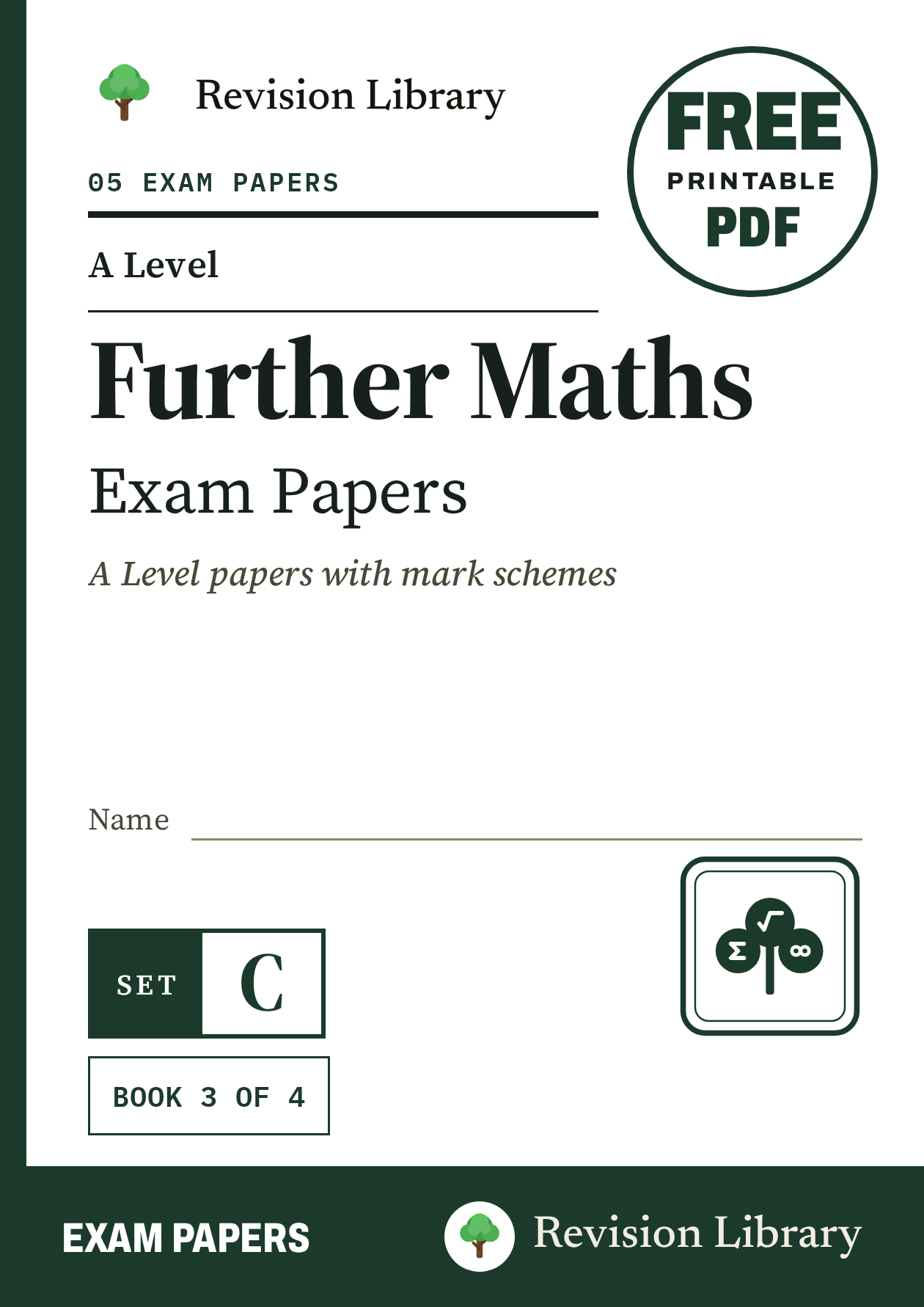
Book 3 of 4

A Level Further Maths Exam Papers Set C

A Level Paper 1: Core Pure Techniques, A Level Paper 2: Complex Numbers and Curves and A Level Paper 3: Calculus and Equations

Level
A Level · Edexcel 9FM0 · AQA 7367 · OCR H245
Series
A Level Further Maths Exam Papers, book 3 of 4
Suitable for
Years 12-13, AQA / Edexcel / OCR
FreePDF download · 2027 edition · 53 A4 pages
  • One file, prints straight to A4
  • No account, no password

3 papers, mark schemes at the back. This set is one of 558 free PDFs on the shelf.

Pages
53 A4 pages
Papers
3 papers
Questions
43 · 200 marks
Answers
From page 42

What is inside

3 papers · answers from p42

Each paper starts with a page showing its marks and a suggested time, followed by the questions. The mark schemes for all 3 papers are at the back, so you can sit each paper as a mock and mark it afterwards.

  1. 01A Level Paper 1: Core Pure Techniques13 questions · 60 marksp3
  2. 02A Level Paper 2: Complex Numbers and Curves13 questions · 60 marksp15
  3. 03A Level Paper 3: Calculus and Equations17 questions · 80 marksp26
  4. AnswersMark schemes for every paperp42

Each paper is drawn from one of our worksheet packs. Follow a paper title for the full pack on its own page, or browse every A Level Further Maths pack. Every book on the shelf is a complete printable workbook of up to 120 A4 pages.

Explore this volume

A Level Further Maths Exam Papers Set C includes A Level Paper 1: Core Pure Techniques (from page 3); A Level Paper 2: Complex Numbers and Curves (from page 15); A Level Paper 3: Calculus and Equations (from page 26).

Worked question 5 - A Level Paper 1: Core Pure Techniques

The matrix C = [[k, 3], [2, k-1]] is singular.

Find the possible value(s) of k, then describe the geometric effect of C on the plane.

Answer

k = 3 or k = -2; C maps the plane onto a line through the origin

Mark scheme

M1for det(C) = k(k-1) - 6
A1for det(C) = k^2 - k - 6
M1for setting det(C) = 0 and factorising: (k-3)(k+2) = 0
A1for k = 3 or k = -2
B1for describing the transformation as collapsing the plane onto a line through the origin

Question 10 - A Level Paper 1: Core Pure Techniques

5 marks

alpha, beta and gamma are the roots of x^3 + 2x^2 - 5x + 1 = 0.

Find a cubic equation with integer coefficients whose roots are 2alpha, 2beta and 2gamma.

Answer

y^3 + 4y^2 - 20y + 8 = 0 (roots 2alpha, 2beta, 2gamma)

Mark scheme

M1for substituting x = y/2 into the original equation
M1for expanding (y/2)^3 + 2(y/2)^2 - 5(y/2) + 1 = 0
A1for y^3/8 + y^2/2 - 5y/2 + 1 = 0
M1for multiplying through by 8 to clear the fractions
A1for y^3 + 4y^2 - 20y + 8 = 0

Question 7 - A Level Paper 1: Core Pure Techniques

4 marks

The roots of x^3 - 6x^2 + 11x - 6 = 0 are alpha, beta and gamma.

Find the value of 1/alpha + 1/beta + 1/gamma, and the value of alpha^2 + beta^2 + gamma^2.

Answer

1/alpha + 1/beta + 1/gamma = 11/6; alpha^2 + beta^2 + gamma^2 = 14

Mark scheme

M1for sum of roots = 6, sum of pairwise products = 11, product of roots = 6 from the coefficients
A1for 1/alpha + 1/beta + 1/gamma = 11/6
M1for alpha^2+beta^2+gamma^2 = (alpha+beta+gamma)^2 - 2(alpha beta + beta gamma + gamma alpha)
A1for alpha^2 + beta^2 + gamma^2 = 14

Question 13 - A Level Paper 1: Core Pure Techniques

6 marks

Let S = the sum of r x 3^r for r = 1 to n. By considering S - 3S, find S in terms of n.

Hence evaluate S for n = 5.

Answer

S = [3 + 3^(n+1)(2n-1)]/4; S = 1641 when n = 5

Mark scheme

M1for defining S and forming 3S by shifting the index
M1for subtracting to get -2S = 3 + (3^2+3^3+...+3^n) - n x 3^(n+1)
M1for using the geometric sum 3^2+3^3+...+3^n = (3^(n+1) - 9)/2
A1for S = [3 + 3^(n+1)(2n-1)] / 4
M1for substituting n = 5
A1for S = 1641

Question 9 - A Level Paper 2: Complex Numbers and Curves

5 marks

alpha, beta and gamma are the roots of x^3 + 2x^2 - 5x + 1 = 0.

Find a cubic equation with integer coefficients whose roots are 2alpha, 2beta and 2gamma.

Answer

y^3 + 4y^2 - 20y + 8 = 0 (roots 2alpha, 2beta, 2gamma)

Mark scheme

M1for substituting x = y/2 into the original equation
M1for expanding (y/2)^3 + 2(y/2)^2 - 5(y/2) + 1 = 0
A1for y^3/8 + y^2/2 - 5y/2 + 1 = 0
M1for multiplying through by 8 to clear the fractions
A1for y^3 + 4y^2 - 20y + 8 = 0

Question 10 - A Level Paper 2: Complex Numbers and Curves

6 marks

Find the area of the region that lies inside the circle r = 4 and outside the curve r = 4 - 4cos(theta), for the range of theta where this region exists.

Answer

Area = 32 - 4pi (approximately 19.4 square units)

Mark scheme

M1for finding the points of intersection by solving 4-4cos(theta) = 4 to get theta = +/- pi/2
M1for identifying the region as bounded by the circle for -pi/2 < theta < pi/2, outside the curve
M1for area = (1/2) times the integral from -pi/2 to pi/2 of [4^2 - (4-4cos(theta))^2] with respect to theta
M1for expanding to 32cos(theta) - 16cos^2(theta) and using cos^2(theta) = (1+cos(2theta))/2
A1for the integral evaluating to 64 - 8pi
A1for area = 32 - 4pi (approximately 19.4 square units)

Question 5 - A Level Paper 2: Complex Numbers and Curves

4 marks

A curve has polar equation r = 4(1 + cos(theta)), for 0 <= theta < 2pi.

Using y = r sin(theta), find the value of theta, with 0 < theta < pi, at which the tangent to the curve is parallel to the initial line, and find the corresponding exact value of y.

Answer

theta = pi/3; y = 3 sqrt(3)

Mark scheme

M1for writing y = 4sin(theta) + 2sin(2theta) and differentiating to dy/d(theta) = 4cos(theta) + 4cos(2theta)
M1for setting dy/d(theta) = 0 and using cos(2theta) = 2cos^2(theta) - 1 to form 2cos^2(theta) + cos(theta) - 1 = 0
A1for solving to cos(theta) = 1/2 (rejecting cos(theta) = -1, the degenerate cusp), giving theta = pi/3
A1for y = 3 sqrt(3) at this point

Question 13 - A Level Paper 3: Calculus and Equations

5 marks

Using cosh(2x) = 1 + 2sinh^2(x), solve the equation cosh(2x) - 5sinh(x) = 1, giving your answer(s) as exact logarithms where appropriate.

Answer

x = 0 or x = ln((5 + sqrt(29))/2)

Mark scheme

M1for using cosh(2x) = 1 + 2sinh^2(x) to rewrite the equation as 2sinh^2(x) - 5sinh(x) = 0
M1for factorising to sinh(x)(2sinh(x) - 5) = 0
A1for sinh(x) = 0, giving x = 0
M1for using sinh(x) = 5/2 with the formula arsinh(x) = ln(x + sqrt(x^2+1))
A1for x = ln((5 + sqrt(29))/2)

Question 10 - A Level Paper 3: Calculus and Equations

5 marks

Use integration by parts to find the integral of x^2 ln(x) with respect to x, for x > 0.

Verify your answer by differentiation.

Answer

(x^3/3)ln(x) - x^3/9 + c

Mark scheme

M1for choosing u = ln(x), dv/dx = x^2, giving du/dx = 1/x, v = x^3/3
M1for applying integration by parts to get (x^3/3)ln(x) - the integral of x^2/3
A1for the integral (x^3/3)ln(x) - x^3/9 + c
M1for differentiating: d/dx[(x^3/3)ln(x) - x^3/9] = x^2 ln(x) + x^3/(3x) - x^2/3
A1for confirming this simplifies to x^2 ln(x), verifying the result

A Level Further Maths Exam Papers runs to 4 volumes

Book 3 of 4 · 226 pages in the set

Each set is a separate free PDF with its own mark schemes at the back.

Volume 1

55 pp · 48 Qs

AS Paper 1: Core Skills, AS Paper 2: Pure and Mechanics and AS Paper 3: Pure and Statistics

Volume 2

58 pp · 48 Qs

AS Paper 4: Applications Focus, AS Paper 5: Mixed Practice and AS Paper 6: All Seven Topics

Volume 3 · this book

53 pp · 43 Qs

A Level Paper 1: Core Pure Techniques, A Level Paper 2: Complex Numbers and Curves and A Level Paper 3: Calculus and Equations

Volume 4

60 pp · 52 Qs

A Level Paper 4: Mechanics and Statistics, A Level Paper 5: Mixed Practice A and A Level Paper 6: Mixed Practice B

More A Level books

A Level Further Maths Decision Topic Workbook

71 pp · 60 Qs

Decision Maths: Algorithms, Sorting and Bin Packing, Decision Maths: Graphs, Trees and Minimum Spanning Trees, Decision Maths: Shortest Paths and Route Inspection and 3 more

Want a different mix of topics?

Sitting an exam soon? Build a A Level Further Maths mock paper or print a ready-made one.