Revision Library
Choose a subject
Menu

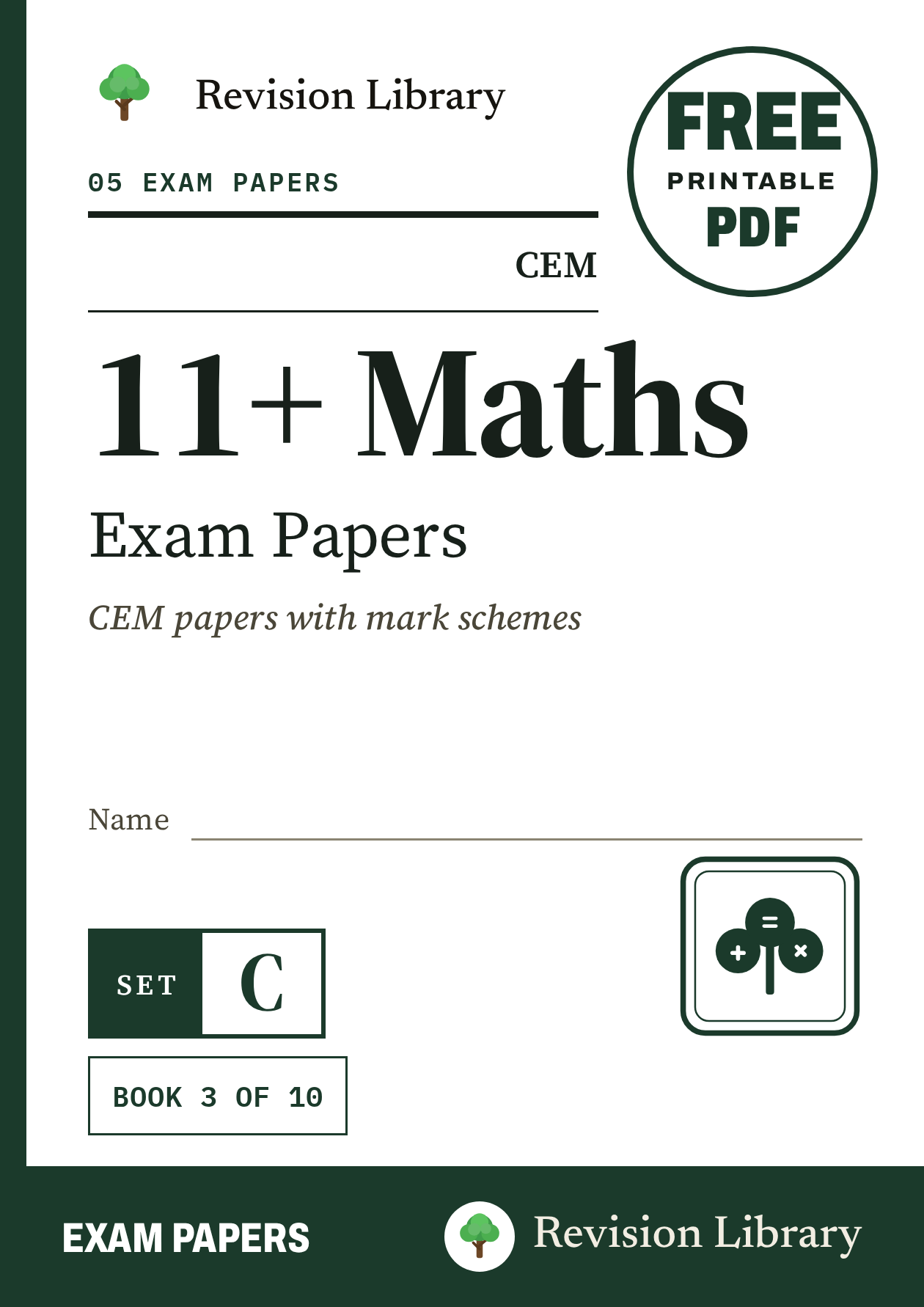
Book 3 of 10

11+ Maths Exam Papers Set C

CEM Style Numerical Reasoning Paper 1, CEM Style Numerical Reasoning Paper 2, CEM Style Numerical Reasoning Paper 3 and 6 more

Level
11+ · CEM
Series
11+ Maths Exam Papers, book 3 of 10
Suitable for
Year 5-6 entrance exams
FreePDF download · 2027 edition · 113 A4 pages
  • One file, prints straight to A4
  • No account, no password

9 papers in the CEM format, timed, mark schemes at the back. This set is one of 558 free PDFs on the shelf.

Pages
113 A4 pages
Papers
9 papers
Questions
310 · 409 marks
Answers
From page 94
Working time
About 6h 55m

What is inside

9 papers · answers from p94

Each paper starts with a page showing its marks and a suggested time, followed by the questions. The mark schemes for all 9 papers are at the back, so you can sit each paper as a mock and mark it afterwards.

  1. 01CEM Style Numerical Reasoning Paper 120 questions · 39 marks · about 40 min Topic guide: CEM Style Numerical Reasoning Paper 1p3
  2. 02CEM Style Numerical Reasoning Paper 226 questions · 40 marks · about 40 min Topic guide: CEM Style Numerical Reasoning Paper 2p9
  3. 03CEM Style Numerical Reasoning Paper 320 questions · 30 marks · about 50 min Topic guide: CEM Style Numerical Reasoning Paper 3p15
  4. 04CEM Style Maths Mixed Section 120 questions · 40 marks · about 40 min Topic guide: CEM Style Maths Mixed Section 1p20
  5. 05CEM Style Maths Mixed Section 224 questions · 40 marks · about 40 min Topic guide: CEM Style Maths Mixed Section 2p25
  6. 06CEM Style Maths Mixed Section 320 questions · 40 marks · about 55 min Topic guide: CEM Style Maths Mixed Section 3p31
  7. 07CEM-Style Mixed Mock 160 questions · 60 marks · about 50 min Topic guide: CEM-Style Mixed Mock 1p36
  8. 08CEM-Style Mixed Mock 360 questions · 60 marks · about 50 min Topic guide: CEM-Style Mixed Mock 3p54
  9. 09CEM-Style Mixed Mock 560 questions · 60 marks · about 50 min Topic guide: CEM-Style Mixed Mock 5p73
  10. AnswersMark schemes for every paperp94

Each paper is drawn from one of our worksheet packs. Follow a paper title for the full pack on its own page, or browse every 11+ Maths pack. Every book on the shelf is a complete printable workbook of up to 120 A4 pages.

Explore this volume

11+ Maths Exam Papers Set C includes CEM Style Numerical Reasoning Paper 1 (from page 3); CEM Style Numerical Reasoning Paper 2 (from page 9); CEM Style Numerical Reasoning Paper 3 (from page 15); CEM Style Maths Mixed Section 1 (from page 20); CEM Style Maths Mixed Section 2 (from page 25); CEM Style Maths Mixed Section 3 (from page 31); CEM-Style Mixed Mock 1 (from page 36); CEM-Style Mixed Mock 3 (from page 54); CEM-Style Mixed Mock 5 (from page 73).

Worked question 14 - CEM-Style Mixed Mock 1

Open the included worksheet

The Otter Watch

Original narrative written for Revision Library; no external source reproduced.

Every Thursday after school, Leila cycled the two miles to Foxglove Wildlife Centre, where she had been a volunteer for almost a year. Her favourite task was helping to monitor the otters that had recently returned to the river after decades of absence. The centre's warden, Mrs Ibrahim, had explained that pollution and habitat loss had driven the otters away in the 1970s, but improvements to the water quality had gradually tempted them back.

Leila's job was simple but important: twice a week she walked a short stretch of the riverbank, noting any paw prints, droppings, known as spraints, or half-eaten fish that suggested an otter had passed through. At first she found the work frustrating, since otters are shy, mostly nocturnal creatures that are rarely seen in daylight. Weeks went by without a single clear sign.

Then, one misty October evening, Leila spotted something moving near an old willow root. She froze, barely daring to breathe, as a sleek, dark shape slipped into the water without a splash. It was her first confirmed otter sighting, and she could hardly wait to tell Mrs Ibrahim.

Over the following months, Leila's records became part of a wider survey used by the county wildlife trust to decide where to focus conservation efforts. She began to realise that even small, patient tasks, carried out consistently, could contribute to something much larger than herself. When a local newspaper asked to interview a volunteer for an article on river conservation, Mrs Ibrahim did not hesitate to suggest Leila, whose quiet dedication had, in her words, 'made the invisible otters visible again'.

SECTION B: VERBAL REASONING (20 minutes). This section has three parts: a cloze passage (questions 14-21), a comprehension passage (questions 22, 24, 25, 26, 27, 28, 29, 30, 31 and 32), and further verbal reasoning items (questions 33, 35, 36, 37, 38, 39 and 40). Read the cloze passage below once, then choose the best word to fill gap (21) from the options given. Each gap has a different correct word, and only one option makes complete sense in its gap when you read the passage carefully.
CLOZE PASSAGE: A Saturday at Alnmouth

Nadia had been looking forward to the school trip to Alnmouth for weeks. The coach set off at eight o'clock, and by half past nine the pupils could already (21)_______ the smell of the sea drifting through the open windows. When they arrived at the estuary, their guide, Mr Okafor, gathered everyone into a (22)_______ group beside the old lifeboat station. He explained that the mudflats were home to hundreds of wading birds, and that visitors needed to stay on the marked path so that the nesting sites were not (23)_______. Nadia had brought a small notebook, and she began to (24)_______ every bird she spotted, from oystercatchers to curlews. After an hour of careful observation, the class stopped for lunch on the dunes, where the wind was so strong that several sandwich wrappers were nearly (25)_______ out to sea. In the afternoon, Mr Okafor asked the pupils to work in pairs and (26)_______ a short report on what they had learned. Nadia's partner, Freddie, suggested they focus on how the tides (27)_______ the birds' feeding patterns. By the time the coach left at four o'clock, Nadia felt she understood far more about coastal habitats than any textbook could have (28)_______ her.

Question 14: which word best completes gap (21)?
  • A) detect
  • B) create
  • C) avoid
  • D) forget
  • E) ignore

Answer and mark scheme

Question 14

CreditAnswer or working
B1A) detect - to 'detect a smell' means to notice it, matching 'the smell of the sea drifting through the open windows'
  • Answer: A

Question 30 - CEM-Style Mixed Mock 1

Open the included worksheet

The Otter Watch

Original narrative written for Revision Library; no external source reproduced.

Every Thursday after school, Leila cycled the two miles to Foxglove Wildlife Centre, where she had been a volunteer for almost a year. Her favourite task was helping to monitor the otters that had recently returned to the river after decades of absence. The centre's warden, Mrs Ibrahim, had explained that pollution and habitat loss had driven the otters away in the 1970s, but improvements to the water quality had gradually tempted them back.

Leila's job was simple but important: twice a week she walked a short stretch of the riverbank, noting any paw prints, droppings, known as spraints, or half-eaten fish that suggested an otter had passed through. At first she found the work frustrating, since otters are shy, mostly nocturnal creatures that are rarely seen in daylight. Weeks went by without a single clear sign.

Then, one misty October evening, Leila spotted something moving near an old willow root. She froze, barely daring to breathe, as a sleek, dark shape slipped into the water without a splash. It was her first confirmed otter sighting, and she could hardly wait to tell Mrs Ibrahim.

Over the following months, Leila's records became part of a wider survey used by the county wildlife trust to decide where to focus conservation efforts. She began to realise that even small, patient tasks, carried out consistently, could contribute to something much larger than herself. When a local newspaper asked to interview a volunteer for an article on river conservation, Mrs Ibrahim did not hesitate to suggest Leila, whose quiet dedication had, in her words, 'made the invisible otters visible again'.

Question 30 (vocabulary in context): In the final paragraph, the phrase 'made the invisible otters visible again' most likely means
  • A) Leila used a special camera to film the otters
  • B) Leila's careful records helped prove and track the otters' return
  • C) The otters became less shy over time
  • D) Mrs Ibrahim released otters into the river herself
  • E) The newspaper published photographs of otters

Answer and mark scheme

Question 30

CreditAnswer or working
B1B) Leila's careful records helped prove and track the otters' return - this follows from the previous sentence describing her records becoming part of the wider county survey
  • Answer: B

Question 43 - CEM-Style Mixed Mock 1

Open the included worksheet

The Otter Watch

Original narrative written for Revision Library; no external source reproduced.

Every Thursday after school, Leila cycled the two miles to Foxglove Wildlife Centre, where she had been a volunteer for almost a year. Her favourite task was helping to monitor the otters that had recently returned to the river after decades of absence. The centre's warden, Mrs Ibrahim, had explained that pollution and habitat loss had driven the otters away in the 1970s, but improvements to the water quality had gradually tempted them back.

Leila's job was simple but important: twice a week she walked a short stretch of the riverbank, noting any paw prints, droppings, known as spraints, or half-eaten fish that suggested an otter had passed through. At first she found the work frustrating, since otters are shy, mostly nocturnal creatures that are rarely seen in daylight. Weeks went by without a single clear sign.

Then, one misty October evening, Leila spotted something moving near an old willow root. She froze, barely daring to breathe, as a sleek, dark shape slipped into the water without a splash. It was her first confirmed otter sighting, and she could hardly wait to tell Mrs Ibrahim.

Over the following months, Leila's records became part of a wider survey used by the county wildlife trust to decide where to focus conservation efforts. She began to realise that even small, patient tasks, carried out consistently, could contribute to something much larger than herself. When a local newspaper asked to interview a volunteer for an article on river conservation, Mrs Ibrahim did not hesitate to suggest Leila, whose quiet dedication had, in her words, 'made the invisible otters visible again'.

Question 43 (punctuation). One dog owns the bone in this sentence. Which version is punctuated correctly?
  • A) The dogs bone was buried in the garden.
  • B) The dogs' bone was buried in the garden.
  • C) The dogs bones' was buried in the garden.
  • D) The dog,s bone was buried in the garden.
  • E) The dog's bone was buried in the garden.

Answer and mark scheme

Question 43

CreditAnswer or working
B1E) The dog's bone was buried in the garden. - apostrophe plus s shows singular possession for one dog
  • Answer: E

Question 14 - CEM-Style Mixed Mock 5

Open the included worksheet

The Repair Table

Original narrative written for Revision Library; no external source reproduced.

Amara used to think the village hall on a Sunday morning was the last place she wanted to be. While her friends were still asleep, she was carrying a box of screwdrivers and an old canvas toolbag through the side door, following her grandfather Kofi to the long trestle table at the back of the room.

Kofi had been fixing things for as long as anyone in the village could remember: clocks that had stopped ticking, toasters that refused to pop, radios that crackled instead of playing music. Every fortnight he set up a small stall at the community repair cafe, where neighbours brought whatever had broken in their homes, hoping someone could bring it back to life instead of throwing it away.

At first, Amara only watched, passing tools when asked and writing names in a battered notebook kept by the till. But one Sunday, an elderly woman arrived clutching a wooden clock that had belonged to her mother, its hands frozen at ten past three for over a year. Kofi turned the clock over gently in his hands, studying the tiny gears inside, then handed Amara a small screwdriver.

'You have steadier hands than me these days,' he said, guiding her fingers towards a loose spring. Amara's heart thudded as she worked, terrified of breaking something that meant so much to a stranger. When the second hand finally twitched and began to move, the woman's eyes filled with tears, and she thanked them both as though they had given her back a piece of her mother.

Walking home that afternoon, Amara realised the repair cafe was not really about broken toasters or slow clocks. It was about neighbours trusting each other with the things they treasured most, and about a grandfather quietly teaching his granddaughter that patience and careful hands could mean more than any new gadget from a shop.

SECTION B: VERBAL REASONING (20 minutes). This section has three parts: a cloze passage (questions 14-21), a comprehension passage (questions 22, 24, 25, 26, 27, 28, 29, 30, 31 and 32), and further verbal reasoning items (questions 33, 35, 36, 37, 38, 39 and 40). Read the cloze passage below once, then choose the best word to fill gap (21) from the options given. Each gap has a different correct word, and only one option makes complete sense in its gap when you read the passage carefully.
CLOZE PASSAGE: The Winter Coat Drive

Every January, Oakfield Primary School runs a coat drive to (21)_______ warm clothing for families who need extra support during winter. This year, the drive was organised by Mr Adeyemi, who (22)_______ each class to bring in at least one clean, gently used coat. On the collection morning, the entrance hall was (23)_______ with cardboard boxes stacked along every wall, and news of the growing pile (24)_______ quickly around the playground. Volunteers arrived early on Saturday to (25)_______ the coats by size, sorting them into neat piles ready for delivery. By the afternoon, the team had finished and began to (26)_______ everything into the minibus waiting outside. In total, the drive had (27)_______ more than two hundred coats, easily overtaking the total Mr Adeyemi had (28)_______ before the half-term holiday.

Question 14: which word best completes gap (21)?
  • A) lose
  • B) waste
  • C) sell
  • D) borrow
  • E) collect

Answer and mark scheme

Question 14

CreditAnswer or working
B1E) collect - to 'collect' warm clothing matches a drive organised to gather items for families who need support
  • Answer: E

Question 29 - CEM-Style Mixed Mock 5

Open the included worksheet

The Repair Table

Original narrative written for Revision Library; no external source reproduced.

Amara used to think the village hall on a Sunday morning was the last place she wanted to be. While her friends were still asleep, she was carrying a box of screwdrivers and an old canvas toolbag through the side door, following her grandfather Kofi to the long trestle table at the back of the room.

Kofi had been fixing things for as long as anyone in the village could remember: clocks that had stopped ticking, toasters that refused to pop, radios that crackled instead of playing music. Every fortnight he set up a small stall at the community repair cafe, where neighbours brought whatever had broken in their homes, hoping someone could bring it back to life instead of throwing it away.

At first, Amara only watched, passing tools when asked and writing names in a battered notebook kept by the till. But one Sunday, an elderly woman arrived clutching a wooden clock that had belonged to her mother, its hands frozen at ten past three for over a year. Kofi turned the clock over gently in his hands, studying the tiny gears inside, then handed Amara a small screwdriver.

'You have steadier hands than me these days,' he said, guiding her fingers towards a loose spring. Amara's heart thudded as she worked, terrified of breaking something that meant so much to a stranger. When the second hand finally twitched and began to move, the woman's eyes filled with tears, and she thanked them both as though they had given her back a piece of her mother.

Walking home that afternoon, Amara realised the repair cafe was not really about broken toasters or slow clocks. It was about neighbours trusting each other with the things they treasured most, and about a grandfather quietly teaching his granddaughter that patience and careful hands could mean more than any new gadget from a shop.

Question 29 (inference): What can be inferred about how Kofi feels about Amara's abilities?
  • A) He trusts her steady hands and is willing to let her help with delicate work
  • B) He wishes she would find a different hobby
  • C) He believes she is not yet ready to help at all
  • D) He is jealous of how quickly she learns
  • E) He doubts she can be trusted with delicate repairs

Answer and mark scheme

Question 29

CreditAnswer or working
B1A) He trusts her steady hands and is willing to let her help with delicate work - Kofi tells her she has 'steadier hands than me these days' before guiding her to help
  • Answer: A

11+ Maths Exam Papers runs to 10 volumes

Book 3 of 10 · 1,009 pages in the set

Each set is a separate free PDF with its own mark schemes at the back.

Volume 1

120 pp · 306 Qs

GL Assessment Style Maths Mock Paper 1, GL Assessment Style Maths Mock Paper 2, GL Assessment Style Maths Mock Paper 3 and 8 more

Volume 2

114 pp · 324 Qs

GL-Style Maths Mock (Standalone), GL-Style Mixed Mock 9: Maths and English, GL-Style Full Mixed Mock 11 and 3 more

Volume 3 · this book

113 pp · 310 Qs

CEM Style Numerical Reasoning Paper 1, CEM Style Numerical Reasoning Paper 2, CEM Style Numerical Reasoning Paper 3 and 6 more

Volume 4

116 pp · 269 Qs

CSSE Essex Style Maths Paper 2, CSSE Essex Style Maths Paper 3, CSSE Essex Style Problem Solving Paper 1 and 8 more

Volume 5

88 pp · 221 Qs

Kent Test Style Maths Paper 1, Kent Test Style Maths Paper 2, Kent Test Style Maths Paper 3 and 3 more

Volume 6

68 pp · 156 Qs

Kent Test-Style Mock 4, Kent Test-Style Mock 5 and Kent Test-Style Mock 6

Volume 7

98 pp · 268 Qs

Buckinghamshire Style Maths Paper 1, Buckinghamshire Style Maths Paper 2, Sutton/SET-Style Maths Mock and 4 more

Volume 8

88 pp · 227 Qs

Sutton/SET-Style Maths Mock 4, Buckinghamshire (SET/GL)-Style Mixed Mock 3, Hertfordshire (SET/Moderator)-Style Mixed Mock and 2 more

Volume 9

113 pp · 301 Qs

Northern Ireland (AQE)-Style Mock, Birmingham (King Edward VI)-Style Mock, Medway-Style Mixed Mock and 3 more

Volume 10

91 pp · 257 Qs

Redbridge/Bexley-Style Mixed Mock, Wolverhampton/Walsall-Style Mock, Devon-Style Maths and Reasoning Mock and 2 more

More 11+ books

Want a different mix of topics?

Sitting an exam soon? Build a 11+ Maths mock paper or print a ready-made one.