Revision Library
Choose a subject
Menu

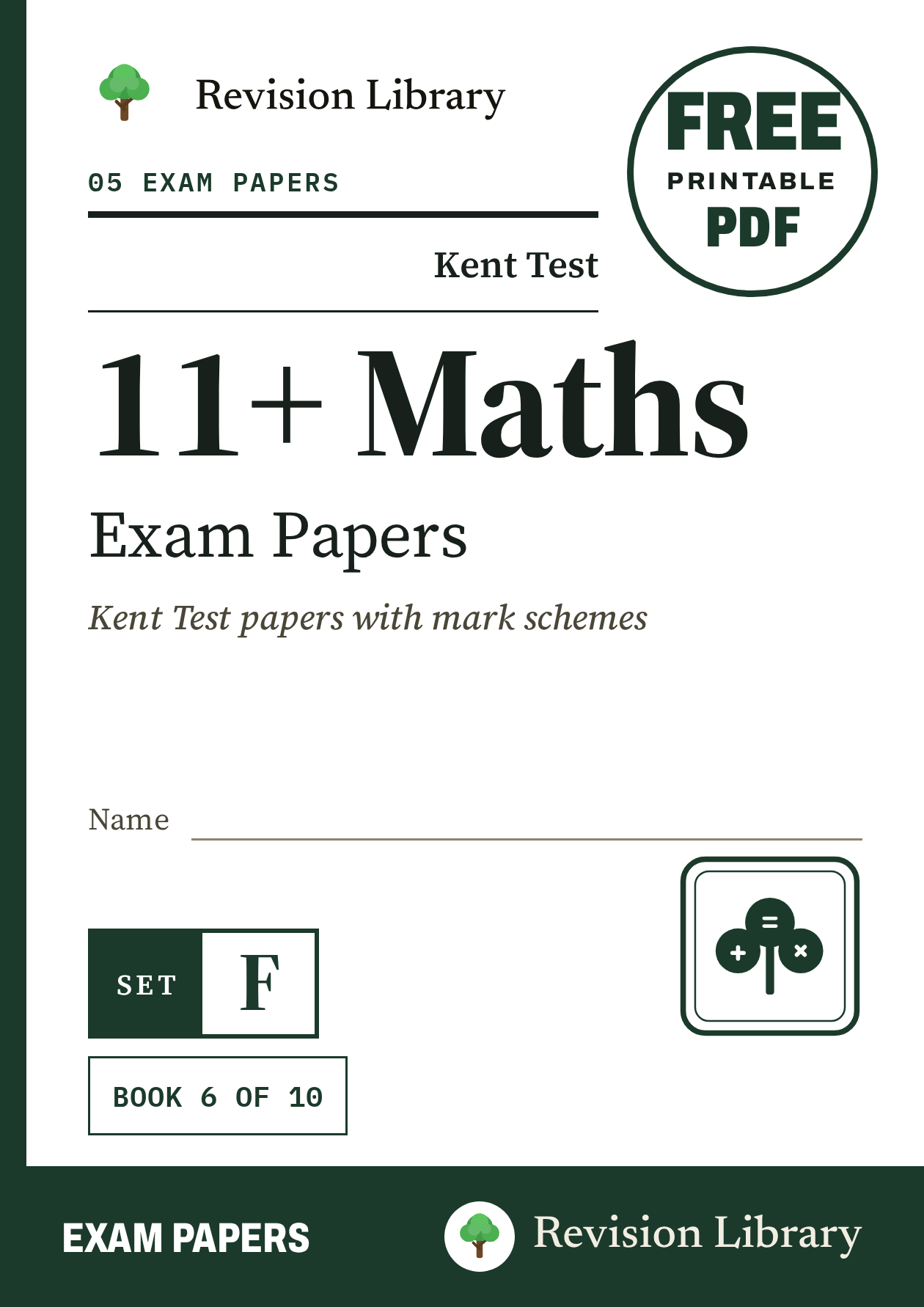
Book 6 of 10

11+ Maths Exam Papers Set F

Kent Test-Style Mock 4, Kent Test-Style Mock 5 and Kent Test-Style Mock 6

Level
11+ · Kent Test
Series
11+ Maths Exam Papers, book 6 of 10
Suitable for
Year 5-6 entrance exams
FreePDF download · 2027 edition · 68 A4 pages
  • One file, prints straight to A4
  • No account, no password

3 papers in the Kent Test format, timed, mark schemes at the back. This set is one of 558 free PDFs on the shelf.

Pages
68 A4 pages
Papers
3 papers
Questions
156 · 156 marks
Answers
From page 60
Working time
About 2h 12m

What is inside

3 papers · answers from p60

Each paper starts with a page showing its marks and a suggested time, followed by the questions. The mark schemes for all 3 papers are at the back, so you can sit each paper as a mock and mark it afterwards.

  1. 01Kent Test-Style Mock 452 questions · 52 marks · about 44 min Topic guide: Kent Test-Style Mock 4p3
  2. 02Kent Test-Style Mock 552 questions · 52 marks · about 44 min Topic guide: Kent Test-Style Mock 5p20
  3. 03Kent Test-Style Mock 652 questions · 52 marks · about 44 min Topic guide: Kent Test-Style Mock 6p41
  4. AnswersMark schemes for every paperp60

Each paper is drawn from one of our worksheet packs. Follow a paper title for the full pack on its own page, or browse every 11+ Maths pack. Every book on the shelf is a complete printable workbook of up to 120 A4 pages.

Explore this volume

11+ Maths Exam Papers Set F includes Kent Test-Style Mock 4 (from page 3); Kent Test-Style Mock 5 (from page 20); Kent Test-Style Mock 6 (from page 41).

Worked example - Kent Test-Style Mock 5

Open the included worksheet

The Shark's Tooth at Warden Point

Original fiction written for Revision Library; no external source reproduced.

Twelve-year-old Aaliyah Chen crunched across the shingle at Warden Point, on the north coast of the Isle of Sheppey, her boots sinking slightly into patches of dark grey clay exposed by the retreating tide. Her grandmother, Margaret Osei, walked a little way ahead, a small trowel and a sieve tucked under one arm.

"Remember the rule," Margaret called back. "We only search the loose clay that has already fallen onto the beach. We never dig into the cliff itself."

Aaliyah nodded, eyeing the crumbling wall of grey-brown rock rising above them. Cracks ran through it like old scars, and here and there a fresh chunk of clay lay scattered across the sand, evidence of last night's storm.

"Why is it so dangerous?" she asked, crouching to sift through a nearby patch.

"These cliffs are made of London Clay," Margaret explained. "It's a soft rock, laid down around fifty million years ago, when a warm, shallow sea covered this whole area. The sea and the rain wear it away constantly, so it can collapse without warning. That's exactly why fossils keep turning up here - the cliff keeps crumbling and revealing what's buried inside it."

Aaliyah worked her fingers carefully through a lump of clay, feeling for anything hard and smooth. Something caught, and she eased it free: a small, triangular object, glossy black and faintly curved, with a serrated edge along one side.

"Grandma, look at this!"

Margaret took it gently, turning it over in the pale winter light. Her eyebrows lifted.

"That's a shark's tooth," she said. "And a good one too - see how sharp the edge still is? Sharks like this one swam in the sea that used to cover Sheppey, long before there were any humans here at all."

Aaliyah stared at the tooth, trying to picture the warm ancient ocean where it had once belonged, so different from the grey water lapping the shore in front of her now.

"Can we keep it?" she asked.

"We can," Margaret said, "but first we should record exactly where we found it. Serious fossil hunters note the location and take a photograph before they pocket anything unusual. If it turns out to be a rare kind of tooth, that information could matter to people studying this coastline."

Together they marked the spot on Margaret's phone and photographed the tooth resting in Aaliyah's open palm, the cliff looming pale behind it. Only then did Aaliyah wrap the tooth carefully in a tissue and slip it into her coat pocket.

"I'll write to the fossil group Grandma mentioned," Aaliyah said, glancing back at the cliff one last time. "Someone might want to know a tooth like this came from here."

Margaret smiled, gathering her sieve. "That's exactly the right instinct. A fossil without its story is only half a discovery."

They turned back along the shingle, the tide creeping steadily behind them, already beginning to smooth away their footprints from the sand.
Worked example (Compound Words). Which word can be added to the front of CASE to make a real compound word - BOOK, SHOE, SPOON, NOSE or HAND? Answer: BOOK. Testing each option against CASE: BOOK + CASE = BOOKCASE, a real compound word for a piece of furniture that holds books. None of SHOE, SPOON, NOSE or HAND combine with CASE to form a standard English word, so BOOK is the only option that works.

Question 40 - Kent Test-Style Mock 5

Open the included worksheet

The Shark's Tooth at Warden Point

Original fiction written for Revision Library; no external source reproduced.

Twelve-year-old Aaliyah Chen crunched across the shingle at Warden Point, on the north coast of the Isle of Sheppey, her boots sinking slightly into patches of dark grey clay exposed by the retreating tide. Her grandmother, Margaret Osei, walked a little way ahead, a small trowel and a sieve tucked under one arm.

"Remember the rule," Margaret called back. "We only search the loose clay that has already fallen onto the beach. We never dig into the cliff itself."

Aaliyah nodded, eyeing the crumbling wall of grey-brown rock rising above them. Cracks ran through it like old scars, and here and there a fresh chunk of clay lay scattered across the sand, evidence of last night's storm.

"Why is it so dangerous?" she asked, crouching to sift through a nearby patch.

"These cliffs are made of London Clay," Margaret explained. "It's a soft rock, laid down around fifty million years ago, when a warm, shallow sea covered this whole area. The sea and the rain wear it away constantly, so it can collapse without warning. That's exactly why fossils keep turning up here - the cliff keeps crumbling and revealing what's buried inside it."

Aaliyah worked her fingers carefully through a lump of clay, feeling for anything hard and smooth. Something caught, and she eased it free: a small, triangular object, glossy black and faintly curved, with a serrated edge along one side.

"Grandma, look at this!"

Margaret took it gently, turning it over in the pale winter light. Her eyebrows lifted.

"That's a shark's tooth," she said. "And a good one too - see how sharp the edge still is? Sharks like this one swam in the sea that used to cover Sheppey, long before there were any humans here at all."

Aaliyah stared at the tooth, trying to picture the warm ancient ocean where it had once belonged, so different from the grey water lapping the shore in front of her now.

"Can we keep it?" she asked.

"We can," Margaret said, "but first we should record exactly where we found it. Serious fossil hunters note the location and take a photograph before they pocket anything unusual. If it turns out to be a rare kind of tooth, that information could matter to people studying this coastline."

Together they marked the spot on Margaret's phone and photographed the tooth resting in Aaliyah's open palm, the cliff looming pale behind it. Only then did Aaliyah wrap the tooth carefully in a tissue and slip it into her coat pocket.

"I'll write to the fossil group Grandma mentioned," Aaliyah said, glancing back at the cliff one last time. "Someone might want to know a tooth like this came from here."

Margaret smiled, gathering her sieve. "That's exactly the right instinct. A fossil without its story is only half a discovery."

They turned back along the shingle, the tide creeping steadily behind them, already beginning to smooth away their footprints from the sand.
Why does Margaret insist that they only search loose clay that has already fallen onto the beach, and never dig into the cliff itself?
  • A) Because the loose clay is easier to sell.
  • B) Because digging into the cliff is against the rules of a nature reserve.
  • C) Because there are no fossils inside the cliff itself.
  • D) Because the soft, crumbling cliff can collapse without warning, so digging into it is dangerous.
  • E) Because Aaliyah is not strong enough to dig into rock.

Answer and mark scheme

Question 40

CreditAnswer or working
B1D) Because the soft, crumbling cliff can collapse without warning, so digging into it is dangerous - Margaret explains the clay 'can collapse without warning', directly giving the reason for the rule.
  • Answer: D

Question 46 - Kent Test-Style Mock 5

Open the included worksheet

The Shark's Tooth at Warden Point

Original fiction written for Revision Library; no external source reproduced.

Twelve-year-old Aaliyah Chen crunched across the shingle at Warden Point, on the north coast of the Isle of Sheppey, her boots sinking slightly into patches of dark grey clay exposed by the retreating tide. Her grandmother, Margaret Osei, walked a little way ahead, a small trowel and a sieve tucked under one arm.

"Remember the rule," Margaret called back. "We only search the loose clay that has already fallen onto the beach. We never dig into the cliff itself."

Aaliyah nodded, eyeing the crumbling wall of grey-brown rock rising above them. Cracks ran through it like old scars, and here and there a fresh chunk of clay lay scattered across the sand, evidence of last night's storm.

"Why is it so dangerous?" she asked, crouching to sift through a nearby patch.

"These cliffs are made of London Clay," Margaret explained. "It's a soft rock, laid down around fifty million years ago, when a warm, shallow sea covered this whole area. The sea and the rain wear it away constantly, so it can collapse without warning. That's exactly why fossils keep turning up here - the cliff keeps crumbling and revealing what's buried inside it."

Aaliyah worked her fingers carefully through a lump of clay, feeling for anything hard and smooth. Something caught, and she eased it free: a small, triangular object, glossy black and faintly curved, with a serrated edge along one side.

"Grandma, look at this!"

Margaret took it gently, turning it over in the pale winter light. Her eyebrows lifted.

"That's a shark's tooth," she said. "And a good one too - see how sharp the edge still is? Sharks like this one swam in the sea that used to cover Sheppey, long before there were any humans here at all."

Aaliyah stared at the tooth, trying to picture the warm ancient ocean where it had once belonged, so different from the grey water lapping the shore in front of her now.

"Can we keep it?" she asked.

"We can," Margaret said, "but first we should record exactly where we found it. Serious fossil hunters note the location and take a photograph before they pocket anything unusual. If it turns out to be a rare kind of tooth, that information could matter to people studying this coastline."

Together they marked the spot on Margaret's phone and photographed the tooth resting in Aaliyah's open palm, the cliff looming pale behind it. Only then did Aaliyah wrap the tooth carefully in a tissue and slip it into her coat pocket.

"I'll write to the fossil group Grandma mentioned," Aaliyah said, glancing back at the cliff one last time. "Someone might want to know a tooth like this came from here."

Margaret smiled, gathering her sieve. "That's exactly the right instinct. A fossil without its story is only half a discovery."

They turned back along the shingle, the tide creeping steadily behind them, already beginning to smooth away their footprints from the sand.
Why does the author include Margaret's closing line, 'A fossil without its story is only half a discovery'?
  • A) To hint that Margaret wants to sell the tooth herself.
  • B) To criticise Aaliyah for finding the tooth.
  • C) To suggest the tooth should be thrown away.
  • D) To emphasise that recording where and how a fossil is found matters as much as the object itself.
  • E) To show that Margaret dislikes fossil hunting.

Answer and mark scheme

Question 46

CreditAnswer or working
B1D) To emphasise that recording where and how a fossil is found matters as much as the object itself - this reflects Margaret's earlier insistence on marking the location and photographing the find before pocketing it.
  • Answer: D

Question 46 - Kent Test-Style Mock 6

Open the included worksheet

The Letterbox on Hound Tor

Original fiction written for Revision Library; no external source reproduced.

Eleven-year-old Zainab Hussain trudged up the springy turf of Dartmoor, the wind tugging at her waterproof jacket and carrying the faint smell of damp bracken. Her uncle, Desmond Clarke, strode a few steps ahead, a folded paper clue gripped firmly in one gloved hand.

"Nearly there," he called back, glancing at a weathered granite outcrop rising from the moor like a broken tooth. "The clue says to look for the letterbox thirty paces north-east of the tallest rock at Hound Tor, hidden beneath a slab."

Zainab quickened her pace, her boots squelching through a boggy patch she had tried and failed to skirt around. Letterboxing, her uncle had explained on the drive down from Exeter, was a tradition almost unique to Dartmoor: hikers hid small waterproof boxes across the moor, each containing a rubber stamp and a logbook, and left clues for others to follow. Anyone who found a box would stamp their own notebook with its design, then leave a stamp of their own inside before hiding it again exactly where they had found it.

"People have been doing this since Victorian times," Desmond said, pausing to check his compass. "The very first letterbox was hidden near Cranmere Pool, over a hundred and fifty years ago. Back then walkers left postcards instead of stamps, and whoever found the box would post them onward."

At the base of the tor, Desmond counted his paces carefully, then crouched beside a flat slab half-buried in heather. "Here," he murmured, working his fingers beneath its edge until the stone shifted. Underneath sat a small tin, its lid rusted at the corners but still watertight.

Zainab knelt and eased it open. Inside, wrapped in a plastic bag, lay a rubber stamp carved into the shape of a running hare, and a logbook filled with faded ink entries stretching back years: names, dates, brief messages from walkers who had stood in this exact spot.

"Some of these are older than me," Zainab said, turning the pages carefully.

"That's the point," Desmond replied. "A letterbox connects everyone who's ever found it, even if they never meet. Go on, stamp your book."

Zainab pressed the hare stamp firmly into her own notebook, then unwrapped the spare stamp she had carved at home from a rubber eraser: a small, lopsided crescent moon. She inked it carefully and pressed it into the logbook, adding her own initials and today's date beneath it.

Together they wrapped the tin back in its bag and slid it beneath the slab, brushing loose soil over the disturbed heather so the hiding place looked untouched.

"Someone else will find that in a week, or a year, or ten years," Desmond said, straightening up. "And they'll never know it was us who left it."

Zainab looked back at the tor as they set off across the moor, already wondering who might stumble across her small crescent moon, and when.

Why does the author include the detail that the logbook was 'filled with faded ink entries stretching back years'?
  • A) To suggest the letterbox has been forgotten by everyone
  • B) To emphasise how many different walkers have connected with this hidden spot over a long time
  • C) To hint that the tin is about to fall apart
  • D) To show that Zainab is the first person ever to find it
  • E) To explain why the stamp is broken

Answer and mark scheme

Question 46

CreditAnswer or working
B1B) To emphasise how many different walkers have connected with this hidden spot over a long time - this detail supports Desmond's later idea that a letterbox 'connects everyone who's ever found it, even if they never meet'.
  • Answer: B

Question 47 - Kent Test-Style Mock 6

Open the included worksheet

The Letterbox on Hound Tor

Original fiction written for Revision Library; no external source reproduced.

Eleven-year-old Zainab Hussain trudged up the springy turf of Dartmoor, the wind tugging at her waterproof jacket and carrying the faint smell of damp bracken. Her uncle, Desmond Clarke, strode a few steps ahead, a folded paper clue gripped firmly in one gloved hand.

"Nearly there," he called back, glancing at a weathered granite outcrop rising from the moor like a broken tooth. "The clue says to look for the letterbox thirty paces north-east of the tallest rock at Hound Tor, hidden beneath a slab."

Zainab quickened her pace, her boots squelching through a boggy patch she had tried and failed to skirt around. Letterboxing, her uncle had explained on the drive down from Exeter, was a tradition almost unique to Dartmoor: hikers hid small waterproof boxes across the moor, each containing a rubber stamp and a logbook, and left clues for others to follow. Anyone who found a box would stamp their own notebook with its design, then leave a stamp of their own inside before hiding it again exactly where they had found it.

"People have been doing this since Victorian times," Desmond said, pausing to check his compass. "The very first letterbox was hidden near Cranmere Pool, over a hundred and fifty years ago. Back then walkers left postcards instead of stamps, and whoever found the box would post them onward."

At the base of the tor, Desmond counted his paces carefully, then crouched beside a flat slab half-buried in heather. "Here," he murmured, working his fingers beneath its edge until the stone shifted. Underneath sat a small tin, its lid rusted at the corners but still watertight.

Zainab knelt and eased it open. Inside, wrapped in a plastic bag, lay a rubber stamp carved into the shape of a running hare, and a logbook filled with faded ink entries stretching back years: names, dates, brief messages from walkers who had stood in this exact spot.

"Some of these are older than me," Zainab said, turning the pages carefully.

"That's the point," Desmond replied. "A letterbox connects everyone who's ever found it, even if they never meet. Go on, stamp your book."

Zainab pressed the hare stamp firmly into her own notebook, then unwrapped the spare stamp she had carved at home from a rubber eraser: a small, lopsided crescent moon. She inked it carefully and pressed it into the logbook, adding her own initials and today's date beneath it.

Together they wrapped the tin back in its bag and slid it beneath the slab, brushing loose soil over the disturbed heather so the hiding place looked untouched.

"Someone else will find that in a week, or a year, or ten years," Desmond said, straightening up. "And they'll never know it was us who left it."

Zainab looked back at the tor as they set off across the moor, already wondering who might stumble across her small crescent moon, and when.

The story opens with Zainab trudging into the wind on the moor and closes with her looking back across the moor, wondering who might find her stamp. What effect does this closing image create?
  • A) It suggests the letterbox will soon be destroyed by weather
  • B) It creates a sense that Zainab's discovery will quietly continue on into the future, long after she has gone
  • C) It shows that Zainab is now lost on the moor
  • D) It proves the letterbox tradition has ended
  • E) It suggests Desmond is angry with Zainab

Answer and mark scheme

Question 47

CreditAnswer or working
B1B) It creates a sense that Zainab's discovery will quietly continue on into the future, long after she has gone - the closing line about 'who might stumble across her small crescent moon, and when' extends the story's themes of connection and time beyond the moment described.
  • Answer: B

11+ Maths Exam Papers runs to 10 volumes

Book 6 of 10 · 1,009 pages in the set

Each set is a separate free PDF with its own mark schemes at the back.

Volume 1

120 pp · 306 Qs

GL Assessment Style Maths Mock Paper 1, GL Assessment Style Maths Mock Paper 2, GL Assessment Style Maths Mock Paper 3 and 8 more

Volume 2

114 pp · 324 Qs

GL-Style Maths Mock (Standalone), GL-Style Mixed Mock 9: Maths and English, GL-Style Full Mixed Mock 11 and 3 more

Volume 3

113 pp · 310 Qs

CEM Style Numerical Reasoning Paper 1, CEM Style Numerical Reasoning Paper 2, CEM Style Numerical Reasoning Paper 3 and 6 more

Volume 4

116 pp · 269 Qs

CSSE Essex Style Maths Paper 2, CSSE Essex Style Maths Paper 3, CSSE Essex Style Problem Solving Paper 1 and 8 more

Volume 5

88 pp · 221 Qs

Kent Test Style Maths Paper 1, Kent Test Style Maths Paper 2, Kent Test Style Maths Paper 3 and 3 more

Volume 6 · this book

68 pp · 156 Qs

Kent Test-Style Mock 4, Kent Test-Style Mock 5 and Kent Test-Style Mock 6

Volume 7

98 pp · 268 Qs

Buckinghamshire Style Maths Paper 1, Buckinghamshire Style Maths Paper 2, Sutton/SET-Style Maths Mock and 4 more

Volume 8

88 pp · 227 Qs

Sutton/SET-Style Maths Mock 4, Buckinghamshire (SET/GL)-Style Mixed Mock 3, Hertfordshire (SET/Moderator)-Style Mixed Mock and 2 more

Volume 9

113 pp · 301 Qs

Northern Ireland (AQE)-Style Mock, Birmingham (King Edward VI)-Style Mock, Medway-Style Mixed Mock and 3 more

Volume 10

91 pp · 257 Qs

Redbridge/Bexley-Style Mixed Mock, Wolverhampton/Walsall-Style Mock, Devon-Style Maths and Reasoning Mock and 2 more

More 11+ books

Want a different mix of topics?

Sitting an exam soon? Build a 11+ Maths mock paper or print a ready-made one.