Multiplication and division are the operations for combining equal groups or sharing an amount into equal groups, used with whole numbers, decimals and negative numbers. They are tested through written methods, calculator problems, and real-life contexts such as sharing costs, scaling recipes and comparing best buys.
For whole number times whole number, use a written method such as the grid method or long multiplication, breaking a number into tens and units.
For division, work out how many times the divisor fits into the dividend, using repeated subtraction, chunking or short division.
To multiply or divide by 10, 100 or 1000, move each digit that many places left (multiply) or right (divide); do not just add zeros.
Follow BIDMAS: multiplication and division are worked out before addition and subtraction, unless brackets say otherwise.
When multiplying or dividing negative numbers, two like signs give a positive answer and two unlike signs give a negative answer.
Check your answer using the inverse operation (e.g. check a division by multiplying the answer by the divisor) or by estimating first.
Worked example
A recipe for 5 people uses 275 g of pasta. Work out how much pasta is needed to make the same recipe for 8 people.
Find the amount needed for one person: 275 divided by 5 = 55 g.
Multiply by the number of people needed: 55 x 8.
55 x 8 = 440.
Final answer: 440 g of pasta is needed for 8 people.
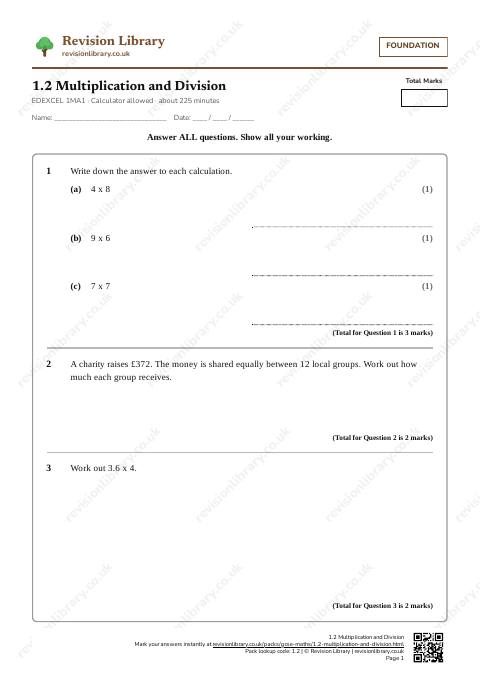
Revision Library
revisionlibrary.co.uk
FOUNDATION
1.2 Multiplication and Division
EDEXCEL 1MA1 · Calculator allowed · about 225 minutes
A charity raises £372. The money is shared equally between 12 local groups. Work out how much each group receives.
(Total for Question 2 is 2 marks)
3
Work out 3.6 x 4.
(Total for Question 3 is 2 marks)
4
Work out 15.6 / 4.
(Total for Question 4 is 2 marks)
5
Work out 15 + 3 x 4.
(Total for Question 5 is 2 marks)
6
Work out the answer to each calculation.
(a)-3 x 4(1)
(b)-20 / -5(1)
(Total for Question 6 is 2 marks)
7
Work out the value of each of the following.
(a)52(1)
(b)23(1)
(Total for Question 7 is 2 marks)
8
Use a written method to work out 213 x 6. You must show your working.
(Total for Question 8 is 3 marks)
9
Write down the answer to each calculation.
(a)36 / 4(1)
(b)63 / 9(1)
(c)48 / 6(1)
(Total for Question 9 is 3 marks)
10
Work out 832 x 56
(Total for Question 10 is 3 marks)
11
Tom books 3 concert tickets at £8 each. There is a booking fee of £5 for the whole order. Work out the total cost.
(Total for Question 11 is 3 marks)
12
204 marbles are shared equally between 5 children. Work out how many each child gets and how many are left over.
(Total for Question 12 is 3 marks)
13
A school trip has 427 people. Each coach holds 36 people. Work out the smallest number of coaches needed.
(Total for Question 13 is 3 marks)
14
Liam books 11 concert tickets at £8 each. There is a booking fee of £4 for the whole order. Work out the total cost.
(Total for Question 14 is 3 marks)
15
Work out each calculation.
(a)23 x 10(1)
(b)4.5 x 100(1)
(c)6 x 1000(1)
(Total for Question 15 is 3 marks)
16
A school trip has 521 people. Each coach holds 32 people. Work out the smallest number of coaches needed.
(Total for Question 16 is 3 marks)
17
Grace books 7 concert tickets at £15 each. There is a booking fee of £4 for the whole order. Work out the total cost.
(Total for Question 17 is 3 marks)
18
Work out 795 x 18
(Total for Question 18 is 3 marks)
19
Work out each calculation.
(a)560 / 10(1)
(b)4500 / 100(1)
(c)8000 / 1000(1)
(Total for Question 19 is 3 marks)
20
Work out 34 x 6. You must show your working.
(Total for Question 20 is 2 marks)
21
Work out 96 / 4.
(Total for Question 21 is 2 marks)
22
Work out 47 x 23. You must show your working.
(Total for Question 22 is 3 marks)
23
Work out 483 / 21.
(Total for Question 23 is 3 marks)
24
A cinema ticket costs £8. Work out the cost of 15 tickets.
(Total for Question 24 is 2 marks)
25
Write down the answer to each calculation.
(a)6 x 7(1)
(b)8 x 9(1)
(c)7 x 8(1)
(Total for Question 25 is 3 marks)
26
A factory produces 456 identical components, which are packed into boxes of 8 for shipping. Work out how many boxes are needed to pack all the components.
(Total for Question 26 is 2 marks)
27
Work out 2.8 x 6.
(Total for Question 27 is 2 marks)
28
Work out 25.5 / 5.
(Total for Question 28 is 2 marks)
29
Work out 6 x 3 - 10 / 2.
(Total for Question 29 is 2 marks)
30
Work out the answer to each calculation.
(a)-6 x -5(1)
(b)18 / -3(1)
(Total for Question 30 is 2 marks)
31
Work out the value of each of the following.
(a)32(1)
(b)43(1)
(Total for Question 31 is 2 marks)
32
Write down the answer to each calculation.
(a)54 / 9(1)
(b)72 / 6(1)
(c)45 / 5(1)
(Total for Question 32 is 3 marks)
33
Work out each calculation.
(a)6.2 x 10(1)
(b)38 x 100(1)
(c)0.9 x 1000(1)
(Total for Question 33 is 3 marks)
34
Work out each calculation.
(a)820 / 10(1)
(b)65 / 100(1)
(c)7000 / 1000(1)
(Total for Question 34 is 3 marks)
35
The table shows the cost of buying packs of highlighter pens. Each pack costs the same amount.
Packs
3
5
8
Cost
£7.50
£12.50
?
Work out the missing cost.
(Total for Question 35 is 2 marks)
36
Priya worked out 34 x 5 like this: 34 x 5 = (30 x 5) + (4 x 5) = 150 + 9 = 159
(a)Identify the mistake Priya has made.(1)
(b)Work out the correct value of 34 x 5.(1)
(Total for Question 36 is 2 marks)
37
Work out 736 / 32.
(Total for Question 37 is 3 marks)
38
A school minibus company charges £14 per seat for a day trip. Work out the total cost for a group of 23 students.
(Total for Question 38 is 2 marks)
39
Work out 7 x 8.
(Total for Question 39 is 1 mark)
40
Work out 12 x 6.
(Total for Question 40 is 1 mark)
41
Calculate 48 x 3.
(Total for Question 41 is 1 mark)
42
Work out 8 x 6.
(Total for Question 42 is 1 mark)
43
Work out 9 x 7.
(Total for Question 43 is 1 mark)
44
Calculate 63 x 4.
(Total for Question 44 is 1 mark)
45
A minibus can carry 15 passengers. 100 people want to go on a trip and every person must travel in a minibus. Work out the number of minibuses needed.
(Total for Question 45 is 2 marks)
46
A recipe for 4 people uses 320 g of rice. Work out how much rice is needed to make the same recipe for 15 people.
(Total for Question 46 is 3 marks)
47
A shop sells two sizes of a pack of yoghurts. A 6-pack costs £2.10. A 9-pack of the same yoghurts costs £2.97. Work out which pack is better value for money. You must show your working.
(Total for Question 47 is 3 marks)
48
By rounding each number to 1 significant figure, work out an estimate for (198 x 51) / 49.
(Total for Question 48 is 2 marks)
49
A print shop can fit 24 raffle tickets on one sheet of card. A school needs 300 tickets printed, and every ticket must come from a full sheet. Work out the least number of sheets needed.
(Total for Question 49 is 2 marks)
50
1 tin of paint covers 12 square metres and costs £18. A hall wall to be painted has an area of 90 square metres. Tins cannot be split, and any leftover paint is wasted. Work out the total cost of the paint needed.
(Total for Question 50 is 3 marks)
51
A garden centre sells bags of bird seed in two sizes, shown in the table.
Size
Weight
Price
Small bag
15 kg
£4.50
Large bag
40 kg
£11.20
Work out which bag is better value for money. You must show your working.
(Total for Question 51 is 3 marks)
52
A stationery supplier delivers 194 boxes of pens to a school. Each box contains 48 pens. The pens are then shared equally between 21 classrooms. By rounding each number to 1 significant figure, work out an estimate for the number of pens each classroom receives.
(Total for Question 52 is 2 marks)
53
Use a written method to work out 316 x 24. You must show your working.
(Total for Question 53 is 3 marks)
54
Work out 15 x 15.
(Total for Question 54 is 1 mark)
55
Calculate 125 x 8.
(Total for Question 55 is 1 mark)
56
Work out 209 x 6.
(Total for Question 56 is 2 marks)
57
Work out 17 x 17.
(Total for Question 57 is 1 mark)
58
Work out 402 / 6.
(Total for Question 58 is 1 mark)
59
A youth club has 180 members. The club leader wants to split the members into equal-sized teams, with more than 1 member and fewer than 180 members per team.
(a)Show that teams of 15 members are possible, with no members left over.(1)
(b)The club leader instead wants each team to have exactly 24 members. Explain whether this is possible.(2)
(Total for Question 59 is 3 marks)
60
Priya buys 48 packs of chocolate. Each pack costs £1.35. Work out the total cost. Give your answer in pounds and pence.
(Total for Question 60 is 2 marks)
61
Calculate 34 x 27.
(Total for Question 61 is 2 marks)
62
Concert tickets cost £23.75 each. A drama club buys 36 tickets. Work out the total cost.
(Total for Question 62 is 2 marks)
63
Calculate 56 x 34.
(Total for Question 63 is 2 marks)
64
Calculate 486 x 23 using a written method.
(Total for Question 64 is 3 marks)
65
A map uses the scale 1: 50000. On the map a road measures 2.3 cm. Work out the real distance in kilometres. Give your answer to 2 decimal places.
(Total for Question 65 is 2 marks)
66
Work out 12345 ÷ 15.
(Total for Question 66 is 2 marks)
67
The grid shows the start of the grid method for 68 x 43. Two entries are missing.
x
60
8
40
2400
?
3
?
24
Complete the grid, then use it to work out 68 x 43.
(Total for Question 67 is 3 marks)
68
An allotment plot is a rectangle measuring 3.6 m by 2.4 m. Work out the area of the plot in square metres.
(Total for Question 68 is 2 marks)
69
A school hires minibuses to take 214 pupils on a trip. Each minibus seats 16 passengers and costs £85 to hire for the day.
(a)Work out the least number of minibuses needed.(2)
(b)Work out the total cost of hiring that many minibuses.(2)
(Total for Question 69 is 4 marks)
70
A charity raised £8736 from a sponsored walk, shared equally between 24 local schools. Work out how much each school receives.
(Total for Question 70 is 3 marks)
71
Work out 1234 ÷ 11. Give the exact answer as a mixed number and as a recurring decimal.
(Total for Question 71 is 3 marks)
72
The product of two whole numbers is 4056. One of the numbers is 24. Work out the other number.
(Total for Question 72 is 3 marks)
Mark scheme · 1.2 Multiplication and Division
A correct answer earns full marks unless the question asks for working, a method, proof or explanation.
Question 1
(a) 32 caoB1
(a) Answer: 32
(b) 54 caoB1
(b) Answer: 54
(c) 49 caoB1
(c) Answer: 49
Question 2
372 / 12 or equivalent complete methodM1
£31 caoA1
Answer: £31
Question 3
36 x 4 (= 144) seen, or equivalent complete methodM1
14.4 caoA1
Answer: 14.4
Question 4
156 / 4 (= 39) seen, or equivalent complete methodM1
3.9 caoA1
Answer: 3.9
Question 5
3 x 4 (= 12) evaluated firstM1
27 caoA1
Answer: 27
Question 6
(a) -12 caoB1
(a) Answer: -12
(b) 4 caoB1
(b) Answer: 4
Question 7
(a) 25 caoB1
(a) Answer: 25
(b) 8 caoB1
(b) Answer: 8
Question 8
correct partition, e.g. 200 x 6 (= 1200) seenM1
10 x 6 (= 60) and 3 x 6 (= 18) seen, or equivalent complete method, ft their partitionM1
1278 caoA1
Answer: 1278
Question 9
(a) 9 caoB1
(a) Answer: 9
(b) 7 caoB1
(b) Answer: 7
(c) 8 caoB1
(c) Answer: 8
Question 10
method for multiplying, e.g. partial products or grid, with at most one arithmetic errorM1
complete method with all parts addedM1
46592 caoA1
Answer: 46592
Question 11
3 x 8M1
adds 5 to the cost of the ticketsM1
£29 caoA1
Answer: £29
Question 12
divides 204 by 5M1
40 eachA1
4 left overB1
Answer: 40 each and 4 left over
Question 13
427 / 36M1
11.86 or 'between 11 and 12'A1
12 coachesB1
Answer: 12
Question 14
11 x 8M1
adds 4 to the cost of the ticketsM1
£92 caoA1
Answer: £92
Question 15
(a) 230 caoB1
(a) Answer: 230
(b) 450 caoB1
(b) Answer: 450
(c) 6000 caoB1
(c) Answer: 6000
Question 16
521 / 32M1
16.28 or 'between 16 and 17'A1
17 coachesB1
Answer: 17
Question 17
7 x 15M1
adds 4 to the cost of the ticketsM1
£109 caoA1
Answer: £109
Question 18
method for multiplying, e.g. partial products or grid, with at most one arithmetic errorM1
complete method with all parts addedM1
14310 caoA1
Answer: 14310
Question 19
(a) 56 caoB1
(a) Answer: 56
(b) 45 caoB1
(b) Answer: 45
(c) 8 caoB1
(c) Answer: 8
Question 20
valid method, e.g. 30 x 6 (= 180) and 4 x 6 (= 24) seen, or equivalent complete methodM1
204 caoA1
Answer: 204
Question 21
valid method, e.g. 4 x 20 (= 80) and 4 x 4 (= 16) seen, or equivalent complete methodM1
24 caoA1
Answer: 24
Question 22
one correct partial product, e.g. 47 x 20 (= 940) or 47 x 3 (= 141)M1
complete correct method with both partial products found and added, ft their partial productsM1
1081 caoA1
Answer: 1081
Question 23
valid first step, e.g. 21 x 20 (= 420) seenM1
483 - 420 (= 63) and 63 / 21 (= 3) seen, or equivalent complete methodM1
23 caoA1
Answer: 23
Question 24
8 x 15 or equivalent complete methodM1
£120 caoA1
Answer: £120
Question 25
(a) 42 caoB1
(a) Answer: 42
(b) 72 caoB1
(b) Answer: 72
(c) 56 caoB1
(c) Answer: 56
Question 26
456 / 8 or equivalent complete methodM1
57 caoA1
Answer: 57 boxes
Question 27
28 x 6 (= 168) seen, or equivalent complete methodM1
16.8 caoA1
Answer: 16.8
Question 28
255 / 5 (= 51) seen, or equivalent complete methodM1
5.1 caoA1
Answer: 5.1
Question 29
6 x 3 (= 18) and 10 / 2 (= 5) both evaluated before the subtractionM1
13 caoA1
Answer: 13
Question 30
(a) 30 caoB1
(a) Answer: 30
(b) -6 caoB1
(b) Answer: -6
Question 31
(a) 9 caoB1
(a) Answer: 9
(b) 64 caoB1
(b) Answer: 64
Question 32
(a) 6 caoB1
(a) Answer: 6
(b) 12 caoB1
(b) Answer: 12
(c) 9 caoB1
(c) Answer: 9
Question 33
(a) 62 caoB1
(a) Answer: 62
(b) 3800 caoB1
(b) Answer: 3800
(c) 900 caoB1
(c) Answer: 900
Question 34
(a) 82 caoB1
(a) Answer: 82
(b) 0.65 caoB1
(b) Answer: 0.65
(c) 7 caoB1
(c) Answer: 7
Question 35
7.50 / 3 (= £2.50) or 12.50 / 5 (= £2.50) seen, or equivalent complete methodM1
£20 oe (e.g. £20.00) caoA1
Answer: £20.00
Question 36
(a) identifies that 4 x 5 should be 20, not 9 (oe, e.g. states the second partial product is wrong)C1
(a) Answer: 4 x 5 should be 20, not 9
(b) 170 cao, ft from a correctly identified errorB1
(b) Answer: 170
Question 37
valid first step, e.g. 32 x 20 (= 640) seenM1
736 - 640 (= 96) and 96 / 32 (= 3) seen, or equivalent complete methodM1
23 caoA1
Answer: 23
Question 38
14 x 23 or equivalent complete methodM1
£322 caoA1
Answer: £322
Question 39
56 caoB1
Answer: 56
Question 40
72 caoB1
Answer: 72
Question 41
144 caoB1
Answer: 144
Question 42
48 caoB1
Answer: 48
Question 43
63 caoB1
Answer: 63
Question 44
252 caoB1
Answer: 252
Question 45
100 / 15 (= 6.67 or 6 remainder 10) seenM1
7 cao, with rounding up justified (6 minibuses only carry 90 people)A1
Answer: 7 minibuses
Question 46
320 / 4 (= 80) to find the amount for one personM1
80 x 15, ft their value for one personM1
1200 g oe (e.g. 1.2 kg) caoA1
Answer: 1200 g (1.2 kg)
Question 47
210 / 6 (= 35p) or 2.10 / 6 (= £0.35) seenM1
297 / 9 (= 33p) or 2.97 / 9 (= £0.33) seenM1
cso: 9-pack is better value, since 33p per yoghurt is less than 35p per yoghurtA1
Answer: 9-pack is better value (33p per yoghurt vs 35p per yoghurt)
Question 48
correct rounding to 1 significant figure: 200, 50 and 50 (all three), or equivalent complete methodM1
200 caoA1
Answer: 200
Question 49
300 / 24 (= 12.5) seenM1
13 cao, with rounding up justified (12 sheets only give 288 tickets)A1
Answer: 13 sheets
Question 50
90 / 12 (= 7.5) seenM1
rounds up to 8 tins, ft their value from 90 / 12M1
£144 caoA1
Answer: £144
Question 51
4.50 / 15 (= £0.30 or 30p) seenM1
11.20 / 40 (= £0.28 or 28p) seenM1
cso: large bag is better value, since 28p per kg is less than 30p per kgA1
Answer: large (40 kg) bag is better value (28p per kg vs 30p per kg)
Question 52
correct rounding to 1 significant figure: 200, 50 and 20 (all three), or equivalent complete methodM1
500 caoA1
Answer: 500 pens
Question 53
one correct partial product, e.g. 316 x 20 (= 6320) or 316 x 4 (= 1264)M1
complete correct method with both partial products found and added, ft their partial productsM1
7584 caoA1
Answer: 7584
Question 54
225 caoB1
Answer: 225
Question 55
1000 caoB1
Answer: 1000
Question 56
attempt to use long or column multiplication (e.g. 200 x 6 and 9 x 6 shown) oeM1
1254 caoA1
Answer: 1254
Question 57
289 caoB1
Answer: 289
Question 58
67 caoB1
Answer: 67
Question 59
(a) 15 x 12 = 180 csoB1
(a) Answer: 15 x 12 = 180
(b) 180 / 24 (= 7.5) evaluated, or 24 x 7 (= 168) and 24 x 8 (= 192) both seenM1
(b) cso: no (not possible), since 180 does not divide exactly by 24 (180 / 24 = 7.5, not a whole number), ft from their evaluationA1
(b) Answer: No, it is not possible: 180 / 24 = 7.5, which is not a whole number
Question 60
correct multiplication shown, e.g. 48 x 1.35 or equivalentM1
£64.80 caoA1
Answer: £64.80
Question 61
correct method shown, e.g. 34 x 20 and 34 x 7 or column method with at least one correct partial productM1
918 caoA1
Answer: 918
Question 62
correct multiplication shown, e.g. 23.75 x 36 oeM1
£855 cao (accept £855.00)A1
Answer: £855
Question 63
correct method shown, e.g. 56 x 30 and 56 x 4, or column method with at least one correct partial productM1
1904 caoA1
Answer: 1904
Question 64
correct first partial product, e.g. 486 x 3 = 1458 or equivalent shownM1
correct second partial product, e.g. 486 x 20 = 9720 or equivalent shownM1
11178 caoA1
Answer: 11178
Question 65
convert map distance to real distance: 2.3 x 50000 cm = 115000 cm and convert to km (or show 2.3 x 500 = 1150 m)M1
1.15 km cao (given to 2 dp as 1.15 km)A1
Answer: 1.15 km
Question 66
evidence of correct division method or statement that 15 x 823 = 12345M1
823 caoA1
Answer: 823
Question 67
8 x 40 = 320 correctly enteredB1
60 x 3 = 180 correctly enteredB1
2924 cao (ft the sum of the candidate's four grid entries)A1
Answer: 2924 (missing entries 320 and 180)
Question 68
correct method shown, e.g. 3.6 x 2.4, or 36 x 24 = 864 scaled by 100 oeM1
8.64 m² caoA1
Answer: 8.64 m2
Question 69
(a) correct division shown, e.g. 214 / 16 = 13 remainder 6, or 13.375 oeM1
(a) 14 minibuses cao (rounds up from 13.375)A1
(a) Answer: 14 minibuses
(b) correct multiplication of their answer to part (a) by 85 shown ftM1
(b) £1190 cao (ft from part (a))A1
(b) Answer: £1190
Question 70
correct first stage of division shown, e.g. 8736 - 7200 = 1536 using 24 x 300 oeM1
correct completion of the division shown, e.g. 1536 / 24 = 64M1
£364 caoA1
Answer: £364
Question 71
correct division showing 1234 = 11 x 112 + 2 or equivalentM1
mixed number 112 2/11 caoA1
recurring decimal 112.18... with 18 recurring, i.e. 112.(18) caoA1
Answer: 112 2/11 and 112.(18)
Question 72
correct division set up, e.g. 4056 / 24 oeM1
correct method to complete the division shown, e.g. 24 x 100 = 2400, 4056 - 2400 = 1656, 1656 / 24 = 69 oeM1
Put this topic and others into one printable pack.
Open the Pack Builder
Worksheets are written for Revision Library and come with a full mark scheme; a few English packs quote an out-of-copyright text, and name it on the page. Exam board names and specification codes say which qualification a pack suits: we are not affiliated with, endorsed by or approved by any exam board, and no past-paper question is reproduced here. Rights queries: hello@revisionlibrary.co.uk