Best buy questions ask which of two or more products gives the best value for money, found by calculating a common unit price such as the cost per 100 g, per litre or per item. They appear throughout GCSE Foundation and Higher calculator papers under ratio and proportion, often combined with percentages or offers.
Identify the quantity (weight, volume, or number of items) and the price for each product being compared.
Divide the price by the quantity to find a unit price, such as price per 100 g, per litre or per item.
Make sure both products are measured in the same units before comparing (convert kg to g, or litres to ml, first).
Compare the unit prices directly: the smaller price per unit is the better value for money.
Write a clear concluding sentence stating both unit prices and which product is better value.
Worked example
A shop sells jars of coffee. Jar A contains 200 g and costs 3.20 pounds. Jar B contains 350 g and costs 5.25 pounds. Which jar is better value for money?
Jar A: price per 100 g = 3.20 / 200 x 100 = 1.60 pounds.
Jar B: price per 100 g = 5.25 / 350 x 100 = 1.50 pounds.
Compare the two unit prices: 1.50 pounds is less than 1.60 pounds.
Final answer: Jar B is better value for money (1.50 pounds per 100 g compared with 1.60 pounds per 100 g for Jar A).
Revision Library
revisionlibrary.co.uk
GCSE · Ratio, Proportion and Rates of Change
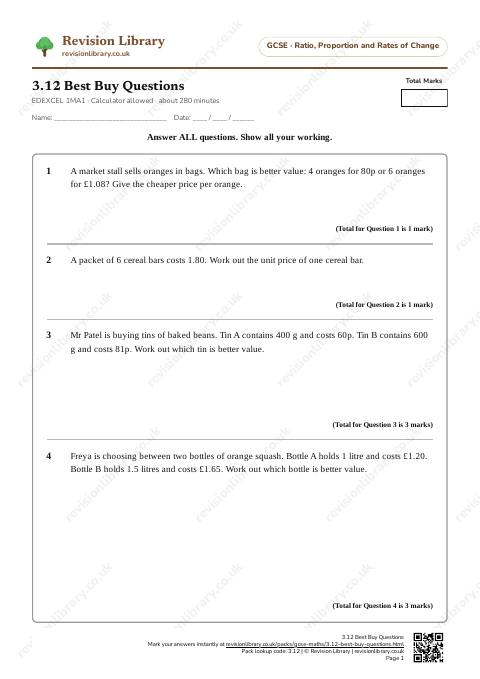
3.12 Best Buy Questions
EDEXCEL 1MA1 · Calculator allowed · about 280 minutes
A market stall sells oranges in bags. Which bag is better value: 4 oranges for 80p or 6 oranges for £1.08? Give the cheaper price per orange.
(Total for Question 1 is 1 mark)
2
A packet of 6 cereal bars costs 1.80. Work out the unit price of one cereal bar.
(Total for Question 2 is 1 mark)
3
Mr Patel is buying tins of baked beans. Tin A contains 400 g and costs 60p. Tin B contains 600 g and costs 81p. Work out which tin is better value.
(Total for Question 3 is 3 marks)
4
Freya is choosing between two bottles of orange squash. Bottle A holds 1 litre and costs £1.20. Bottle B holds 1.5 litres and costs £1.65. Work out which bottle is better value.
(Total for Question 4 is 3 marks)
5
Priya is comparing two bags of rice. Bag A weighs 2 kg and costs £3.00. Bag B weighs 5 kg and costs £7.00. Show working to find the price per kg of each bag, then circle the bag which is better value.
A) Bag A
B) Bag B
C) They are the same value
D) Not possible to tell
(Total for Question 5 is 2 marks)
6
A 750 g packet of couscous costs £2.10. Work out the cost of 1.5 kg of couscous.
(Total for Question 6 is 2 marks)
7
A pack of 6 toilet rolls costs £2.40. A pack of 12 costs £4.56. Which pack is better value per roll? Show your working.
(Total for Question 7 is 2 marks)
8
Which is cheaper per litre: a 750 ml bottle for £1.20 or a 1.5 litre bottle for £2.50? Give the cheaper option and the price per litre.
(Total for Question 8 is 1 mark)
9
A 600 g bag of cereal costs £1.50. Work out the cost per 100 g.
(Total for Question 9 is 1 mark)
10
A chocolate bar is sold singly for 95p or as 4 bars for £3.20. Which is the better buy by unit price? Show your working.
(Total for Question 10 is 2 marks)
11
A 400 g pack of birdseed costs £1.60. Work out the cost of 1.4 kg of birdseed.
(Total for Question 11 is 2 marks)
12
A pack of 4 batteries costs £2.60. A pack of 10 batteries costs £6.00. Which pack is better value per battery? Show your working.
(Total for Question 12 is 2 marks)
13
A 500 g bag of pasta costs £1.20. Work out the cost per 100 g.
(Total for Question 13 is 1 mark)
14
A box of 12 fish fingers costs £3.00. A portion uses 3 fish fingers. Work out the cost of one portion.
(Total for Question 14 is 2 marks)
15
Jo buys a 750 g bag of rice for 1.95. Work out the price of 100 g of rice. Give your answer in pence, correct to 1 decimal place if necessary.
(Total for Question 15 is 2 marks)
16
Leon is choosing dog food for his dog. Pack A: 3 kg for £6.60. Pack B: 5 kg for £10.50. Work out which pack is better value.
(Total for Question 16 is 3 marks)
17
Yasmin usually pays 60p for a pot of yogurt. Shop 1 has an offer: buy 3 pots and only pay for 2. Shop 2 sells the same yogurt in a multipack of 4 pots for £1.80. Work out which shop offers better value.
(Total for Question 17 is 4 marks)
18
A stationery shop sells notebooks. Pack A: 4 notebooks for £5.00. Pack B: 6 notebooks for £6.90. Work out which pack is better value.
(Total for Question 18 is 3 marks)
19
Declan is deciding how to pay for his bus travel for one day. A day ticket costs £4.50 and allows unlimited journeys. A single ticket costs £1.20 and Declan plans to make 4 journeys that day. Work out which option is cheaper and how much Declan saves.
(Total for Question 19 is 3 marks)
20
A DIY store sells the same paint in two tin sizes. Tin A: 2.5 litres for £18.75. Tin B: 5 litres for £35.00. Work out which tin is better value.
(Total for Question 20 is 3 marks)
21
Sofia is comparing two jars of jam. Jar A: 300 g for £1.80. Jar B: 500 g for £2.75. Show working to find the price per 100 g of each jar, then circle the jar which is better value.
A) Jar A
B) Jar B
C) They are the same value
D) Not possible to tell
(Total for Question 21 is 2 marks)
22
Two garages sell the same petrol, one in Leeds and one in Bradford. The Leeds garage charges £1.42 per litre. The Bradford garage charges £70.00 for 50 litres. Work out which garage is cheaper per litre.
(Total for Question 22 is 3 marks)
23
A supermarket sells the same cereal in three box sizes. Small box: 300 g for £1.35. Medium box: 500 g for £2.10. Large box: 750 g for £3.00.
(a)Work out the price per 100 g of the small box.(1)
(b)Work out the price per 100 g of the medium box and the large box.(2)
(c)State, with a reason, which box size is the best value for money, ft from (a) and (b).(1)
(Total for Question 23 is 4 marks)
24
Kwame wants to buy some chocolate bars. A single bar (45 g) costs 55p. A multipack of 6 bars (45 g each) costs £2.70. Work out whether the single bar or the multipack is better value.
(Total for Question 24 is 3 marks)
25
A school office is ordering pens. A pack of 10 pens costs £3.50. A pack of 25 pens costs £8.00. Work out which pack is better value.
(Total for Question 25 is 3 marks)
26
Aisha is comparing two tubs of ice cream. Medium tub: 900 ml for £3.60. Large tub: 1.5 litres for £5.40. Show that the large tub is better value for money.
(Total for Question 26 is 3 marks)
27
Mrs Okafor is comparing two bags of flour. Bag A: 750 g for £1.05. Bag B: 1.2 kg for £1.56. Work out which bag is better value.
(Total for Question 27 is 3 marks)
28
A shop sells washing powder in two box sizes. Box A: 40 washes for £6.00. Box B: 65 washes for £9.10. Work out which box is better value.
(Total for Question 28 is 3 marks)
29
Shampoo is sold in a 250 ml bottle for £3.60 and a 500 ml bottle for £6.40. Which bottle is better value per 100 ml? Show working.
(Total for Question 29 is 2 marks)
30
Which is better value per kg: a 2 kg bag of flour for £2.40 or a 500 g pack for 72p? Work out the cost per kg for both.
(Total for Question 30 is 2 marks)
31
A 1.2 kg bag of sugar costs £3.60. Work out the cost of 300 g of sugar.
(Total for Question 31 is 2 marks)
32
A store sells pens at £3.20 each. Offer A is "buy one get one half price". Offer B is "3 for £5". Which offer gives the lowest price per pen? Show working.
(Total for Question 32 is 2 marks)
33
Hand wash is sold in a 300 ml bottle for £1.80 and a 500 ml refill pouch for £2.50. Which is better value per 100 ml? Show your working.
(Total for Question 33 is 2 marks)
34
Which is better value per kg: a 250 g block of cheese for £2.10, or a 400 g block for £3.20? Work out the cost per kg for both.
(Total for Question 34 is 2 marks)
35
A 3 kg bag of dog food costs £9.00. Work out the cost of 800 g of dog food.
(Total for Question 35 is 2 marks)
36
A pack of 8 pens costs 3.20. A different shop sells individual pens at 0.45 each. Which is cheaper and by how much per pen? Show working.
(Total for Question 36 is 3 marks)
37
A supermarket sells a 500 g jar of jam for 1.40 or a 340 g jar for 1.00. Work out which jar is better value and show the price per 100 g for the better value jar.
(Total for Question 37 is 3 marks)
38
Chloe is comparing two shops selling the same jacket. Shop A: normal price £50, with 15% off. Shop B: normal price £45, with a £4 voucher taken off. Work out which shop is cheaper.
(Total for Question 38 is 4 marks)
39
A recipe uses dried pasta. Bag A: 500 g for £1.20, making 4 portions. Bag B: 750 g for £1.65, making 6 portions.
(a)Work out the price per 100 g of each bag.(2)
(b)Work out the cost per portion of each bag.(2)
(c)State, with a reason, which bag is the better value, ft from (a) and (b).(1)
(Total for Question 39 is 5 marks)
40
Aaliyah needs at least 2 kg of sugar for a school bake sale. A shop sells sugar in bags of 750 g for 90p each, and bags of 1 kg for £1.10 each. She can only buy whole bags.
(Total for Question 40 is 4 marks)
41
Two shops sell the same tins of soup, each priced at 79p. Mr Ahmed's shop has an offer: buy 2 tins and get 1 tin free. Mrs Wilson's shop sells the tins in a multipack of 3 for £1.90. Work out which shop is better value.
(Total for Question 41 is 4 marks)
42
A chocolate costs £1.20 each. You can buy a pack of 5 for £5.00 or take a "3 for 2" offer in the shop. Which way is cheapest if you need 9 bars? Show working.
(Total for Question 42 is 3 marks)
43
A 2.25 kg bag of rice costs £4.95. Work out the cost per 100 g. Give your answer in pence.
(Total for Question 43 is 2 marks)
44
A school needs at least 20 exercise books. A shop sells exercise books singly at £1.10, or in packs of 6 for £6.00. Compare the cost of buying 4 packs of 6 with the cost of buying 3 packs of 6 plus 2 single books, and state the cheaper way to get at least 20 books.
(Total for Question 44 is 3 marks)
45
A 1.5 kg bag of porridge oats costs £2.70. Work out the cost per 100 g. Give your answer in pence.
(Total for Question 45 is 2 marks)
46
A shop sells fruit squash in three sizes. Compare the prices and state which is best value per 100 ml. Small: 500 ml for £1.35. Medium: 1 litre for £2.40. Large: 2 litre for £4.20. Work out the price per 100 ml for each size and give the best value.
(Total for Question 46 is 3 marks)
47
Notebooks normally cost £2.50 each. Offer A: 20% off when you buy 2 or more. Offer B: buy 2, get the 3rd half price. Priya wants exactly 3 notebooks. Which offer gives the lower total price? Show your working.
(Total for Question 47 is 3 marks)
48
A bakery sells muffins in boxes of 4 for 2.80 or loose at 0.80 each. There is a school event needing exactly 20 muffins. Work out the least cost way to buy exactly 20 muffins and give the total cost. Show working.
(Total for Question 48 is 4 marks)
49
Maya is choosing between two offers on detergent. - Offer A: 2 packs for 6.00 - Offer B: 3 packs for 8.25 Which offer gives the lower price per pack? Show your working and give the answer to the nearest penny.
(Total for Question 49 is 4 marks)
50
A shop sells a jacket at 35% off the original price. The sale price is £78. Work out the original price of the jacket. Give your answer to the nearest 10p.
(Total for Question 50 is 3 marks)
51
A hardware shop in Leeds sells a strimmer. The price shown includes VAT at 20%. The price shown is £99.50. Work out the price of the strimmer before VAT was added. Give your answer to the nearest penny.
(Total for Question 51 is 3 marks)
52
You need to fill a 40 litre petrol tank. Station A sells petrol at £1.349 per litre. Station B sells petrol at £1.329 per litre. How much would you save by filling at Station B instead of Station A? Give your answer to the nearest penny.
(Total for Question 52 is 2 marks)
53
Compare three coffee options and state the cheapest per 100 g and how much cheaper per 100 g it is than the most expensive option. A: 200 g jar £2.40. B: 500 g jar £5.70. C: 1 kg bag £10.80. Work out per 100 g prices and the difference between best and worst.
(Total for Question 53 is 3 marks)
54
A shop sells small packets of biscuits as 5 for £6.75. Work out the cost of 8 packets.
(Total for Question 54 is 2 marks)
55
A homeowner needs 500 litres of heating oil. Supplier A charges 68p per litre. Supplier B charges 65p per litre. How much would be saved by using Supplier B instead of Supplier A?
(Total for Question 55 is 2 marks)
56
A shop sells biscuits in tins. The 350 g tin costs 2.20 and the 600 g tin costs 3.60. A customer needs 1 kg of biscuits. Work out whether it is cheaper to buy two 600 g tins or three 350 g tins. Show full working and state the cheapest option with the total cost.
(Total for Question 56 is 5 marks)
57
Priya compares two mobile phone deals. Deal A: 12 months at £18 per month, plus a one-off activation fee of £25. Deal B: 24 months at £12 per month, no activation fee. Which deal is cheaper overall? Show your working and give the difference in total cost.
(Total for Question 57 is 4 marks)
58
A supermarket sells olives in two pack sizes. Small jar: 180 g for £1.10. Large jar: 350 g for £1.85. Which jar gives the better value for money in pence per 100 g? Show your calculations and give pence per 100 g to 2 decimal places.
(Total for Question 58 is 5 marks)
59
Amelia is comparing three bags of basmati rice at a supermarket in Cardiff. Bag A: 500 g for £1.20. Bag B: 1.5 kg for £3.30. Bag C: 2 kg for £4.60. Work out the price per kilogram for each bag, giving each answer to 2 decimal places where needed, and state which bag gives the best value for money.
(Total for Question 59 is 5 marks)
60
Oliwia is choosing between two shops for a jacket that has a full price of £60 at both shops. Northgate Fashion: 10% off, then a further 10% off the reduced price at the till. Willowbrook Clothing: a single discount of 20% off. Work out the final price at each shop and state which shop is cheaper, and by how much.
(Total for Question 60 is 5 marks)
61
An item normally costs £9.60 each. Offer A: 3 for £25.00. Offer B: Buy 2 get the 3rd half price. Which offer gives the lower price per item, and by how much per item? Show working and give the saving per item in pence, to the nearest whole penny.
(Total for Question 61 is 4 marks)
62
A garden furniture set normally costs £180. Offer A: 15% off the normal price. Offer B: £25 off the normal price. Work out the price under each offer, state which offer is cheaper, and give the difference between the two prices.
(Total for Question 62 is 4 marks)
63
A gardener needs at least 9 kg of compost for a raised bed. Compost is sold in 2 kg bags at £3.20 and 5 kg bags at £7.00. Show that buying one 5 kg bag and two 2 kg bags is cheaper than buying five 2 kg bags or two 5 kg bags.
(Total for Question 63 is 3 marks)
64
A retailer offers a yearly subscription with the following two payment options: Option 1: Pay monthly at m pounds per month for 12 months with no discount. Option 2: Pay a single yearly price of 10m - £24. For which values of m is Option 2 cheaper than Option 1? Show your algebra and give your answer in inequality form.
(Total for Question 64 is 5 marks)
65
Yusuf is comparing two boxes of cereal in a supermarket in Bristol. Box X: 750 g for £2.85. Box Y: 500 g for £1.95. Yusuf's working is shown below. Box X: 2.85 / 700 * 100 = 40.71p per 100 g (to 2 dp) Box Y: 1.95 / 500 * 100 = 39p per 100 g Since 39 is less than 40.71, Yusuf concludes that Box Y is better value. Identify the mistake in Yusuf's working, then work out the correct price per 100 g for Box X and state which box actually gives better value.
(Total for Question 65 is 5 marks)
66
A sofa has a full price of £640 at two furniture branches. Ashworth Furniture: the sofa is reduced by 1/4, plus a £35 delivery charge. Bellhaven Home: the sofa is reduced by 20%, with free delivery. Callum wants to buy the sofa as cheaply as possible. Work out the total cost at each branch and state which is cheaper, and by how much.
(Total for Question 66 is 5 marks)
67
Two brands of dishwasher tablets are sold. Brand A: 30 tablets for £6.90, and a normal wash uses 1 tablet. Brand B: 45 tablets for £9.45, but each wash needs 1.5 tablets for a full-size load. Work out the cost per wash for each brand and state which is better value per wash.
(Total for Question 67 is 3 marks)
68
A department store sells a blender with recommended retail price £95. They mark up cost price by 40% to set RRP. After an initial sale they reduce the RRP by x percent to a sale price of £80. Show all working.
(a)Find the cost price of the blender.(3)
(b)Find x, the percentage reduction from RRP to sale price (RRP = 95, sale price = 80). Give x to 1 decimal place.(3)
(Total for Question 68 is 6 marks)
69
A shop sells fabric by the metre. The price per metre is p pounds. There is a special offer: buy at least 2 metres and get 15% off the total price; buy 5 or more metres and get 25% off the total price.
(a)For a customer buying 4 metres, show in terms of p the total cost after discount.(2)
(b)For what values of p (p > 0) will the cost for 4 metres after that discount be less than £40? Give your answer as an inequality and solve.(4)
(Total for Question 69 is 6 marks)
Mark scheme · 3.12 Best Buy Questions
Question 1
Identify 6 for £1.08 is better value, 108/6 = 18p each caoB1
Answer: 6 oranges for £1.08 (18p each). 4 for 80p is 20p each, 6 for £1.08 is 18p each (better). 18p cao
Question 2
30p or 0.30 caoB1
Answer: 0.30 (30p)
Question 3
60 / 4 oe (price per 100 g for tin A)M1
81 / 6 oe (price per 100 g for tin B)M1
15p and 13.5p, with tin B stated as better value caoA1
Answer: Tin B is better value (13.5p per 100 g compared with 15p per 100 g)
Question 4
120 / 10 oe (price per 100 ml for bottle A)M1
165 / 15 oe (price per 100 ml for bottle B)M1
12p and 11p, with bottle B stated as better value caoA1
Answer: Bottle B is better value (11p per 100 ml compared with 12p per 100 ml)
Question 5
3.00 / 2 and 7.00 / 5 both attempted, oeM1
B circled, with 1.50 and 1.40 shown caoA1
Answer: B (Bag B, at £1.40 per kg compared with £1.50 per kg for Bag A)
Question 6
Recognise 1.5 kg is 2 times 750 g and multiply: 2.10 * 2M1
£4.20 caoA1
Answer: £4.20 (2 × £2.10).
Question 7
Calculate unit prices: 240p/6 = 40p; 456p/12 = 38pM1
12 pack is better value, 38p per roll caoA1
Answer: 12 pack is better value: 38p per roll (6 pack is 40p per roll).
Question 8
750 ml bottle cheaper, 120p/0.75 = 160p per litre caoB1
Answer: 750 ml bottle, 160p per litre (cheaper than 166.67p per litre for 1.5 L).
Question 9
25p per 100 g caoB1
Answer: 25p per 100 g (150p/600g = 0.25p per g, so 25p per 100 g).
Question 10
Calculate unit prices: 95p for single, 320p/4 = 80p eachM1
State 4 for £3.20 is better value, 80p each caoA1
Answer: 4 for £3.20 is better value; 80p each rather than 95p each.
Question 11
Recognise 1.4 kg is 3.5 times 400 g and multiply: 1.60 * 3.5M1
£5.60 caoA1
Answer: £5.60 (3.5 x £1.60).
Question 12
Calculate unit prices: 260p/4 = 65p; 600p/10 = 60pM1
10 pack is better value, 60p per battery caoA1
Answer: 10 pack is better value: 60p per battery (4 pack is 65p per battery).
Question 13
24p per 100 g caoB1
Answer: 24p per 100 g (120p/500g = 0.24p per g, so 24p per 100 g).
Question 14
Find unit price: 300p/12 = 25p per fish fingerM1
75p caoA1
Answer: 75p (25p per fish finger x 3 = 75p per portion).
Question 15
correct method, e.g. 1.95/750 × 100 or 1.95 × (100/750) shownM1
26.0p caoA1
Answer: 26.0p
Question 16
6.60 / 3 oe and 10.50 / 5 oe both attemptedM1
£2.20 and £2.10 both correct caoA1
correct conclusion that pack B is better valueC1
Answer: Pack B is better value (£2.10 per kg compared with £2.20 per kg)
Question 17
2 x 60 (= 120) oe (cost of 3 pots under the Shop 1 offer)M1
120 / 3 oe and 180 / 4 oe (price per pot for each shop)M1
40p and 45p both correct caoA1
correct conclusion that Shop 1's offer is better valueC1
Answer: Shop 1's offer is better value (40p per pot compared with 45p per pot at Shop 2)
Question 18
500 / 4 oe and 690 / 6 oe both attemptedM1
125p and 115p both correct caoA1
correct conclusion that pack B is better valueC1
Answer: Pack B is better value (115p per notebook compared with 125p per notebook)
Question 19
4 x 1.20 oeM1
4.80 caoA1
correct conclusion that the day ticket is cheaper, with correct saving statedC1
Answer: The day ticket is cheaper, saving 30p (£4.50 compared with £4.80 for 4 single tickets)
Question 20
18.75 / 2.5 oe and 35.00 / 5 oe both attemptedM1
£7.50 and £7.00 both correct caoA1
correct conclusion that tin B is better valueC1
Answer: Tin B is better value (£7.00 per litre compared with £7.50 per litre)
Question 21
180 / 3 and 275 / 5 both attempted, oeM1
B circled, with 60p and 55p shown caoA1
Answer: B (Jar B, at 55p per 100 g compared with 60p per 100 g for Jar A)
Question 22
70.00 / 50 oeM1
1.40 caoA1
correct conclusion that the Bradford garage is cheaper per litreC1
Answer: The Bradford garage is cheaper (£1.40 per litre compared with £1.42 per litre in Leeds)
Question 23
(a) 45p (per 100 g) caoB1
(a) Answer: 45p per 100 g
(b) 210 / 5 oe (medium) or 300 / 7.5 oe (large)M1
(b) 42p and 40p both correct caoA1
(b) Answer: Medium: 42p per 100 g. Large: 40p per 100 g
(c) large box, since it has the lowest price per 100 g, ftB1ft
(c) Answer: The large box, since 40p per 100 g is the lowest of the three prices
Question 24
270 / 6 oeM1
45p caoA1
correct conclusion comparing 45p with 55p, e.g. multipack is better valueC1
Answer: The multipack is better value (45p per bar compared with 55p for a single bar)
Question 25
350 / 10 oe and 800 / 25 oe both attemptedM1
35p and 32p both correct caoA1
correct conclusion that the pack of 25 is better valueC1
Answer: The pack of 25 pens is better value (32p per pen compared with 35p per pen)
Question 26
3.60 / 0.9 oe (price per litre for medium tub)M1
5.40 / 1.5 oe (price per litre for large tub)M1
cso, £4.00 and £3.60 shown, with correct conclusion since 3.60 < 4.00C1
Answer: Large tub is better value: £3.60 per litre compared with £4.00 per litre for the medium tub
Question 27
1.2 kg converted to 1200 g oeM1
105 / 7.5 oe and 156 / 12 oe (price per 100 g for each bag)M1
14p and 13p both correct, with bag B stated as better value caoA1
Answer: Bag B is better value (13p per 100 g compared with 14p per 100 g)
Question 28
600 / 40 oe and 910 / 65 oe both attemptedM1
15p and 14p both correct caoA1
correct conclusion that box B is better valueC1
Answer: Box B is better value (14p per wash compared with 15p per wash)
Question 29
Calculate per 100 ml: 250 ml bottle = 360p/250*100 = 144p; 500 ml bottle = 640p/500*100 = 128pM1
500 ml bottle is better value, 128p per 100 ml caoA1
Answer: 500 ml bottle is better value: 128p per 100 ml (250 ml bottle is 144p per 100 ml).
Question 30
Calculate 2 kg bag: 240p/2 = 120p per kg; 500 g pack: 72p/0.5 = 144p per kgM1
2 kg bag is better value, 120p per kg caoA1
Answer: 2 kg bag is better value: 120p per kg vs 144p per kg for the 500 g pack.
Question 31
Scale: 300/1200 of £3.60 or 360p * 300/1200M1
90p caoA1
Answer: 90p (360p * 300/1200 = 90p).
Question 32
Compute effective price: BOGOHalf two pens cost 3.20 + 1.60 = 4.80 so 2.40 each; 3 for £5 gives £1.666... eachM1
3 for £5 is cheaper, about £1.67 each caoA1
Answer: 3 for £5 is cheaper: effective price approx £1.67 per pen (BOGOHalf is £2.40 each).
Question 33
Calculate per 100 ml: 300 ml bottle = 180p/300*100 = 60p; 500 ml pouch = 250p/500*100 = 50pM1
500 ml refill pouch is better value, 50p per 100 ml caoA1
Answer: 500 ml refill pouch is better value: 50p per 100 ml (300 ml bottle is 60p per 100 ml).
Question 34
Calculate 250 g block: 210p/0.25 = 840p per kg; 400 g block: 320p/0.4 = 800p per kgM1
400 g block is better value, 800p per kg caoA1
Answer: 400 g block is better value: 800p per kg vs 840p per kg for the 250 g block.
Question 35
Scale: 800/3000 of £9.00 or 900p * 800/3000M1
£2.40 caoA1
Answer: £2.40 (900p x 800/3000 = 240p).
Question 36
find unit price of pack: 3.20/8 = 0.40 shownM1
compare with 0.45 and find difference 0.05 shownM1
Pack is cheaper by 5p per pen caoA1
Answer: Pack is cheaper by 0.05 (5p) per pen
Question 37
method for unit price for at least one jar e.g. 1.40/500 = 0.0028 or 1.00/340 = 0.002941...M1
compare and identify better value jar (500 g is cheaper) shownM1
price per 100 g for 500 g jar = 0.28 (28p) caoA1
Answer: 500 g jar is better value; 100 g costs 0.28 (28p)
Question 38
50 x 0.15 (= 7.50) oe, or 50 x 0.85M1
42.50 cao (Shop A final price)A1
45 - 4 oe (Shop B final price)M1
41 stated for Shop B, with correct conclusion that Shop B is cheaperC1
Answer: Shop B is better value (£41.00 compared with £42.50 at Shop A)
Question 39
(a) 120 / 5 oe and 165 / 7.5 oe both attemptedM1
(a) 24p and 22p both correct caoA1
(a) Answer: Bag A: 24p per 100 g. Bag B: 22p per 100 g
(b) 120 / 4 oe and 165 / 6 oe both attemptedM1
(b) 30p and 27.5p both correct caoA1
(b) Answer: Bag A: 30p per portion. Bag B: 27.5p per portion
(c) Bag B, since it is cheaper both per 100 g and per portion, ftB1ft
(c) Answer: Bag B, since it is cheaper per 100 g (22p vs 24p) and cheaper per portion (27.5p vs 30p)
Question 40
at least two valid combinations of whole bags totalling at least 2 kg identified, e.g. 3 x 750 g and 2 x 1 kgP1
3 x 90 (= 2.70) oe and 2 x 1.10 (= 2.20) oeM1
£2.70 and £2.20 both correct caoA1
correct conclusion that 2 x 1 kg bags for £2.20 is the cheapest way to buy at least 2 kgC1
Answer: Buy 2 bags of 1 kg sugar for £2.20 (this gives exactly 2 kg for the least cost)
Question 41
2 x 79 (= 158) oe (cost of 3 tins under Mr Ahmed's offer)M1
158 / 3 oe and 190 / 3 oe (price per tin for each shop)M1
awrt 53p and awrt 63p both correctA1
correct conclusion that Mr Ahmed's offer is better valueC1
Answer: Mr Ahmed's offer is better value (awrt 53p per tin compared with awrt 63p per tin at Mrs Wilson's shop)
Question 42
Compute cost as singles: 9 * £1.20 = £10.80 or as two 5-packs = £10.00M1
Compute cost with 3 for 2: for 9 bars pay for 6 -> 6 * £1.20 = £7.20M1
3 for 2 is cheapest, £7.20 caoA1
Answer: 3 for 2 is cheapest: cost = £7.20 (pay for 6 bars). Singles cost £10.80, two 5-packs cost £10.00.
Calculate unit prices: A = 240p/200*100 = 120p; B = 570p/500*100 = 114p; C = 1080p/1000*100 = 108pM1
Identify cheapest = C at 108p per 100 gM1
State difference worst - best = 120p - 108p = 12p caoA1
Answer: Per 100 g: A = 120p, B = 114p, C = 108p. Cheapest is C (108p per 100 g). It is 12p per 100 g cheaper than the worst (A).
Question 54
Find unit price: £6.75/5 = £1.35 and multiply by 8M1
£10.80 caoA1
Answer: £10.80 (unit price £1.35 × 8 = £10.80).
Question 55
Calculate difference per litre: 68 - 65 = 3pM1
Saving = 3p * 500 = £15.00 caoA1
Answer: £15.00 saved (3p per litre x 500 litres = £15.00).
Question 56
calculate cost of 2 x 600 g tins = 2 × 3.60 = 7.20M1
calculate mass of 2 × 600 g = 1200 g and note covers 1 kgM1
calculate cost of 3 × 350 g tins = 3 × 2.20 = 6.60M1
compare totals and identify cheaper optionM1
Three 350 g tins are cheaper; total cost 6.60 caoA1
Answer: Buy three 350 g tins; total cost 6.60 (cheaper than 7.20)
Question 57
calculate total for Deal A: 12*18 + 25M1
calculate total for Deal B: 24*12M1
correct totals: Deal A = £241, Deal B = £288A1
state cheaper deal A and difference £47 caoA1
Answer: Deal A is cheaper by £47. (Deal A: 12*18 + 25 = 216 + 25 = 241. Deal B: 24*12 = 288. Difference 288 - 241 = 47.) Working check: totals recomputed above.
Question 58
calculate pence per 100 g for small jar: (110p / 180) * 100 or equivalentM1
small jar = 61.11p per 100 g (to 2 dp) caoA1
calculate pence per 100 g for large jar: (185p / 350) * 100 or equivalentM1
large jar = 52.86p per 100 g (to 2 dp) caoA1
state large jar is better value and give difference 8.25p per 100 g (61.11 - 52.86 = 8.25) caoB1
Answer: Small jar: 61.11p per 100 g. Large jar: 52.86p per 100 g. The large jar is better value by 8.25p per 100 g. (Checks: 110/180*100 = 61.111... -> 61.11; 185/350*100 = 52.857... -> 52.86.)
Question 59
convert Bag A to price per kg: 1.20 / 0.5 (recognising 500 g = 0.5 kg)M1
Bag A = £2.40 per kg caoA1
find price per kg for Bag B and Bag C: 3.30 / 1.5 and 4.60 / 2M1
Bag B = £2.20 per kg AND Bag C = £2.30 per kg, both caoA1
correctly identify Bag B as the best value, with a valid comparison of all three prices per kgB1
Answer: Bag A = £2.40 per kg. Bag B = £2.20 per kg. Bag C = £2.30 per kg. Bag B gives the best value for money, being the cheapest per kilogram. Working check: 1.20 / 0.5 = 2.40; 3.30 / 1.5 = 2.20; 4.60 / 2 = 2.30; 2.20 is the smallest of the three.
Question 60
apply the first discount at Northgate Fashion: 60 * 0.9, or a complete method 60 * 0.9 * 0.9M1
Northgate Fashion final price = £48.60 caoA1
apply the single discount at Willowbrook Clothing: 60 * 0.8M1
Willowbrook Clothing final price = £48.00 caoA1
state Willowbrook Clothing is cheaper, by £0.60, cao (ft from the two totals)B1
Answer: Northgate Fashion: 60 * 0.9 * 0.9 = £48.60. Willowbrook Clothing: 60 * 0.8 = £48.00. Willowbrook Clothing is cheaper, by £0.60. (Two successive 10% discounts give an overall reduction of 19%, not 20%: 1 - 0.9*0.9 = 0.19.) Working check: 48.60 - 48.00 = 0.60.
Question 61
Calculate Offer A unit price: £25/3 = £8.333... per itemM1
Calculate Offer B unit price: for 3 items cost = 9.60 + 9.60 + 4.80 = £24 -> £8.00 per itemM1
State Offer B is cheaper caoA1
State saving per item approx £0.333... -> 33p per item (awrt 33p) caoA1
Answer: Offer B is cheaper. Offer A = £8.333... per item, Offer B = £8.00 per item. Saving approx £0.333... = 33p per item (to nearest penny).
State difference = £155.00 - £153.00 = £2.00 caoA1
Answer: Offer A is cheaper. Offer A = £153.00, Offer B = £155.00. Difference = £2.00.
Question 63
Calculate cost of 5 x 2 kg = 5 * £3.20 = £16.00 csodM1
Calculate cost of 1 x 5 kg + 2 x 2 kg = £7.00 + £6.40 = £13.40 csodM1
Conclude cheapest is 5 kg + 2x2 kg = £13.40 cao, less than both £16.00 and £14.00A1
Answer: 1 x 5 kg + 2 x 2 kg costs £13.40 and gives 9 kg. Five 2 kg bags cost £16.00 (10 kg). Two 5 kg bags cost £14.00 (10 kg). Since £13.40 is less than both £16.00 and £14.00, one 5 kg bag plus two 2 kg bags is the cheapest way to get at least 9 kg.
Question 64
form inequality 10m - 24 < 12m or equivalentM1
rearrange: -24 < 2m leading to m > -12 or equivalent sign handlingM1
simplify correctly to m > -12A1
interpretation: since m is price (m > 0), Option 2 is always cheaper for all realistic m > 0 (give reasoning)B1
final statement in inequality form m > -12 with note that for all practical m > 0 Option 2 is cheaperA1
Answer: Inequality: 10m - 24 < 12m -> -24 < 2m -> m > -12. Since m represents a positive monthly price, Option 2 is cheaper for all realistic m > 0. Working check: substitute m = 10 gives yearly price 10*10-24=76 < 120.
Question 65
identify that Yusuf used 700 g instead of the correct mass of 750 g for Box XB1
recalculate Box X using the correct mass: 2.85 / 750 * 100M1
Box X = 38p per 100 g caoA1
Box Y correctly confirmed as 39p per 100 gB1
correct conclusion: Box X is actually the better value (cheaper per 100 g), not Box Y as Yusuf claimed, caoA1
Answer: Yusuf used 700 g instead of 750 g for Box X. Correct calculation: Box X = 2.85 / 750 * 100 = 38p per 100 g. Box Y = 1.95 / 500 * 100 = 39p per 100 g. Box X is actually the better value, not Box Y as Yusuf concluded. Working check: 2.85 / 750 = 0.0038, * 100 = £0.38 = 38p; 1.95 / 500 = 0.0039, * 100 = £0.39 = 39p; 38 is less than 39.
Question 66
a complete method to find Ashworth Furniture's total cost, e.g. 640 * 3/4 + 35M1
Ashworth Furniture total = £515 caoA1
a method to find Bellhaven Home's total cost, e.g. 640 * 0.8M1
Bellhaven Home total = £512 caoA1
state Bellhaven Home is cheaper, by £3, cao (ft from the two totals)B1
Answer: Ashworth Furniture: 640 * 3/4 = 480, plus 35 delivery = £515. Bellhaven Home: 640 * 0.8 = £512. Bellhaven Home is cheaper, by £3. Working check: 515 - 512 = 3.
Question 67
Cost per tablet: Brand A = 690/30 = 23p; Brand B = 945/45 = 21pM1
Cost per wash: Brand A = 23p; Brand B = 21p * 1.5 = 31.5pM1
Brand A is better value per wash, 23p caoA1
Answer: Brand A is better value: 23p per wash (Brand B costs 31.5p per wash).
(a) Answer: Total cost = 4p * 0.85 = 3.4 p. Working check: 15% off means pay 85% so 4p*0.85 = 3.4p.
(b) form inequality 3.4 p < 40M1
(b) solve p < 40 / 3.4M1
(b) compute 40 / 3.4 = 11.764705... and round appropriatelyA1
(b) final inequality p < 11.76... so p < 11.76(47) or p < 11.76 to 2 dp and state p > 0A1
(b) Answer: Inequality: 3.4 p < 40 -> p < 40 / 3.4 = 11.764705... So for p > 0 the cost is less than £40 when p < 11.764705... (approximately p < £11.76). Working check: p = 11.76 gives 3.4*11.76 = 40.0 approx.
Put this topic and others into one printable pack.
Open the Pack Builder
Worksheets are written for Revision Library and come with a full mark scheme; a few English packs quote an out-of-copyright text, and name it on the page. Exam board names and specification codes say which qualification a pack suits: we are not affiliated with, endorsed by or approved by any exam board, and no past-paper question is reproduced here. Rights queries: hello@revisionlibrary.co.uk