A two-way table organises data by two categories at once, such as year group and travel method, with row and column totals used to check that all the numbers add up correctly. Completing and interpreting two-way tables is a key GCSE statistics and probability skill, often combined with simple probability questions.
Read the table carefully, noting which totals, such as row totals, column totals or the grand total, are already given.
Use the rule that each row and each column must add up to its stated total to find missing values, working from the values you already know.
Fill in missing cells one at a time, starting with any row or column that has only one missing value.
Check your completed table: every row should sum to its row total, and every column should sum to its column total, and both should agree with the grand total.
For probability questions, write the relevant frequency from the table over the appropriate total: the grand total for 'a person chosen from everyone', or a row/column total for 'given that'.
Worked example
A school surveyed 100 pupils about whether they prefer football or netball. Of the 55 boys, 38 prefer football. Of the 45 girls, 20 prefer football. Complete a two-way table, then find the probability that a pupil chosen at random prefers netball.
Boys who prefer netball = 55 - 38 = 17.
Girls who prefer netball = 45 - 20 = 25.
Total who prefer football = 38 + 20 = 58.
Total who prefer netball = 17 + 25 = 42 (check: 58 + 42 = 100).
Probability of netball = 42/100 = 21/50.
Final answer: 21/50.
Revision Library
revisionlibrary.co.uk
GCSE · Statistics: representing and interpreting data
3.20 Two Way Tables
EDEXCEL 1MA1 · Calculator allowed · about 220 minutes
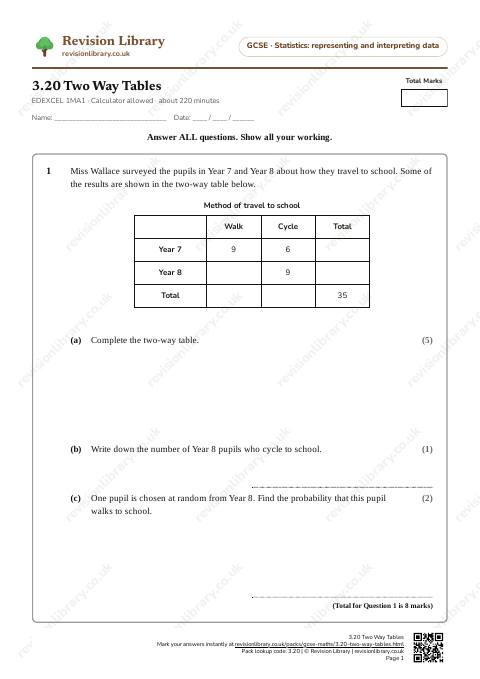
Miss Wallace surveyed the pupils in Year 7 and Year 8 about how they travel to school. Some of the results are shown in the two-way table below.
(a)Complete the two-way table.(5)
(b)Write down the number of Year 8 pupils who cycle to school.(1)
(c)One pupil is chosen at random from Year 8. Find the probability that this pupil walks to school.(2)
(Total for Question 1 is 8 marks)
2
Mrs Ahmed recorded the lunch choices of 60 pupils in the school canteen. The two-way table shows some of the results.
(a)Write down the number of Year 10 students who chose a hot meal.(1)
(b)Work out the total number of students who chose a sandwich.(2)
(Total for Question 2 is 3 marks)
3
Mr Nkemelu asked 90 students in Year 10 and Year 11 to name their favourite subject from Maths, English and Science. The completed two-way table shows the results. Find the probability that a student chosen at random named Science as their favourite subject.
(Total for Question 3 is 2 marks)
4
A teacher records which pupils passed or failed a short test and whether they are boys or girls. Complete the missing entry in this two-way table.
Passed Failed Total Boys 28 7 35 Girls ? 5 13 Total 36 12 48
Work out the number of girls who passed.
(Total for Question 4 is 1 mark)
5
In a group of 36 pupils, 21 play music and 15 do not. There are 14 boys and 22 girls. Of the boys, 9 play music.
Complete the missing entry: how many girls do not play music?
(Total for Question 5 is 1 mark)
6
A school has 50 pupils. 30 buy fruit from the canteen and 20 do not.
Work out the probability that a randomly chosen pupil buys fruit.
(Total for Question 6 is 1 mark)
7
A club surveyed 50 members about whether they play football and whether they are under 18. The two way table is shown.
Under 18
18 or over
Total
Play football
18
12
30
Do not play
?
10
20
Total
28
22
50
(a)Calculate the missing entry marked ?.(1)
(b)Give the probability that a member chosen at random is under 18 and does not play football.(1)
(Total for Question 7 is 2 marks)
8
A two way table gives information about 90 customers in a shop. The table shows whether they bought milk and whether they used a loyalty card.
Loyalty card
No card
Total
Bought milk
50
10
60
No milk
?
20
30
Total
60
30
90
(a)Work out the missing entry marked ?.(1)
(b)Give the probability that a randomly chosen customer both bought milk and used a loyalty card.(1)
(Total for Question 8 is 2 marks)
9
Freya Sinclair organised a charity bake sale where 90 cakes were sold, either Sponge or Chocolate, in the morning or the afternoon. Some of the results are shown in the two-way table below. Complete the two-way table.
(Total for Question 9 is 5 marks)
10
Mrs Osei, the school nurse, recorded whether pupils in Class A and Class B have a peanut allergy, out of 60 pupils in total. The completed two-way table is shown below.
(a)Write down the number of pupils in Class B who do not have a peanut allergy.(1)
(b)Work out the probability that a randomly selected pupil (from all 60) has a peanut allergy.(2)
(c)One pupil is chosen at random from Class A. Find the probability that this pupil does not have a peanut allergy.(2)
(Total for Question 10 is 5 marks)
11
Mr Fitzgerald recorded the exam results of 100 students who each sat one exam, either Maths or Science. The completed two-way table is shown below.
(a)Write down the total number of students who failed their exam.(1)
(b)A student says that a greater proportion of Maths students passed than Science students. Determine, showing your working, whether the student is correct.(3)
(Total for Question 11 is 4 marks)
12
Aisha Malik surveyed a sample of 60 visitors to a museum about whether they bought a souvenir, split by Adult and Child. The completed two-way table is shown below.
(a)Find the probability that a randomly chosen visitor from the sample bought a souvenir.(2)
(b)There are 900 visitors to the museum on Saturday. Use the table to estimate the number of these visitors who will buy a souvenir.(3)
(Total for Question 12 is 5 marks)
13
Marcus Reid coaches a running club with 40 members. The completed two-way table shows how many members finished a marathon, split by gender.
(a)Write down the number of female members who finished the marathon.(1)
(b)Find the probability that a randomly chosen member did not finish the marathon.(2)
(c)20% of the members who did not finish the marathon were injured during the race. Work out how many members did not finish due to injury.(2)
(Total for Question 13 is 5 marks)
14
Mrs Devine, an assistant head teacher, checked whether 90 pupils across three tutor groups had completed their homework. The completed two-way table is shown below.
(a)Write down the number of pupils in 7B who had not completed their homework.(1)
(b)Find the probability that a randomly chosen pupil (from all 90) had completed their homework.(2)
(c)One pupil is chosen at random from 7C. Find the probability that this pupil had completed their homework.(2)
(Total for Question 14 is 5 marks)
15
A survey asked people to fill in a two-way table with rows cats and dogs and columns adults and puppies or kittens. The total number of cats and dogs was 93. Three of the four cells were: cats puppies or kittens: 16; dogs adults: 8; dogs puppies or kittens: 31. Work out the number of cats in the adults group.
(Total for Question 15 is 3 marks)
16
Year 10 has 24 boys and 39 girls. Year 11 has 28 boys and 23 girls. Write the ratio of all the boys to all the girls in its simplest form.
(Total for Question 16 is 3 marks)
17
The table shows information about pupils in two year groups. Year 10: 34 boys and 30 girls. Year 11: 15 boys and 33 girls. A pupil is chosen at random from Year 11. Work out the probability that the pupil is a boy. Give your answer as a fraction in its simplest form.
(Total for Question 17 is 3 marks)
18
Year 10 has 15 boys and 34 girls. Year 11 has 27 boys and 17 girls. Write the ratio of all the boys to all the girls in its simplest form.
(Total for Question 18 is 3 marks)
19
A survey asked people to fill in a two-way table with rows boys and girls and columns Year 10 and Year 11. The total number of people was 89. Three of the four cells were: boys Year 11: 13; girls Year 10: 10; girls Year 11: 40. Work out the number of boys in the Year 10 group.
(Total for Question 19 is 3 marks)
20
Of 67 boys, 32 are in Year 10 and the rest are in Year 11. Of 63 girls, 37 are in Year 10 and the rest are in Year 11. What percentage of the girls are in Year 10? Give your answer correct to 1 decimal place.
(Total for Question 20 is 3 marks)
21
The table shows information about pupils in two year groups. Year 10: 11 boys and 17 girls. Year 11: 15 boys and 38 girls. A boy is chosen at random. Work out the probability that the pupil is in Year 10. Give your answer as a fraction in its simplest form.
(Total for Question 21 is 3 marks)
22
Of 44 boys, 10 are in Year 10 and the rest are in Year 11. Of 31 girls, 20 are in Year 10 and the rest are in Year 11. What percentage of the boys are in Year 10? Give your answer correct to 1 decimal place.
(Total for Question 22 is 3 marks)
23
The table shows information about pupils in two year groups. Year 10: 30 boys and 30 girls. Year 11: 35 boys and 34 girls. A pupil is chosen at random from Year 11. Work out the probability that the pupil is a boy. Give your answer as a fraction in its simplest form.
(Total for Question 23 is 3 marks)
24
Year 10 has 14 boys and 8 girls. Year 11 has 39 boys and 20 girls. Write the ratio of all the boys to all the girls in its simplest form.
(Total for Question 24 is 2 marks)
25
The table shows information about pupils in two year groups. Year 10: 24 boys and 20 girls. Year 11: 24 boys and 9 girls. A boy is chosen at random. Work out the probability that the pupil is in Year 11. Give your answer as a fraction in its simplest form.
(Total for Question 25 is 3 marks)
26
Of 50 boys, 36 are in Year 10 and the rest are in Year 11. Of 27 girls, 9 are in Year 10 and the rest are in Year 11. What percentage of the girls are in Year 10? Give your answer correct to 1 decimal place.
(Total for Question 26 is 3 marks)
27
Priya Chandra manages Riverside Car Park. She recorded how many cars and vans were parked there in the morning and in the afternoon. Complete the two-way table.
(Total for Question 27 is 5 marks)
28
The completed two-way table from Priya's car park survey is shown below. Find the probability that a vehicle parked in the afternoon was a van.
(Total for Question 28 is 2 marks)
29
Chloe Bennett, a council officer, surveyed 80 households about whether they recycle glass and whether they recycle paper. The completed two-way table is shown below.
(a)Write down the number of households that recycle neither glass nor paper.(1)
(b)Find the probability that a randomly chosen household recycles both glass and paper.(2)
(c)One household is chosen at random from those that recycle paper. Find the probability that this household does not recycle glass.(2)
(Total for Question 29 is 5 marks)
30
Tomasz Nowak runs an ice cream stall at a fair. He recorded which flavour was bought by 100 customers, split by Adult and Child. The completed two-way table is shown below.
(a)Which flavour was the most popular overall?(1)
A) Vanilla
B) Chocolate
C) Strawberry
D) Cannot be determined
(b)Work out the probability that a randomly selected customer chose strawberry.(2)
(Total for Question 30 is 3 marks)
31
A survey of 40 pupils asked whether they prefer tea or coffee. Complete the two missing entries in the table.
Tea Coffee Total Year 10 12 8 20 Year 11 10 ? 20 Total 22 ? 40
Find Year 11 coffee and the total who prefer coffee.
(Total for Question 31 is 2 marks)
32
A two-way table records pupils who play football and their gender. There are 35 pupils in total. 11 boys play football and 18 pupils play football overall. There are 15 girls in the class.
Work out the probability that a randomly chosen pupil is a girl who plays football.
(Total for Question 32 is 1 mark)
33
A two way table shows types of transport used by 40 students and whether they are in Year 7 or Year 8.
Year 7
Year 8
Total
Bus
12
8
20
Walk
6
4
10
Cycle
2
8
10
Total
20
20
40
Work out the probability that a student chosen at random is in Year 7 given that they ride the bus. Give your answer as a fraction in lowest terms.
(Total for Question 33 is 3 marks)
34
A survey of 80 families asked whether they have a dog and whether they have a garden. The completed two way table is below.
Garden
No garden
Total
Have a dog
36
14
50
No dog
10
20
30
Total
46
34
80
Work out the percentage of families who have a dog and a garden. Give your answer to 1 decimal place.
(Total for Question 34 is 3 marks)
35
Ade Okafor surveyed 120 adults about whether they prefer to read a Tabloid or a Broadsheet newspaper. The number of males who prefer a Tabloid is 2x, and the number of females who prefer a Tabloid is (x + 10). 28 males prefer a Broadsheet, and 37 females prefer a Broadsheet.
(a)Form and solve an equation to find the value of x.(3)
(b)Work out the total number of male adults in the survey.(2)
(Total for Question 35 is 5 marks)
36
Kwame Mensah manages a leisure centre with 120 members. The completed two-way table shows the age and gender of the members.
(a)Write down the number of female members aged 30 and over.(1)
(b)One member under 30 is chosen at random. Show that the probability this member is male is 17/31.(2)
(Total for Question 36 is 3 marks)
37
Grace Adeyemi is a quality control supervisor at a factory. 300 items were tested for faults using two machines, A and B. Machine A tested 3/5 of all 300 items, and Machine B tested the rest. Of the items tested by Machine A, 1 in 20 were found to be faulty. Of the items tested by Machine B, 15% were found to be faulty.
(a)Work out the number of items tested by Machine A and the number of items tested by Machine B.(3)
(b)Complete a two-way table to show the number of faulty and non-faulty items for each machine.(4)
(c)Work out the total number of faulty items out of the 300 tested.(2)
(Total for Question 37 is 9 marks)
38
In a sports club there are 24 boys. 9 of the boys play hockey. Work out the probability that a member chosen at random from the boys plays hockey.
(Total for Question 38 is 2 marks)
39
A census of 80 households gives: 31 have a dog, 28 have a cat, 10 have both a dog and a cat.
Complete the 2 by 2 table and find how many households have neither a dog nor a cat.
(Total for Question 39 is 2 marks)
40
A community centre asked 70 visitors whether they used the gym and whether they attended a class. The partially completed two way table is below.
Attend class
Do not attend class
Total
Use gym
28
?
40
Do not use gym| 12
?
30
Total
40
30
70
(a)Work out the value of the entry marked ? in the Use gym row.(1)
(b)Work out the value of the other ? in the Do not use gym row.(1)
(c)Find the probability that a visitor both uses the gym and attends a class.(2)
(Total for Question 40 is 4 marks)
41
A sample of 200 households records whether they have internet and whether they have a landline. The proportions are: P(internet) = 0.70, P(landline) = 0.40, P(both) = 0.30.
(a)Complete the two-way table of counts for the 200 households.(2)
(b)Work out the probability that a household has internet but not a landline.(1)
(c)Find the probability that a household has a landline given it does not have internet.(1)
(Total for Question 41 is 4 marks)
42
A survey of 250 people records age and usual transport. Complete the table then answer the probabilities.
Bus Car Walk Total Under 30 40 30 ? 90 30 to 59 70 40 30 140 60 and over ? 10 0 20 Total 120 80 50 250
(a)Complete the three missing entries in the table.(2)
(b)Work out the probability that a randomly chosen person uses the bus.(1)
(c)Find the probability that a person uses the bus given they are aged 30 to 59.(1)
(Total for Question 42 is 4 marks)
43
In a town, a council records whether households have broadband and whether they have a landline. Out of 500 households, 365 have broadband and 210 have a landline. Exactly 150 households have both broadband and a landline.
Complete the two-way table for Broadband / Landline and work out the number of households that have broadband only.
(Total for Question 43 is 3 marks)
44
A class of 30 pupils were asked whether they cycle to school and whether they wear a helmet. The completed two-way table is below.
Helmet
No Helmet
Total
Cycle
8
4
12
Do not cycle
6
12
18
Total
14
16
30
Calculate the probability that a randomly chosen pupil cycles given that they wear a helmet. Give your answer as a fraction in lowest terms.
(Total for Question 44 is 3 marks)
45
A survey records whether adults exercise regularly and whether they are smokers. The table for 400 adults is below.
Smoker
Non-smoker
Total
Exercise
40
160
200
No exercise
90
110
200
Total
130
270
400
Use this table to show whether the events 'exercise' and 'smoker' are independent. You must justify your conclusion.
(Total for Question 45 is 4 marks)
46
A two-way table classifies 360 people by whether they own a pet and whether they own a bicycle. It is known that 126 people own both a pet and a bicycle, 174 own a pet, and 210 own a bicycle.
Show that the number of people who own neither a pet nor a bicycle is 102.
(Total for Question 46 is 5 marks)
47
Stretch question. A researcher considers a large sample where the proportion who prefer Coffee is p and the proportion who prefer Tea is 1 - p. Independently, the proportion who choose Milk is m and choose No milk is 1 - m. She assumes preference for drink and choice about milk are independent.
(a)Construct the 2x2 probability table with rows Coffee / Tea and columns Milk / No milk in terms of p and m.(2)
(b)Find P(Coffee | Milk) in terms of p and m.(2)
(c)Check the numerical claim for p = 0.6 and m = 0.25.(4)
(Total for Question 47 is 8 marks)
Mark scheme · 3.20 Two Way Tables
Question 1
(a) Year 7 Total = 15 caoB1
(a) Year 8 Total = 20 caoB1
(a) Year 8 Walk = 11 caoB1
(a) Walk column Total = 20 caoB1
(a) Cycle column Total = 15 caoB1
(a) Answer: Year 7 Total = 15, Year 8 Total = 20, Year 8 Walk = 11, Walk Total = 20, Cycle Total = 15
(b) 9 caoB1
(b) Answer: 9
(c) 11/20 oe (their Year 8 Walk over their Year 8 Total)M1
(b) correct conclusion that the student is correct, since 76% > 66%, caoA1
(b) Answer: The student is correct. 76% of Maths students passed compared with 66% of Science students, so a greater proportion of Maths students passed.
Question 12
(a) 24/60 oeM1
(a) 2/5 oe caoA1
(a) Answer: 2/5
(b) 2/5 (or 24/60) identified as the proportion, ft their (a)M1
(b) 2/5 x 900 oeM1
(b) 360 caoA1
(b) Answer: 360
Question 13
(a) 5 caoB1
(a) Answer: 5
(b) 15/40 oeM1
(b) 3/8 oe caoA1
(b) Answer: 3/8
(c) 0.2 x 15 oeM1
(c) 3 caoA1
(c) Answer: 3
Question 14
(a) 12 caoB1
(a) Answer: 12
(b) 70/90 oeM1
(b) 7/9 oe caoA1
(b) Answer: 7/9
(c) 28/30 oeM1
(c) 14/15 oe caoA1
(c) Answer: 14/15
Question 15
93 - the sum of the other cellsM1
sum of the other three is 55M1
38A1
Answer: 38
Question 16
52:62 foundM1
divides by the common factorM1
26:31A1
Answer: 26:31
Question 17
48 as the denominatorM1
15 as the numeratorM1
5/16A1
Answer: 5/16
Question 18
42:51 foundM1
divides by the common factorM1
14:17A1
Answer: 14:17
Question 19
89 - the sum of the other cellsM1
sum of the other three is 63M1
26A1
Answer: 26
Question 20
37 / 63M1
x 100M1
58.7%A1
Answer: 58.7%
Question 21
26 as the denominatorM1
11 as the numeratorM1
11/26A1
Answer: 11/26
Question 22
10 / 44M1
x 100M1
22.7%A1
Answer: 22.7%
Question 23
69 as the denominatorM1
35 as the numeratorM1
35/69A1
Answer: 35/69
Question 24
14 + 39 = 53 boys and 8 + 20 = 28 girlsM1
53:28, already in simplest formA1
Answer: 53:28
Question 25
48 as the denominatorM1
24 as the numeratorM1
1/2A1
Answer: 1/2
Question 26
9 / 27M1
x 100M1
33.3%A1
Answer: 33.3%
Question 27
Afternoon column Total = 60 caoB1
Vans Morning = 15 caoB1
Cars Afternoon = 35 caoB1
Cars Total = 80 caoB1
Vans Total = 40 caoB1
Answer: Afternoon Total = 60, Vans Morning = 15, Cars Afternoon = 35, Cars Total = 80, Vans Total = 40
Question 28
25/60 oeM1
5/12 oe caoA1
Answer: 5/12
Question 29
(a) 12 caoB1
(a) Answer: 12
(b) 42/80 oeM1
(b) 21/40 oe caoA1
(b) Answer: 21/40
(c) 18/60 oeM1
(c) 3/10 oe caoA1
(c) Answer: 3/10
Question 30
(a) B (Chocolate) caoB1
(a) Answer: B) Chocolate
(b) 22/100 oeM1
(b) 11/50 oe caoA1
(b) Answer: 11/50
Question 31
use row total to find Year 11 coffee = 20 - 10 = 10 oeM1
coffee total = 8 + 10 = 18 caoA1
Answer: Year 11 coffee = 10; Coffee total = 18
Question 32
girls who play = 18 - 11 = 7 so probability = 7/35 = 1/5 caoB1
Answer: 1/5
Question 33
identify conditional probability: Year 7 and bus over total bus = 12/20M1
(a) Answer: Both 60; Internet only 80; Landline only 20; Neither 40
(b) 80/200 = 2/5 = 0.4 caoB1
(b) Answer: 2/5 or 0.4
(c) P(landline | no internet) = 20/60 = 1/3 cao (no internet total = 20 landline-only + 40 neither = 60)B1
(c) Answer: 1/3
Question 42
(a) Under 30 walk = 90 - 40 - 30 = 20; 60+ bus = 20 - 10 - 0 = 10 oeM1
(a) column totals consistent: Bus 40+70+10 = 120, so Walk total 20+30+0 = 50 caoA1
(a) Answer: Under 30 Walk = 20; 60+ Bus = 10; Totals: Bus 120, Car 80, Walk 50
(b) 120/250 = 12/25 = 0.48 caoB1
(b) Answer: 12/25 or 0.48
(c) P(bus | 30 to 59) = 70/140 = 1/2 caoB1
(c) Answer: 1/2
Question 43
correctly compute broadband only = 365 - 150 or show methodM1
215 caoA1
complete table entries: Broadband & Landline 150; Broadband only 215; Landline only 60; Neither 75; totals 500 caoB1
Answer: Broadband only = 215. Full table: Broadband & Landline 150; Broadband only 215; Landline only 60; Neither 75.
Question 44
identify conditional probability P(cycle | helmet) = number cycling and wearing helmet / total wearing helmet = 8/14M1
4/7 in lowest terms caoA1
explicit statement: probability = 8/14 = 4/7B1
Answer: 4/7
Question 45
calculate P(exercise) = 200/400 = 1/2 and P(smoker) = 130/400 = 13/40 or state valuesM1
compute P(exercise and smoker) = 40/400 = 1/10M1
compare 1/10 with P(exercise) x P(smoker) = (1/2)*(13/40) = 13/80 and note they are not equalA1
conclude not independent with correct justification: 1/10 ≠ 13/80 so events are not independentB1
Answer: Not independent because P(exercise and smoker) = 40/400 = 1/10 but P(exercise)P(smoker) = (1/2)*(13/40) = 13/80; 1/10 (0.10) does not equal 13/80 (0.1625).
Question 46
use inclusion-exclusion: number owning at least one = pet + bicycle - both = 174 + 210 - 126M1
compute 174 + 210 - 126 = 258M1
number neither = total - number owning at least one = 360 - 258M1
102 caoA1
clear statement: therefore 102 people own neitherB1
Answer: 102 (since 174 + 210 - 126 = 258 own at least one, and 360 - 258 = 102 own neither).
Question 47
(a) fill entries as products since independentM1
(a) table: Coffee & Milk p m; Coffee & No milk p(1-m); Tea & Milk (1-p)m; Tea & No milk (1-p)(1-m) with margins summing to 1A1
(a) Answer: Coffee & Milk = p m; Coffee & No milk = p(1-m); Tea & Milk = (1-p)m; Tea & No milk = (1-p)(1-m).
(b) write conditional probability = P(Coffee and Milk) / P(Milk) = p m / (p m + (1-p)m)M1
(b) simplify to p m / (m(p + 1 - p)) = pA1
(b) Answer: P(Coffee | Milk) = (p m) / (p m + (1-p)m) = p
(c) substitute p = 0.6 into expression from (b) or compute directlyM1
(c) demonstrate algebraic simplification gives P(Coffee | Milk) = p so equals 0.6M1
(c) state numeric evaluation: 0.6 caoA1
(c) clear conclusion that the claim is true for any m in (0,1), so true for m = 0.25B1
(c) Answer: Substituting gives P(Coffee | Milk) = p = 0.6, so the claim is true; this holds for any m > 0 since the conditional simplifies to p.
Put this topic and others into one printable pack.
Open the Pack Builder
Worksheets are written for Revision Library and come with a full mark scheme; a few English packs quote an out-of-copyright text, and name it on the page. Exam board names and specification codes say which qualification a pack suits: we are not affiliated with, endorsed by or approved by any exam board, and no past-paper question is reproduced here. Rights queries: hello@revisionlibrary.co.uk