Revision Library
Choose a subject
Menu

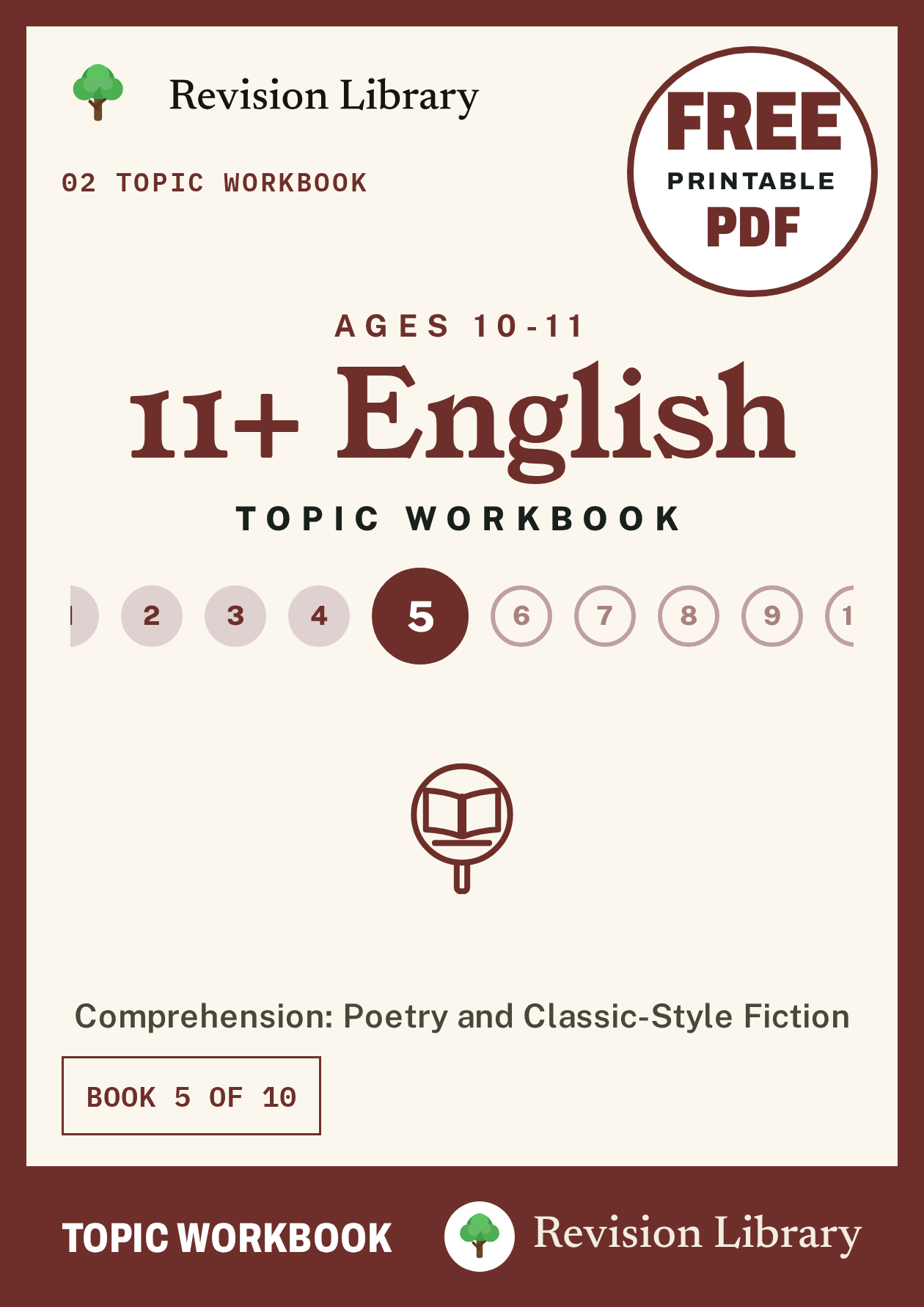
11+ English Ages 10-11 Topic Workbooks · Book 5 of 10

11+ English Ages 10-11 Topic Workbook 5

Comprehension: Poetry, Comprehension: Poetry: Practice Set 2, Comprehension: Poetry Set 2 and 7 more

Level
11+ · GL Assessment · CEM
Series
11+ English Ages 10-11 Topic Workbooks, book 5 of 10
Suitable for
Year 5-6 entrance exams
FreePDF download · 2027 edition · 115 A4 pages
  • One file, prints straight to A4
  • No account, no password

Workbooks like this one, with 10 topics, 238 questions and mark schemes at the back, are usually printed and sold by publishers. This one is one of 558 free PDFs on the shelf.

Pages
115 A4 pages
Chapters
10 worksheet chapters
Questions
238 · 518 marks
Answers
From page 84
Working time
About 8h 35m

What is inside

10 chapters · answers from p84

Each chapter starts with a page showing its marks and a suggested time, followed by the questions. The mark schemes for all 10 chapters are at the back, so the book works for homework, a timed test or revision.

  1. 01Comprehension: Poetry18 questions · 90 marks · about 90 min Topic guide: Comprehension: Poetryp3
  2. 02Comprehension: Poetry: Practice Set 218 questions · 90 marks · about 90 min Topic guide: Comprehension: Poetry: Practice Set 2p12
  3. 03Comprehension: Poetry Set 226 questions · 40 marks · about 40 min Topic guide: Comprehension: Poetry Set 2p20
  4. 04Comprehension: Poetry Set 325 questions · 46 marks · about 45 min Topic guide: Comprehension: Poetry Set 3p28
  5. 05Comprehension: Poetry Set 424 questions · 45 marks · about 45 min Topic guide: Comprehension: Poetry Set 4p36
  6. 06Comprehension: Poetry Set 526 questions · 40 marks · about 40 min Topic guide: Comprehension: Poetry Set 5p43
  7. 07Comprehension: Poetry Set 626 questions · 43 marks · about 45 min Topic guide: Comprehension: Poetry Set 6p51
  8. 08Comprehension: Poetry Set 725 questions · 42 marks · about 40 min Topic guide: Comprehension: Poetry Set 7p59
  9. 09Comprehension: Poetry Set 825 questions · 41 marks · about 40 min Topic guide: Comprehension: Poetry Set 8p67
  10. 10Comprehension: Poetry Set 925 questions · 41 marks · about 40 min Topic guide: Comprehension: Poetry Set 9p75
  11. AnswersMark schemes for every chapterp84

Each chapter is drawn from one of our worksheet packs. Follow a chapter title for the full pack on its own page, or browse every 11+ English pack. Every book on the shelf is a complete printable workbook of up to 120 A4 pages.

Explore this volume

11+ English Ages 10-11 Topic Workbook 5 includes Comprehension: Poetry (from page 3); Comprehension: Poetry: Practice Set 2 (from page 12); Comprehension: Poetry Set 2 (from page 20); Comprehension: Poetry Set 3 (from page 28); Comprehension: Poetry Set 4 (from page 36); Comprehension: Poetry Set 5 (from page 43); Comprehension: Poetry Set 6 (from page 51); Comprehension: Poetry Set 7 (from page 59); Comprehension: Poetry Set 8 (from page 67); Comprehension: Poetry Set 9 (from page 75).

Worked question 17 - Comprehension: Poetry: Practice Set 2

Open the included worksheet

Smoke and Gold

Source written for Revision Library (original, copyright-free). Original poem created for 11+ comprehension practice.

My grandmother kept six hives by the wall,

with frames all blistered gold from rim to rim,

and every August brought the ache of stings

to fingers far too young and far too slim.

She'd light the smoker, calm as evening air,

and lift each frame as gently as a book,

her veiled face steady above a thousand wings

that rose and settled, no matter how it shook.

"They only sting," she'd say, "when they're afraid,

so keep your breathing low and stay quite still;

the hive's one creature, not a swarm of parts,

and fear is caught much faster than a chill."

I did not trust her then. I told myself

however hard I tried, I could not stay still,

and thought her calm was something like a trick,

too strange to learn, a lesson far uphill.

Now every summer when the clover blooms,

I light the smoker slow the way she taught,

and stand as still as she once stood, and feel

the calm that as a child I never caught.

The hive does not reward the loud or fast;

it only asks for patience we can make;

it gives its gold to those who hold themselves

as steady as a branch that will not shake.

Discuss how the poet presents the relationship between the speaker and his grandmother in 'Smoke and Gold'. Support your response with detailed reference to language, structure and form across the whole poem.

Answer and mark scheme

Question 17

CreditAnswer or working
1-2Level 1 A simple, general comment on the relationship, with little or no textual support.
3-4Level 2 A clear response identifying aspects of the relationship, with some relevant reference to language or structure.
5-6Level 3 A detailed, well-supported discussion exploring more than one aspect of the relationship (for example the grandmother's words, the speaker's changing attitude), with well-chosen quotation.
7-8Level 4 A perceptive discussion considering how language, structure and form together shape the presentation of the relationship, with precise, well-integrated textual support.
9-10Level 5 A sophisticated, convincing discussion that explores the relationship in a nuanced way across the whole poem, evaluating how the poet's choices of language, structure and form work together, with skilfully selected and embedded evidence throughout.
  • Indicative content:
    • The grandmother is presented through calm, controlled action and direct, quoted speech (stanza 3), giving her an authoritative but reassuring voice within the poem
    • The simile 'as gently as a book' (stanza 2) suggests her deep familiarity and quiet respect for the bees, presenting her as skilled and patient
    • The relationship is presented as one of inherited skill and confidence passed down across time: the child does not initially trust or understand his grandmother's calm (stanza 4), but comes to repeat her exact actions as an adult (stanza 5)
    • The repetition of 'still' across stanzas 3 to 5 structurally embodies the passing on of calmness from grandmother to grandchild
    • The regular quatrain form and steady ABCB rhyme scheme give the whole poem a controlled, measured tone appropriate to a considered adult looking back with gratitude
    • The grandmother is not directly present in stanzas 5 and 6 (referred to only through the speaker's memory of her actions), suggesting she may no longer be alive, deepening the sense of a skill or legacy carried forward after her
    • Strong responses will consider the relationship as one of quiet, inherited confidence that deepens with time and distance rather than one that is straightforwardly close throughout

Answer: The poem presents a relationship built on quietly inherited calm: the grandmother, characterised through patient action and direct speech, is not fully trusted by the young speaker, but her example is eventually adopted and repeated in adulthood, with the recurring motif of stillness and the poem's controlled form suggesting a respectful, matured confidence that may now be tinged with loss.
Question 18 - Comprehension: Poetry: Practice Set 2

Open the included worksheet

Smoke and Gold

Source written for Revision Library (original, copyright-free). Original poem created for 11+ comprehension practice.

My grandmother kept six hives by the wall,

with frames all blistered gold from rim to rim,

and every August brought the ache of stings

to fingers far too young and far too slim.

She'd light the smoker, calm as evening air,

and lift each frame as gently as a book,

her veiled face steady above a thousand wings

that rose and settled, no matter how it shook.

"They only sting," she'd say, "when they're afraid,

so keep your breathing low and stay quite still;

the hive's one creature, not a swarm of parts,

and fear is caught much faster than a chill."

I did not trust her then. I told myself

however hard I tried, I could not stay still,

and thought her calm was something like a trick,

too strange to learn, a lesson far uphill.

Now every summer when the clover blooms,

I light the smoker slow the way she taught,

and stand as still as she once stood, and feel

the calm that as a child I never caught.

The hive does not reward the loud or fast;

it only asks for patience we can make;

it gives its gold to those who hold themselves

as steady as a branch that will not shake.

A reader said, 'This poem is really about far more than beekeeping; it is a poem about learning to trust rather than fear.' To what extent do you agree? Support your response with detailed reference to the poem's language, structure and ideas.

Answer and mark scheme

Question 18

CreditAnswer or working
1-2Level 1 A simple statement of agreement or disagreement, with little or no textual support.
3-4Level 2 A clear response with some relevant reference to language or ideas, showing basic understanding of the poem's wider meaning.
5-6Level 3 A detailed, well-supported evaluation exploring more than one aspect of the poem's wider meaning, with well-chosen quotation.
7-8Level 4 A perceptive evaluation that considers different aspects of the poem's ideas in a balanced way, with precise textual support and a considered personal judgement.
9-10Level 5 A sophisticated, convincing evaluation that engages closely with the reader's statement, weighing evidence for and against it across the whole poem, and reaches a well-supported, nuanced personal judgement.
  • Indicative content:
    • Consideration of evidence supporting the statement: the personification of the comb and hive using body-like or living language ('blistered gold', 'the hive's one creature'), the grandmother's insistence that bees only sting 'when they're afraid', and the final stanza's generalised claim that the hive rewards steadiness all point beyond a literal account of beekeeping towards ideas about trust and fear
    • Consideration of the poem's structural journey, from childhood fear to adult calm, as itself modelling the process of learning to trust rather than fear
    • A more balanced or challenging response might argue the poem stays rooted in specific, concrete, personal memory (a particular grandmother, particular hives, a particular garden wall) and that its wider meaning is suggested rather than stated outright, so readers should be cautious about treating it purely as an abstract lesson
    • Discussion of the ambiguous final phrase 'those who hold themselves' rather than a named person, which does support a reading of the poem as reaching beyond this one family towards a universal audience
    • Reward well-supported personal judgements in either direction, or nuanced positions that partly agree, provided they are backed by precise, relevant textual evidence from across the whole poem

Answer: A convincing response can agree, partly agree, or challenge the statement, provided it is supported with precise evidence; the strongest answers recognise that while the poem remains rooted in specific, personal memory, its imagery, structure and final generalised address to 'those who hold themselves' do extend its meaning towards a wider idea about learning trust rather than fear.

Question 7 - Comprehension: Poetry: Practice Set 2

Open the included worksheet

Smoke and Gold

Source written for Revision Library (original, copyright-free). Original poem created for 11+ comprehension practice.

My grandmother kept six hives by the wall,

with frames all blistered gold from rim to rim,

and every August brought the ache of stings

to fingers far too young and far too slim.

She'd light the smoker, calm as evening air,

and lift each frame as gently as a book,

her veiled face steady above a thousand wings

that rose and settled, no matter how it shook.

"They only sting," she'd say, "when they're afraid,

so keep your breathing low and stay quite still;

the hive's one creature, not a swarm of parts,

and fear is caught much faster than a chill."

I did not trust her then. I told myself

however hard I tried, I could not stay still,

and thought her calm was something like a trick,

too strange to learn, a lesson far uphill.

Now every summer when the clover blooms,

I light the smoker slow the way she taught,

and stand as still as she once stood, and feel

the calm that as a child I never caught.

The hive does not reward the loud or fast;

it only asks for patience we can make;

it gives its gold to those who hold themselves

as steady as a branch that will not shake.

The hive is used as an extended metaphor throughout the poem. Explore how the poet develops this metaphor from stanza 1 to stanza 6, and what it comes to represent by the end of the poem.

Answer and mark scheme

Question 7

CreditAnswer or working
1-2Level 1 A simple identification that the hive represents something beyond itself, with limited or no supporting reference.
3-4Level 2 A clear explanation of the hive as a metaphor, supported by relevant reference to more than one stanza.
5-6Level 3 A detailed exploration of how the metaphor develops across the poem, supported by well-chosen quotation from several stanzas.
7-8Level 4 A perceptive, well-structured exploration that traces the metaphor's development across the whole poem and considers precisely what it comes to represent, with skilfully integrated textual support.
  • Indicative content:
    • In stanza 1 the hive is introduced through physical discomfort, 'the ache of stings', suggesting something intimidating and not yet understood
    • In stanzas 2 and 3 the grandmother's calm handling of the hive and her spoken advice begin to suggest that the hive represents a set of values: calmness, trust and control over fear
    • In stanza 4 the young speaker's admission that he 'could not stay still' shows he has not yet grasped what the hive represents
    • By stanza 5 the hive's lesson is directly connected to the speaker's own achievement of calm, shown through his physical repetition of his grandmother's actions
    • In stanza 6 the hive becomes a metaphor for patience and trust more broadly, applicable beyond beekeeping to how people might earn reward or overcome fear in any area of life
    • The strongest responses will trace this development precisely stanza by stanza and offer a clear, well-supported view of what the hive ultimately represents

Answer: The hive develops from an intimidating, painful presence in stanza 1 into an extended metaphor for patience and trust, coming by stanza 6 to represent a wider truth about how calm and steadiness, rather than fear or haste, are what earn reward in any area of life.

Question 18 - Comprehension: Poetry

Open the included worksheet

Windfall

Source written for Revision Library (original, copyright-free). Original poem created for 11+ comprehension practice.

The orchard keeps its secrets in the grass,

where fallen apples bruise and slowly turn,

brown-freckled, sweet with sugar turning sharp,

too soft for baskets, too far gone to churn.

My grandfather would stoop for every one,

his old back curved like branches in the wind,

and drop them, softly, in a rusted pail,

as though each bruise were something he had sinned.

"Nothing here is waste," he'd always say,

"the wasps will have their share, the birds the rest;

and what the frost don't take, the earth will keep;

there's compost in the coldest, hardest test."

I did not understand him then. I thought

an apple bruised was just an apple spoiled,

a thing to bin, not bury, not to bless,

not worth the kneeling, worth the fingers soiled.

Now every autumn when the light turns thin,

and windfalls freckle grass with green and gold,

I kneel the way he knelt, and understand

the patience of a hand that's always cold.

The orchard does not mind the bruised, the late,

the ones that fall before the picking's done.

It only asks that someone kneel to gather

what the wind has taken from the sun.

A reader said, 'This poem is really about far more than an orchard; it is a poem about forgiving imperfection wherever we find it.' To what extent do you agree? Support your response with detailed reference to the poem's language, structure and ideas.

Answer and mark scheme

Question 18

CreditAnswer or working
1-2Level 1 A simple statement of agreement or disagreement, with little or no textual support.
3-4Level 2 A clear response with some relevant reference to language or ideas, showing basic understanding of the poem's wider meaning.
5-6Level 3 A detailed, well-supported evaluation exploring more than one aspect of the poem's wider meaning, with well-chosen quotation.
7-8Level 4 A perceptive evaluation that considers different aspects of the poem's ideas in a balanced way, with precise textual support and a considered personal judgement.
9-10Level 5 A sophisticated, convincing evaluation that engages closely with the reader's statement, weighing evidence for and against it across the whole poem, and reaches a well-supported, nuanced personal judgement.
  • Indicative content:
    • Consideration of evidence supporting the statement: the personification of the apples using human vocabulary ('freckled', 'bruise'), the grandfather's insistence that 'nothing here is waste', and the final stanza's generalised claim that the orchard 'does not mind the bruised, the late' all point beyond a literal orchard towards ideas about forgiving imperfection
    • Consideration of the poem's structural journey, from childhood dismissal to adult understanding, as itself modelling the process of learning to forgive or accept flaws over time
    • A more balanced or challenging response might argue the poem stays rooted in specific, concrete, personal memory (a particular grandfather, a particular pail, a particular orchard) and that its wider meaning is suggested rather than stated outright, so readers should be cautious about treating it purely as an abstract lesson
    • Discussion of the ambiguous ending, where 'someone' rather than a named person is asked to kneel and gather, which does support a reading of the poem as reaching beyond this one family towards a universal audience
    • Reward well-supported personal judgements in either direction, or nuanced positions that partly agree, provided they are backed by precise, relevant textual evidence from across the whole poem

Answer: A convincing response can agree, partly agree, or challenge the statement, provided it is supported with precise evidence; the strongest answers recognise that while the poem remains rooted in specific, personal memory, its imagery, structure and final generalised address to 'someone' do extend its meaning towards a wider idea about forgiving imperfection.

Question 7 - Comprehension: Poetry

Open the included worksheet

Windfall

Source written for Revision Library (original, copyright-free). Original poem created for 11+ comprehension practice.

The orchard keeps its secrets in the grass,

where fallen apples bruise and slowly turn,

brown-freckled, sweet with sugar turning sharp,

too soft for baskets, too far gone to churn.

My grandfather would stoop for every one,

his old back curved like branches in the wind,

and drop them, softly, in a rusted pail,

as though each bruise were something he had sinned.

"Nothing here is waste," he'd always say,

"the wasps will have their share, the birds the rest;

and what the frost don't take, the earth will keep;

there's compost in the coldest, hardest test."

I did not understand him then. I thought

an apple bruised was just an apple spoiled,

a thing to bin, not bury, not to bless,

not worth the kneeling, worth the fingers soiled.

Now every autumn when the light turns thin,

and windfalls freckle grass with green and gold,

I kneel the way he knelt, and understand

the patience of a hand that's always cold.

The orchard does not mind the bruised, the late,

the ones that fall before the picking's done.

It only asks that someone kneel to gather

what the wind has taken from the sun.

The orchard is used as an extended metaphor throughout the poem. Explore how the poet develops this metaphor from stanza 1 to stanza 6, and what it comes to represent by the end of the poem.

Answer and mark scheme

Question 7

CreditAnswer or working
1-2Level 1 A simple identification that the orchard represents something beyond itself, with limited or no supporting reference.
3-4Level 2 A clear explanation of the orchard as a metaphor, supported by relevant reference to more than one stanza.
5-6Level 3 A detailed exploration of how the metaphor develops across the poem, supported by well-chosen quotation from several stanzas.
7-8Level 4 A perceptive, well-structured exploration that traces the metaphor's development across the whole poem and considers precisely what it comes to represent, with skilfully integrated textual support.
  • Indicative content:
    • In stanza 1 the orchard 'keeps its secrets', introduced as something private and slightly mysterious, holding apples that seem wasted
    • In stanzas 2 and 3 the grandfather's care for the fallen fruit begins to suggest that the orchard represents a set of values, patience, respect for nature and a refusal to see anything as truly wasted
    • In stanza 4 the young speaker's dismissal of the fruit as 'spoiled' shows he has not yet grasped what the orchard represents
    • By stanza 5 the orchard's lesson is directly connected to the speaker's own understanding of patience, shown through his physical repetition of his grandfather's kneeling
    • In stanza 6 the orchard becomes a metaphor for forgiveness or acceptance of imperfection more broadly, applicable beyond the setting of an orchard to how people might treat flaws, lateness or failure in themselves and others
    • The strongest responses will trace this development precisely stanza by stanza and offer a clear, well-supported view of what the orchard ultimately represents

Answer: The orchard develops from a private, almost secretive setting in stanza 1 into an extended metaphor for patience, forgiveness and the acceptance of imperfection, coming by stanza 6 to represent a wider truth about how flawed or overlooked things, and by extension people, deserve care rather than rejection.

11+ English Ages 10-11 Topic Workbooks runs to 10 volumes

Book 5 of 10 · 846 pages in the set

Each book is a separate free PDF.

Volume 1

83 pp · 161 Qs

Comprehension: Fiction, Comprehension: Fiction: Practice Set 2, Comprehension: Fiction Set 3 and 4 more

Volume 2

87 pp · 178 Qs

Comprehension: Fiction Set 8, Comprehension: Fiction Set 9, Comprehension: Fiction Set 10 and 4 more

Volume 3

68 pp · 130 Qs

Comprehension: Non-Fiction, Comprehension: Non-Fiction: Practice Set 2, Comprehension: Non-Fiction Set 3 and 3 more

Volume 4

75 pp · 174 Qs

Comprehension: Non-Fiction Set 7, Comprehension: Non-Fiction Set 8, Comprehension: Non-Fiction Set 9 and 4 more

Volume 5 · this book

115 pp · 238 Qs

Comprehension: Poetry, Comprehension: Poetry: Practice Set 2, Comprehension: Poetry Set 2 and 7 more

Volume 6

79 pp · 144 Qs

Comprehension: Classic-Style Fiction, Comprehension: Classic Fiction Set 2, Comprehension: Classic Fiction Set 3 and 3 more

Volume 7

97 pp · 136 Qs

Comprehension: Mixed-Genre Set 1, Comprehension: Mixed-Genre Set 2, Comprehension: Mixed-Genre Set 3 and 4 more

Volume 8

78 pp · 126 Qs

Persuasive and Discursive Writing Focus, Persuasive and Discursive Writing Focus Set 2, Grammar Gap-Fill and 2 more

Volume 9

77 pp · 127 Qs

SPaG: Mixed Timed Test, SPaG Mixed Drill Set 2, Vocabulary in Context and 1 more

Volume 10

87 pp · 219 Qs

Cloze and Sentence Completion Set 2, Cloze and Sentence Completion Set 3, Cloze and Sentence Completion Set 4 and 3 more

More 11+ books

11+ English Exam Papers Set A

100 pp · 265 Qs

GL-Style English and Verbal Reasoning Mock, GL-Style English and Verbal Reasoning Mock 2, Warwickshire (GL)-Style Mixed Mock and 2 more

Want a different mix of topics?