Revision Library
Choose a subject
Menu

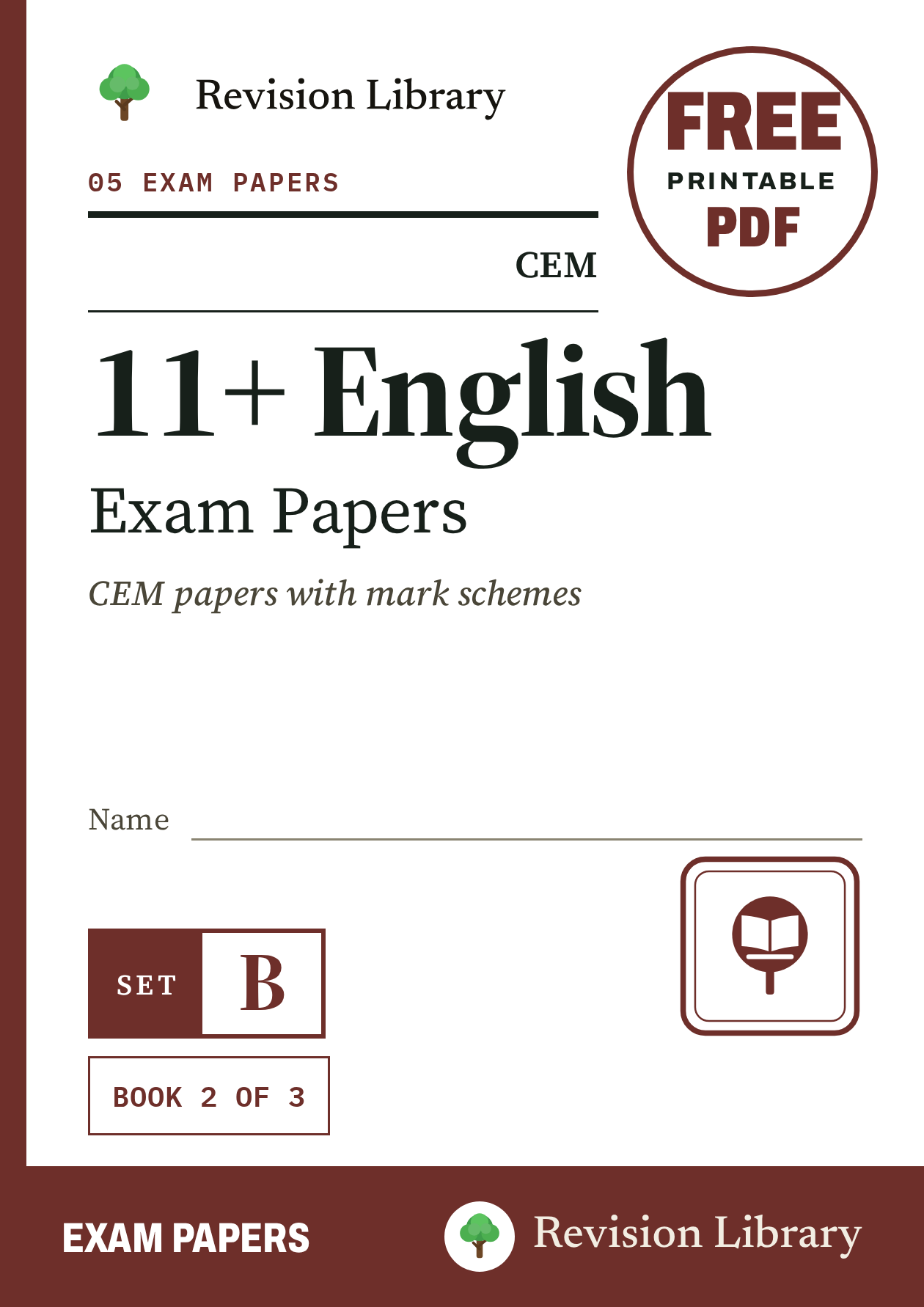
Book 2 of 3

11+ English Exam Papers Set B

CEM-Style Mixed Mock 2, CEM-Style Mixed Mock 4 and CEM-Style Mixed Mock 6

Level
11+ · CEM
Series
11+ English Exam Papers, book 2 of 3
Suitable for
Year 5-6 entrance exams
FreePDF download · 2027 edition · 62 A4 pages
  • One file, prints straight to A4
  • No account, no password

3 papers in the CEM format, timed, mark schemes at the back. This set is one of 558 free PDFs on the shelf.

Pages
62 A4 pages
Papers
3 papers
Questions
154 · 154 marks
Answers
From page 54
Working time
About 2h 19m

What is inside

3 papers · answers from p54

Each paper starts with a page showing its marks and a suggested time, followed by the questions. The mark schemes for all 3 papers are at the back, so you can sit each paper as a mock and mark it afterwards.

  1. 01CEM-Style Mixed Mock 254 questions · 54 marks · about 47 min Topic guide: CEM-Style Mixed Mock 2p3
  2. 02CEM-Style Mixed Mock 450 questions · 50 marks · about 46 min Topic guide: CEM-Style Mixed Mock 4p20
  3. 03CEM-Style Mixed Mock 650 questions · 50 marks · about 46 min Topic guide: CEM-Style Mixed Mock 6p36
  4. AnswersMark schemes for every paperp54

Each paper is drawn from one of our worksheet packs. Follow a paper title for the full pack on its own page, or browse every 11+ English pack. Every book on the shelf is a complete printable workbook of up to 120 A4 pages.

Explore this volume

11+ English Exam Papers Set B includes CEM-Style Mixed Mock 2 (from page 3); CEM-Style Mixed Mock 4 (from page 20); CEM-Style Mixed Mock 6 (from page 36).

Worked question 50 - CEM-Style Mixed Mock 6

Open the included worksheet

The Bells of St Wilfrid's

Original short story written for Revision Library; not based on any existing published work.

Zainab had walked past St Wilfrid's church every day of her life without ever wondering what went on behind its heavy oak door, until the Saturday her grandmother mentioned, almost as an afterthought while polishing a small brass handbell at the kitchen table, that she used to ring the tenor bell there as a girl. 'Every Tuesday evening, six thirty sharp,' her grandmother said. 'Best two hours of my week, they were.' She pressed the handbell into Zainab's palm before she left. 'Go along and see if you like it. Tell them Yvonne Adeyemi sent you.'

The following Tuesday, Zainab climbed the narrow spiral staircase inside the tower for the first time, her legs already aching by the fourth turn. The ringing chamber was smaller than expected: eight thick ropes hung from a hole in the ceiling, each ending in a fluffy woollen grip called a sally, and the tower captain, Mr Whitlock, a broad man who ran the bakery downstairs, greeted her with a nod towards the heaviest rope. 'That one's Old Meg,' he said. 'Cast in 1823, and she weighs more than a small car.' A boy about Zainab's own age, Connor Doyle, showed her how to grip the sally without letting it slip through her fingers.

For the first three weeks, Zainab caught nothing but her own frustration. The rope seemed to have a will of its own, snapping upward and stinging her palms whenever she pulled too hard, and twice she let go entirely, sending the sally whipping towards the ceiling while Connor ducked out of the way, laughing despite himself. Mr Whitlock never once raised his voice. 'Bell ringing isn't about strength,' he told her patiently. 'It's about listening for your moment and trusting the rope to do the rest.'

It was on one of those frustrating afternoons, resting against the tower's stone wall, that Zainab noticed something scratched into the wooden bell frame above Old Meg: three faint initials, Y.A., followed by a date almost worn away by damp. She traced the letters with her thumb, and it took her a moment to understand. Y.A. Yvonne Adeyemi. Her grandmother had stood in this exact spot, over fifty years before, learning to ring the very same bell.

Mr Whitlock announced a fortnight later that the tower would take part in the village's Midsummer Open Day, when six local towers would ring in sequence to mark the anniversary of the church's founding. Zainab's band had six weeks to learn a method called Plain Bob Doubles, a set pattern in which the ringers change places with every bell in turn until the pattern returns to where it began. Zainab was terrified; she had barely mastered ringing a single steady bell, and now a shifting pattern felt impossible.

Disaster struck four days before the open day. During a Thursday evening practice, Old Meg's rope frayed and snapped clean through, sending the sally tumbling to the floor. Without a working rope for the tenor bell, the whole method would be impossible to ring, and Mr Whitlock's face, usually so calm, creased with worry as he examined the broken strands.

There was no time to order a replacement rope from the specialist supplier before the open day, so Mr Whitlock spent the following two evenings splicing a spare length of rope by hand, teaching Zainab and Connor to help, 'so the tower is never caught out like this again.' Zainab stayed long after practice had ended, her fingers sore but her earlier nervousness slowly replaced by something closer to pride.

On the morning of the Open Day, Zainab climbed the spiral staircase with her grandmother close behind her, moving carefully but refusing all offers of help. From the ringing chamber, through the narrow slit window, Zainab could see visitors gathering in the churchyard, and for a moment her hands trembled on the newly spliced rope. Then Mr Whitlock gave the signal to begin, and the pattern of Plain Bob Doubles rang out over the village exactly as it had, Zainab realised, for centuries before her, and would, she hoped, for years after she herself had grown too old to climb the tower stairs.

According to paragraph three, what did Mr Whitlock repeatedly tell Zainab?
  • A) That she needed to pull harder each time
  • B) That bell ringing is about listening for the moment and trusting the rope, not strength
  • C) That she should give up if it felt too difficult
  • D) That only Connor could teach her properly
  • E) That the rope was too old to be used safely

Answer and mark scheme

Question 50

CreditAnswer or working
B1B) That bell ringing is about listening for the moment and trusting the rope, not strength - he says 'Bell ringing isn't about strength ... it's about listening for your moment and trusting the rope to do the rest'; (oe)
  • Answer: B

Question 48 - CEM-Style Mixed Mock 6

Open the included worksheet

The Bells of St Wilfrid's

Original short story written for Revision Library; not based on any existing published work.

Zainab had walked past St Wilfrid's church every day of her life without ever wondering what went on behind its heavy oak door, until the Saturday her grandmother mentioned, almost as an afterthought while polishing a small brass handbell at the kitchen table, that she used to ring the tenor bell there as a girl. 'Every Tuesday evening, six thirty sharp,' her grandmother said. 'Best two hours of my week, they were.' She pressed the handbell into Zainab's palm before she left. 'Go along and see if you like it. Tell them Yvonne Adeyemi sent you.'

The following Tuesday, Zainab climbed the narrow spiral staircase inside the tower for the first time, her legs already aching by the fourth turn. The ringing chamber was smaller than expected: eight thick ropes hung from a hole in the ceiling, each ending in a fluffy woollen grip called a sally, and the tower captain, Mr Whitlock, a broad man who ran the bakery downstairs, greeted her with a nod towards the heaviest rope. 'That one's Old Meg,' he said. 'Cast in 1823, and she weighs more than a small car.' A boy about Zainab's own age, Connor Doyle, showed her how to grip the sally without letting it slip through her fingers.

For the first three weeks, Zainab caught nothing but her own frustration. The rope seemed to have a will of its own, snapping upward and stinging her palms whenever she pulled too hard, and twice she let go entirely, sending the sally whipping towards the ceiling while Connor ducked out of the way, laughing despite himself. Mr Whitlock never once raised his voice. 'Bell ringing isn't about strength,' he told her patiently. 'It's about listening for your moment and trusting the rope to do the rest.'

It was on one of those frustrating afternoons, resting against the tower's stone wall, that Zainab noticed something scratched into the wooden bell frame above Old Meg: three faint initials, Y.A., followed by a date almost worn away by damp. She traced the letters with her thumb, and it took her a moment to understand. Y.A. Yvonne Adeyemi. Her grandmother had stood in this exact spot, over fifty years before, learning to ring the very same bell.

Mr Whitlock announced a fortnight later that the tower would take part in the village's Midsummer Open Day, when six local towers would ring in sequence to mark the anniversary of the church's founding. Zainab's band had six weeks to learn a method called Plain Bob Doubles, a set pattern in which the ringers change places with every bell in turn until the pattern returns to where it began. Zainab was terrified; she had barely mastered ringing a single steady bell, and now a shifting pattern felt impossible.

Disaster struck four days before the open day. During a Thursday evening practice, Old Meg's rope frayed and snapped clean through, sending the sally tumbling to the floor. Without a working rope for the tenor bell, the whole method would be impossible to ring, and Mr Whitlock's face, usually so calm, creased with worry as he examined the broken strands.

There was no time to order a replacement rope from the specialist supplier before the open day, so Mr Whitlock spent the following two evenings splicing a spare length of rope by hand, teaching Zainab and Connor to help, 'so the tower is never caught out like this again.' Zainab stayed long after practice had ended, her fingers sore but her earlier nervousness slowly replaced by something closer to pride.

On the morning of the Open Day, Zainab climbed the spiral staircase with her grandmother close behind her, moving carefully but refusing all offers of help. From the ringing chamber, through the narrow slit window, Zainab could see visitors gathering in the churchyard, and for a moment her hands trembled on the newly spliced rope. Then Mr Whitlock gave the signal to begin, and the pattern of Plain Bob Doubles rang out over the village exactly as it had, Zainab realised, for centuries before her, and would, she hoped, for years after she herself had grown too old to climb the tower stairs.

According to Mr Whitlock, in what year was Old Meg cast, and roughly how heavy is she?
  • A) Cast in 1923, heavier than a small car
  • B) Cast in 1823, about the same weight as a person
  • C) Cast in 1791, heavier than a small car
  • D) Cast in 1823, heavier than a small car
  • E) Cast in 1823, lighter than a bicycle

Answer and mark scheme

Question 48

CreditAnswer or working
B1D) Cast in 1823, heavier than a small car - Mr Whitlock says 'Cast in 1823, and she weighs more than a small car'; cao
  • Answer: D

Question 49 - CEM-Style Mixed Mock 6

Open the included worksheet

The Bells of St Wilfrid's

Original short story written for Revision Library; not based on any existing published work.

Zainab had walked past St Wilfrid's church every day of her life without ever wondering what went on behind its heavy oak door, until the Saturday her grandmother mentioned, almost as an afterthought while polishing a small brass handbell at the kitchen table, that she used to ring the tenor bell there as a girl. 'Every Tuesday evening, six thirty sharp,' her grandmother said. 'Best two hours of my week, they were.' She pressed the handbell into Zainab's palm before she left. 'Go along and see if you like it. Tell them Yvonne Adeyemi sent you.'

The following Tuesday, Zainab climbed the narrow spiral staircase inside the tower for the first time, her legs already aching by the fourth turn. The ringing chamber was smaller than expected: eight thick ropes hung from a hole in the ceiling, each ending in a fluffy woollen grip called a sally, and the tower captain, Mr Whitlock, a broad man who ran the bakery downstairs, greeted her with a nod towards the heaviest rope. 'That one's Old Meg,' he said. 'Cast in 1823, and she weighs more than a small car.' A boy about Zainab's own age, Connor Doyle, showed her how to grip the sally without letting it slip through her fingers.

For the first three weeks, Zainab caught nothing but her own frustration. The rope seemed to have a will of its own, snapping upward and stinging her palms whenever she pulled too hard, and twice she let go entirely, sending the sally whipping towards the ceiling while Connor ducked out of the way, laughing despite himself. Mr Whitlock never once raised his voice. 'Bell ringing isn't about strength,' he told her patiently. 'It's about listening for your moment and trusting the rope to do the rest.'

It was on one of those frustrating afternoons, resting against the tower's stone wall, that Zainab noticed something scratched into the wooden bell frame above Old Meg: three faint initials, Y.A., followed by a date almost worn away by damp. She traced the letters with her thumb, and it took her a moment to understand. Y.A. Yvonne Adeyemi. Her grandmother had stood in this exact spot, over fifty years before, learning to ring the very same bell.

Mr Whitlock announced a fortnight later that the tower would take part in the village's Midsummer Open Day, when six local towers would ring in sequence to mark the anniversary of the church's founding. Zainab's band had six weeks to learn a method called Plain Bob Doubles, a set pattern in which the ringers change places with every bell in turn until the pattern returns to where it began. Zainab was terrified; she had barely mastered ringing a single steady bell, and now a shifting pattern felt impossible.

Disaster struck four days before the open day. During a Thursday evening practice, Old Meg's rope frayed and snapped clean through, sending the sally tumbling to the floor. Without a working rope for the tenor bell, the whole method would be impossible to ring, and Mr Whitlock's face, usually so calm, creased with worry as he examined the broken strands.

There was no time to order a replacement rope from the specialist supplier before the open day, so Mr Whitlock spent the following two evenings splicing a spare length of rope by hand, teaching Zainab and Connor to help, 'so the tower is never caught out like this again.' Zainab stayed long after practice had ended, her fingers sore but her earlier nervousness slowly replaced by something closer to pride.

On the morning of the Open Day, Zainab climbed the spiral staircase with her grandmother close behind her, moving carefully but refusing all offers of help. From the ringing chamber, through the narrow slit window, Zainab could see visitors gathering in the churchyard, and for a moment her hands trembled on the newly spliced rope. Then Mr Whitlock gave the signal to begin, and the pattern of Plain Bob Doubles rang out over the village exactly as it had, Zainab realised, for centuries before her, and would, she hoped, for years after she herself had grown too old to climb the tower stairs.

Why did Zainab struggle during her first three weeks of practice?
  • A) Mr Whitlock was often absent from practice
  • B) Connor refused to help her
  • C) She could not find the ringing chamber
  • D) She was afraid of heights in the tower
  • E) She pulled the rope too hard and could not control it

Answer and mark scheme

Question 49

CreditAnswer or working
B1E) She pulled the rope too hard and could not control it - the passage explains the rope kept 'snapping upward and stinging her palms whenever she pulled too hard'; (oe)
  • Answer: E

Question 52 - CEM-Style Mixed Mock 2

Open the included worksheet

The Locked Shed on Chestnut Lane

Original short story written for Revision Library; not based on any existing published work.

Every Saturday morning, without fail, Priya Chandra walked the length of Chestnut Lane with her grandfather, Bimal, until they reached the row of allotments behind the old chapel. Most of the thirty plots were neat rectangles of runner beans, potatoes and marrows, tended by neighbours who nodded and called out greetings as Priya passed. Plot Nineteen, though, was different. Waist-high grass had swallowed the paths, brambles had knitted themselves across the gate, and at the very back, half hidden by an overgrown apple tree, stood a small wooden shed with a rusted padlock that nobody, as far as Priya knew, had opened in years.

'Whose plot is that?' Priya asked one frosty morning, her breath clouding in the air. Bimal set down his trowel and looked towards the shed for a long moment before answering. 'That was Mr. Whitfield's,' he said. 'Arthur Whitfield. He kept that plot for over forty years, longer than anyone else on this lane. When he passed away, nobody came forward to claim it, and nobody could find a key to that shed. The committee talked about knocking it down more than once, but somehow it always got left for another year.' There was something in her grandfather's voice, a note of quiet respect, that made Priya want to know more.

That afternoon, Priya persuaded her friend Callum, who lived two doors down, to come and look at the shed with her. The padlock was solid with rust, far too stubborn to force open with the stick Callum had found, so instead they spent the afternoon dragging brambles away from the path and pulling up fistfuls of choking grass, until their palms were scratched raw and their knees were caked in mud. It was tedious, unglamorous work, and more than once Priya was tempted to give up, but something about clearing a space that had been forgotten for so long felt important, even if she could not have explained exactly why.

It was Callum who found the tin. Wedged beneath a loose paving stone near the shed's foundations, half buried in soil, sat a battered biscuit tin, its lid sealed shut with age. Priya prised it open with trembling fingers, half expecting nothing more than rusted nails or old seed packets. Instead, inside, carefully wrapped in a sheet of brittle greaseproof paper, lay a stack of hand-drawn charts, each one dated and filled with neat, spidery handwriting, and a single faded photograph of a heron standing in shallow water.

Bimal's eyes widened when Priya showed him what they had found. He explained, turning the charts over slowly, that Arthur Whitfield had been a devoted birdwatcher, recording every species that visited the allotments across three decades, long before anyone thought to call it citizen science. The shed, it turned out, had never been a mystery worth fearing; it had simply held the quiet, patient record of one man's lifelong hobby, a hobby nobody else on the lane had ever fully known about. 'He never made a fuss about it,' Bimal said softly. 'He just kept watching, year after year, and wrote it all down.'

By the following spring, Plot Nineteen looked entirely different. The allotment committee, moved by Priya's discovery, agreed to turn the overgrown corner into a small wildlife garden, with a new noticeboard beside the shed displaying photocopies of Arthur Whitfield's original charts. Priya took to visiting most weekends with a notebook of her own, jotting down whatever birds she spotted among the brambles and the apple tree, quietly continuing a record that had very nearly been lost forever. She never did discover what had happened to the original key, but she had come to think that perhaps it did not matter nearly as much as what the shed had been protecting all along.

Why does Priya feel tempted to give up while clearing the brambles in paragraph 3?
  • A) Because Callum refuses to help her
  • B) Because the work is described as tedious and physically uncomfortable, with no immediate reward
  • C) Because Bimal tells her to stop
  • D) Because it begins to rain heavily
  • E) Because she injures herself badly and cannot continue

Answer and mark scheme

Question 52

CreditAnswer or working
B1B) Because the work is described as tedious and physically uncomfortable, with no immediate reward - it is called 'tedious, unglamorous work' and leaves her hands 'scratched raw' (oe)
  • Answer: B

Question 53 - CEM-Style Mixed Mock 2

Open the included worksheet

The Locked Shed on Chestnut Lane

Original short story written for Revision Library; not based on any existing published work.

Every Saturday morning, without fail, Priya Chandra walked the length of Chestnut Lane with her grandfather, Bimal, until they reached the row of allotments behind the old chapel. Most of the thirty plots were neat rectangles of runner beans, potatoes and marrows, tended by neighbours who nodded and called out greetings as Priya passed. Plot Nineteen, though, was different. Waist-high grass had swallowed the paths, brambles had knitted themselves across the gate, and at the very back, half hidden by an overgrown apple tree, stood a small wooden shed with a rusted padlock that nobody, as far as Priya knew, had opened in years.

'Whose plot is that?' Priya asked one frosty morning, her breath clouding in the air. Bimal set down his trowel and looked towards the shed for a long moment before answering. 'That was Mr. Whitfield's,' he said. 'Arthur Whitfield. He kept that plot for over forty years, longer than anyone else on this lane. When he passed away, nobody came forward to claim it, and nobody could find a key to that shed. The committee talked about knocking it down more than once, but somehow it always got left for another year.' There was something in her grandfather's voice, a note of quiet respect, that made Priya want to know more.

That afternoon, Priya persuaded her friend Callum, who lived two doors down, to come and look at the shed with her. The padlock was solid with rust, far too stubborn to force open with the stick Callum had found, so instead they spent the afternoon dragging brambles away from the path and pulling up fistfuls of choking grass, until their palms were scratched raw and their knees were caked in mud. It was tedious, unglamorous work, and more than once Priya was tempted to give up, but something about clearing a space that had been forgotten for so long felt important, even if she could not have explained exactly why.

It was Callum who found the tin. Wedged beneath a loose paving stone near the shed's foundations, half buried in soil, sat a battered biscuit tin, its lid sealed shut with age. Priya prised it open with trembling fingers, half expecting nothing more than rusted nails or old seed packets. Instead, inside, carefully wrapped in a sheet of brittle greaseproof paper, lay a stack of hand-drawn charts, each one dated and filled with neat, spidery handwriting, and a single faded photograph of a heron standing in shallow water.

Bimal's eyes widened when Priya showed him what they had found. He explained, turning the charts over slowly, that Arthur Whitfield had been a devoted birdwatcher, recording every species that visited the allotments across three decades, long before anyone thought to call it citizen science. The shed, it turned out, had never been a mystery worth fearing; it had simply held the quiet, patient record of one man's lifelong hobby, a hobby nobody else on the lane had ever fully known about. 'He never made a fuss about it,' Bimal said softly. 'He just kept watching, year after year, and wrote it all down.'

By the following spring, Plot Nineteen looked entirely different. The allotment committee, moved by Priya's discovery, agreed to turn the overgrown corner into a small wildlife garden, with a new noticeboard beside the shed displaying photocopies of Arthur Whitfield's original charts. Priya took to visiting most weekends with a notebook of her own, jotting down whatever birds she spotted among the brambles and the apple tree, quietly continuing a record that had very nearly been lost forever. She never did discover what had happened to the original key, but she had come to think that perhaps it did not matter nearly as much as what the shed had been protecting all along.

What does Bimal's comment 'He never made a fuss about it' suggest about Arthur Whitfield's character?
  • A) He was boastful and enjoyed attention
  • B) He was humble and did not seek recognition for his hobby
  • C) He disliked birdwatching but did it anyway
  • D) He was often rude to his neighbours
  • E) He was careless with his belongings

Answer and mark scheme

Question 53

CreditAnswer or working
B1B) He was humble and did not seek recognition for his hobby - keeping thirty years of careful records privately, without 'a fuss', suggests quiet modesty (oe)
  • Answer: B

11+ English Exam Papers runs to 3 volumes

Book 2 of 3 · 258 pages in the set

Each set is a separate free PDF with its own mark schemes at the back.

Volume 1

100 pp · 265 Qs

GL-Style English and Verbal Reasoning Mock, GL-Style English and Verbal Reasoning Mock 2, Warwickshire (GL)-Style Mixed Mock and 2 more

Volume 2 · this book

62 pp · 154 Qs

CEM-Style Mixed Mock 2, CEM-Style Mixed Mock 4 and CEM-Style Mixed Mock 6

Volume 3

96 pp · 150 Qs

CSSE-Style English Mock (Essex), CSSE-Style English Mock 2 (Essex), CSSE-Style English Mock 3 (Essex) and 4 more

More 11+ books

Want a different mix of topics?