Revision Library
Choose a subject
Menu

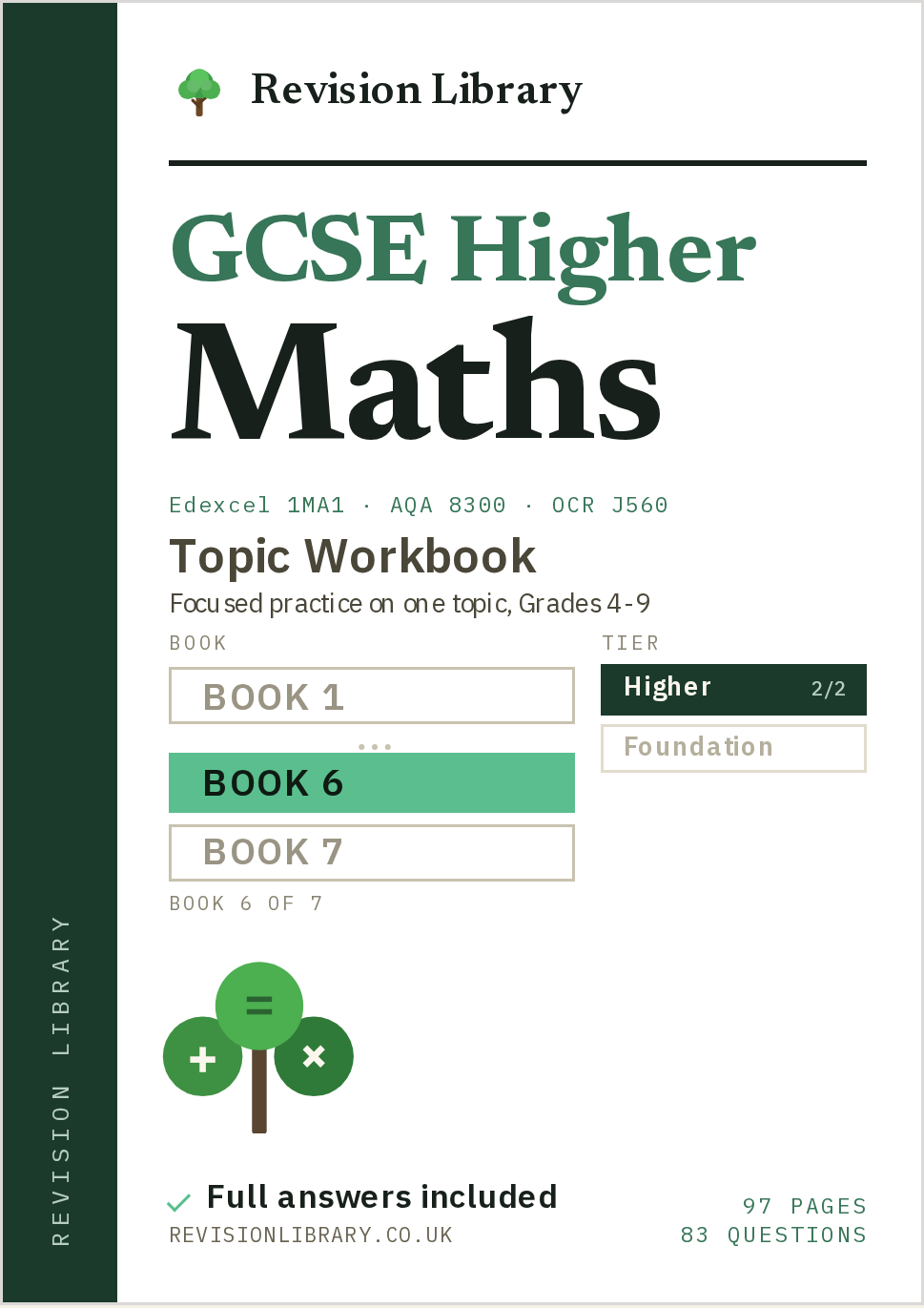
GCSE Maths Higher Topic Workbooks · Book 6 of 7

GCSE Maths Higher Topic Workbook 6

The Cosine Rule, Congruent Triangles, 3d Pythagoras and Trigonometry and 3 more

Level
GCSE Higher · Edexcel 1MA1 · AQA 8300 · OCR J560
Series
GCSE Maths Higher Topic Workbooks, book 6 of 7
Suitable for
Years 10-11, AQA / Edexcel / OCR

Higher tier is where most students lose marks on method rather than on the final answer. These volumes keep the mark scheme for every exam-style question, broken down line by line, so you can see which step earned which mark and where your own working stopped short.

FreePDF download · 2027 edition · 97 A4 pages
  • One file, prints straight to A4
  • No account, no password

Workbooks like this one, with 6 topics, 83 questions and mark schemes at the back, are usually printed and sold by publishers. This one is one of 558 free PDFs on the shelf.

Pages
97 A4 pages
Chapters
6 worksheet chapters
Questions
83 · 405 marks
Answers
From page 86
Working time
About 8h 30m

What is inside

6 chapters · answers from p86

Each chapter starts with a page showing its marks and a suggested time, followed by the questions. The mark schemes for all 6 chapters are at the back, so the book works for homework, a timed test or revision.

  1. 01The Cosine Rule14 questions · 58 marks · about 75 min Topic guide: The Cosine Rulep3
  2. 02Congruent Triangles13 questions · 61 marks · about 75 min Topic guide: Congruent Trianglesp17
  3. 033d Pythagoras and Trigonometry13 questions · 69 marks · about 85 min Topic guide: 3d Pythagoras and Trigonometryp31
  4. 04Proof of the Circle Theorems15 questions · 74 marks · about 95 min Topic guide: Proof of the Circle Theoremsp46
  5. 05Perpendicular Lines and the equation of a tangent15 questions · 74 marks · about 95 min Topic guide: Perpendicular Lines and the equation of a tangentp62
  6. 06Vectors Proof Questions13 questions · 69 marks · about 85 min Topic guide: Vectors Proof Questionsp71
  7. AnswersMark schemes for every chapterp86

Each chapter is drawn from one of our worksheet packs. Follow a chapter title for the full pack on its own page, or browse every GCSE Maths pack. Every book on the shelf is a complete printable workbook of up to 120 A4 pages.

Explore this volume

GCSE Maths Higher Topic Workbook 6 includes The Cosine Rule (from page 3); Congruent Triangles (from page 17); 3d Pythagoras and Trigonometry (from page 31); Proof of the Circle Theorems (from page 46); Perpendicular Lines and the equation of a tangent (from page 62); Vectors Proof Questions (from page 71).

Worked question 12 - Proof of the Circle Theorems

Open the included worksheet

Prove that the angle at the centre of a circle is twice the angle at the circumference, when both angles are subtended by the same arc. Use a clearly labelled diagram and full geometric reasoning in your answer.
Diagram NOT accurately drawn
OABCD

Answer and mark scheme

Question 12

CreditAnswer or working
B1states OA = OB = OC (all radii of the circle), so triangles OAC and OBC are isosceles
B1lets angle OAC = angle OCA and angle OBC = angle OCB (base angles of isosceles triangles)
M1uses the exterior angle of a triangle = sum of the two interior opposite angles to write angle AOD = angle OAC + angle OCA = 2 x angle OCA, and similarly angle BOD = 2 x angle OCB
M1combines angle AOB = angle AOD + angle BOD (using the configuration with D on the minor arc AB between the rays OA and OB, opposite C)
C1concludes angle AOB = 2 x angle OCA + 2 x angle OCB = 2(angle OCA + angle OCB) = 2 x angle ACB, as required; fully correct and complete chain of reasoning shown
  • Answer: Proved: angle AOB = 2 x angle ACB
Question 15 - Proof of the Circle Theorems

Open the included worksheet

TAS is a tangent to a circle at point A. AB is a chord, and C is a point on the major arc (the alternate segment relative to the tangent-chord angle at A).
Diagram NOT accurately drawn
OABCDTS
(a)Prove that angle BAT (the angle between the tangent and the chord) equals angle ACB (the angle in the alternate segment). This is known as the alternate segment theorem.(5)
(b)Hence, in a different circle, the angle between a tangent and a chord is 63 degrees. Write down the size of the angle in the alternate segment.(1)

Answer and mark scheme

Question 15

CreditAnswer or working
B1(a) draws diameter AD through the centre O, and states angle ABD = 90 degrees (angle in a semicircle)
B1(a) states angle DAT = 90 degrees (tangent perpendicular to the diameter at A), so angle DAB = 90 - angle BAT
M1(a) uses the angle sum of triangle ABD: angle ADB = 180 - 90 - angle DAB
A1(a) substitutes to get angle ADB = 90 - (90 - angle BAT) = angle BAT (oe correct algebra)
C1(a) states angle ADB = angle ACB (angles in the same segment, both subtended by arc AB from the major arc), so angle ACB = angle BAT, as required
B1(b) 63 degrees
  • (a) Answer: Proved: angle ACB = angle BAT
  • (b) Answer: 63 degrees

Question 14 - Proof of the Circle Theorems

Open the included worksheet

ABCD is a cyclic quadrilateral, with vertices in order around a circle with centre O. Prove that angle ABC + angle ADC = 180 degrees.
Diagram NOT accurately drawn
A B C D O

Answer and mark scheme

Question 14

CreditAnswer or working
B1states the reflex angle AOC = 2 x angle ABC (angle at the centre is twice the angle at the circumference, both standing on arc ADC)
B1states the non-reflex angle AOC = 2 x angle ADC (angle at the centre is twice the angle at the circumference, both standing on arc ABC)
M1uses angles around a point: reflex angle AOC + non-reflex angle AOC = 360
M1substitutes to get 2 x angle ABC + 2 x angle ADC = 360
C1divides by 2 to conclude angle ABC + angle ADC = 180 degrees, as required
  • Answer: Proved: angle ABC + angle ADC = 180 degrees

Question 10 - Perpendicular Lines and the equation of a tangent

Open the included worksheet

A circle with centre O, the origin, has equation x2 + y2 = 100
The tangent to the circle at the point P(6, 8) crosses the x-axis at point A and crosses the y-axis at point B.
Diagram NOT accurately drawn
x y 10 -10 10 -10 x² + y² = 100 O P(6, 8) A B
(a)Find the equation of the tangent to the circle at P.(3)
(b)Find the coordinates of A.(1)
(c)Find the coordinates of B.(1)
(d)Calculate the area of triangle OAB, where O is the origin. Give your answer as an exact fraction or correct to 3 significant figures.(3)

Answer and mark scheme

Question 10

CreditAnswer or working
M1(a) gradient of OP = 8/6 = 4/3, so tangent gradient = -3/4
M1(a) correct method using point P, e.g. y - 8 = -(3/4)(x - 6)
A1(a) y = -(3/4)x + 12.5 (oe, e.g. 3x + 4y = 50) (cao)
A1(b) (50/3, 0) (oe awrt (16.7, 0)), ft their part (a)
A1(c) (0, 12.5) (oe (0, 25/2)), ft their part (a)
M1(d) recognises that OA and OB are perpendicular (along the axes), so area = (1/2) x OA x OB
M1(d) substitutes their values, e.g. (1/2) x (50/3) x 12.5
A1(d) 625/6 (oe awrt 104) square units, ft their parts (b) and (c)
  • (a) Answer: y = -(3/4)x + 12.5
  • (b) Answer: A = (50/3, 0)
  • (c) Answer: B = (0, 12.5)
  • (d) Answer: Area = 625/6 square units (awrt 104 square units)

Question 15 - Perpendicular Lines and the equation of a tangent

Open the included worksheet

A circle with centre O, the origin, has equation x2 + y2 = 169
The line with equation 5x + 12y = 169 is a tangent to this circle.
Show that the point of contact of the tangent with the circle is (5, 12).

Answer and mark scheme

Question 15

CreditAnswer or working
B1checks 52 + 122 = 169, so (5, 12) lies on the circle
B1checks 5(5) + 12(12) = 169, so (5, 12) lies on the tangent line
M1checks perpendicularity: gradient of the radius to (5, 12) is 12/5, and the gradient of the line 5x + 12y = 169 is -5/12, and (12/5) x (-5/12) = -1
C1correct conclusion: (5, 12) lies on both the circle and the line, and the radius to this point is perpendicular to the line, so (5, 12) must be the point of contact (cso)
  • Answer: (5, 12) is the point of contact (shown)

Question 11 - Vectors Proof Questions

Open the included worksheet

OAB is a triangle with OA = a and OB = b. M is the midpoint of OA. N is the point on OB extended beyond B such that OB = BN. P is the point on AB such that AP:PB = 2:1.
Diagram NOT accurately drawn
OABabMPN21
(a)Find OM in terms of a.(1)
(b)Find ON in terms of b.(1)
(c)Find OP in terms of a and b.(2)
(d)Prove that M, P and N lie on a straight line.(3)
(e)Find the ratio MP:PN.(1)

Answer and mark scheme

Question 11

CreditAnswer or working
B1(a) (1/2)a (oe) (cao)
B1(b) 2b (oe) (cao)
M1(c) AP = (2/3)(b - a), and OP = OA + AP
A1(c) (1/3)a + (2/3)b (oe) (cao)
M1(d) finds MP = OP - OM = -(1/6)a + (2/3)b (ft their parts (a) and (c))
M1(d) finds MN = ON - OM = -(1/2)a + 2b (ft their parts (a) and (b))
A1(d) MN = 3 x MP (since -(1/2) = 3 x -(1/6) and 2 = 3 x (2/3)), so MN is a scalar multiple of MP, and since M is a common point, M, P and N are collinear (cso)
B1(e) 1:2 (cao) (ft their part (d))
  • (a) Answer: OM = (1/2)a
  • (b) Answer: ON = 2b
  • (c) Answer: OP = (1/3)a + (2/3)b
  • (d) Answer: M, P and N are collinear (MN = 3MP)
  • (e) Answer: MP:PN = 1:2

Question 13 - Vectors Proof Questions

Open the included worksheet

O, A, B and C are four points such that OA = a, OB = b and OC = c. P, Q, R and S are the midpoints of OA, AB, BC and CO respectively.
Diagram NOT accurately drawn
OABCPQRS
(a)Find OP in terms of a.(1)
(b)Find OQ in terms of a and b.(1)
(c)Show that PQ = (1/2)b.(2)
(d)Find OS and OR, and hence show that SR = (1/2)b.(2)
(e)Hence prove that PQRS is a parallelogram.(1)

Answer and mark scheme

Question 13

CreditAnswer or working
B1(a) (1/2)a (oe) (cao)
B1(b) (1/2)(a + b) (oe) (cao)
M1(c) PQ = OQ - OP = (1/2)(a+b) - (1/2)a (ft their parts (a) and (b))
A1(c) correctly simplifies to (1/2)b (cso)
M1(d) OS = (1/2)c (S is the midpoint of CO) and OR = (1/2)(b+c) (R is the midpoint of BC)
A1(d) SR = OR - OS = (1/2)b (cso)
B1(e) PQ = SR = (1/2)b, so PQ is parallel and equal to SR, therefore PQRS is a parallelogram (cso, ft their parts (c) and (d))
  • (a) Answer: OP = (1/2)a
  • (b) Answer: OQ = (1/2)(a + b)
  • (c) Answer: PQ = (1/2)b
  • (d) Answer: OS = (1/2)c, OR = (1/2)(b+c), SR = (1/2)b
  • (e) Answer: PQRS is a parallelogram, since PQ = SR = (1/2)b

GCSE Maths Higher Topic Workbooks runs to 7 volumes

Book 6 of 7 · 759 pages in the set

Each book is a separate free PDF.

Volume 1

112 pp · 174 Qs

Reverse Percentages, Standard Form, Recurring Decimals to Fractions and 8 more

Volume 2

112 pp · 154 Qs

Drawing Other Graphs: Cubic/Reciprocal, Simultaneous Equations, Solving Simultaneous Equations Graphically and 7 more

Volume 3

111 pp · 194 Qs

Algebraic Fractions, Rearranging Harder Formulae, Trigonometric and Exponential Graphs and 8 more

Volume 4

112 pp · 139 Qs

Writing a Ratio as a Fraction or Linear Function, Direct and Inverse Proportion, Speed and Density and 6 more

Volume 5

114 pp · 119 Qs

SOHCAHTOA (Trigonometry), Exact trig values, Vectors and 5 more

Volume 6 · this book

97 pp · 83 Qs

The Cosine Rule, Congruent Triangles, 3d Pythagoras and Trigonometry and 3 more

Volume 7

101 pp · 103 Qs

Probability Trees, Venn Diagrams, Conditional Probability and 5 more

More GCSE Higher books

Want a different mix of topics?

Sitting an exam soon? Build a GCSE Maths mock paper or print a ready-made one.