The cosine rule links all three sides of a triangle with one of its angles: a2 = b2 + c2 - 2bc x cosA, where a is the side opposite angle A. It is used on GCSE Higher papers to find a missing side when two sides and the angle between them (SAS) are known, or a missing angle when all three sides (SSS) are known.
Decide whether you have SAS (two sides and the included angle) to find the third side, or SSS (all three sides) to find an angle.
For a missing side, substitute into a2 = b2 + c2 - 2bc x cosA, using the two known sides as b and c and the angle between them as A, then square root the result.
For a missing angle, rearrange to cosA = (b2 + c2 - a2) / (2bc), where a is the side opposite the angle you want, then take inverse cosine.
Work out the value inside the brackets first, then divide by 2bc before taking the inverse cosine, to avoid rounding errors.
A negative value of cosA means the angle is obtuse (greater than 90 degrees); the calculator's inverse cosine gives the correct obtuse angle directly.
Round the final answer to the accuracy given, including the correct units for a length or degrees for an angle.
Worked example
In triangle ABC, AB = 11 cm, BC = 8 cm and angle ABC = 65 degrees. Calculate the length of AC, giving your answer correct to 3 significant figures.
Identify the two known sides AB = 11 cm and BC = 8 cm, and the included angle ABC = 65 degrees (SAS).
Substitute into AC2 = 112 + 82 - 2 x 11 x 8 x cos65.
Calculate 112 + 82 = 185, and 2 x 11 x 8 = 176.
Calculate cos65 = 0.4226, so AC2 = 185 - (176 x 0.4226) = 185 - 74.38 = 110.62.
Square root to find AC = √110.62 = 10.5176..., then round to 3 significant figures: AC = 10.5 cm (3 sf).
Revision Library
revisionlibrary.co.uk
HIGHER
7.13 The Cosine Rule
EDEXCEL 1MA1 · Calculator allowed · about 230 minutes
Revision Library original resource, written for Edexcel 1MA1 (Higher tier)
The cosine rule connects the three sides of a triangle with one of its angles. For a triangle with sides a, b and c, and angle A opposite side a:
a^2 = b^2 + c^2 - 2*b*c*cos(A)
Rearranged to find an angle when all three sides are known:
cos(A) = (b^2 + c^2 - a^2) / (2*b*c)
Use the cosine rule whenever you know two sides and the included angle (to find the third side), or all three sides (to find any angle). A calculator is allowed and expected throughout; give lengths correct to 3 significant figures and angles correct to 1 decimal place unless told otherwise. Questions 1 to 14 build fluency with the rule in both directions. Questions 38, 39, 42, 43, 44 and 45 apply it to exam-style problems, including bearings, perimeters, a combined area calculation, a two-triangle quadrilateral problem and an algebraic setup. The final two questions are grade 9 stretch problems requiring an exact surd answer and multi-step reasoning.
1
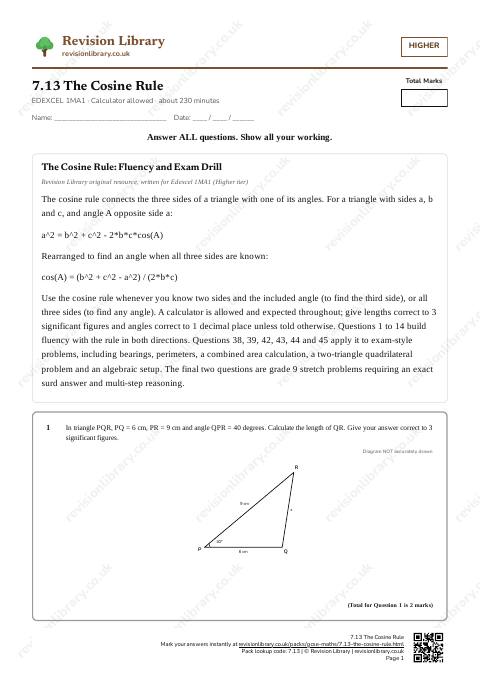
In triangle PQR, PQ = 6 cm, PR = 9 cm and angle QPR = 40 degrees. Calculate the length of QR. Give your answer correct to 3 significant figures.
Diagram NOT accurately drawn
(Total for Question 1 is 2 marks)
2
In triangle PQR, PQ = 5 cm, PR = 8 cm and angle QPR = 120 degrees. Work out the length of QR. Give your answer correct to 3 significant figures.
Diagram NOT accurately drawn
(Total for Question 2 is 2 marks)
3
Triangle ABC has AB = 10 cm, AC = 10 cm and angle BAC = 60 degrees. Calculate the length of BC, then state (with a reason) what type of triangle ABC is.
Diagram NOT accurately drawn
(Total for Question 3 is 3 marks)
4
In triangle PQR, PQ = 8 cm, PR = 6 cm and angle QPR = 70 degrees. Calculate the length of QR. Give your answer correct to 3 significant figures.
Diagram NOT accurately drawn
(Total for Question 4 is 3 marks)
5
In triangle ABC, AB = 9 cm, BC = 7 cm and CA = 5 cm. Calculate the size of angle C. Give your answer correct to 1 decimal place.
Diagram NOT accurately drawn
(Total for Question 5 is 3 marks)
6
A triangular garden plot has two sides of length 15 m and 22 m, with an angle of 58 degrees between them.
Diagram NOT accurately drawn
(a)Calculate the length of the third side of the plot. Give your answer correct to 3 significant figures.(3)
(b)A fence is to be built along this third side, costing £8.50 per metre. Using your unrounded answer to part (a), work out the total cost of the fence. Give your answer to the nearest penny.(2)
(Total for Question 6 is 5 marks)
7
Fatima is fencing a triangular flower bed in her garden. Two of the sides measure 1.5 m and 2.3 m, with an angle of 48 degrees between them. Calculate the length of the third side. Give your answer correct to 3 significant figures.
Diagram NOT accurately drawn
(Total for Question 7 is 2 marks)
8
Triangle ABC is isosceles with AB = AC = 14 cm and angle BAC = 100 degrees. Work out the length of BC. Give your answer correct to 3 significant figures.
Diagram NOT accurately drawn
(Total for Question 8 is 2 marks)
9
A roof truss has two struts of length 3.6 m and 5.1 m, meeting at an angle of 130 degrees. Work out the length of the third side of the triangular truss. Give your answer correct to 3 significant figures.
Diagram NOT accurately drawn
(Total for Question 9 is 2 marks)
10
A triangle has sides of length 7 cm, 9 cm and 13 cm. Calculate the size of the largest angle in the triangle. Give your answer correct to 1 decimal place.
Diagram NOT accurately drawn
(Total for Question 10 is 3 marks)
11
In triangle XYZ, XY = 4.2 cm, XZ = 6.7 cm and angle YXZ = 75 degrees. Work out the length of YZ. Give your answer correct to 3 significant figures.
Diagram NOT accurately drawn
(Total for Question 11 is 2 marks)
12
In triangle PQR, PQ = 9 cm, PR = 11 cm and angle QPR = 15 degrees. Calculate the length of QR. Give your answer correct to 3 significant figures.
Diagram NOT accurately drawn
(Total for Question 12 is 2 marks)
13
Three towns X, Y and Z are positioned so that XY = 11 km, YZ = 14 km and XZ = 19 km. Calculate the size of angle XYZ. Give your answer correct to 1 decimal place.
Diagram NOT accurately drawn
(Total for Question 13 is 3 marks)
14
ABCD is a parallelogram with AB = 9 cm, BC = 13 cm and angle ABC = 55 degrees. Calculate the length of the diagonal AC. Give your answer correct to 3 significant figures.
Diagram NOT accurately drawn
(Total for Question 14 is 3 marks)
15
A yacht race course is a triangle with buoys X, Y and Z, where XY = 4.2 km, YZ = 3.6 km and angle XYZ = 115 degrees.
Diagram NOT accurately drawn
(a)Calculate the length XZ. Give your answer correct to 3 significant figures.(3)
(b)The race requires sailing around the course (X to Y to Z to X) twice. Using your unrounded answer to part (a), work out the total distance sailed. Give your answer correct to 3 significant figures.(2)
(Total for Question 15 is 5 marks)
16
The diagram shows quadrilateral ABCD, made up of triangle ABC and triangle ACD joined along the diagonal AC. In triangle ABC, AB = 25 m, BC = 18 m and angle ABC = 112 degrees. In triangle ACD, AD = 22 m and DC = 24 m.
Diagram NOT accurately drawn
(a)Calculate the length of AC. Give your answer correct to 3 significant figures.(3)
(b)Using your unrounded answer to part (a), calculate the size of angle ADC. Give your answer correct to 1 decimal place.(3)
(Total for Question 16 is 6 marks)
17
In triangle XYZ, YZ = 8.1 cm, XZ = 4.1 cm and XY = 8 cm. Work out the size of angle YXZ. Give your answer correct to 1 decimal place.
Diagram NOT accurately drawn
(Total for Question 17 is 3 marks)
18
In triangle ABC, BC = 9 cm, AC = 10 cm and AB = 8 cm. Work out the exact value of cos A. Give your answer as a fraction in its simplest form.
Diagram NOT accurately drawn
(Total for Question 18 is 3 marks)
19
The sides of a triangle are 11.7 cm, 15.3 cm and 17.2 cm. Work out the size of the largest angle in the triangle. Give your answer correct to 1 decimal place.
Diagram NOT accurately drawn
(Total for Question 19 is 3 marks)
20
In triangle ABC, BC = 6 cm, AC = 8 cm and AB = 7 cm. Work out the exact value of cos A. Give your answer as a fraction in its simplest form.
Diagram NOT accurately drawn
(Total for Question 20 is 3 marks)
21
In triangle ABC, AC = 12.9 cm, AB = 5.7 cm and angle BAC = 71 degrees. Work out the length of BC. Give your answer correct to 3 significant figures.
Diagram NOT accurately drawn
(Total for Question 21 is 3 marks)
22
Two ships leave port P at the same time. Ship A sails 7 km on a bearing of 034 degrees. Ship B sails 11.8 km on a bearing of 146 degrees. Work out the distance between the two ships. Give your answer correct to 3 significant figures.
Diagram NOT accurately drawn
(Total for Question 22 is 4 marks)
23
In triangle ABC, BC = 4 cm, AC = 17.1 cm and AB = 15.6 cm. Work out the size of angle BAC. Give your answer correct to 1 decimal place.
Diagram NOT accurately drawn
(Total for Question 23 is 3 marks)
24
In triangle ABC, BC = 12 cm, AC = 9 cm and AB = 11 cm. Work out the exact value of cos A. Give your answer as a fraction in its simplest form.
Diagram NOT accurately drawn
(Total for Question 24 is 3 marks)
25
Two ships leave port P at the same time. Ship A sails 17.1 km on a bearing of 005 degrees. Ship B sails 26 km on a bearing of 152 degrees. Work out the distance between the two ships. Give your answer correct to 3 significant figures.
Diagram NOT accurately drawn
(Total for Question 25 is 4 marks)
26
In triangle ABC, BC = 12 cm, AC = 8 cm and AB = 6 cm. Work out the exact value of cos A. Give your answer as a fraction in its simplest form.
Diagram NOT accurately drawn
(Total for Question 26 is 3 marks)
27
In triangle ABC, AC = 9.1 cm, AB = 3.5 cm and angle BAC = 45 degrees. Work out the length of BC. Give your answer correct to 3 significant figures.
Diagram NOT accurately drawn
(Total for Question 27 is 3 marks)
28
Two ships leave port P at the same time. Ship A sails 10.7 km on a bearing of 135 degrees. Ship B sails 14.9 km on a bearing of 180 degrees. Work out the distance between the two ships. Give your answer correct to 3 significant figures.
Diagram NOT accurately drawn
(Total for Question 28 is 4 marks)
29
In triangle KLM, LM = 17 cm, KM = 7.8 cm and KL = 15 cm. Work out the size of angle LKM. Give your answer correct to 1 decimal place.
Diagram NOT accurately drawn
(Total for Question 29 is 3 marks)
30
In triangle ABC, BC = 4 cm, AC = 9 cm and AB = 11 cm. Work out the exact value of cos A. Give your answer as a fraction in its simplest form.
Diagram NOT accurately drawn
(Total for Question 30 is 3 marks)
31
In triangle DEF, DF = 9.7 cm, DE = 16 cm and angle EDF = 64 degrees. Work out the length of EF. Give your answer correct to 3 significant figures.
Diagram NOT accurately drawn
(Total for Question 31 is 3 marks)
32
Two ships leave port P at the same time. Ship A sails 26.7 km on a bearing of 070 degrees. Ship B sails 19.1 km on a bearing of 118 degrees. Work out the distance between the two ships. Give your answer correct to 3 significant figures.
Diagram NOT accurately drawn
(Total for Question 32 is 4 marks)
33
In triangle PQR, PR = 11.9 cm, PQ = 3 cm and angle QPR = 64 degrees. Work out the length of QR. Give your answer correct to 3 significant figures.
Diagram NOT accurately drawn
(Total for Question 33 is 3 marks)
34
In triangle ABC, BC = 10 cm, AC = 4 cm and AB = 12 cm. Work out the exact value of cos A. Give your answer as a fraction in its simplest form.
Diagram NOT accurately drawn
(Total for Question 34 is 3 marks)
35
A triangle has sides of length 11 cm, 13 cm and 18 cm. Show that the triangle is obtuse-angled.
Diagram NOT accurately drawn
(Total for Question 35 is 3 marks)
36
In triangle ABC, AB = 6 cm, BC = 8 cm and CA = 11 cm.
Diagram NOT accurately drawn
(a)Calculate the size of angle B. Give your answer correct to 1 decimal place.(3)
(b)Using your answer to part (a), calculate the area of triangle ABC. Give your answer correct to 3 significant figures.(3)
(Total for Question 36 is 6 marks)
37
In triangle ABC, angle A = 65 degrees, AB = 10 cm and AC = 7 cm.
Diagram NOT accurately drawn
(a)Calculate the length of BC. Give your answer correct to 3 significant figures.(3)
(b)Calculate the size of angle ABC. Give your answer correct to 1 decimal place.(3)
(Total for Question 37 is 6 marks)
38
A ship's captain, Priya, sails from port P to point Q, a distance of 42 km, on a bearing of 070 degrees. She then sails from Q to point R, a distance of 35 km, on a bearing of 150 degrees. Calculate the distance PR. Give your answer correct to 3 significant figures.
Diagram NOT accurately drawn
(Total for Question 38 is 4 marks)
39
Amara is edging a triangular garden plot ABC. AB = 18 m, BC = 24 m and angle ABC = 105 degrees. Calculate the total length of edging needed to go around the whole perimeter of the plot. Give your answer correct to 3 significant figures.
Diagram NOT accurately drawn
(Total for Question 39 is 4 marks)
40
Triangle ABC has AB = 9 cm, AC = 7 cm and BC = 5 cm. Calculate the size of angle BAC. Give your answer correct to 1 decimal place.
Diagram NOT accurately drawn
(Total for Question 40 is 3 marks)
41
VABC is a tetrahedron on a horizontal base ABC, with VB perpendicular to the plane ABC. In the base, AB = 6 cm, BC = 8 cm and angle ABC = 100 degrees. The edge VB = 24 cm.
Diagram NOT accurately drawn
(a)Calculate the length of AC. Give your answer correct to 3 significant figures.(3)
(b)Calculate the size of angle AVC. Give your answer correct to 1 decimal place.(4)
(Total for Question 41 is 7 marks)
42
Triangle PQR has PQ = 11 cm, QR = 6 cm and PR = 14 cm.
Diagram NOT accurately drawn
(a)Calculate the size of angle PQR. Give your answer correct to 1 decimal place.(3)
(b)Hence, without further calculation, state whether triangle PQR is acute-angled, right-angled or obtuse-angled. Give a reason for your answer.(1)
(Total for Question 42 is 4 marks)
43
Liam is making a triangular sail for a small dinghy. Two sides of the sail measure 5.2 m and 3.8 m, with an angle of 72 degrees between them.
Diagram NOT accurately drawn
(a)Calculate the length of the third side of the sail. Give your answer correct to 3 significant figures.(3)
(b)Calculate the area of the sail. Give your answer correct to 3 significant figures.(2)
(Total for Question 43 is 5 marks)
44
Quadrilateral ABCD is made up of two triangles, ABD and BCD, joined along the diagonal BD. In triangle ABD, AB = 9 cm, AD = 7 cm and angle BAD = 95 degrees. In triangle BCD, BC = 10 cm and CD = 12 cm.
Diagram NOT accurately drawn
(a)Calculate the length of BD. Give your answer correct to 3 significant figures.(3)
(b)Using an unrounded value of BD2 from part (a), calculate the size of angle BCD. Give your answer correct to 1 decimal place.(3)
(Total for Question 44 is 6 marks)
45
Chidi is designing a triangular metal bracket with sides of length x cm, (x + 2) cm and (x + 4) cm. The angle between the two shorter sides is 120 degrees, and this angle is opposite the longest side.
Diagram NOT accurately drawn
(a)Show that x satisfies the equation x2 - x - 6 = 0.(3)
(b)Hence find the value of x, and state the three side lengths of the bracket.(3)
(Total for Question 45 is 6 marks)
46
Triangle ABC has AB = 4 cm, BC = 6 cm and angle ABC = 60 degrees. Show that AC = 2*√7 cm.
Diagram NOT accurately drawn
(Total for Question 46 is 3 marks)
47
Quadrilateral ABCD is made up of two triangles, ABD and BCD, joined along the diagonal BD. In triangle ABD, AB = 6 cm, AD = 10 cm and angle BAD = 130 degrees. Triangle BCD is isosceles with BC = CD, and angle BCD = 70 degrees.
Diagram NOT accurately drawn
(a)Calculate the length of BD. Give your answer correct to 3 significant figures.(3)
(b)Using an unrounded value of BD2 from part (a), and the fact that triangle BCD is isosceles with BC = CD, calculate the length of BC. Give your answer correct to 3 significant figures.(4)
equilateral (ft their BC), since AB = AC = BC = 10 cm (all three sides equal)B1
Answer: BC = 10 cm; triangle ABC is equilateral (all three sides equal 10 cm)
Question 4
QR2 = 82 + 62 - 2 x 8 x 6 x cos70 oeM1
QR2 = 67.2 awrt (dep)M1
8.20 cm awrtA1
Answer: 8.20 cm (3 sf)
Question 5
cosC = (72 + 52 - 92) / (2 x 7 x 5) oeM1
cosC = -0.1 awrt (dep)M1
95.7 degrees awrtA1
Answer: 95.7 degrees (1 dp)
Question 6
(a) x2 = 152 + 222 - 2 x 15 x 22 x cos58 oeM1
(a) x2 = 359 awrt (dep)M1
(a) 19.0 m awrtA1
(a) Answer: 19.0 m (3 sf)
(b) their unrounded length x 8.50 ftM1
(b) £161.11 cao using the unrounded length. Accept £161.08 from 18.95 m or £161.50 from 19.0 m only with the corresponding correctly rounded intermediate length shown; accept other values only when supported by correct rounding of intermediate steps. Do not accept a continuous range.A1
(b) Answer: £161.11
Question 7
correct substitution, e.g. third side2 = 1.52 + 2.32 - 2*1.5*2.3*cos(48) oeM1
correct substitution, e.g. third side2 = 3.62 + 5.12 - 2*3.6*5.1*cos(130) oeM1
7.91 m (awrt 7.91), caoA1
Answer: Third side = 7.91 m (3 s.f.)
Question 10
identifies that the largest angle is opposite the longest side (13 cm) and attempts cos C = (a2+b2-c2)/(2ab) with correct values, e.g. cos C = (72+92-132)/(2*7*9)M1
(b) obtuse-angled (ft their angle from part (a)), because angle PQR (awrt 107 degrees) is greater than 90 degrees, oe (equivalently, because cos(PQR) is negative)B1
Put this topic and others into one printable pack.
Open the Pack Builder
Worksheets are written for Revision Library and come with a full mark scheme; a few English packs quote an out-of-copyright text, and name it on the page. Exam board names and specification codes say which qualification a pack suits: we are not affiliated with, endorsed by or approved by any exam board, and no past-paper question is reproduced here. Rights queries: hello@revisionlibrary.co.uk