Revision Library
Choose a subject
Menu
Spanish
Need a new topic?
Missing a topic, found a bug, or want something added?

GCSE Spanish Topic Workbooks · Book 2 of 5

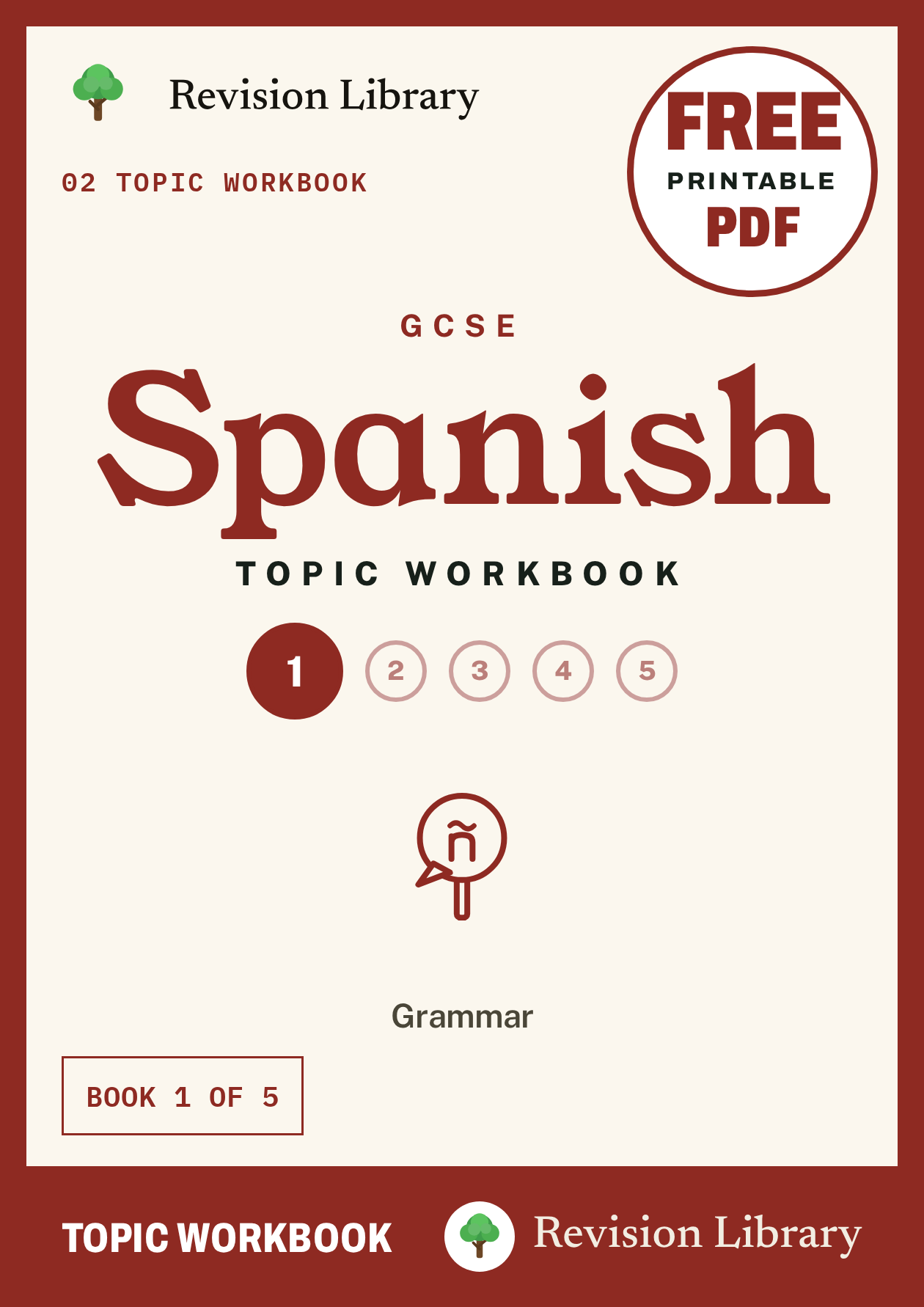
GCSE Spanish Topic Workbook 2

Tener Que, Hay Que, Poder and Deber Plus Infinitive, An Introduction to the Present Subjunctive for GCSE Higher Tier, Theme 1.1: Identity and relationships with others - Vocabulary and 12 more

Level
GCSE · AQA 8692
Series
GCSE Spanish Topic Workbooks, book 2 of 5
Suitable for
Years 10-11, AQA (2024 spec)
FreePDF download · 2027 edition · 113 A4 pages
  • One file, prints straight to A4
  • No account, no password

Workbooks like this one, with 15 topics, 105 questions and mark schemes at the back, are usually printed and sold by publishers. This one is one of 558 free PDFs on the shelf.

Pages
113 A4 pages
Chapters
15 worksheet chapters
Questions
105 · 510 marks
Answers
From page 94
Working time
About 7h 45m

What is inside

15 chapters · answers from p94

Each chapter starts with a page showing its marks and a suggested time, followed by the questions. The mark schemes for all 15 chapters are at the back, so the book works for homework, a timed test or revision.

  1. 01Tener Que, Hay Que, Poder and Deber Plus Infinitive12 questions · 30 marks · about 25 min Topic guide: Tener Que, Hay Que, Poder and Deber Plus Infinitivep3
  2. 02An Introduction to the Present Subjunctive for GCSE Higher Tier5 questions · 28 marks · about 25 min Topic guide: An Introduction to the Present Subjunctive for GCSE Higher Tierp10
  3. 03Theme 1.1: Identity and relationships with others - Vocabulary6 questions · 29 marks · about 25 min Topic guide: Theme 1.1: Identity and relationships with others - Vocabularyp15
  4. 04Theme 1.2: Healthy living and lifestyle - Vocabulary6 questions · 27 marks · about 25 min Topic guide: Theme 1.2: Healthy living and lifestyle - Vocabularyp20
  5. 05Theme 1.3: Education and work - Vocabulary6 questions · 29 marks · about 25 min Topic guide: Theme 1.3: Education and work - Vocabularyp25
  6. 06Theme 2.1: Free-time activities - Vocabulary6 questions · 27 marks · about 25 min Topic guide: Theme 2.1: Free-time activities - Vocabularyp30
  7. 07Theme 3.1: Travel and tourism - Vocabulary6 questions · 27 marks · about 25 min Topic guide: Theme 3.1: Travel and tourism - Vocabularyp35
  8. 08Theme 3.3: The environment and where people live - Vocabulary6 questions · 27 marks · about 25 min Topic guide: Theme 3.3: The environment and where people live - Vocabularyp40
  9. 09Technology in Everyday Life: Social Media and the Internet (Vocabulary)13 questions · 45 marks · about 40 min Topic guide: Technology in Everyday Life: Social Media and the Internet (Vocabulary)p45
  10. 10Technology in Everyday Life: Mobile Devices and Digital Habits6 questions · 44 marks · about 40 min Topic guide: Technology in Everyday Life: Mobile Devices and Digital Habitsp52
  11. 11Festivals and Celebrations in Spanish-Speaking Countries5 questions · 42 marks · about 40 min Topic guide: Festivals and Celebrations in Spanish-Speaking Countriesp60
  12. 12Everyday Customs and Traditions in the Spanish-Speaking World12 questions · 42 marks · about 40 min Topic guide: Everyday Customs and Traditions in the Spanish-Speaking Worldp66
  13. 13Charity, Volunteering and Household Chores5 questions · 44 marks · about 40 min Topic guide: Charity, Volunteering and Household Choresp75
  14. 14Poverty and Homelessness (Vocabulary)6 questions · 42 marks · about 40 min Topic guide: Poverty and Homelessness (Vocabulary)p82
  15. 15Theme 1.1: Me, my family and friends - Reading comprehension5 questions · 27 marks · about 25 min Topic guide: Theme 1.1: Me, my family and friends - Reading comprehensionp88
  16. AnswersMark schemes for every chapterp94

Each chapter is drawn from one of our worksheet packs. Follow a chapter title for the full pack on its own page, or browse every GCSE Spanish pack. Every book on the shelf is a complete printable workbook of up to 120 A4 pages.

Explore this volume

GCSE Spanish Topic Workbook 2 includes Tener Que, Hay Que, Poder and Deber Plus Infinitive (from page 3); An Introduction to the Present Subjunctive for GCSE Higher Tier (from page 10); Theme 1.1: Identity and relationships with others - Vocabulary (from page 15); Theme 1.2: Healthy living and lifestyle - Vocabulary (from page 20); Theme 1.3: Education and work - Vocabulary (from page 25); Theme 2.1: Free-time activities - Vocabulary (from page 30); Theme 3.1: Travel and tourism - Vocabulary (from page 35); Theme 3.3: The environment and where people live - Vocabulary (from page 40); Technology in Everyday Life: Social Media and the Internet (Vocabulary) (from page 45); Technology in Everyday Life: Mobile Devices and Digital Habits (from page 52); Festivals and Celebrations in Spanish-Speaking Countries (from page 60); Everyday Customs and Traditions in the Spanish-Speaking World (from page 66); Charity, Volunteering and Household Chores (from page 75); Poverty and Homelessness (Vocabulary) (from page 82); Theme 1.1: Me, my family and friends - Reading comprehension (from page 88).

Worked question 5 - Theme 1.1: Me, my family and friends - Reading comprehension

Open the included worksheet

Mi familia y yo

Source written for Revision Library (original, copyright-free). A first-person account by a fictional Spanish teenager, Sofía, describing her family.

Me llamo Sofía y tengo dieciséis años. Vivo en Valencia, en el este de España, con mi familia. Somos una familia bastante grande: mis padres, mis dos hermanos y yo. Mi hermano mayor se llama Diego y tiene diecinueve años. Es alto y deportista, y juega al baloncesto todos los fines de semana. Mi hermana pequeña se llama Elena y solo tiene ocho años. Es muy habladora y siempre quiere jugar conmigo después del colegio.

Mi madre se llama Carmen y trabaja como enfermera en el hospital central. Es una persona paciente y cariñosa, y siempre me ayuda con los deberes cuando tengo problemas. Mi padre se llama Javier y es profesor de matemáticas en un instituto cerca de casa. Es bastante estricto pero también tiene sentido del humor.

Los fines de semana, mi familia entera va a la casa de mis abuelos, que viven en un pueblo pequeño cerca de la costa. Mi abuela, que se llama Pilar, cocina platos tradicionales como la paella, y mi abuelo, Antonio, cultiva verduras en su huerto. Me encanta pasar tiempo allí porque el ambiente es tranquilo y siempre hay mucho que hacer.

También tengo un perro que se llama Rocky. Es pequeño y muy juguetón, y duerme en mi habitación cada noche. Aunque a veces mi familia es un poco caótica, con tanta gente y tantas opiniones diferentes, no cambiaría nada. Para mí, la familia es lo más importante de la vida.

Translate this extract from the text into English.
(a)Los fines de semana, mi familia entera va a la casa de mis abuelos,(2)
(b)que viven en un pueblo pequeño cerca de la costa.(2)
(c)Mi abuela cocina platos tradicionales,(2)
(d)y mi abuelo cultiva verduras(2)
(e)en su huerto.(2)

Answer and mark scheme

Question 5

CreditAnswer or working
B1(a) 'At the weekend(s)' or 'On weekends' for Los fines de semana
B1(a) 'my whole family goes to my grandparents' house' - entera (whole/entire) and va (goes) both rendered; allow 'my entire family'
B1(b) 'who live' for que viven (relative clause, plural verb agreeing with abuelos)
B1(b) 'in a small village/town near the coast' for en un pueblo pequeño cerca de la costa
B1(c) 'My grandmother cooks' for Mi abuela cocina
B1(c) 'traditional dishes' for platos tradicionales, allow 'traditional food/meals'
B1(d) 'and my grandfather grows' for y mi abuelo cultiva
B1(d) 'vegetables' for verduras
B1(e) 'in his' for en su (su is unambiguous here, referring back to el abuelo)
B1(e) 'vegetable garden' or 'allotment' for huerto
  • (a) Answer: At the weekend(s), my whole family goes to my grandparents' house,
  • (b) Answer: who live in a small village near the coast.
  • (c) Answer: My grandmother cooks traditional dishes,
  • (d) Answer: and my grandfather grows vegetables
  • (e) Answer: in his vegetable garden (allotment).
Question 1 - Theme 1.1: Me, my family and friends - Reading comprehension

Open the included worksheet

Mi familia y yo

Source written for Revision Library (original, copyright-free). A first-person account by a fictional Spanish teenager, Sofía, describing her family.

Me llamo Sofía y tengo dieciséis años. Vivo en Valencia, en el este de España, con mi familia. Somos una familia bastante grande: mis padres, mis dos hermanos y yo. Mi hermano mayor se llama Diego y tiene diecinueve años. Es alto y deportista, y juega al baloncesto todos los fines de semana. Mi hermana pequeña se llama Elena y solo tiene ocho años. Es muy habladora y siempre quiere jugar conmigo después del colegio.

Mi madre se llama Carmen y trabaja como enfermera en el hospital central. Es una persona paciente y cariñosa, y siempre me ayuda con los deberes cuando tengo problemas. Mi padre se llama Javier y es profesor de matemáticas en un instituto cerca de casa. Es bastante estricto pero también tiene sentido del humor.

Los fines de semana, mi familia entera va a la casa de mis abuelos, que viven en un pueblo pequeño cerca de la costa. Mi abuela, que se llama Pilar, cocina platos tradicionales como la paella, y mi abuelo, Antonio, cultiva verduras en su huerto. Me encanta pasar tiempo allí porque el ambiente es tranquilo y siempre hay mucho que hacer.

También tengo un perro que se llama Rocky. Es pequeño y muy juguetón, y duerme en mi habitación cada noche. Aunque a veces mi familia es un poco caótica, con tanta gente y tantas opiniones diferentes, no cambiaría nada. Para mí, la familia es lo más importante de la vida.

Read the text again. Choose the correct letter (A, B, C or D) for each question.
(a)Where does Sofía live?(1)
  • A Madrid
  • B Valencia
  • C Barcelona
  • D Sevilla
(b)How old is Sofía's brother, Diego?(1)
  • A 16
  • B 19
  • C 8
  • D 21
(c)What is Sofía's mother's job?(1)
  • A Teacher
  • B Doctor
  • C Nurse
  • D Chef
(d)What does Sofía's grandfather, Antonio, grow in his garden?(1)
  • A Flowers
  • B Vegetables
  • C Fruit trees
  • D Nothing, he keeps chickens

Answer and mark scheme

Question 1

CreditAnswer or working
B1(a) B - Valencia
B1(b) B - 19
B1(c) C - Nurse
B1(d) B - Vegetables
  • (a) Answer: B - Valencia
  • (b) Answer: B - 19
  • (c) Answer: C - Nurse
  • (d) Answer: B - Vegetables

Question 4 - Theme 1.1: Me, my family and friends - Reading comprehension

Open the included worksheet

Mi familia y yo

Source written for Revision Library (original, copyright-free). A first-person account by a fictional Spanish teenager, Sofía, describing her family.

Me llamo Sofía y tengo dieciséis años. Vivo en Valencia, en el este de España, con mi familia. Somos una familia bastante grande: mis padres, mis dos hermanos y yo. Mi hermano mayor se llama Diego y tiene diecinueve años. Es alto y deportista, y juega al baloncesto todos los fines de semana. Mi hermana pequeña se llama Elena y solo tiene ocho años. Es muy habladora y siempre quiere jugar conmigo después del colegio.

Mi madre se llama Carmen y trabaja como enfermera en el hospital central. Es una persona paciente y cariñosa, y siempre me ayuda con los deberes cuando tengo problemas. Mi padre se llama Javier y es profesor de matemáticas en un instituto cerca de casa. Es bastante estricto pero también tiene sentido del humor.

Los fines de semana, mi familia entera va a la casa de mis abuelos, que viven en un pueblo pequeño cerca de la costa. Mi abuela, que se llama Pilar, cocina platos tradicionales como la paella, y mi abuelo, Antonio, cultiva verduras en su huerto. Me encanta pasar tiempo allí porque el ambiente es tranquilo y siempre hay mucho que hacer.

También tengo un perro que se llama Rocky. Es pequeño y muy juguetón, y duerme en mi habitación cada noche. Aunque a veces mi familia es un poco caótica, con tanta gente y tantas opiniones diferentes, no cambiaría nada. Para mí, la familia es lo más importante de la vida.

Complete each sentence about the text using a word from the box. There are two extra words that you do not need.
(a)Word box: hospital, huerto, baloncesto, paciente, pueblo, mayor. Diego es el hermano ______ de Sofía.(1)
(b)La madre de Sofía trabaja en el ______.(1)
(c)Los abuelos de Sofía viven en un ______ pequeño.(1)
(d)El abuelo cultiva verduras en su ______.(1)

Answer and mark scheme

Question 4

CreditAnswer or working
B1(a) mayor
B1(b) hospital
B1(c) pueblo
B1(d) huerto
  • (a) Answer: mayor
  • (b) Answer: hospital
  • (c) Answer: pueblo
  • (d) Answer: huerto

Question 4 - Charity, Volunteering and Household Chores

Open the included worksheet

Traduce al inglés: Translate this short Spanish passage about a charity event into English. Context: a student report about a school charity day. Translate each underlined idea as a separate sense chunk; there are 9 marks.
(a)El jueves pasado hicimos una feria para recaudar fondos.(1)
(b)Organizamos puestos de comida(1)
(c)y una venta de libros.(1)
(d)Mis amigos y yo donamos ropa(1)
(e)y trabajamos como voluntarios.(1)
(f)Durante la tarde, ayudamos a servir el café(1)
(g)y limpiar las mesas.(1)
(h)Gracias a todas las donaciones,(1)
(i)la organización benéfica recibió mucho apoyo.(1)

Answer and mark scheme

Question 4

CreditAnswer or working
B1(a) Last Thursday we held a fair to raise funds
B1(b) We organised food stalls
B1(c) and a book sale
B1(d) My friends and I donated clothes
B1(e) and worked as volunteers
B1(f) In the afternoon, we helped to serve the coffee
B1(g) and to clean the tables / and clean the tables
B1(h) Thanks to all the donations,
B1(i) the charity organisation received a lot of support
  • (a) Answer: Last Thursday we held a fair to raise funds.
  • (b) Answer: We organised food stalls.
  • (c) Answer: and a book sale.
  • (d) Answer: My friends and I donated clothes.
  • (e) Answer: and worked as volunteers.
  • (f) Answer: In the afternoon, we helped to serve the coffee.
  • (g) Answer: and clean the tables.
  • (h) Answer: Thanks to all the donations,
  • (i) Answer: the charity organisation received a lot of support.

Question 1 - Charity, Volunteering and Household Chores

Open the included worksheet

Empareja: Match each Spanish phrase about charity or volunteering to its correct English meaning. Context: a leaflet describing voluntary activities for teenagers.
(a)la organización benéfica(1)
  • A an organisation that gives advice
  • B a charity organisation
  • C a community centre
  • D a fundraising event
(b)hacer trabajo voluntario(1)
  • A to work for money
  • B to organise a charity
  • C to do voluntary work
  • D to donate clothes
(c)recaudar fondos(1)
  • A to raise funds
  • B to recycle clothes
  • C to help elderly people
  • D to sweep the floor
(d)donar ropa(1)
  • A to repair clothes
  • B to donate clothes
  • C to sell clothes
  • D to wear old clothes
(e)pasar la aspiradora(1)
  • A to do the washing up
  • B to tidy the bedroom
  • C to vacuum
  • D to make the bed
(f)sacar la basura(1)
  • A to set the table
  • B to take out the rubbish
  • C to water the plants
  • D to iron the clothes

Answer and mark scheme

Question 1

CreditAnswer or working
B1(a) B - a charity organisation
B1(b) C - to do voluntary work
B1(c) A - to raise funds
B1(d) B - to donate clothes
B1(e) C - to vacuum
B1(f) B - to take out the rubbish
  • (a) Answer: B - a charity organisation
  • (b) Answer: C - to do voluntary work
  • (c) Answer: A - to raise funds
  • (d) Answer: B - to donate clothes
  • (e) Answer: C - to vacuum
  • (f) Answer: B - to take out the rubbish

GCSE Spanish Topic Workbooks runs to 5 volumes

Book 2 of 5 · 559 pages in the set

Each book is a separate free PDF.

Volume 1

107 pp · 170 Qs

Grammar in context: Present tense, Preterite Tense: Regular and High-Frequency Irregular Verbs, Imperfect Tense and Contrasting It With the Preterite and 12 more

Volume 2 · this book

113 pp · 105 Qs

Tener Que, Hay Que, Poder and Deber Plus Infinitive, An Introduction to the Present Subjunctive for GCSE Higher Tier, Theme 1.1: Identity and relationships with others - Vocabulary and 12 more

Volume 3

110 pp · 124 Qs

Theme 1.1: Identity and relationships with others - Reading comprehension, Theme 1.2: Healthy living and lifestyle - Reading comprehension, Theme 1.3: Education and work - Reading comprehension and 11 more

Volume 4

114 pp · 109 Qs

Theme 1.2: Healthy Living and Lifestyle - Listening Comprehension, Theme 3.1: Travel and Tourism - Listening Comprehension, Theme 1.3: Education and Work - Listening Comprehension and 13 more

Volume 5

115 pp · 85 Qs

Social Media, Online Safety and Screen Time, Food, Family Celebrations and Regional Customs, Theme 1.1: Me, my family and friends - Writing and 11 more

More GCSE books

GCSE Spanish 10-Minute Tests 1

87 pp · 87 Qs

Grammar in context: Present tense, Preterite Tense: Regular and High-Frequency Irregular Verbs, Imperfect Tense and Contrasting It With the Preterite and 17 more

Want a different mix of topics?

Sitting an exam soon? Build a GCSE Spanish mock paper or print a ready-made one.