Worked question 29 - The Conditional Tense: Formation and Everyday Uses
Answer and mark scheme
Question 29
| Credit | Answer or working |
|---|---|
| B1 | habría |
- Answer: habría
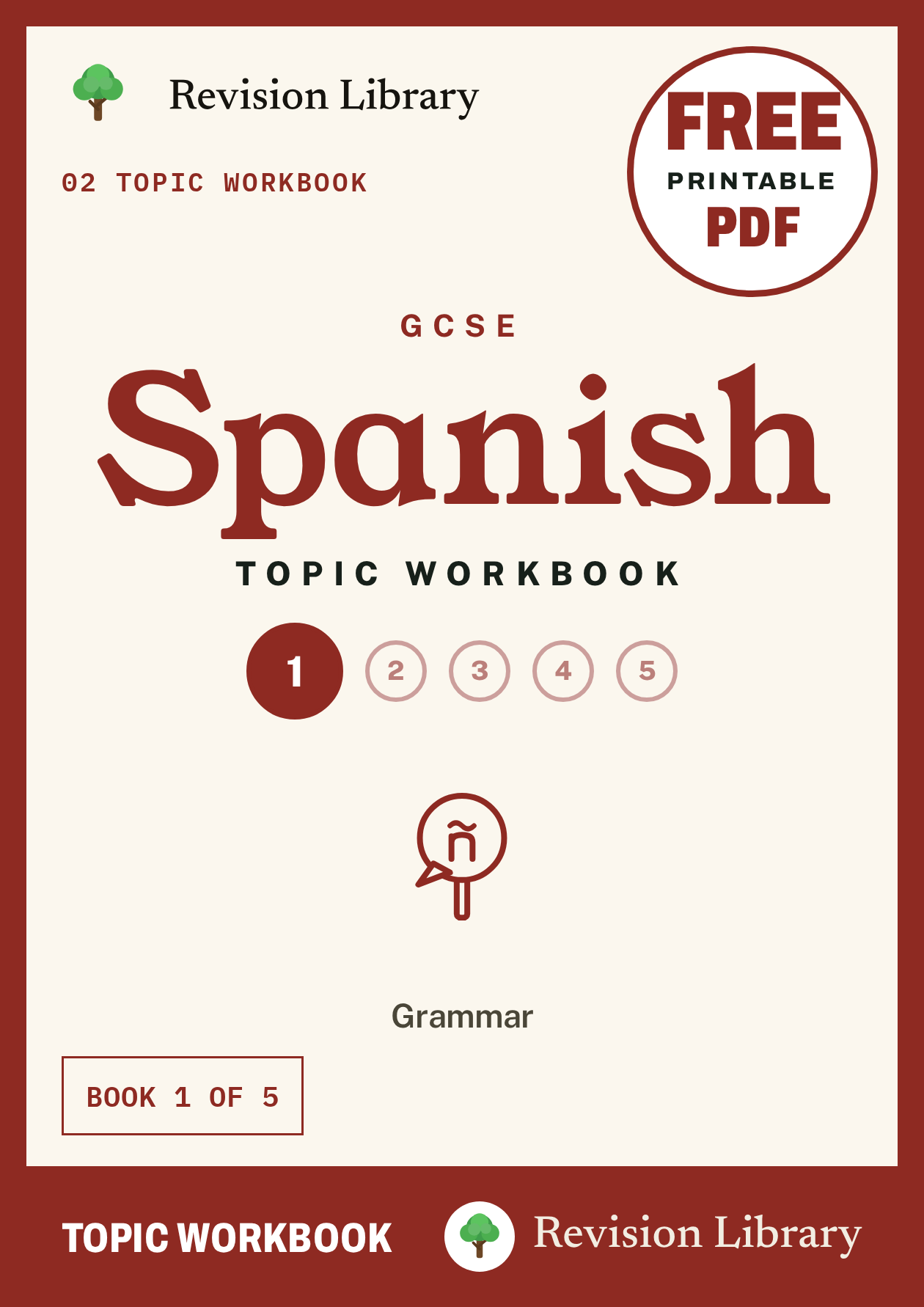
Front cover
GCSE Spanish Topic Workbooks · Book 1 of 5
Grammar in context: Present tense, Preterite Tense: Regular and High-Frequency Irregular Verbs, Imperfect Tense and Contrasting It With the Preterite and 12 more
Workbooks like this one, with 15 topics, 170 questions and mark schemes at the back, are usually printed and sold by publishers. This one is one of 558 free PDFs on the shelf.
Each chapter starts with a page showing its marks and a suggested time, followed by the questions. The mark schemes for all 15 chapters are at the back, so the book works for homework, a timed test or revision.
Each chapter is drawn from one of our worksheet packs. Follow a chapter title for the full pack on its own page, or browse every GCSE Spanish pack. Every book on the shelf is a complete printable workbook of up to 120 A4 pages.
GCSE Spanish Topic Workbook 1 includes Grammar in context: Present tense (from page 3); Preterite Tense: Regular and High-Frequency Irregular Verbs (from page 7); Imperfect Tense and Contrasting It With the Preterite (from page 14); Talking About the Future: Ir a + Infinitive and the Simple Future Tense (from page 19); The Conditional Tense: Formation and Everyday Uses (from page 26); The Perfect Tense and an Introduction to the Pluperfect Tense (from page 32); Ser and Estar: Choosing the Right Verb for To Be (from page 38); Object Pronouns: Direct, Indirect and Combined Pronoun Order (from page 43); Reflexive Verbs and Gustar-Type Constructions (from page 49); Negation: No, Nunca, Nada, Nadie and Other Negative Structures (from page 55); Comparatives, Superlatives and Adjective Agreement and Position (from page 60); Possessive and Demonstrative Adjectives and Pronouns (from page 66); Por and Para and Other Common Prepositions (from page 73); The Imperative: Giving Commands and Instructions (from page 79); Question Words and Forming Questions (from page 85).
| Credit | Answer or working |
|---|---|
| B1 | habría |
| Credit | Answer or working |
|---|---|
| B1 | tener |
| Credit | Answer or working |
|---|---|
| B1 | I would like to travel to Mexico. |
| Credit | Answer or working |
|---|---|
| B1 | (a) La llamo todas las noches. |
| B1 | (b) Se los da a los niños. or Les da los libros a los niños. Credit combined form se los da. |
| B1 | (c) Le enviamos el correo ayer. or Se lo enviamos (if direct object specified as it). |
| B1 | (d) Me la está mostrando ahora. or Me la está enseñando ahora. or Me la muestra ahora. |
| B1 | (e) Te mandaré las entradas mañana. or Te enviaré las entradas mañana. |
| B1 | (f) Se lo están comprando ahora. or Le están comprando el café a él ahora. |
| Credit | Answer or working |
|---|---|
| B1 | (a) Correct combined pronoun le+lo -> se lo attached to the infinitive: leérselo |
| B1 | (a) Correct overall sentence order including all the jumbled words, e.g. 'Quiero leérselo a mi hermana esta noche.' |
| Credit | Answer or working |
|---|---|
| M1 | (a) Correct placement of tampoco relative to the negative idea |
| A1 | (a) Meaning and verb form correct, e.g. 'Tampoco voy a estudiar esta noche' or 'No voy a estudiar esta noche tampoco' |
| M1 | (b) Correct use of ninguna with feminine noun tarea |
| A1 | (b) Correct verb and meaning, e.g. 'No tengo ninguna tarea esta semana' or 'No tengo tarea ninguna esta semana' (credit first) |
| M1 | (c) Use of jamás or placement at sentence start |
| A1 | (c) Correct verb form and meaning, e.g. 'Jamás olvido mis problemas' or 'No olvido jamás mis problemas' (credit either) |
| Credit | Answer or working |
|---|---|
| B1 | (a) Use of nunca or jamás in correct position |
| B1 | (a) Correct verb form, e.g. 'Nunca desayuno antes del colegio' or 'No desayuno nunca antes del colegio' |
| B1 | (b) Correct use of nadie or no + hay nadie |
| B1 | (b) Correct agreement with library context, e.g. 'No hay nadie en la biblioteca ahora' or 'En la biblioteca no hay nadie ahora' (first is preferred) |
| B1 | (c) Correct use of nada in object position or 'no... nada' |
| B1 | (c) Correct verb form, e.g. 'No tengo nada que hacer esta tarde' or 'Nada tengo que hacer esta tarde' (accept either) |
Each book is a separate free PDF.
Grammar in context: Present tense, Preterite Tense: Regular and High-Frequency Irregular Verbs, Imperfect Tense and Contrasting It With the Preterite and 12 more
Tener Que, Hay Que, Poder and Deber Plus Infinitive, An Introduction to the Present Subjunctive for GCSE Higher Tier, Theme 1.1: Identity and relationships with others - Vocabulary and 12 more
Theme 1.1: Identity and relationships with others - Reading comprehension, Theme 1.2: Healthy living and lifestyle - Reading comprehension, Theme 1.3: Education and work - Reading comprehension and 11 more
Theme 1.2: Healthy Living and Lifestyle - Listening Comprehension, Theme 3.1: Travel and Tourism - Listening Comprehension, Theme 1.3: Education and Work - Listening Comprehension and 13 more
Social Media, Online Safety and Screen Time, Food, Family Celebrations and Regional Customs, Theme 1.1: Me, my family and friends - Writing and 11 more
Grammar, Vocabulary, Reading comprehension
Grammar in context: Present tense, Preterite Tense: Regular and High-Frequency Irregular Verbs, Imperfect Tense and Contrasting It With the Preterite and 17 more
Sitting an exam soon? Build a GCSE Spanish mock paper or print a ready-made one.