Revision Library
Choose a subject
Menu
Maths
Need a new topic?
Missing a topic, found a bug, or want something added?

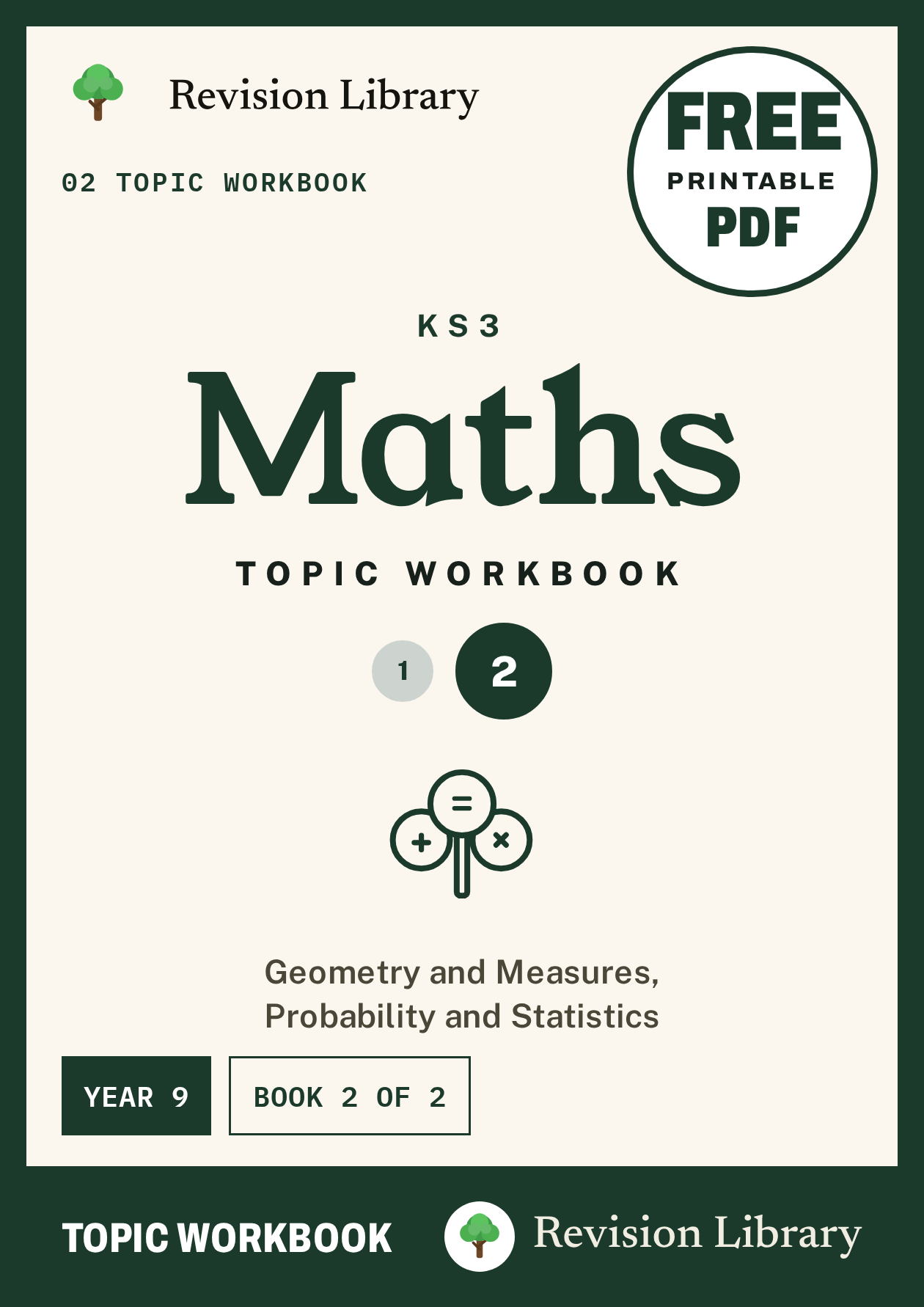
KS3 Maths Year 9 Topic Workbooks · Book 2 of 2

KS3 Maths Year 9 Topic Workbook 2

Congruence and Similarity, Bearings and Scale, 3D Shapes, Plans and Elevations and 8 more

Level
KS3
Series
KS3 Maths Year 9 Topic Workbooks, book 2 of 2
Suitable for
Years 7-9, ages 11-14
FreePDF download · 2027 edition · 96 A4 pages
  • One file, prints straight to A4
  • No account, no password

Workbooks like this one, with 11 topics, 146 questions and mark schemes at the back, are usually printed and sold by publishers. This one is one of 558 free PDFs on the shelf.

Pages
96 A4 pages
Chapters
11 worksheet chapters
Questions
146 · 433 marks
Answers
From page 80
Working time
About 9h 20m

What is inside

11 chapters · answers from p80

Each chapter starts with a page showing its marks and a suggested time, followed by the questions. The mark schemes for all 11 chapters are at the back, so the book works for homework, a timed test or revision.

  1. 01Congruence and Similarity13 questions · 36 marks · about 45 min Topic guide: Congruence and Similarityp3
  2. 02Bearings and Scale18 questions · 40 marks · about 55 min Topic guide: Bearings and Scalep9
  3. 033D Shapes, Plans and Elevations14 questions · 36 marks · about 45 min Topic guide: 3D Shapes, Plans and Elevationsp15
  4. 04Geometry: Transformations14 questions · 50 marks · about 65 min Topic guide: Geometry: Transformationsp24
  5. 05Venn Diagrams and Set Notation7 questions · 20 marks · about 25 min Topic guide: Venn Diagrams and Set Notationp37
  6. 06Tree Diagrams for Independent Events13 questions · 36 marks · about 45 min Topic guide: Tree Diagrams for Independent Eventsp41
  7. 07Probability14 questions · 73 marks · about 95 min Topic guide: Probabilityp46
  8. 08Mixed Probability Problem Set13 questions · 36 marks · about 45 min Topic guide: Mixed Probability Problem Setp58
  9. 09Grouped Data and the Estimated Mean8 questions · 37 marks · about 50 min Topic guide: Grouped Data and the Estimated Meanp63
  10. 10Comparing Distributions14 questions · 38 marks · about 50 min Topic guide: Comparing Distributionsp68
  11. 11Statistical Enquiry and Misleading Graphs18 questions · 31 marks · about 40 min Topic guide: Statistical Enquiry and Misleading Graphsp73
  12. AnswersMark schemes for every chapterp80

Each chapter is drawn from one of our worksheet packs. Follow a chapter title for the full pack on its own page, or browse every KS3 Maths pack. Every book on the shelf is a complete printable workbook of up to 120 A4 pages.

Explore this volume

KS3 Maths Year 9 Topic Workbook 2 includes Congruence and Similarity (from page 3); Bearings and Scale (from page 9); 3D Shapes, Plans and Elevations (from page 15); Geometry: Transformations (from page 24); Venn Diagrams and Set Notation (from page 37); Tree Diagrams for Independent Events (from page 41); Probability (from page 46); Mixed Probability Problem Set (from page 58); Grouped Data and the Estimated Mean (from page 63); Comparing Distributions (from page 68); Statistical Enquiry and Misleading Graphs (from page 73).

Worked question 11 - 3D Shapes, Plans and Elevations

Open the included worksheet

Draw the front elevation and a top plan for a cube with a small square hole cut through the centre from the top to the bottom. The cube has side 6 cm. The hole is a square of side 2 cm centred on the cube. Describe the shapes seen in the front elevation and top plan.

Answer and mark scheme

Question 11

CreditAnswer or working
M1identifies front elevation shows a plain 6 cm by 6 cm square with no hole visible (the hole runs from the top to the bottom, so it is hidden from the front)
M1identifies top plan shows a square with a central square hole of side 2 cm
A1both descriptions correct and refer to sizes or relative positions (eg central small square) cao
  • Answer: Front elevation: a plain 6 cm by 6 cm square (the 2 cm hole runs from top to bottom, so it cannot be seen from the front); Top plan: a 6 cm square with a central 2 cm square hole centred inside
Question 7 - 3D Shapes, Plans and Elevations

Open the included worksheet

A castle model has a rectangular tower 14 cm by 10 cm base and height 30 cm. On top of the tower sits a crenelated parapet formed by removing four equal square prisms of side 2 cm from the corners of a thin slab of thickness 2 cm. Calculate the surface area added to the tower by the parapet (that is, the increase in the total surface area of the model; the slab has the same 14 cm by 10 cm base as the tower).
Diagram NOT accurately drawn
14 cm10 cm30 cm2 cm2 cm

Answer and mark scheme

Question 7

CreditAnswer or working
M1calculates area of top slab before cuts = 14 x 10 = 140 and area removed by four corner squares = 4 x 22 = 16, so exposed top of parapet = 124
M1calculates exposed vertical wall area of the parapet: each corner notch removes as much edge length as it adds, so the perimeter is unchanged at 2 x (14+10) = 48 cm, giving wall area = 48 x 2 = 96 cm²
A1recognises that the 124 cm² of exposed slab top exactly replaces the 124 cm² of tower top it now covers, and the 16 cm² of tower top seen through the notches was already exposed, so only the walls add area: final added surface area = 96 cm² cao
  • Answer: 96 cm2

Question 12 - 3D Shapes, Plans and Elevations

Open the included worksheet

A cone and a cylinder have the same base radius 4 cm and the same height 9 cm. State whether the cone has the same volume as the cylinder. Give a brief reason.
Diagram NOT accurately drawn
4 cm9 cm4 cm9 cm

Answer and mark scheme

Question 12

CreditAnswer or working
M1some correct idea about relationship of cone and cylinder volumes e.g. cone volume = (1/3) cylinder volume if same height
A1answer stating cone could not have same volume unless its height was 27 cm (cao) or explaining ratio 1:3
  • Answer: No. A cone with the same base and height has volume 1/3 of the cylinder; to equal the cylinder the cone would need height 27 cm (1/3 rule) so with height 9 cm it is smaller

Question 9 - Bearings and Scale

Open the included worksheet

A scale drawing uses scale 1:5000. A river runs in a straight line on the drawing from point R to point S measuring 14.6 cm. A bridge is built 1.8 km downstream from S along the same river. Calculate the position of the bridge on the drawing in centimetres measured from R. Show your working clearly.

Answer and mark scheme

Question 9

CreditAnswer or working
M1converts 1.8 km to cm: 1.8 x 1000 = 1800 m then x100 = 180 000 cm
M1divides by scale 5000 to get map cm for downstream distance: 180 000 / 5000 = 36
M1adds this to distance RS on drawing: 14.6 + 36 = 50.6 cm
A150.6 cm cao
  • Answer: 50.6 cm

Question 15 - Bearings and Scale

Open the included worksheet

On a map, road R goes from village V to town T. The bearing from V to T is 328. A cyclist at V rides on a bearing of 050 for a while. Calculate the smaller angle between the cyclist's direction and the direction to T from V.

Answer and mark scheme

Question 15

CreditAnswer or working
M1method to find difference using clockwise bearings: 050 - 328 or add 360 then subtract gives 82
M1identifies need to take smaller angle (82 is less than 278) oe
A182 degrees cao
  • Answer: 82 degrees

Question 12 - Geometry: Transformations

Open the included worksheet

A map has a scale of 1 : 25000.
(a)The distance between the villages of Ashcombe and Bramerton on the map is 6.4 cm. Work out the real distance between the villages, in kilometres.(3)
(b)A footpath on the map is being redrawn. Its length on the map changes from 3 cm to 4.5 cm, at the same scale. Work out the increase in the real length of the footpath, in metres.(3)

Answer and mark scheme

Question 12

CreditAnswer or working
M1(a) 6.4 x 25000
M1(a) correct conversion of cm to km (divide by 100000)
A1(a) 1.6 km cao
M1(b) real length before = 3 x 25000 = 75000 cm (= 750 m) and real length after = 4.5 x 25000 = 112500 cm (= 1125 m)
M1(b) correct conversion of cm to m (divide by 100) for at least one length
A1(b) 375 m cao
  • (a) Answer: 1.6 km
  • (b) Answer: 375 m

Question 11 - Geometry: Transformations

Open the included worksheet

Two rectangles are similar. Rectangle A measures 4 cm by 6 cm. Rectangle B is an enlargement of rectangle A with scale factor 2.5.
Diagram NOT accurately drawn
A 4 cm 6 cm B
(a)Work out the dimensions of rectangle B.(2)
(b)Work out the area of rectangle B.(2)
(c)Amir says, 'The area of rectangle B is 2.5 times the area of rectangle A.' Explain why Amir is wrong, and state the correct area scale factor.(2)

Answer and mark scheme

Question 11

CreditAnswer or working
M1(a) 4 x 2.5 and 6 x 2.5 oe
A1(a) 10 cm and 15 cm cao
M1(b) 10 x 15 oe, ft from part (a)
A1(b) 150 cm² cao
M1(c) compares area of A (24 cm²) with area of B (150 cm²), giving ratio 150/24 = 6.25 oe
A1(c) correct explanation: the area scale factor is the linear scale factor squared, 2.52 = 6.25, not 2.5
  • (a) Answer: 10 cm by 15 cm
  • (b) Answer: 150 cm2
  • (c) Answer: Amir is wrong; the area scale factor is 2.52 = 6.25, not 2.5

KS3 Maths Year 9 Topic Workbooks runs to 2 volumes

Book 2 of 2 · 200 pages in the set

Each book is a separate free PDF.

Volume 1

104 pp · 208 Qs

Roots, Powers and Exact Values, Expanding Double Brackets, Introduction to Factorising Quadratics and 12 more

Volume 2 · this book

96 pp · 146 Qs

Congruence and Similarity, Bearings and Scale, 3D Shapes, Plans and Elevations and 8 more

More KS3 books

KS3 Maths Year 8 Topic Workbook 1

94 pp · 191 Qs

Fractions: Multiplying and Dividing, Percentages of Amounts and Percentage Change, Indices and the Index Laws and 10 more

Want a different mix of topics?

Sitting an exam soon? Build a KS3 Maths mock paper or print a ready-made one.