Perimeter is the total distance around the outside edge of a 2D shape. Area is the amount of flat space a 2D shape covers, measured in square units such as cm2 or m2.
For perimeter, add together the lengths of all the sides of the shape; if a side length is missing, use the fact that opposite sides of a rectangle are equal to work it out.
For a rectangle, area = length x width.
For a triangle, area = 1/2 x base x perpendicular height.
For a parallelogram, area = base x perpendicular height.
For a trapezium, area = 1/2 x (sum of the parallel sides) x perpendicular height.
For a compound shape, split it into rectangles and triangles you know how to handle, find each area separately, then add or subtract them to get the total.
Worked example
A trapezium has parallel sides of 6 cm and 10 cm, and a perpendicular height of 4 cm. Find its area.
Use the trapezium formula: area = 1/2 x (a + b) x h.
Add the parallel sides: 6 + 10 = 16.
Multiply by the height: 16 x 4 = 64.
Multiply by 1/2: 64 x 1/2 = 32.
The area is 32 cm2.
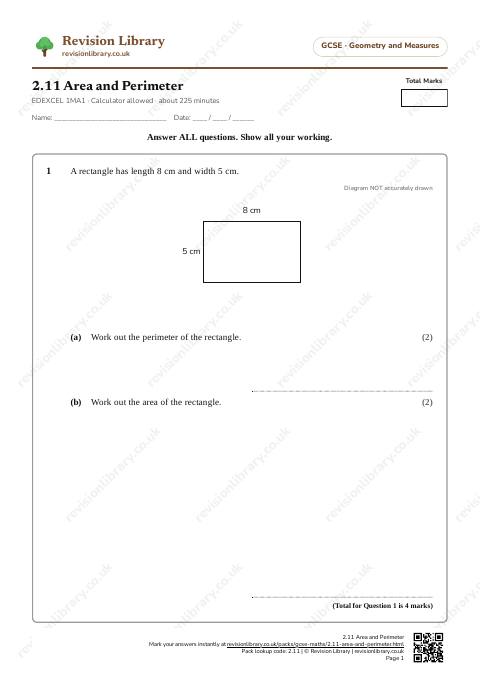
Revision Library
revisionlibrary.co.uk
GCSE · Geometry and Measures
2.11 Area and Perimeter
EDEXCEL 1MA1 · Calculator allowed · about 225 minutes
The shape below is drawn on a 1 cm square grid, made from whole centimetre squares.
(a)Find the area of the shape by counting whole squares.(1)
(b)Find the perimeter of the shape by counting the unit lengths along the edge.(1)
(Total for Question 3 is 2 marks)
4
A rectangular vegetable patch measures 9 m by 4 m.
(a)Work out the perimeter of the vegetable patch.(2)
(b)Work out the area of the vegetable patch.(2)
(Total for Question 4 is 4 marks)
5
A square rug has a side length of 1.8 m.
Diagram NOT accurately drawn
(a)Work out the perimeter of the rug.(1)
(b)Work out the area of the rug.(2)
(Total for Question 5 is 3 marks)
6
A right-angled triangle has side lengths 6 cm, 8 cm and 10 cm. Work out its perimeter.
Diagram NOT accurately drawn
(Total for Question 6 is 1 mark)
7
Work out the perimeter of a trapezium with parallel sides 14 cm and 8 cm and non-parallel sides 5 cm and 7 cm.
Diagram NOT accurately drawn
(Total for Question 7 is 1 mark)
8
A rectangular allotment plot is 14 m long and 6 m wide. Work out the perimeter of the plot.
(Total for Question 8 is 1 mark)
9
A square patio has side length 6.5 m. Work out the perimeter of the patio.
(Total for Question 9 is 1 mark)
10
A trapezium-shaped garden bed has parallel sides of length 9 m and 5 m, and sloping sides of length 3 m and 4 m. Work out the perimeter of the garden bed.
Diagram NOT accurately drawn
(Total for Question 10 is 1 mark)
11
A rectangular room measures 4 m by 3.5 m. Carpet costs £12.50 per m2.
Work out the total cost of carpeting the room.
Diagram NOT accurately drawn
(Total for Question 11 is 3 marks)
12
A rectangular garden measures 12 m by 7 m. One of the 12 m sides is against the house wall, so fencing is only needed along the other three sides. Fencing costs £4.20 per metre.
Work out the total cost of the fencing.
Diagram NOT accurately drawn
(Total for Question 12 is 3 marks)
13
Rectangle A has length 7 cm and width 4 cm. Rectangle B has length 6 cm and width 5 cm.
Which rectangle has the greater area? You must show your working.
Diagram NOT accurately drawn
(Total for Question 13 is 3 marks)
14
A triangle has a base of 10 cm and a perpendicular height of 6.4 cm.
Work out the area of the triangle.
Diagram NOT accurately drawn
(Total for Question 14 is 2 marks)
15
A square has a perimeter of 16 cm. Work out the area of the square.
Diagram NOT accurately drawn
(Total for Question 15 is 3 marks)
16
A rectangle has an area of 18 cm² and a width of 3 cm. Work out the perimeter of the rectangle.
Diagram NOT accurately drawn
(Total for Question 16 is 3 marks)
17
A square has an area of 49 cm². Work out the perimeter of the square.
Diagram NOT accurately drawn
(Total for Question 17 is 3 marks)
18
A rectangle has length 19 cm and width 2 cm. Work out its area and its perimeter.
Diagram NOT accurately drawn
(Total for Question 18 is 3 marks)
19
A room has a floor 9 m by 7 m. It is covered with square tiles of side 20 cm. Work out how many tiles are needed to cover the floor completely.
Diagram NOT accurately drawn
(Total for Question 19 is 3 marks)
20
A square has a perimeter of 44 cm. Work out the area of the square.
Diagram NOT accurately drawn
(Total for Question 20 is 3 marks)
21
A rectangle has an area of 84 cm² and a width of 7 cm. Work out the perimeter of the rectangle.
Diagram NOT accurately drawn
(Total for Question 21 is 3 marks)
22
A square has an area of 169 cm². Work out the perimeter of the square.
Diagram NOT accurately drawn
(Total for Question 22 is 3 marks)
23
A square has an area of 16 cm². Work out the perimeter of the square.
Diagram NOT accurately drawn
(Total for Question 23 is 3 marks)
24
A room has a floor 8 m by 8 m. It is covered with square tiles of side 40 cm. Work out how many tiles are needed to cover the floor completely.
Diagram NOT accurately drawn
(Total for Question 24 is 3 marks)
25
A room has a floor 6 m by 6 m. It is covered with square tiles of side 50 cm. Work out how many tiles are needed to cover the floor completely.
Diagram NOT accurately drawn
(Total for Question 25 is 3 marks)
26
A square has a perimeter of 20 cm.
Work out the length of one side of the square.
Diagram NOT accurately drawn
(Total for Question 26 is 2 marks)
27
A rectangle has a perimeter of 30 cm. The width of the rectangle is 6 cm.
Diagram NOT accurately drawn
(a)Work out the length of the rectangle.(2)
(b)Work out the area of the rectangle.(2)
(Total for Question 27 is 4 marks)
28
A rectangle has an area of 48 cm². The length of the rectangle is 8 cm.
Diagram NOT accurately drawn
(a)Work out the width of the rectangle.(2)
(b)Work out the perimeter of the rectangle.(2)
(Total for Question 28 is 4 marks)
29
The diagram shows the floor plan of an L-shaped room. The bottom edge is 10 m, the left edge is 7 m, the top edge is 6 m, and the small vertical step near the top right is 2 m. The two remaining edges are not labelled.
Work out the perimeter of the L-shaped room.
Diagram NOT accurately drawn
(Total for Question 29 is 3 marks)
30
Using the same L-shaped room as the previous question (bottom edge 10 m, left edge 7 m, top edge 6 m, vertical step 2 m), work out the area of the room.
Diagram NOT accurately drawn
(Total for Question 30 is 3 marks)
31
A patio is L-shaped. It is formed by cutting a 3 m by 2 m rectangle out of one corner of a 9 m by 6 m rectangular patio, to leave space for a tree.
Work out the perimeter of the L-shaped patio.
Diagram NOT accurately drawn
(Total for Question 31 is 3 marks)
32
Using the same L-shaped patio as the previous question (a 3 m by 2 m rectangle cut from the corner of a 9 m by 6 m rectangular patio), work out the area of the patio.
Diagram NOT accurately drawn
(Total for Question 32 is 3 marks)
33
A rectangular picture frame has a length of 45 cm and a width of 0.3 m.
Work out the perimeter of the frame in centimetres.
(Total for Question 33 is 3 marks)
34
A garden gate is cut from a rectangular sheet of wood measuring 1.2 m wide and 1.4 m tall. To let the gate swing clear of a sloping path, a right-angled triangular corner is cut off the top of the sheet. The triangular corner removed has a base of 0.6 m and a perpendicular height of 0.4 m.
Work out the area of the gate that remains after the corner is cut off.
(Total for Question 34 is 3 marks)
35
A square patio has an area of 49 m².
Work out the perimeter of the patio.
(Total for Question 35 is 3 marks)
36
A triangular sail has a base of 3.6 m and a perpendicular height of 2.5 m.
Work out the area of the sail.
(Total for Question 36 is 2 marks)
37
A triangular flag has an area of 24 cm² and a base of 8 cm.
Work out the perpendicular height of the flag.
(Total for Question 37 is 3 marks)
38
A rectangle has a perimeter of 50 cm. One side is 13 cm. Work out the length of the other side.
Diagram NOT accurately drawn
(Total for Question 38 is 2 marks)
39
Work out the area of a triangle with base 10 cm and height 6 cm.
Diagram NOT accurately drawn
(Total for Question 39 is 1 mark)
40
Calculate the area of a parallelogram with base 12 cm and perpendicular height 5 cm.
Diagram NOT accurately drawn
(Total for Question 40 is 1 mark)
41
Calculate the area of a rectangular whiteboard measuring 160 cm by 90 cm.
(Total for Question 41 is 1 mark)
42
A triangular window pane has a base of 18 cm and a height of 11 cm. Work out the area of the window pane.
(Total for Question 42 is 1 mark)
43
A parallelogram-shaped ceramic tile has a base of 13 cm and a perpendicular height of 7 cm. Calculate the area of the tile.
Diagram NOT accurately drawn
(Total for Question 43 is 1 mark)
44
A garden shed end wall is shaped like a rectangle with a triangular roof section on top. The rectangle is 8 m wide and 5 m tall. The triangular roof section has a base of 8 m and a height of 3 m.
Work out the total area of the shed end wall.
Diagram NOT accurately drawn
(Total for Question 44 is 3 marks)
45
A rectangular floor measures 10 m by 2 m. Square tiles measuring 40 cm by 40 cm are used to cover the floor exactly, with no cutting or overlap. Each tile costs £3.60.
Work out the total cost of the tiles needed to cover the floor.
Diagram NOT accurately drawn
(Total for Question 45 is 4 marks)
46
A rectangular garden measures 14 m by 9 m. Inside the garden there is a rectangular pond measuring 3 m by 2 m, which does not touch the edge of the garden. The rest of the garden needs turfing, and the whole perimeter of the garden needs fencing. Turf costs £8.50 per m2 and fencing costs £6 per metre.
Diagram NOT accurately drawn
(a)Work out the area of the garden that needs turfing (that is, the total garden area minus the pond).(3)
(b)Work out the cost of the turf.(2)
(c)Work out the cost of the fencing needed for the whole perimeter of the garden.(3)
(d)Work out the total cost of the turf and the fencing.(1)
(Total for Question 46 is 9 marks)
47
Mr Whitfield is repainting one wall of the school hall storeroom. The wall measures 6 m by 2.4 m. One tin of paint covers 5 m², and tins can only be bought whole. Each tin costs £18.50.
(a)Work out the area of the wall.(1)
(b)Work out the number of tins of paint needed.(2)
(c)Work out the total cost of the paint.(1)
(Total for Question 47 is 4 marks)
48
A classroom floor measures 8 m by 6 m. The school is comparing two ways of covering the floor:
Vinyl flooring costs £9.20 per m2. Carpet tiles are sold in boxes costing £45 each, and each box covers exactly 3 m².
(a)Work out the area of the classroom floor.(1)
(b)Work out the cost of covering the floor with vinyl flooring.(2)
(c)Work out the cost of covering the floor with carpet tiles.(3)
(d)State which type of flooring is cheaper, and work out the difference in cost.(2)
(Total for Question 48 is 8 marks)
49
Calculate the area of a trapezium with parallel sides 8 cm and 14 cm and height 5 cm.
Diagram NOT accurately drawn
(Total for Question 49 is 2 marks)
50
The area of a triangle is 72 cm² and its perpendicular height is 8 cm. Work out the length of the base.
(Total for Question 50 is 2 marks)
51
A composite shape is made of a rectangle 10 cm by 6 cm with an isosceles triangle on one 10 cm side. The triangle has base 10 cm and height 4 cm. Work out the total area of the shape.
Diagram NOT accurately drawn
(Total for Question 51 is 2 marks)
52
The area of a triangle is 45 cm² and its base is 9 cm. Work out the height of the triangle.
(Total for Question 52 is 2 marks)
53
A parallelogram has area 84 cm² and its perpendicular height is 7 cm. Work out the length of the base.
Diagram NOT accurately drawn
(Total for Question 53 is 2 marks)
54
A parallelogram has an area of 108 cm² and a base of 9 cm. Work out the perpendicular height of the parallelogram.
Diagram NOT accurately drawn
(Total for Question 54 is 2 marks)
55
A trapezium-shaped tabletop has parallel sides of length 12 cm and 18 cm and a height of 9 cm. Calculate the area of the tabletop.
Diagram NOT accurately drawn
(Total for Question 55 is 2 marks)
56
A trapezium has parallel sides 9 cm and 15 cm. The two non-parallel sides are equal in length. The perimeter is 50 cm. Work out the length of each non-parallel side.
Diagram NOT accurately drawn
(Total for Question 56 is 2 marks)
57
A trapezium has an area of 84 cm², a height of 8 cm and one parallel side of length 11 cm. Work out the length of the other parallel side.
Diagram NOT accurately drawn
(Total for Question 57 is 2 marks)
58
The diagram shows the floor plan of an L-shaped room. The overall length of the room is 12 m and the overall width is 8 m. A rectangular corner measuring 5 m by 3 m has been cut away, with its edges parallel to the sides of the room. Work out the perimeter of the room.
Diagram NOT accurately drawn
(Total for Question 58 is 3 marks)
59
A rectangular garden measures 15 m by 8 m. A uniform path of width x m is laid around the inside so that the lawn that remains has area 66 m² less than the original garden. Work out x, giving your answer correct to 2 decimal places.
(Total for Question 59 is 4 marks)
60
A right-angled isosceles triangle has its two perpendicular sides each of length 8 cm. Find the exact perimeter of the triangle, giving your answer in the form (a + b √2) cm, where a and b are integers.
Diagram NOT accurately drawn
(Total for Question 60 is 2 marks)
61
A rectangle has length (x + 4) cm and width x cm. The area of the rectangle is 96 cm². Work out the value of x.
Diagram NOT accurately drawn
(Total for Question 61 is 3 marks)
62
A triangle has side lengths 13 cm, 14 cm and 15 cm. Work out the area of the triangle.
Diagram NOT accurately drawn
(Total for Question 62 is 3 marks)
Mark scheme · 2.11 Area and Perimeter
Question 1
(a) 8 + 8 + 5 + 5 or 2(8 + 5) oeM1
(a) 26 caoA1
(a) Answer: 26 cm
(b) 8 x 5M1
(b) 40 caoA1
(b) Answer: 40 cm2
Question 2
(a) 24 caoB1
(a) Answer: 24 m
(b) 36 caoB1
(b) Answer: 36 m2
Question 3
(a) 11 caoB1
(a) Answer: 11 cm2
(b) 16 caoB1
(b) Answer: 16 cm
Question 4
(a) 9 + 9 + 4 + 4 or 2(9 + 4) oeM1
(a) 26 caoA1
(a) Answer: 26 m
(b) 9 x 4M1
(b) 36 caoA1
(b) Answer: 36 m2
Question 5
(a) 7.2 caoB1
(a) Answer: 7.2 m
(b) 1.8 x 1.8M1
(b) 3.24 caoA1
(b) Answer: 3.24 m2
Question 6
Perimeter = 6 + 8 + 10 = 24 cm caoB1
Answer: 24 cm
Question 7
Perimeter = 14 + 8 + 5 + 7 = 34 cm caoB1
Answer: 34 cm
Question 8
Perimeter = 2(14 + 6) = 40 m caoB1
Answer: 40 m
Question 9
Perimeter = 4 x 6.5 = 26 m caoB1
Answer: 26 m
Question 10
Perimeter = 9 + 5 + 3 + 4 = 21 m caoB1
Answer: 21 m
Question 11
4 x 3.5M1
14 x 12.50, ft their areaM1
175 (pounds) caoA1
Answer: £175
Question 12
12 + 7 + 7 oeM1
26 x 4.20, ft their lengthM1
109.20 (pounds) caoA1
Answer: £109.20
Question 13
7 x 4 = 28M1
6 x 5 = 30M1
Rectangle B, since 30 > 28, dependent on both areas correctA1
Answer: Rectangle B (30 cm2 compared with 28 cm2)
Question 14
0.5 x 10 x 6.4 oeM1
32 caoA1
Answer: 32 cm2
Question 15
16 / 4M1
4 x 4M1
16 cm² caoA1
Answer: 16 cm2
Question 16
18 / 3M1
2 x (6 + 3)M1
18 cm caoA1
Answer: 18 cm
Question 17
√49M1
4 x 7M1
28 cm caoA1
Answer: 28 cm
Question 18
19 x 2M1
area 38 cm²A1
perimeter 42 cmA1
Answer: area 38 cm2, perimeter 42 cm
Question 19
converts to cm or tile area 400 cm² or 0.04 m²M1
divides floor area by tile areaM1
1575 caoA1
Answer: 1575
Question 20
44 / 4M1
11 x 11M1
121 cm² caoA1
Answer: 121 cm2
Question 21
84 / 7M1
2 x (12 + 7)M1
38 cm caoA1
Answer: 38 cm
Question 22
√169M1
4 x 13M1
52 cm caoA1
Answer: 52 cm
Question 23
√16M1
4 x 4M1
16 cm caoA1
Answer: 16 cm
Question 24
converts to cm or tile area 1600 cm² or 0.16 m²M1
divides floor area by tile areaM1
400 caoA1
Answer: 400
Question 25
converts to cm or tile area 2500 cm² or 0.25 m²M1
divides floor area by tile areaM1
144 caoA1
Answer: 144
Question 26
20 / 4 oeM1
5 caoA1
Answer: 5 cm
Question 27
(a) (30 / 2) - 6 oeM1
(a) 9 caoA1
(a) Answer: 9 cm
(b) 9 x 6, ft their (a)M1
(b) 54 caoA1
(b) Answer: 54 cm2
Question 28
(a) 48 / 8M1
(a) 6 caoA1
(a) Answer: 6 cm
(b) 2(8 + 6), ft their (a)M1
(b) 28 caoA1
(b) Answer: 28 cm
Question 29
10 - 6 to find the missing horizontal edge oeM1
7 - 2 to find the missing vertical edge oeM1
34 caoA1
Answer: 34 m
Question 30
splits shape into two rectangles, e.g. 6 x 7 and 4 x 5, or uses bounding box 10 x 7 minus notch 4 x 2 oeM1
42 + 20 or 70 - 8 oeM1
62 caoA1
Answer: 62 m2
Question 31
6 - 2 = 4 to find the missing shorter side oeM1
9 - 3 = 6 to find the missing longer side oeM1
30 caoA1
Answer: 30 m
Question 32
9 x 6 = 54M1
3 x 2 = 6M1
48 caoA1
Answer: 48 m2
Question 33
0.3 m = 30 cm oeM1
2 x (45 + 30) oeM1
150 caoA1
Answer: 150 cm
Question 34
1.2 x 1.4M1
0.5 x 0.6 x 0.4M1
1.56 caoA1
Answer: 1.56 m2
Question 35
finds the side length: √49 = 7 oeM1
4 x 7, ft their side lengthM1
28 caoA1
Answer: 28 m
Question 36
0.5 x 3.6 x 2.5 oeM1
4.5 caoA1
Answer: 4.5 m2
Question 37
0.5 x 8 x h = 24 oeM1
24 x 2 / 8 or 48 / 8 oeM1
6 caoA1
Answer: 6 cm
Question 38
Use 2(a + b) = 50 so a + b = 25, then subtract 13 from 25M1
12 cm caoA1
Answer: 12 cm
Question 39
Area = 1/2 × 10 × 6 = 30 cm² caoB1
Answer: 30 cm2
Question 40
Area = base × height = 12 × 5 = 60 cm² caoB1
Answer: 60 cm2
Question 41
Area = 160 x 90 = 14400 cm² caoB1
Answer: 14400 cm2
Question 42
Area = 1/2 x 18 x 11 = 99 cm² caoB1
Answer: 99 cm2
Question 43
Area = base x height = 13 x 7 = 91 cm² caoB1
Answer: 91 cm2
Question 44
8 x 5M1
0.5 x 8 x 3M1
52 caoA1
Answer: 52 m2
Question 45
10 x 2 = 20 (floor area in m2)M1
0.4 x 0.4 = 0.16 (tile area in m2, or equivalent working in cm2)M1
20 / 0.16 = 125 (number of tiles), ft their areasM1
450 (pounds) caoA1
Answer: £450
Question 46
(a) 14 x 9 = 126M1
(a) 3 x 2 = 6M1
(a) 120 caoA1
(a) Answer: 120 m2
(b) 120 x 8.50, ft their (a)M1
(b) 1020 (pounds) caoA1
(b) Answer: £1020
(c) 2(14 + 9) = 46M1
(c) 46 x 6, ft their perimeterM1
(c) 276 (pounds) caoA1
(c) Answer: £276
(d) 1296 (pounds), ft their (b) + (c)B1
(d) Answer: £1296
Question 47
(a) 14.4 caoB1
(a) Answer: 14.4 m2
(b) 14.4 / 5 = 2.88, ft their (a)M1
(b) 3, since tins can only be bought whole and 2 tins (covering 10 m²) would not be enough to cover the wallA1
(b) Answer: 3 tins
(c) 55.50 (pounds), ft their (b)B1
(c) Answer: £55.50
Question 48
(a) 48 caoB1
(a) Answer: 48 m2
(b) 48 x 9.20, ft their (a)M1
(b) 441.60 (pounds) caoA1
(b) Answer: £441.60
(c) 48 / 3 = 16 (boxes), ft their (a)M1
(c) 16 x 45, ft their number of boxesM1
(c) 720 (pounds) caoA1
(c) Answer: £720
(d) 720 - 441.60, ft their (b) and (c)M1
(d) Vinyl flooring, 278.40 (pounds) caoA1
(d) Answer: Vinyl flooring, £278.40 cheaper
Question 49
Use area = 1/2 × (sum of parallel sides) × height = 1/2 × (8 + 14) × 5M1
55 cm² caoA1
Answer: 55 cm2
Question 50
Use base = 2 × area / height = 2 × 72 / 8M1
18 cm caoA1
Answer: 18 cm
Question 51
Area rectangle = 10 × 6 = 60; area triangle = 1/2 × 10 × 4 = 20M1
Total area = 80 cm² caoA1
Answer: 80 cm2
Question 52
Use 45 = 1/2 × 9 × h so h = (2 × 45) / 9M1
10 cm caoA1
Answer: 10 cm
Question 53
Use base = area / height = 84 / 7M1
12 cm caoA1
Answer: 12 cm
Question 54
Use height = area / base = 108 / 9M1
12 cm caoA1
Answer: 12 cm
Question 55
Use area = 1/2 x (sum of parallel sides) x height = 1/2 x (12 + 18) x 9M1
135 cm² caoA1
Answer: 135 cm2
Question 56
Let each non-parallel side be s: 9 + 15 + 2s = 50 so 2s = 26M1
s = 13 cm caoA1
Answer: 13 cm
Question 57
Use 84 = 1/2 x (11 + b) x 8 to form an equation for the other parallel side, bM1
10 cm caoA1
Answer: 10 cm
Question 58
Missing horizontal edge = 12 - 5 = 7 mM1
Missing vertical edge = 8 - 3 = 5 mM1
Perimeter = 12 + 8 + 5 + 3 + 7 + 5 = 40 m caoA1
Answer: 40 m
Question 59
Write inner area = (15 - 2x)(8 - 2x) and set equal to 120 - 66 = 54M1
Expand to form quadratic: 4x2 - 46x + 66 = 0 (or equivalent)M1
Use quadratic formula to find positive solution for xM1
x = 1.68 m awrt (1.6803...)A1
Answer: 1.68 m
Question 60
Use Pythagoras to find the hypotenuse: √82 + 82 = √128 = 8√2M1
Put this topic and others into one printable pack.
Open the Pack Builder
Worksheets are written for Revision Library and come with a full mark scheme; a few English packs quote an out-of-copyright text, and name it on the page. Exam board names and specification codes say which qualification a pack suits: we are not affiliated with, endorsed by or approved by any exam board, and no past-paper question is reproduced here. Rights queries: hello@revisionlibrary.co.uk