The area and circumference of a circle are found from its radius or diameter using the formulae area = π x r2 and circumference = π x d (or 2 x π x r). These formulae are essential throughout GCSE geometry, including compound shape, surface area and volume questions.
Identify whether you are given the radius or the diameter, and find the other one if needed (radius = diameter / 2).
For circumference, use C = π x d or C = 2 x π x r.
For area, use A = π x r2, making sure you square the radius, not the diameter.
Use the π button on your calculator for full accuracy, or the value given in the question, such as π = 3.14.
Round your final answer to the accuracy asked for, and always include the correct units, such as cm or cm2.
Worked example
A circle has radius 9 cm. Work out its area and circumference, both correct to 1 decimal place.
Circumference: C = 2 x π x 9 = 56.548...
Round: C = 56.5 cm (1 d.p.)
Area: A = π x 92 = π x 81 = 254.469...
Round: A = 254.5 cm2 (1 d.p.)
Final answer: circumference = 56.5 cm, area = 254.5 cm2.
Revision Library
revisionlibrary.co.uk
GCSE · Geometry and Measures
3.16 Area and Circumference of Circles
EDEXCEL 1MA1 · Calculator allowed · about 225 minutes
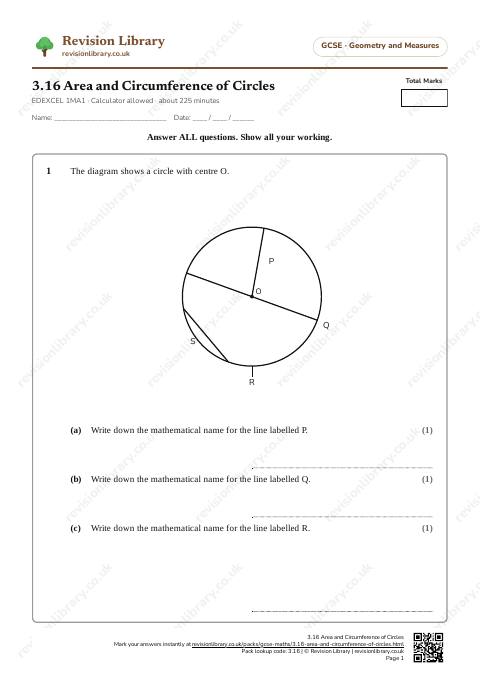
(a)Write down the mathematical name for the line labelled P.(1)
(b)Write down the mathematical name for the line labelled Q.(1)
(c)Write down the mathematical name for the line labelled R.(1)
(d)Write down the mathematical name for the line labelled S.(1)
(Total for Question 1 is 4 marks)
2
Answer each part below.
(a)The diameter of a circle is 12 cm. Write down the radius of the circle.(1)
(b)The radius of a circle is 4.5 cm. Write down the diameter of the circle.(1)
(Total for Question 2 is 2 marks)
3
A circle has diameter 9.4 cm. Write down the radius of the circle.
(Total for Question 3 is 1 mark)
4
Which of these is the correct formula for the circumference of a circle with radius r?
A) π x r
B) π x r2
C) 2 x π x r
D) π x r / 2
(Total for Question 4 is 1 mark)
5
Which of these is the correct formula for the area of a circle with radius r?
A) 2 x π x r
B) π x r2
C) π x r
D) 2 x π x r2
(Total for Question 5 is 1 mark)
6
A circle has radius 4 cm. Work out the circumference of the circle. Give your answer correct to 1 decimal place.
(Total for Question 6 is 2 marks)
7
A circle has diameter 10 cm. Work out the circumference of the circle. Give your answer as a multiple of π.
(Total for Question 7 is 2 marks)
8
A circle has radius 6 cm. Calculate the circumference of the circle. Give your answer correct to 1 decimal place.
(Total for Question 8 is 2 marks)
9
A circle has diameter 15 cm. Calculate the circumference of the circle. Give your answer correct to 1 decimal place.
(Total for Question 9 is 2 marks)
10
Work out the circumference of a circle with diameter 10 cm. Use π = 3.14.
(Total for Question 10 is 1 mark)
11
Grace is edging a circular flower bed with radius 3.5 m. Work out the length of edging she needs. Give your answer correct to 1 decimal place.
(Total for Question 11 is 2 marks)
12
The circumference of a circular table top is 37.68 cm. Use π = 3.14 to work out the diameter of the table top.
(Total for Question 12 is 2 marks)
13
A semicircle has radius 6 cm. Work out the perimeter of the semicircle. Give your answer correct to 1 decimal place.
Diagram NOT accurately drawn
(Total for Question 13 is 3 marks)
14
A semicircle has diameter 20 cm. Work out the area of the semicircle. Give your answer correct to 1 decimal place.
Diagram NOT accurately drawn
(Total for Question 14 is 3 marks)
15
The diagram shows a quarter circle with the two straight edges each of length 8 cm.
Diagram NOT accurately drawn
(a)Work out the area of the quarter circle. Give your answer correct to 1 decimal place.(3)
(b)Work out the perimeter of the quarter circle. Give your answer correct to 1 decimal place.(3)
(Total for Question 15 is 6 marks)
16
Jamal's bicycle wheel has diameter 0.65 m.
(a)Work out the circumference of the wheel. Give your answer correct to 2 decimal places.(2)
(b)The wheel rotates exactly 500 times as Jamal cycles to school. Work out the total distance he travels. Give your answer in metres, correct to the nearest metre.(2)
(Total for Question 16 is 4 marks)
17
A circle has area 78.5 cm². Use π = 3.14 throughout this question.
(a)Work out the radius of the circle.(3)
(b)Work out the diameter of the circle.(1)
(Total for Question 17 is 4 marks)
18
A semicircle has diameter 5 m. Work out the perimeter of the semicircle, including the diameter. Give your answer correct to 3 significant figures.
Diagram NOT accurately drawn
(Total for Question 18 is 3 marks)
19
A circle has radius 19 m. Work out the area of the circle. Give your answer in terms of π.
(Total for Question 19 is 2 marks)
20
A semicircle has diameter 32 m. Work out the perimeter of the semicircle, including the diameter. Give your answer correct to 3 significant figures.
Diagram NOT accurately drawn
(Total for Question 20 is 3 marks)
21
A circle has radius 6 cm. Work out the area of the circle. Give your answer correct to 1 decimal place.
(Total for Question 21 is 2 marks)
22
A circle has diameter 14 cm. Work out the area of the circle. Give your answer correct to 1 decimal place.
(Total for Question 22 is 3 marks)
23
Show that the area of a circle with radius 5 cm is 78.5 cm². Use π = 3.14.
(Total for Question 23 is 2 marks)
24
A circle has radius 2.5 m. Calculate the circumference of the circle. Give your answer correct to 2 decimal places.
(Total for Question 24 is 2 marks)
25
A circle has radius 1.2 cm. Work out the area of the circle. Give your answer correct to 2 decimal places.
(Total for Question 25 is 2 marks)
26
A circle has radius 4 cm. Work out the area of the circle. Give your answer correct to 1 decimal place.
(Total for Question 26 is 2 marks)
27
A circle has diameter 20 cm. Work out the area of the circle. Give your answer correct to the nearest whole number.
(Total for Question 27 is 2 marks)
28
A circle has radius 3.5 cm. Calculate the circumference of the circle. Give your answer as a multiple of π.
(Total for Question 28 is 1 mark)
29
A circle has radius 10 cm. Work out the area of the circle. Give your answer as a multiple of π.
(Total for Question 29 is 1 mark)
30
Work out the area of a circle with radius 5 cm. Use π = 3.14.
(Total for Question 30 is 2 marks)
31
A circular roundabout has diameter 12 m. Work out its area. Use π = 3.14 and give your answer to 1 decimal place.
(Total for Question 31 is 2 marks)
32
Work out the circumference of a circle with radius 2.5 cm. Use π = 3.14 and give your answer to 2 decimal places.
(Total for Question 32 is 3 marks)
33
The diagram shows a shape made from a rectangle measuring 12 cm by 8 cm, with a semicircle of diameter 8 cm attached to one of the 8 cm ends.
Diagram NOT accurately drawn
(a)Work out the perimeter of the shape. Give your answer correct to 1 decimal place.(3)
(b)Work out the area of the shape. Give your answer correct to 1 decimal place.(3)
(Total for Question 33 is 6 marks)
34
Chloe cuts a semicircular notch of diameter 10 cm out of one side of a rectangular sheet of card measuring 16 cm by 10 cm. Work out the area of card remaining. Give your answer correct to 1 decimal place.
Diagram NOT accurately drawn
(Total for Question 34 is 4 marks)
35
The diagram shows a quarter circle with both straight edges of length 14 cm. Work out the area of the quarter circle. Give your answer correct to 1 decimal place.
(Total for Question 35 is 2 marks)
36
A circle has radius 45 mm. Calculate the circumference of the circle. Give your answer in centimetres, correct to 1 decimal place.
(Total for Question 36 is 2 marks)
37
The minute hand of a clock has length 9 cm. Work out the distance travelled by the tip of the minute hand in exactly 1 hour. Give your answer correct to 1 decimal place.
(Total for Question 37 is 3 marks)
38
The area of a circle is 201 cm², correct to 3 significant figures. Work out the radius of the circle. Give your answer correct to 1 decimal place.
(Total for Question 38 is 2 marks)
39
The circumference of a circle is 69.1 cm, correct to 3 significant figures. Work out the diameter of the circle. Give your answer correct to 1 decimal place.
(Total for Question 39 is 2 marks)
40
The diagram shows a semicircle with diameter 26 cm. Work out the area of the semicircle. Give your answer correct to 1 decimal place.
(Total for Question 40 is 2 marks)
41
A circular flower bed has area 50.24 m². Use π = 3.14. Work out the radius of the flower bed, giving your answer to 2 decimal places.
(Total for Question 41 is 3 marks)
42
A circular pond has radius 4 m. A path of width 1 m runs all around the pond (the path is a ring around the circle). Work out the area of the path. Use π = 3.14 and give your answer to 1 decimal place.
(Total for Question 42 is 3 marks)
43
Work out the circumference of a circle with radius 7 cm. Give your answer in terms of π.
(Total for Question 43 is 2 marks)
44
A circular badge has diameter 10 cm. Work out the area of the badge. Give your answer in terms of π.
(Total for Question 44 is 3 marks)
45
Aaliyah makes a washer by cutting a circle of radius 6 cm out of the middle of a circle of radius 10 cm. Work out the area of the shaded washer (ring). Give your answer correct to 1 decimal place.
Diagram NOT accurately drawn
(Total for Question 45 is 4 marks)
46
Priya is choosing between two round pizzas. The small pizza has diameter 24 cm and costs £6.00. The large pizza has diameter 32 cm and costs £9.50. Work out which pizza is better value for money. You must show your working.
(Total for Question 46 is 5 marks)
47
Dev is fitting safety padding around the edge of a circular trampoline. The circumference of the trampoline is 18.8 m, correct to 3 significant figures. The padding is sold in strips of length 1.2 m, and each strip cannot be cut. Work out the minimum number of strips Dev needs to go all the way around the trampoline.
(Total for Question 47 is 3 marks)
48
The diagram shows the outline of a running track. It is made from two straight sections, each of length 90 m, and two semicircular ends, each with diameter 60 m. Work out the total distance around one lap of the track. Give your answer correct to the nearest metre.
(Total for Question 48 is 4 marks)
49
Kwame is a workshop technician. He cuts a circular hole of diameter 14 cm from the centre of a square sheet of steel with side length 30 cm, as shown in the diagram. Work out the area of steel remaining. Give your answer correct to 1 decimal place.
(Total for Question 49 is 4 marks)
50
A circular table top has area 153.86 cm². Use π = 3.14. Work out the diameter of the table top, giving your answer to 1 decimal place.
(Total for Question 50 is 4 marks)
51
A sector of a circle has radius 9 cm and angle 120 degrees. Work out the length of the arc of the sector. Give your answer in terms of π.
Diagram NOT accurately drawn
(Total for Question 51 is 4 marks)
52
A sector has radius 6 cm and central angle 150 degrees. Work out the area of the sector. Give your answer in terms of π.
Diagram NOT accurately drawn
(Total for Question 52 is 5 marks)
53
A coin has diameter 2.8 cm.
(a)Calculate the circumference of the coin. Give your answer correct to 1 decimal place.(2)
(b)A collector places 50 identical coins in a row, edge to edge, in a straight line. Work out the total length of the row of coins, in centimetres.(2)
(Total for Question 53 is 4 marks)
54
Fatima manages a leisure centre. A circular pool cover has radius 4 m. Fatima orders a new, larger cover with its radius increased by 20%. Work out the percentage increase in the area of the cover.
(Total for Question 54 is 4 marks)
55
Munira is comparing two circular drainpipes. Pipe A has internal diameter 80 mm. Pipe B has internal diameter 100 mm. Munira says, 'Pipe B can carry 25% more water than Pipe A, because its diameter is 25% bigger.' Use calculations to decide whether Munira is correct. You must show your working.
(Total for Question 55 is 5 marks)
56
Yusuf is painting a circular tabletop with diameter 1.4 m. He needs to apply 2 coats of paint. One litre of paint covers 10 m² for a single coat. Paint is sold in tins of 250 ml, and Yusuf can only buy whole tins. Work out the minimum number of tins Yusuf needs to buy.
(Total for Question 56 is 5 marks)
57
A circle is drawn inside a square of side length 20 cm so that the circle touches all four sides of the square, as shown in the diagram. Work out the area of the square that is not covered by the circle. Give your answer correct to 3 significant figures.
(Total for Question 57 is 4 marks)
58
A circle has area A cm2 and circumference C cm. Given that A = 5C, work out the radius of the circle.
(Total for Question 58 is 3 marks)
Mark scheme · 3.16 Area and Circumference of Circles
Put this topic and others into one printable pack.
Open the Pack Builder
Worksheets are written for Revision Library and come with a full mark scheme; a few English packs quote an out-of-copyright text, and name it on the page. Exam board names and specification codes say which qualification a pack suits: we are not affiliated with, endorsed by or approved by any exam board, and no past-paper question is reproduced here. Rights queries: hello@revisionlibrary.co.uk