A function machine is a diagram that applies a sequence of operations, such as multiply, add or subtract, to an input number to produce an output number. It is used at GCSE Foundation level to link arithmetic and algebra, including forming an expression for the output and working backwards from an output to find the input using inverse operations.
Read the machine from left to right and note each operation in the order it is applied.
To find an output, apply each operation to the input one at a time, in the order shown.
To find an input from a known output, work backwards through the machine using inverse operations in reverse order: undo addition with subtraction, undo multiplication with division, and so on.
Write the whole machine as a single algebraic expression by replacing the input with a letter and combining the operations.
Check your answer by substituting it back into the original machine to see if it gives the stated output.
Worked example
A function machine takes an input n. It multiplies n by 4, then subtracts 3, to give the output. (a) Work out the output when n = 6. (b) The output is 41. Find the input.
(a) Multiply the input by 4: 6 x 4 = 24.
Subtract 3 from the result: 24 - 3 = 21, so the output is 21.
(b) Work backwards from the output using inverse operations in reverse order. First add 3 to undo the subtraction: 41 + 3 = 44.
Then divide by 4 to undo the multiplication: 44 / 4 = 11.
Final answer: (a) output = 21; (b) input = 11.
Revision Library
revisionlibrary.co.uk
GCSE · Algebra
2.8 Function Machines
EDEXCEL 1MA1 · Calculator allowed · about 225 minutes
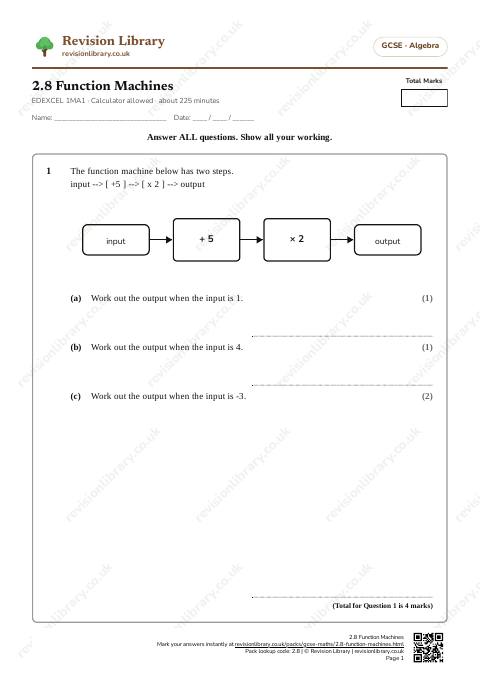
The function machine below has two steps. input --> [ +5 ] --> [ x 2 ] --> output
(a)Work out the output when the input is 1.(1)
(b)Work out the output when the input is 4.(1)
(c)Work out the output when the input is -3.(2)
(Total for Question 1 is 4 marks)
2
The function machine below subtracts 6 from every input. input --> [ -6 ] --> output Work out the input for each output given.
(a)The output is 10. Find the input.(1)
(b)The output is -2. Find the input.(1)
(c)The output is 0. Find the input.(1)
(Total for Question 2 is 3 marks)
3
A function machine multiplies the input by 6. The input is 7. Work out the output.
(Total for Question 3 is 1 mark)
4
A function machine subtracts 9 from the input. The input is 15. Work out the output.
(Total for Question 4 is 1 mark)
5
A function machine has two steps: input --> [ x 5 ] --> [ +2 ] --> output.
(a)Write down the inverse function machine (reverse the order and use the inverse operations).(2)
(b)Use your inverse function machine to find the input when the output is 27.(2)
(Total for Question 5 is 4 marks)
6
A coach company uses the function machine below to work out the total cost, C (in pounds), for a group booking with p passengers: p --> [ x 2.50 ] --> [ +1.20 ] --> C
(a)Work out the total cost for a group of 6 passengers.(2)
(b)Another group paid a total cost of £26.20. Work out how many passengers were in the group.(3)
(Total for Question 6 is 5 marks)
7
A sequence is generated using the function machine: term --> [ x 2 ] --> [ -3 ] --> next term. The first term is 5.
(a)Work out the second term.(1)
(b)Work out the third term.(2)
(Total for Question 7 is 3 marks)
8
Here is a function machine. input --> [ + 2 ] --> output The output is 5. Work out the input.
(Total for Question 8 is 2 marks)
9
Here is a function machine. input --> [ + 12 ] --> output Work out the output when the input is each of 3, 12, 9.
(Total for Question 9 is 3 marks)
10
Here is a function machine. input --> [ x 6 ] --> [ + 7 ] --> output The input is n. (a) Write an expression for the output. (b) Work out the output when n = 6.
(Total for Question 10 is 3 marks)
11
Here is a function machine. input --> [ + 2 ] --> [ - 2 ] --> output Work out the output when the input is 10, and when the input is 1.
(Total for Question 11 is 3 marks)
12
Here is a function machine. input --> [ - 4 ] --> output Work out the output when the input is each of 20, 2, 15.
(Total for Question 12 is 3 marks)
13
Here is a function machine. input --> [ + 5 ] --> [ x 2 ] --> output The input is n. (a) Write an expression for the output. (b) Work out the output when n = 8.
(Total for Question 13 is 3 marks)
14
Here is a function machine. input --> [ + 2 ] --> [ + 6 ] --> output Work out the output when the input is 8, and when the input is 2.
(Total for Question 14 is 3 marks)
15
Here is a function machine. input --> [ + 3 ] --> output Work out the output when the input is each of 8, 13, 18.
(Total for Question 15 is 3 marks)
16
Here is a function machine. input --> [ + 4 ] --> [ x 4 ] --> output The input is n. (a) Write an expression for the output. (b) Work out the output when n = 9.
(Total for Question 16 is 3 marks)
17
Here is a function machine. input --> [ x 4 ] --> [ - 9 ] --> output The output is 71. Work out the input.
(Total for Question 17 is 3 marks)
18
Here is a function machine. input --> [ x 3 ] --> output Work out the output when the input is each of 2, 5, 8.
(Total for Question 18 is 3 marks)
19
Here is a function machine. input --> [ + 8 ] --> [ - 8 ] --> output Work out the output when the input is 15, and when the input is 1.
(Total for Question 19 is 3 marks)
20
Here is a function machine. input --> [ x 6 ] --> [ - 6 ] --> output The output is 84. Work out the input.
(Total for Question 20 is 3 marks)
21
Here is a function machine. input --> [ - 10 ] --> output Work out the output when the input is each of 12, 15, 19.
(Total for Question 21 is 3 marks)
22
Here is a function machine. input --> [ - 6 ] --> [ - 7 ] --> output Work out the output when the input is 6, and when the input is 13.
(Total for Question 22 is 3 marks)
23
Here is a function machine. input --> [ + 9 ] --> [ x 4 ] --> output The input is n. (a) Write an expression for the output. (b) Work out the output when n = 10.
(Total for Question 23 is 3 marks)
24
Here is a function machine. input --> [ - 5 ] --> output Work out the output when the input is each of 6, 7, 5.
(Total for Question 24 is 3 marks)
25
Here is a function machine. input --> [ + 8 ] --> [ x 3 ] --> output The output is 36. Work out the input.
(Total for Question 25 is 3 marks)
26
Here is a function machine. input --> [ + 4 ] --> [ - 9 ] --> [ - 8 ] --> output Work out the output when the input is 10, and when the input is 8.
(Total for Question 26 is 3 marks)
27
Here is a function machine. input --> [ + 4 ] --> [ x 4 ] --> output The input is n. (a) Write an expression for the output. (b) Work out the output when n = 3.
(Total for Question 27 is 3 marks)
28
Here is a function machine. input --> [ + 5 ] --> [ - 9 ] --> output The output is -2. Work out the input.
(Total for Question 28 is 3 marks)
29
Here is a function machine. input --> [ x 11 ] --> output Work out the output when the input is each of 4, 19, 13.
(Total for Question 29 is 3 marks)
30
Here is a function machine. input --> [ x 9 ] --> [ + 4 ] --> output Work out the output when the input is 15, and when the input is 8.
(Total for Question 30 is 3 marks)
31
Here is a function machine. input --> [ x 4 ] --> [ + 9 ] --> output The input is n. (a) Write an expression for the output. (b) Work out the output when n = 5.
(Total for Question 31 is 3 marks)
32
Here is a function machine. input --> [ - 5 ] --> [ x 5 ] --> output The output is 35. Work out the input.
(Total for Question 32 is 3 marks)
33
Here is a function machine. input --> [ + 1 ] --> [ x 4 ] --> output The input is n. (a) Write an expression for the output. (b) Work out the output when n = 9.
(Total for Question 33 is 3 marks)
34
The function machine below has two steps. input --> [ x 3 ] --> [ -4 ] --> output Complete the table of outputs.
(a)input = 0(1)
(b)input = 2(1)
(c)input = 5(1)
(d)input = -1(1)
(Total for Question 34 is 4 marks)
35
Here is a function machine. input --> [ + 8 ] --> [ x 6 ] --> [ + 2 ] --> output Work out the output when the input is 12, and when the input is 15.
(Total for Question 35 is 3 marks)
36
Here is a function machine. input --> [ x 12 ] --> output Work out the output when the input is each of 8, 19, 8.
(Total for Question 36 is 3 marks)
37
Here is a function machine. input --> [ + 8 ] --> output The output is 12. Work out the input.
(Total for Question 37 is 2 marks)
38
Here is a function machine. input --> [ x 4 ] --> output Work out the output when the input is each of 17, 7, 6.
(Total for Question 38 is 3 marks)
39
Here is a function machine. input --> [ + 8 ] --> [ x 2 ] --> [ - 4 ] --> output Work out the output when the input is 5, and when the input is 13.
(Total for Question 39 is 3 marks)
40
Here is a function machine. input --> [ x 12 ] --> output Work out the output when the input is each of 15, 16, 15.
(Total for Question 40 is 3 marks)
41
Here is a function machine. input --> [ - 8 ] --> [ x 8 ] --> output Work out the output when the input is 5, and when the input is 14.
(Total for Question 41 is 3 marks)
42
Here is a function machine. input --> [ x 7 ] --> output Work out the output when the input is each of 7, 10, 16.
(Total for Question 42 is 3 marks)
43
Two function machines are described below. Find the missing operation in each.
(a)A function machine has the rule: input --> [ ? ] --> output. When the input is 3 the output is 15, and when the input is 6 the output is 30. Find the missing operation.(1)
(b)A function machine has two steps: input --> [ x 2 ] --> [ ? ] --> output. When the input is 4 the output is 5, and when the input is 10 the output is 17. Find the missing second operation.(2)
(Total for Question 43 is 3 marks)
44
A function machine multiplies the input by 3, then adds 5. The input is 4. Work out the output.
(Total for Question 44 is 2 marks)
45
A function machine adds 8 to the input, then divides the result by 2. The input is 10. Work out the output.
(Total for Question 45 is 2 marks)
46
A number enters Machine A which adds 4. The result goes into Machine B which multiplies by 5. The starting input is 6. Work out the final output.
(Total for Question 46 is 2 marks)
47
A function machine has two steps: input --> [ x 1.5 ] --> [ -2.5 ] --> output.
(a)Work out the output when the input is 10.(2)
(b)The output is 5. Find the input.(3)
(Total for Question 47 is 5 marks)
48
A function machine has the rule: input --> [ x k ] --> [ +4 ] --> output, where k is a number. When the input is 3, the output is 19. Find the value of k.
(Total for Question 48 is 3 marks)
49
A plumber uses the function machine below to work out the total charge, C (in pounds), for a job lasting h hours: h --> [ x 30 ] --> [ +45 ] --> C
(a)Work out the total charge for a job that takes 3 hours.(2)
(b)A job cost a total of £165. Work out how many hours the job took.(3)
(Total for Question 49 is 5 marks)
50
Two function machines are connected. Machine 1: n --> [ x 2 ] --> [ +1 ] --> result. The result from Machine 1 becomes the input for Machine 2. Machine 2: result --> [ x 3 ] --> [ -4 ] --> final output.
(a)Work out the final output when n = 2.(1)
(b)Find the value of n that gives a final output of 29.(3)
(Total for Question 50 is 4 marks)
51
A function machine adds 15 to the input then divides by 5. The output is 14. Work out the input.
(Total for Question 51 is 2 marks)
52
A function machine doubles the input then subtracts 3. The output is 19. Work out the input.
(Total for Question 52 is 2 marks)
53
A function machine multiplies the input by 7 then subtracts 2. Write an expression in terms of x for the output.
(Total for Question 53 is 1 mark)
54
Let f(x) = 2x - 7 and g(x) = x + 3. Work out g(f(2)).
(Total for Question 54 is 2 marks)
55
A machine applies f(x) = 3x + 2 then a second machine applies g(x) = x - 5. Work out all values of x such that g(f(x)) = 22.
(Total for Question 55 is 3 marks)
56
A function f is linear: f(x) = ax + b. Given f(2) = 11 and f(5) = 20, work out a and b, then find the input that gives output 38.
(Total for Question 56 is 4 marks)
57
A machine multiplies the input by 3/2 then subtracts 4. The output is 8. Work out the input.
(Total for Question 57 is 3 marks)
Mark scheme · 2.8 Function Machines
A correct answer earns full marks unless the question asks for working, a method, proof or explanation.
Question 1
(a) 12 caoB1
(a) Answer: 12
(b) 18 caoB1
(b) Answer: 18
(c) 2 seen (correct value after the first step, -3+5)M1
(c) 4 caoA1
(c) Answer: 4
Question 2
(a) 16 caoB1
(a) Answer: 16
(b) 4 caoB1
(b) Answer: 4
(c) 6 caoB1
(c) Answer: 6
Question 3
42 caoB1
Answer: 42 (because 6 x 7 = 42).
Question 4
6 caoB1
Answer: 6 (because 15 - 9 = 6).
Question 5
(a) correct inverse operations identified: -2 and /5M1
Put this topic and others into one printable pack.
Open the Pack Builder
Worksheets are written for Revision Library and come with a full mark scheme; a few English packs quote an out-of-copyright text, and name it on the page. Exam board names and specification codes say which qualification a pack suits: we are not affiliated with, endorsed by or approved by any exam board, and no past-paper question is reproduced here. Rights queries: hello@revisionlibrary.co.uk