Revision Library
Choose a subject
Menu

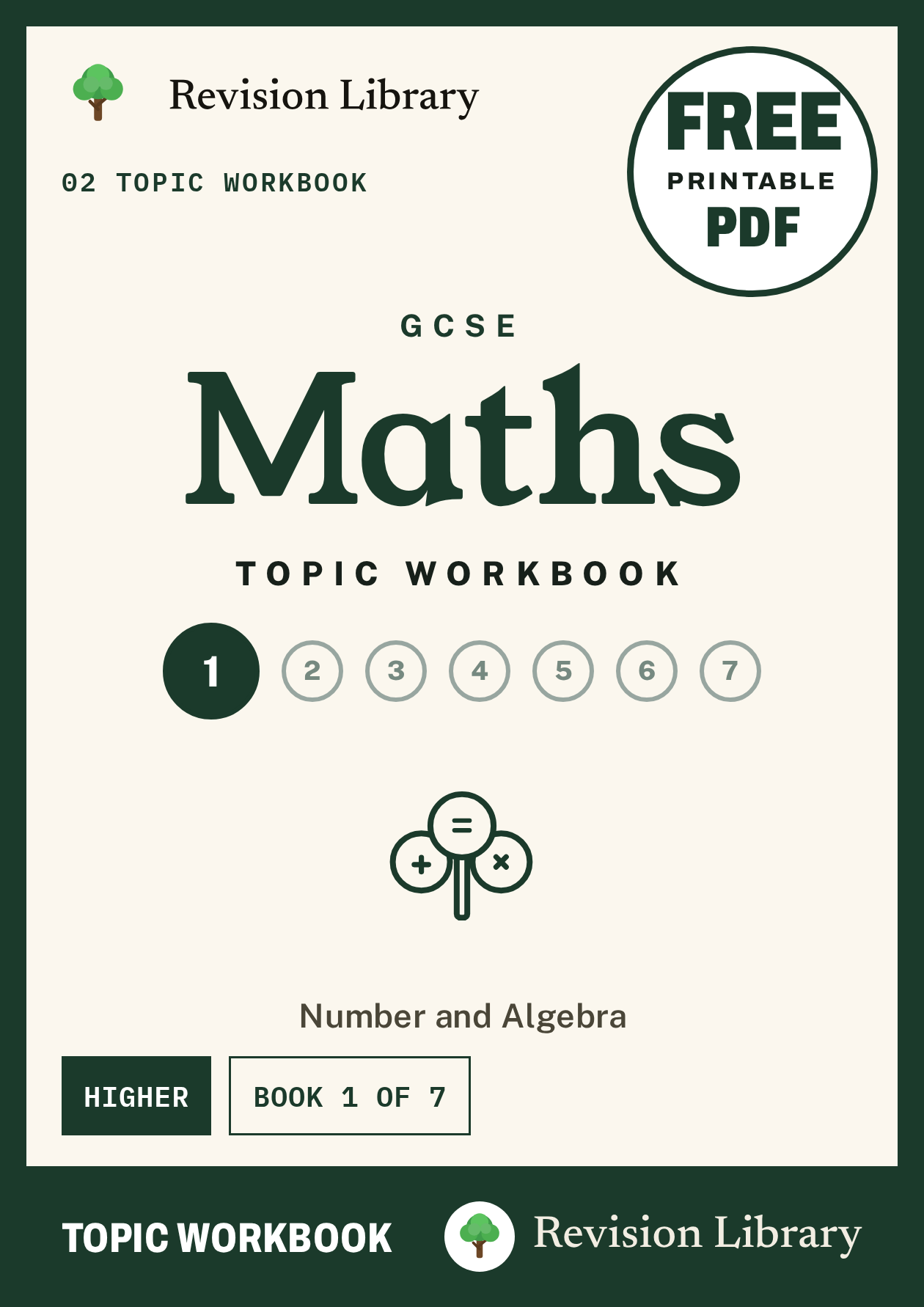
GCSE Maths Foundation Topic Workbooks · Book 2 of 9

GCSE Maths Foundation Topic Workbook 2

Estimating, Percentage Change, Indices and 10 more

Level
GCSE Foundation · Edexcel 1MA1 · AQA 8300 · OCR J560
Series
GCSE Maths Foundation Topic Workbooks, book 2 of 9
Suitable for
Years 10-11, AQA / Edexcel / OCR

Foundation tier rewards accuracy on the topics that come up every year far more than it rewards breadth. Each volume takes a run of related topics in curriculum order and gives you the fluency practice first, then the exam-style questions on the same material, so a weak topic gets rebuilt rather than revised around.

FreePDF download · 2027 edition · 113 A4 pages
  • One file, prints straight to A4
  • No account, no password

Workbooks like this one, with 13 topics, 208 questions and mark schemes at the back, are usually printed and sold by publishers. This one is one of 558 free PDFs on the shelf.

Pages
113 A4 pages
Chapters
13 worksheet chapters
Questions
208 · 619 marks
Answers
From page 96
Working time
About 12h 55m

What is inside

13 chapters · answers from p96

Each chapter starts with a page showing its marks and a suggested time, followed by the questions. The mark schemes for all 13 chapters are at the back, so the book works for homework, a timed test or revision.

  1. 01Estimating18 questions · 42 marks · about 55 min Topic guide: Estimatingp3
  2. 02Percentage Change15 questions · 47 marks · about 60 min Topic guide: Percentage Changep8
  3. 03Indices15 questions · 57 marks · about 70 min Topic guide: Indicesp13
  4. 04Prime Factors, HCF and LCM15 questions · 47 marks · about 60 min Topic guide: Prime Factors, HCF and LCMp20
  5. 05Reverse Percentages16 questions · 41 marks · about 50 min Topic guide: Reverse Percentagesp26
  6. 06Standard Form15 questions · 48 marks · about 60 min Topic guide: Standard Formp32
  7. 07Simplifying Algebra20 questions · 40 marks · about 50 min Topic guide: Simplifying Algebrap38
  8. 08Writing an Expression21 questions · 42 marks · about 55 min Topic guide: Writing an Expressionp44
  9. 09Function Machines14 questions · 53 marks · about 65 min Topic guide: Function Machinesp53
  10. 10Solving One Step Equations16 questions · 41 marks · about 50 min Topic guide: Solving One Step Equationsp62
  11. 11Substitution15 questions · 56 marks · about 70 min Topic guide: Substitutionp68
  12. 12Solving Equations12 questions · 65 marks · about 80 min Topic guide: Solving Equationsp75
  13. 13Drawing Linear Graphs16 questions · 40 marks · about 50 min Topic guide: Drawing Linear Graphsp82
  14. AnswersMark schemes for every chapterp96

Each chapter is drawn from one of our worksheet packs. Follow a chapter title for the full pack on its own page, or browse every GCSE Maths pack. Every book on the shelf is a complete printable workbook of up to 120 A4 pages.

Explore this volume

GCSE Maths Foundation Topic Workbook 2 includes Estimating (from page 3); Percentage Change (from page 8); Indices (from page 13); Prime Factors, HCF and LCM (from page 20); Reverse Percentages (from page 26); Standard Form (from page 32); Simplifying Algebra (from page 38); Writing an Expression (from page 44); Function Machines (from page 53); Solving One Step Equations (from page 62); Substitution (from page 68); Solving Equations (from page 75); Drawing Linear Graphs (from page 82).

Worked question 15 - Standard Form

Open the included worksheet

A cuboid has a volume of 4.8 x 108 mm3.
The length of the cuboid is 1.2 x 104 mm and the width of the cuboid is 8 x 102 mm.

Diagram: a cuboid labelled with length 1.2 x 104 mm, width 8 x 102 mm and an unknown height h.
Diagram NOT accurately drawn
1.2 x 104mm8 x 102mmh
(a)Work out the height of the cuboid, in mm. Give your answer in standard form.(3)
(b)Given that 1 m = 1000 mm, work out the height of the cuboid in metres. Give your answer in standard form.(3)

Answer and mark scheme

Question 15

CreditAnswer or working
M1(a) finds length x width, (1.2 x 104) x (8 x 102) = 9.6 x 10⁶
M1(a) dependent, divides volume by their length x width, (4.8 x 10⁸) / (9.6 x 10⁶)
A1(a) 5 x 101 cao (50 mm)
M1(b) ft, divides their part (a) answer by 103, e.g. (5 x 101) / (1 x 10³)
M1(b) dependent, subtracts powers correctly, 101 / 103 = 10-2
A1(b) ft, 5 x 10⁻² cao (0.05 m)
  • (a) Answer: 5 x 101 mm (50 mm)
  • (b) Answer: 5 x 10⁻² m (0.05 m)
Question 9 - Standard Form

Open the included worksheet

A single red blood cell has a volume of 9.0 x 10⁻¹¹ cm3.
An adult has approximately 2.5 x 10¹³ red blood cells in their body.
Work out the total volume of all the red blood cells in the adult's body. Give your answer, in cm3, in standard form, correct to 2 significant figures.

Answer and mark scheme

Question 9

CreditAnswer or working
M1multiplies coefficients, 9.0 x 2.5 = 22.5
M1adds powers of 10, -11 + 13 = 2, giving 22.5 x 10²
A12.25 x 103 (unrounded standard form value)
B1ft, awrt 2.3 x 10³ (cm3)
  • Answer: 2.3 x 103 cm3 (awrt, 2 sig figs)

Question 14 - Standard Form

Open the included worksheet

A company produces microchips. Each microchip has a mass of 2.5 x 10⁻⁴ g.
The company packs the microchips into boxes. Each box has a maximum mass of 1.5 kg.
(a)Work out the maximum number of microchips that can be packed into one box.(3)
(b)The company has an order for 3.6 x 10⁷ microchips. Work out the minimum number of boxes needed to pack this order.(2)

Answer and mark scheme

Question 14

CreditAnswer or working
M1(a) converts 1.5 kg to grams, 1.5 kg = 1.5 x 10³ g
M1(a) sets up (1.5 x 10³) / (2.5 x 10⁻⁴)
A1(a) 6 x 10⁶ cao (6000000 microchips)
M1(b) ft, divides 3.6 x 10⁷ by their part (a) answer
A1(b) 6 (boxes) cao, rounded up to a whole number of boxes if not exact
  • (a) Answer: 6 x 10⁶ microchips
  • (b) Answer: 6 boxes

Question 14 - Estimating

Open the included worksheet

Explain why rounding 148 to 1 significant figure gives 100, and not 150.

Answer and mark scheme

Question 14

CreditAnswer or working
B1identifying that the first significant figure is the hundreds digit, 1, and all following digits become 0 for 1 sf
B1correct reasoning that the next digit (4, the tens digit) is less than 5, so the 1 is not rounded up, giving 100; 150 is not a rounding to 1 significant figure
  • Answer: 100, because the first significant figure (1) is followed by a 4, which is less than 5, so it rounds down; 150 has two significant figures, not one.

Question 17 - Estimating

Open the included worksheet

By rounding each number to 1 significant figure, estimate the value of (6.9 x 103) x (3.8 x 10-5). Give your answer in standard form.

Answer and mark scheme

Question 17

CreditAnswer or working
M1rounding both values to 1 sf, 7 and 4
M1dep, 7 x 4 = 28 with powers of 10 combined, 103 x 10-5 = 10-2
A12.8 x 10-1 cao (accept 0.28)
  • Answer: 2.8 x 10⁻¹

Question 9 - Reverse Percentages

Open the included worksheet

Tom says, 'A laptop's price was reduced by 15% in a sale. To find the original price from the sale price, you should increase the sale price by 15%.'
Tom is wrong.
Explain why Tom is wrong. You should include an example with numbers to support your answer.

Answer and mark scheme

Question 9

CreditAnswer or working
B1states the sale price should be divided by 0.85 (not increased by 15%), since the sale price is 85% of the original oe
B1correct supporting numerical example showing the two methods give different results, e.g. sale price £85: 85 / 0.85 = 100 (correct) but 85 x 1.15 = 97.75 (incorrect)
  • Answer: Tom is wrong; you must divide by 0.85, not increase by 15%. For example, a sale price of £85 gives an original price of £100, not £97.75.

Question 11 - Reverse Percentages

Open the included worksheet

A shop increases the price of a laptop by 20%. In a later sale, the shop reduces this new price by 20%. The final sale price of the laptop is £249.60.
Work out the price of the laptop before the first increase.

Answer and mark scheme

Question 11

CreditAnswer or working
M1overall multiplier 1.20 x 0.80 (= 0.96) found oe
M1249.60 / 0.96 used, dependent on a correct method for the overall multiplier
A1£260 cao
  • Answer: £260

GCSE Maths Foundation Topic Workbooks runs to 9 volumes

Book 2 of 9 · 1,011 pages in the set

Each book is a separate free PDF.

Volume 1

114 pp · 256 Qs

Addition and Subtraction, Multiplication and Division, Writing, Simplifying and Ordering Fractions and 12 more

Volume 2 · this book

113 pp · 208 Qs

Estimating, Percentage Change, Indices and 10 more

Volume 3

109 pp · 154 Qs

Inequalities, Forming and Solving Equations, Sequences (Nth Term) and 6 more

Volume 4

107 pp · 174 Qs

Simultaneous Equations, Solving Simultaneous Equations Graphically, Gradient of a Line and 9 more

Volume 5

112 pp · 151 Qs

Compound Interest and Depreciation, Real Life and Distance Time Graphs, Writing a Ratio as a Fraction or Linear Function and 7 more

Volume 6

116 pp · 133 Qs

Area and Circumference of Circles, Transformations, Area of Compound Shapes and 6 more

Volume 7

116 pp · 119 Qs

Loci and Construction, Bearings, Plans and Elevations and 5 more

Volume 8

112 pp · 126 Qs

Vectors, Systematic Listing, Probability (Foundation) and 6 more

Volume 9

112 pp · 108 Qs

Bar Charts, Stem and Leaf, Pie Charts and 4 more

More GCSE Foundation books

Want a different mix of topics?

Sitting an exam soon? Build a GCSE Maths mock paper or print a ready-made one.