Converting units means changing a measurement from one unit to another, for example between metric units of length, mass, capacity, time or speed, while keeping the same underlying quantity, including area and volume unit conversions. It combines with speed, density and time throughout GCSE papers.
Learn the standard metric conversion facts, for example 1 km = 1000 m, 1 kg = 1000 g, 1 litre = 1000 ml, 1 m = 100 cm.
To convert from a larger unit to a smaller unit, multiply by the conversion factor; to convert from a smaller unit to a larger unit, divide.
For area conversions, square the length conversion factor, for example 1 m2 = 1002 = 10000 cm2; for volume, cube it.
For time and speed conversions, remember there are 60 minutes in an hour and 3600 seconds in an hour, and convert distance and time to consistent units before dividing.
When comparing or ordering measurements, convert every value to the same unit first.
Check your final answer is a sensible size for the unit you have converted into.
Worked example
A car travels at a constant speed of 54 km/h. Show that this speed is equal to 15 m/s.
Convert 54 km to metres: 54 x 1000 = 54000 m.
Convert 1 hour to seconds: 1 x 3600 = 3600 s.
Divide the distance in metres by the time in seconds: 54000 / 3600.
Work out the division: 54000 / 3600 = 15.
State the final answer: 54 km/h is equal to 15 m/s, as required.
Revision Library
revisionlibrary.co.uk
GCSE · Ratio, Proportion and Rates of Change
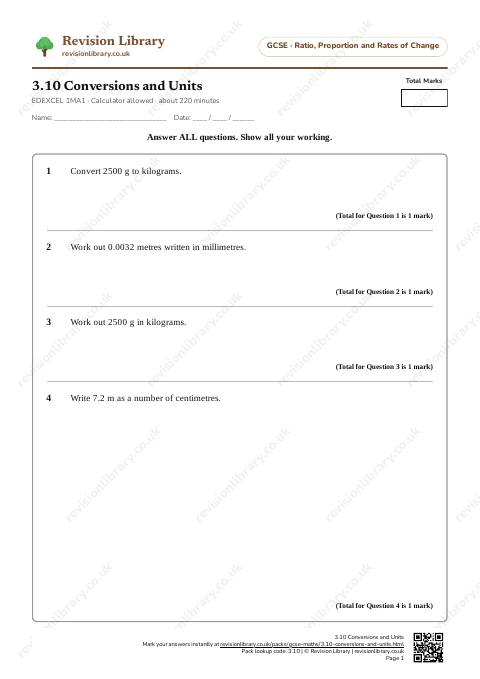
3.10 Conversions and Units
EDEXCEL 1MA1 · Calculator allowed · about 220 minutes
Write down the missing number in each metric conversion fact.
(a)1 km = _____ m(1)
(b)1 kg = _____ g(1)
(c)1 litre = _____ ml(1)
(d)1 m = _____ cm(1)
(Total for Question 5 is 4 marks)
6
The diagram shows part of a ruler.
(a)Write down the length shown by the arrow. Give your answer in centimetres.(1)
(b)Give your answer to part (a) in millimetres.(1)
(Total for Question 6 is 2 marks)
7
Convert each measurement to the unit shown.
(a)Convert 3.5 m to cm.(1)
(b)Convert 4200 g to kg.(1)
(c)Convert 1.2 litres to ml.(1)
(Total for Question 7 is 3 marks)
8
Write 5.4 km as a number of metres.
(Total for Question 8 is 1 mark)
9
Write 2.4 litres as a number of millilitres.
(Total for Question 9 is 3 marks)
10
A 1.5 litre bottle of juice is shared into glasses of 250 ml. Work out how many full glasses can be filled.
(Total for Question 10 is 2 marks)
11
Work out 3 hours 45 minutes in minutes.
(Total for Question 11 is 2 marks)
12
Convert 4.5 km into metres.
(Total for Question 12 is 2 marks)
13
Write 1200 ml as a number of litres.
(Total for Question 13 is 2 marks)
14
Convert 5 metres into centimetres and into millimetres. Give both answers with units.
(a)Write 5 m in centimetres.(2)
(b)Write 5 m in millimetres.(2)
(Total for Question 14 is 4 marks)
15
A film lasts 1 hour 48 minutes and starts at 14:35.
(a)Write the length of the film in minutes only.(1)
(b)Work out the time the film finishes. Give your answer using the 24-hour clock.(2)
(Total for Question 15 is 3 marks)
16
Deepak buys three pieces of fencing wire with lengths 2.4 m, 85 cm and 630 mm. He joins them together to make one length of wire. Work out the total length of the wire. Give your answer in metres.
(Total for Question 16 is 3 marks)
17
Given that 1 gallon is about 4.5 litres, change 112.5 litres into gallons.
(Total for Question 17 is 2 marks)
18
A water tank is a cuboid 40 cm long, 20 cm wide and 50 cm high. 1 litre = 1000 cm³. How many litres of water does it hold when full?
Diagram NOT accurately drawn
(Total for Question 18 is 3 marks)
19
A cyclist travels at 198 km/h. Convert this speed to metres per second.
(Total for Question 19 is 3 marks)
20
A mat has area 15000 cm². Write this area in m2.
(Total for Question 20 is 2 marks)
21
A train travels at 14 m/s. Convert this speed to kilometres per hour.
(Total for Question 21 is 3 marks)
22
A water tank is a cuboid 25 cm long, 100 cm wide and 10 cm high. 1 litre = 1000 cm³. How many litres of water does it hold when full?
Diagram NOT accurately drawn
(Total for Question 22 is 3 marks)
23
Aisha has four lengths of ribbon: 850 mm, 0.7 m, 76 cm and 0.008 km. Write the four lengths in order of size, starting with the smallest.
(Total for Question 23 is 3 marks)
24
Convert between units of time.
(a)Convert 2.25 hours into hours and minutes.(2)
(b)Convert 100 minutes into hours and minutes.(2)
(Total for Question 24 is 4 marks)
25
A coach timetable shows a coach leaving Sheffield at 08:55 and arriving in Leeds at 11:20 (both times shown using the 24-hour clock).
(a)Write 19:45 using the 12-hour clock.(1)
(b)Work out how long the coach journey from Sheffield to Leeds takes. Give your answer in hours and minutes.(2)
(Total for Question 25 is 3 marks)
26
The exchange rate is £1 sterling (£) = 1.16 euros (EUR).
(a)Nadia changes £250 into euros. Work out how many euros she receives.(2)
(b)On the way home Nadia changes 87 euros back into £, using the same exchange rate. Work out how many £ she receives.(2)
(Total for Question 26 is 4 marks)
27
You are given that 5 miles is approximately 8 km, and 1 kg is approximately 2.2 pounds (lb).
(a)A road sign shows a distance of 40 miles. Change this to kilometres.(2)
(b)A parcel weighs 9 kg. Change this to pounds (lb).(2)
(Total for Question 27 is 4 marks)
28
Work out 12500 mm³ expressed in cm3.
(Total for Question 28 is 2 marks)
29
Convert 25000 cm² to square metres (m2).
(Total for Question 29 is 2 marks)
30
Convert 12.5 m² into cm2.
(Total for Question 30 is 2 marks)
31
Work out 0.072 m³ expressed in litres.
(Total for Question 31 is 2 marks)
32
On a map 1 cm represents 4 km. A route measures 7.5 cm on the map. Work out the actual distance in kilometres.
(Total for Question 32 is 3 marks)
33
Convert 6500 mm into metres. Give the answer with the correct unit.
(Total for Question 33 is 3 marks)
34
A cake recipe uses 0.75 kg of flour and 350 g of sugar. Work out the total mass of flour and sugar in kilograms.
(Total for Question 34 is 3 marks)
35
A car travels 90 km in 1.5 hours. Work out its average speed in kilometres per hour. Give the unit.
(Total for Question 35 is 3 marks)
36
Convert the following areas.
(a)Convert 3.2 m² to cm2.(2)
(b)Convert 45000 cm² to m2.(2)
(Total for Question 36 is 4 marks)
37
A fish tank in the shape of a cuboid has length 60 cm, width 30 cm and height 40 cm.
Diagram NOT accurately drawn
(a)Work out the volume of the tank in cm3.(2)
(b)Given that 1000 cm³ = 1 litre, work out the maximum volume of water the tank can hold. Give your answer in litres.(2)
(Total for Question 37 is 4 marks)
38
A recipe for flapjacks that serves 6 people uses 750 g of oats.
(a)Write 750 g in kilograms.(1)
(b)Bilal wants to make enough flapjacks to serve 15 people, using the recipe in the same proportions. Work out how many kilograms of oats he needs.(3)
(Total for Question 38 is 4 marks)
39
Two tins of the same paint are sold in a DIY shop. Tin A contains 2.5 litres and costs £18. Tin B contains 750 ml and costs £5.85.
(a)Work out the price per litre for Tin A.(1)
(b)Work out the price per litre for Tin B.(2)
(c)Which tin is the better value for money? Give a reason for your answer.(1)
(Total for Question 39 is 4 marks)
40
Convert 250 km² into hectares.
(Total for Question 40 is 2 marks)
41
Work out 36000 cm³ expressed in cubic metres (m3).
(Total for Question 41 is 2 marks)
42
Convert 75 mm² into square metres (m2).
(Total for Question 42 is 2 marks)
43
Work out 4.8 km/h in metres per second. Give an exact value if possible.
(Total for Question 43 is 2 marks)
44
A car is travelling at 90 km/h. Work out its speed in metres per second.
(Total for Question 44 is 2 marks)
45
Convert 3.5 tonnes to kilograms and to grams. Give both answers with units.
(a)Write 3.5 tonnes in kilograms.(2)
(b)Write 3.5 tonnes in grams.(2)
(Total for Question 45 is 4 marks)
46
A painter uses 2.5 litres of paint to cover 12 square metres. Work out how many litres of paint are needed for 1 square metre. Give your answer to 2 decimal places.
(Total for Question 46 is 3 marks)
47
This question has two parts.
(a)Write 3 hours 20 minutes as a number of hours to 3 decimal places.(2)
(b)A car travels 200 km in that time. Work out the average speed in km/h. Give the unit.(2)
(Total for Question 47 is 4 marks)
48
A recipe uses 450 millilitres of milk. Kit wants to make 0.6 of the recipe. Work out the volume of milk Kit needs in litres.
(Total for Question 48 is 2 marks)
49
The density of aluminium is 2.7 g/cm3. Work out the density of aluminium in kg/m3.
(Total for Question 49 is 3 marks)
50
Freya drives a distance of 175 miles. You are given that 5 miles is approximately 8 km. The journey takes 2 hours 30 minutes.
(a)Work out the distance in kilometres.(2)
(b)Work out Freya's average speed for the journey in km/h.(3)
(Total for Question 50 is 5 marks)
51
A car's fuel consumption is quoted as 40 miles per gallon (mpg). You are given that 1 gallon is approximately 4.5 litres, and 5 miles is approximately 8 km.
(a)Work out the car's fuel consumption in kilometres per litre. Give your answer to 1 decimal place.(3)
(b)The car's fuel tank holds 50 litres. Estimate how far the car can travel on a full tank. Give your answer in kilometres.(2)
(Total for Question 51 is 5 marks)
52
Convert 72 km/h into centimetres per second (cm/s). Show your working.
(Total for Question 52 is 3 marks)
53
A train travels 108 km in 1.5 hours. Work out its average speed in metres per second. Give your answer to the nearest whole number.
(Total for Question 53 is 3 marks)
54
Write 0.00042 kilograms in grams and then in milligrams.
(Total for Question 54 is 2 marks)
55
A rectangular pool is 12.5 m long, 4 m wide and 1.6 m deep. Work out the volume of water in the pool in litres.
(Total for Question 55 is 4 marks)
56
A cyclist travels 18 metres in 2 seconds. Work out the speed in metres per second and convert this speed into kilometres per hour, correct to the nearest whole number.
(Total for Question 56 is 5 marks)
57
An engineer is designing a cylindrical water tank with radius r metres and height h metres. Give an expression for the volume in cubic metres. The engineer needs the volume in litres. Show the algebraic steps to convert the expression for volume in m3 into litres and state the final expression in terms of r and h.
(Total for Question 57 is 6 marks)
Mark scheme · 3.10 Conversions and Units
Question 1
2.5 kg caoB1
Answer: 2.5 kg
Question 2
3.2 mm caoB1
Answer: 3.2 mm
Question 3
2.5 kg caoB1
Answer: 2.5 kg
Question 4
720 cm caoB1
Answer: 720 cm
Question 5
(a) 1000 caoB1
(a) Answer: 1000
(b) 1000 caoB1
(b) Answer: 1000
(c) 1000 caoB1
(c) Answer: 1000
(d) 100 caoB1
(d) Answer: 100
Question 6
(a) 7.4 caoB1
(a) Answer: 7.4 cm
(b) 74 ft from (a)B1
(b) Answer: 74 mm
Question 7
(a) 350 caoB1
(a) Answer: 350 cm
(b) 4.2 caoB1
(b) Answer: 4.2 kg
(c) 1200 caoB1
(c) Answer: 1200 ml
Question 8
5400 m caoB1
Answer: 5400 m
Question 9
method, 2.4 x 1000 or move decimalM1
2400 caoA1
include unit ml: 2400 mlB1
Answer: 2400 ml
Question 10
convert 1.5 L to 1500 ml and divide by 250 or method showing 1500 ÷ 250M1
6 caoA1
Answer: 6
Question 11
correct method, converting 3 hours to 180 minutes or 45 minutes to 0.75 hoursM1
225 minutes caoA1
Answer: 225 minutes
Question 12
method shown, 4.5 x 1000 or move decimalM1
4500 m caoA1
Answer: 4500 m
Question 13
method shown, divide 1200 by 1000 or move decimalM1
1.2 L caoA1
Answer: 1.2 L
Question 14
(a) method, 5 x 100M1
(a) 500 cm caoA1
(a) Answer: 500 cm
(b) method, 5 x 1000M1
(b) 5000 mm caoA1
(b) Answer: 5000 mm
Question 15
(a) 108 caoB1
(a) Answer: 108 minutes
(b) adds 1 hour 48 minutes to 14:35, e.g. via 15:35 then + 48 minutesM1
(b) 16:23 caoA1
(b) Answer: 16:23
Question 16
converts all three lengths to metres: 2.4 m, 0.85 m, 0.63 mM1
dep, adds the three converted lengthsM1
3.88 (m) caoA1
Answer: 3.88 m
Question 17
112.5 / 4.5M1
25 gallonsA1
Answer: 25 gallons
Question 18
40 x 20 x 50 = 40000M1
divides by 1000M1
40 litresA1
Answer: 40 litres
Question 19
198 x 1000 (metres per hour)M1
divides by 3600M1
55 m/sA1
Answer: 55 m/s
Question 20
divides by 100 x 100 = 10000M1
1.5 m²A1
Answer: 1.5 m2
Question 21
14 x 3600 (metres per hour)M1
divides by 1000M1
50.4 km/hA1
Answer: 50.4 km/h
Question 22
25 x 100 x 10 = 25000M1
divides by 1000M1
25 litresA1
Answer: 25 litres
Question 23
converts at least three of the four lengths to a common unitM1
all four lengths correctly converted to a common unit, oe (70 cm, 76 cm, 85 cm, 800 cm)A1
correct final order caoA1
Answer: 0.7 m, 76 cm, 850 mm, 0.008 km
Question 24
(a) 0.25 x 60 (= 15)M1
(a) 2 hours 15 minutes oe caoA1
(a) Answer: 2 hours 15 minutes
(b) 100 / 60 or equivalent divisionM1
(b) 1 hour 40 minutes oe caoA1
(b) Answer: 1 hour 40 minutes
Question 25
(a) 7:45 pm cao (accept 7.45 pm)B1
(a) Answer: 7:45 pm
(b) correct method, e.g. 08:55 to 09:00 is 5 minutes, then 09:00 to 11:20 is 2 hours 20 minutesM1
(b) 2 hours 25 minutes caoA1
(b) Answer: 2 hours 25 minutes
Question 26
(a) 250 x 1.16M1
(a) 290 (euros) caoA1
(a) Answer: 290 euros
(b) 87 / 1.16M1
(b) 75 (pounds) caoA1
(b) Answer: £75
Question 27
(a) 40 / 5 x 8, or equivalent scalingM1
(a) 64 (km) caoA1
(a) Answer: 64 km
(b) 9 x 2.2M1
(b) 19.8 (lb) awrt 19.8A1
(b) Answer: 19.8 lb
Question 28
use 1 cm³ = 1000 mm³ or divide by 1000 oeM1
12.5 cm³ caoA1
Answer: 12.5 cm3
Question 29
divide by 10000 (conversion cm2 to m2) oeM1
2.5 m² caoA1
Answer: 2.5 m2
Question 30
multiply 12.5 by 10000 (conversion factor m2 to cm2) oeM1
125000 cm² caoA1
Answer: 125000 cm2
Question 31
use 1 m³ = 1000 litres, multiply 0.072 by 1000 oeM1
72 L caoA1
Answer: 72 L
Question 32
method, 7.5 x 4M1
30 caoA1
unit km included: 30 kmB1
Answer: 30 km
Question 33
method, divide 6500 by 1000 or move decimalM1
6.5 caoA1
units m included: 6.5 mB1
Answer: 6.5 m
Question 34
correct conversion of 0.75 kg to 750 g or 350 g to 0.35 kgM1
correct addition of masses (750 + 350 = 1100 g or 0.75 + 0.35 = 1.1 kg)M1
1.1 kg caoA1
Answer: 1.1 kg
Question 35
division method, 90 ÷ 1.5M1
60 caoA1
unit given: 60 km/hB1
Answer: 60 km/h
Question 36
(a) 3.2 x 10000, using 1 m² = 10000 cm²M1
(a) 32000 (cm2) caoA1
(a) Answer: 32000 cm2
(b) 45000 / 10000, using 1 m² = 10000 cm²M1
(b) 4.5 (m2) caoA1
(b) Answer: 4.5 m2
Question 37
(a) 60 x 30 x 40M1
(a) 72000 (cm3) caoA1
(a) Answer: 72000 cm3
(b) their (a) / 1000, dep on (a)M1
(b) 72 (litres) ftA1
(b) Answer: 72 litres
Question 38
(a) 0.75 caoB1
(a) Answer: 0.75 kg
(b) 750 / 6 (= 125), finding the oats needed per personM1
(b) their 125 x 15, depM1
(b) 1.875 (kg) oe cao (accept 1875 g)A1
(b) Answer: 1.875 kg
Question 39
(a) 7.20 (pounds per litre) caoB1
(a) Answer: £7.20 per litre
(b) converts 750 ml to 0.75 litres, then 5.85 / 0.75M1
(b) 7.80 (pounds per litre) caoA1
(b) Answer: £7.80 per litre
(c) Tin A, ft, with correct reason (lower price per litre: 7.20 < 7.80)C1
(c) Answer: Tin A, because it costs less per litre (£7.20 compared with £7.80).
Question 40
use 1 km² = 100 hectares, multiply 250 x 100 oeM1
25000 hectares caoA1
Answer: 25000 hectares
Question 41
divide by 1 000 000 (conversion cm3 to m3) oeM1
0.036 m³ caoA1
Answer: 0.036 m3
Question 42
use 1 mm² = 1e-6 m², multiply 75 x 1e-6 oeM1
0.000075 m² caoA1
Answer: 0.000075 m2
Question 43
apply conversion factor 1 km/h = 5/18 m/s (or multiply by 5/18) oeM1
4/3 m/s or 1.333... m/s caoA1
Answer: 4/3 m/s (1.333... m/s)
Question 44
convert 90 km/h to m/s by multiplying by 5/18 oeM1
25 m/s caoA1
Answer: 25 m/s
Question 45
(a) method, 3.5 x 1000M1
(a) 3500 kg caoA1
(a) Answer: 3500 kg
(b) method, 3.5 x 1 000 000 or 3500 x 1000M1
(b) 3500000 g caoA1
(b) Answer: 3500000 g
Question 46
method, 2.5 ÷ 12M1
correct calculation 0.208333... shownM1
0.21 L/m2 awrtA1
Answer: 0.21 L/m2
Question 47
(a) method, 20 minutes = 20/60 hoursM1
(a) 3.333 hours cao to 3 dpA1
(a) Answer: 3.333 hours
(b) method, 200 ÷ 3.333M1
(b) 60 km/h caoA1
(b) Answer: 60 km/h
Question 48
450 * 0.6 = 270 ml method or 450/1000 * 0.6M1
0.27 L caoA1
Answer: 0.27 L
Question 49
converts 2.7 g to kg, e.g. 2.7 / 1000 = 0.0027 kg (per cm3), or uses 1 g/cm3 = 1000 kg/m3M1
dep, converts 1 cm³ to (1/100)3 = 0.000001 m³ and divides 0.0027 by 0.000001, or completes 0.0027 x 1000000dM1
2700 (kg/m3) caoA1
Answer: 2700 kg/m3
Question 50
(a) 175 / 5 x 8, or equivalent scalingM1
(a) 280 (km) caoA1
(a) Answer: 280 km
(b) converts 2 hours 30 minutes to 2.5 hoursM1
(b) their (a) / 2.5, depM1
(b) 112 (km/h) caoA1
(b) Answer: 112 km/h
Question 51
(a) converts 40 miles to km: 40 / 5 x 8 (= 64)M1
(a) their 64 / 4.5, depM1
(a) awrt 14.2 (km per litre)A1
(a) Answer: awrt 14.2 km per litre
(b) 50 x their (a), or 50 x 64/4.5 unroundedM1
(b) ft, awrt 710-711 (km)A1
(b) Answer: awrt 711 km
Question 52
convert km/h to m/s: 72 x 5/18 = 20 m/s oeM1
convert m/s to cm/s by multiplying by 100 oeM1
2000 cm/s caoA1
Answer: 2000 cm/s
Question 53
find speed in km/h: 108 / 1.5 = 72 km/h oeM1
convert 72 km/h to m/s by multiplying by 5/18 oeM1
20 m/s cao (nearest whole number)A1
Answer: 20 m/s
Question 54
convert to grams: 0.00042 * 1000 = 0.42 g shownM1
420 mg cao (0.42 g = 420 mg)A1
Answer: 0.42 g and 420 mg
Question 55
calculate volume in m3: 12.5 x 4 x 1.6 oeM1
find 80 m³ result or show the multiplication correctly oeM1
80000 caoA1
correct unit stated as litresB1
Answer: 80000 L
Question 56
compute speed in m/s: 18 / 2 = 9 m/sM1
9 m/s caoA1
convert to km/h: 9 * 3.6 or 9 * 3600 / 1000M1
method to nearest whole number shownM1
32 km/h caoA1
Answer: 9 m/s, 32 km/h
Question 57
write volume in m3: π * r2 * hM1
state conversion 1 m³ = 1000 LM1
multiply expression by 1000 to convert to litresM1
1000 * π * r2 * h litres caoA1
show any algebraic rearrangement if needed, e.g. VL = 1000 π r2 h oeM1
final expression VL = 1000 π r2 h caoA1
Answer: Volume in m3 = π * r2 * h. In litres: V = 1000 * π * r2 * h L
Put this topic and others into one printable pack.
Open the Pack Builder
Worksheets are written for Revision Library and come with a full mark scheme; a few English packs quote an out-of-copyright text, and name it on the page. Exam board names and specification codes say which qualification a pack suits: we are not affiliated with, endorsed by or approved by any exam board, and no past-paper question is reproduced here. Rights queries: hello@revisionlibrary.co.uk