Compound shapes are made by combining two or more simple shapes, such as rectangles, triangles and semicircles, and their area is found by splitting the shape into these simpler parts, then adding or subtracting the separate areas. This is a common GCSE geometry skill, often combined with real-life costing questions.
Split the compound shape into simple shapes you know the area formulas for, such as rectangles, triangles or semicircles.
Work out any missing lengths using the given measurements, since opposite or adjacent sides of a rectilinear shape are often equal or add up to a known total.
Calculate the area of each simple shape separately, showing your working clearly.
Add the areas together if the shapes are joined, or subtract if one shape, such as a hole or notch, has been removed from another.
Check your final answer has the correct units, such as cm2 or m2, and multiply by a cost per unit area if the question asks for a total cost.
Worked example
A garden is L-shaped, made from a rectangle 9 m by 6 m with a rectangular section 3 m by 2 m removed from one corner. Work out the area of the garden.
Area of the full rectangle = 9 x 6 = 54 m2.
Area of the removed section = 3 x 2 = 6 m2.
Subtract the removed section from the full rectangle: 54 - 6.
Final answer: 48 m2.
Revision Library
revisionlibrary.co.uk
GCSE · Geometry and Measures
3.18 Area of Compound Shapes
EDEXCEL 1MA1 · Calculator allowed · about 230 minutes
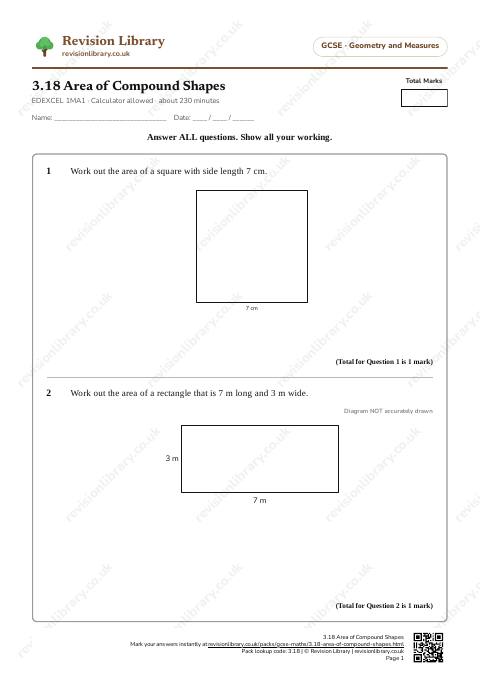
Work out the area of a square with side length 7 cm.
(Total for Question 1 is 1 mark)
2
Work out the area of a rectangle that is 7 m long and 3 m wide.
Diagram NOT accurately drawn
(Total for Question 2 is 1 mark)
3
The diagram shows a rectangle. Work out the area of the rectangle.
Diagram NOT accurately drawn
(Total for Question 3 is 2 marks)
4
The diagram shows a right-angled triangle. Work out the area of the triangle.
Diagram NOT accurately drawn
(Total for Question 4 is 2 marks)
5
Jamal has cut a piece of card that is made from two rectangles, A and B, joined together. Rectangle A measures 7 cm by 4 cm. Rectangle B measures 3 cm by 2 cm. Work out the total area of the card.
Diagram NOT accurately drawn
(Total for Question 5 is 3 marks)
6
An L-shaped figure is made from two rectangles. One rectangle is 6 cm by 4 cm and the other is 3 cm by 4 cm. Work out the total area of the L-shape.
(Total for Question 6 is 2 marks)
7
A rectangle measures 10 cm by 6 cm. A small rectangle of size 3 cm by 2 cm has been removed from one corner. Work out the area of the remaining shape.
(Total for Question 7 is 2 marks)
8
A rectangle is 12 cm by 5 cm. A square of side 3 cm is removed from one corner. Work out the area of the shape left.
(Total for Question 8 is 2 marks)
9
A rectangle measures 12 cm by 9 cm. A smaller rectangle of size 4 cm by 3 cm inside it is shaded. Work out the area of the unshaded part of the rectangle.
(Total for Question 9 is 2 marks)
10
A triangle has base 8 cm and height 5 cm. Work out its area.
Diagram NOT accurately drawn
(Total for Question 10 is 2 marks)
11
The shape is made of a rectangle 6 cm by 4 cm with a right-angled triangle on top. The triangle has base 6 cm and height 3 cm. Work out the total area of the shape.
Diagram NOT accurately drawn
(Total for Question 11 is 3 marks)
12
A rectangular paving slab has area 48 m² and length 6 m. Work out the width of the slab.
(Total for Question 12 is 2 marks)
13
The diagram shows an L-shaped courtyard. The bottom edge is 10 m, the left-hand edge is 7 m, the top edge is 6 m and the lower right-hand edge is 4 m. All corners are right angles.
Diagram NOT accurately drawn
(a)Work out the area of the courtyard.(3)
(b)Work out the perimeter of the courtyard.(3)
(Total for Question 13 is 6 marks)
14
The diagram shows a garage roof end made from a rectangle with a triangle on top, forming a pentagon shape. The rectangle is 8 m wide and 5 m tall. The triangle on top has a base of 8 m and a perpendicular height of 3 m. Work out the total area of the garage end.
Diagram NOT accurately drawn
(Total for Question 14 is 4 marks)
15
A rectangular picture frame measures 15 cm by 8 cm on the outside. A rectangular window measuring 6 cm by 3 cm is cut from the middle of the frame to hold the photo. Work out the area of the frame itself (not including the window).
Diagram NOT accurately drawn
(Total for Question 15 is 4 marks)
16
Kwame's garden is a rectangle 10 m by 6 m. A rectangular flowerbed 3 m by 2 m is dug in one corner. The rest of the garden is turfed.
Diagram NOT accurately drawn
(a)Work out the area to be turfed.(2)
(b)Turf costs £7.25 per m2. Work out the total cost of the turf.(2)
(Total for Question 16 is 4 marks)
17
The diagram shows a bracket-shaped piece of steel. The overall shape is a rectangle 14 cm by 6 cm, with a rectangular notch cut from the middle of the top edge. The notch is 6 cm wide and 3 cm deep. Work out the area of the steel bracket.
Diagram NOT accurately drawn
(Total for Question 17 is 5 marks)
18
The diagram shows a shape made from a rectangle 6.5 cm wide and 4 cm tall, with a triangle on top sharing the same 6.5 cm base. The perpendicular height of the triangle is 2.4 cm. Work out the total area of the shape.
Diagram NOT accurately drawn
(Total for Question 18 is 4 marks)
19
An L-shape is made by taking a rectangle 15 m by 7 m and cutting a rectangle 6 m by 4 m out of one corner. Work out the perimeter of the L-shape.
Diagram NOT accurately drawn
(Total for Question 19 is 3 marks)
20
An L-shape is made by taking a rectangle 20 cm by 15 cm and cutting a rectangle 14 cm by 11 cm out of one corner. Work out the area of the L-shape.
Diagram NOT accurately drawn
(Total for Question 20 is 3 marks)
21
A rectangular lawn is 14 m by 8 m. A path of width 4 m goes all the way round the outside of the lawn. Work out the area of the path.
Diagram NOT accurately drawn
(Total for Question 21 is 4 marks)
22
A shape is made from a rectangle 15 m by 9 m and a right-angled triangle joined along a 9 m side. The triangle has base 10 m and height 9 m. Work out the total area of the shape.
Diagram NOT accurately drawn
(Total for Question 22 is 3 marks)
23
An L-shape is made by taking a rectangle 17 cm by 8 cm and cutting a rectangle 10 cm by 5 cm out of one corner. Work out the area of the L-shape.
Diagram NOT accurately drawn
(Total for Question 23 is 3 marks)
24
The diagram shows a shape made from a rectangle with a triangle on top. The rectangle is 6 cm wide and 4 cm tall. The total height of the whole shape is 7 cm. Work out the area of the whole shape.
Diagram NOT accurately drawn
(Total for Question 24 is 4 marks)
25
The diagram shows an L-shaped piece of sheet metal. Show that the area of the shape is 83 cm².
Diagram NOT accurately drawn
(Total for Question 25 is 4 marks)
26
The diagram shows a cross-shaped garden bed made from two overlapping rectangles. The vertical rectangle measures 4 m by 12 m. The horizontal rectangle measures 10 m by 4 m. The square where they overlap measures 4 m by 4 m. Work out the total area of the garden bed.
Diagram NOT accurately drawn
(Total for Question 26 is 4 marks)
27
Priya's living room is L-shaped. It is made from a rectangle 5 m by 4 m with an alcove that adds a rectangle 2 m by 1.5 m.
Diagram NOT accurately drawn
(a)Work out the total floor area of the living room.(2)
(b)Carpet for the room costs £18.50 per m2. Work out the total cost of the carpet.(2)
(Total for Question 27 is 4 marks)
28
A rectangular garden measures 15 m by 9 m. A square patio measuring 6 m by 6 m is built in one corner of the garden. The rest of the garden is grass. Work out the area of grass.
Diagram NOT accurately drawn
(Total for Question 28 is 3 marks)
29
The diagram shows a T-shaped tile. The top bar of the T is 14 cm wide and 3 cm tall. The vertical stem is 4 cm wide. The total height of the tile is 10 cm. Work out the area of the tile.
Diagram NOT accurately drawn
(Total for Question 29 is 4 marks)
30
The shape below is made from two rectangles joined together. Rectangle A is 8 cm by 5 cm and rectangle B is 5 cm by 3 cm. Work out the total area of the shape.
(Total for Question 30 is 3 marks)
31
A composite shape is made from two rectangles side by side. Both rectangles have height 6 cm. The left rectangle has width 4 cm. The total area of the composite shape is 60 cm². Find the width of the right rectangle.
(Total for Question 31 is 3 marks)
32
Two rectangles, A (5 m by 2 m) and B (3 m by 2 m), are joined along aligned complete 2 m sides to form a rectangle. Find the area of the resulting rectangle.
Diagram NOT accurately drawn
(Total for Question 32 is 3 marks)
33
Work out the area of a trapezium with parallel sides 7 cm and 3 cm and height 4 cm. (Use area = (1/2) * (sum of parallel sides) * height.)
Diagram NOT accurately drawn
(Total for Question 33 is 3 marks)
34
Work out the area of a parallelogram with base 9 cm and perpendicular height 4 cm.
Diagram NOT accurately drawn
(Total for Question 34 is 2 marks)
35
A compound shape is made from a rectangle measuring 8 cm by 5 cm joined to a second rectangle that is x cm wide and 3 cm tall. The total area of the whole shape is 58 cm². Find the value of x.
Diagram NOT accurately drawn
(Total for Question 35 is 4 marks)
36
The diagram shows a shop sign made from a rectangle with a semicircle on one end. The rectangle measures 14 cm by 8 cm. The semicircle has a diameter of 8 cm, the same as the width of the rectangle. Calculate the total area of the sign. Give your answer correct to 3 significant figures.
Diagram NOT accurately drawn
(Total for Question 36 is 4 marks)
37
A rectangular playground is 20 m by 12 m. A paved patio of 6 m by 5 m occupies one corner. Work out the area of the playground that is not paved.
(Total for Question 37 is 3 marks)
38
A large rectangle is 18 cm by 10 cm. A central rectangle of 8 cm by 6 cm is not shaded. Find the area of the shaded part of the large rectangle.
(Total for Question 38 is 3 marks)
39
Two congruent right-angled triangles each have legs 6 cm and 8 cm. They are joined along their hypotenuses to form a kite. Work out the area of the kite.
Diagram NOT accurately drawn
(Total for Question 39 is 3 marks)
40
A garden is made from a large rectangle 8.0 m by 5.0 m. A small rectangular pond 3.0 m by 2.0 m is removed from one corner. A triangular flowerbed with base 4.0 m and height 1.5 m is added along one long edge of the large rectangle. Work out the total area of the garden.
(Total for Question 40 is 6 marks)
41
A roof tile is shaped like a rectangle 12 cm by 8 cm with a small isosceles triangle attached along the short side. The triangle has base 8 cm and height 3 cm. Work out the area of one tile.
Diagram NOT accurately drawn
(Total for Question 41 is 4 marks)
42
Fatima and Rhys are comparing two designs for a new decked area in their garden. Design A is an L-shape: an overall rectangle 6 m by 5 m with a 2 m by 2 m corner cut off. Decking for Design A costs £24.99 per m2. Design B is a rectangle 5.5 m by 4.5 m. Decking for Design B costs £26.50 per m2.
Diagram NOT accurately drawn
(a)Work out the total cost of decking for Design A.(2)
(b)Work out the total cost of decking for Design B.(2)
(c)Which design should Fatima and Rhys choose if they want the cheaper decking? Give a reason, supported by your figures from parts (a) and (b).(2)
(Total for Question 42 is 6 marks)
43
A cross-shaped figure is formed by a central square of side 6 cm and four identical rectangular arms attached to the middle of each side of the square. Each arm is 2 cm by 4 cm. Work out the total area of the cross.
(Total for Question 43 is 3 marks)
44
A notice panel is a rectangle measuring 120 cm by 80 cm. A triangular corner is cut away; the triangle has base 30 cm and height 40 cm. Work out the area of the remaining panel in square metres. Give your answer to 2 decimal places.
Diagram NOT accurately drawn
(Total for Question 44 is 6 marks)
45
A classroom notice board is a compound shape: a rectangle 2.0 m by 1.2 m with a small rectangle of 0.4 m by 0.6 m removed from one corner. Work out the area of the notice board to 2 decimal places in square metres.
Diagram NOT accurately drawn
(Total for Question 45 is 5 marks)
46
A right-angled triangle has legs 8 cm and 15 cm. A quarter-circle sector with radius 8 cm is attached to the shorter leg so that the right angle of the triangle and the centre of the sector coincide. Find the total area of the combined shape (triangle plus sector). Give your answer as an exact expression in terms of π and as a decimal to 2 decimal places.
Diagram NOT accurately drawn
(Total for Question 46 is 3 marks)
47
A composite shape is formed by removing a semicircular notch from a square of side 10 cm. The diameter of the semicircle equals the side of the square. Calculate the area of the remaining shape. Give your answer in terms of π and as a decimal to 1 decimal place.
Diagram NOT accurately drawn
(Total for Question 47 is 4 marks)
48
A gardener makes a raised flower bed in the shape of a rectangle 6 m by 3 m. At each end she places a semicircular planting area whose diameters are the short side of the rectangle, so the semicircles extend beyond the rectangle. She covers the combined area with turf costing £4.50 per square metre. Work out the total cost of turf to the nearest pound. Show your working.
Diagram NOT accurately drawn
(Total for Question 48 is 6 marks)
49
A rectangular garden is 14 m by 10 m. A path of uniform width x metres runs all the way around the inside of the garden, leaving a rectangular lawn in the centre. The area of the lawn is 84 m². Find the width of the path. Give the exact value and a decimal approximation to 2 decimal places.
(Total for Question 49 is 5 marks)
Mark scheme · 3.18 Area of Compound Shapes
Question 1
49 cm² caoB1
Answer: 49 cm2 (or 49)
Question 2
21 m² caoB1
Answer: 21 m2
Question 3
8 x 5M1
40 (cm2) caoA1
Answer: 40 cm2
Question 4
0.5 x 6 x 4M1
12 (cm2) caoA1
Answer: 12 cm2
Question 5
area of A = 7 x 4 (= 28)M1
area of B = 3 x 2 (= 6)M1
34 (cm2) caoA1
Answer: 34 cm2
Question 6
find areas of the two rectangles, 6×4 and 3×4, or equivalent methodM1
36 cm² cao (24 + 12 = 36)A1
Answer: 36 cm2
Question 7
60 - 3×2, or equivalent subtraction methodM1
54 cm² caoA1
Answer: 54 cm2
Question 8
60 - 3×3, or equivalent subtraction methodM1
51 cm² caoA1
Answer: 51 cm2
Question 9
108 - 4×3, or equivalent subtractionM1
96 cm² caoA1
Answer: 96 cm2
Question 10
uses 1/2 * base * height or equivalent methodM1
20 cm² caoA1
Answer: 20 cm2
Question 11
area rectangle = 6 * 4 = 24 cm² or equivalentM1
area triangle = 1/2 * 6 * 3 = 9 cm² or equivalentM1
33 cm² cao (24 + 9)A1
Answer: 33 cm2
Question 12
uses width = area / length or equivalentM1
8 m caoA1
Answer: 8 m
Question 13
(a) finds a missing length, e.g. 10 - 6 (= 4) or 7 - 4 (= 3)M1
(a) correct method for area, e.g. 10 x 7 - 4 x 3M1
(a) 58 (m2) caoA1
(a) Answer: 58 m2
(b) finds both missing lengths (4 and 3)M1
(b) adds all six side lengthsM1
(b) 34 (m) caoA1
(b) Answer: 34 m
Question 14
area of rectangle = 8 x 5 (= 40)M1
area of triangle = 0.5 x 8 x 3 (= 12)M1
adds the two areasM1
52 (m2) caoA1
Answer: 52 m2
Question 15
outer area = 15 x 8 (= 120)M1
window area = 6 x 3 (= 18)M1
subtracts window from outer areaM1
102 (cm2) caoA1
Answer: 102 cm2
Question 16
(a) 10 x 6 - 3 x 2M1
(a) 54 (m2) caoA1
(a) Answer: 54 m2
(b) their (a) x 7.25, ftM1
(b) 391.50 (pounds) cao, ft from (a)A1
(b) Answer: £391.50
Question 17
overall area = 14 x 6 (= 84)M1
notch area = 6 x 3 (= 18)M1
identifies that the notch must be subtracted onceM1
84 - 18M1
66 (cm2) caoA1
Answer: 66 cm2
Question 18
area of rectangle = 6.5 x 4 (= 26)M1
area of triangle = 0.5 x 6.5 x 2.4 (= 7.8)M1
adds the two areasM1
33.8 (cm2) caoA1
Answer: 33.8 cm2
Question 19
the cut-out edges replace the removed sides: 6 + 4 added, 6 + 4 removed (or a full method)M1
sums the six sidesM1
44 mA1
Answer: 44 m
Question 20
20 x 15 = 300M1
14 x 11 = 154M1
146 cm²A1
Answer: 146 cm2
Question 21
outer length 22 and width 16M1
outer area 352M1
subtracts lawn area 112M1
240 m²A1
Answer: 240 m2
Question 22
15 x 9M1
1/2 x 10 x 9M1
180 m²A1
Answer: 180 m2
Question 23
17 x 8 = 136M1
10 x 5 = 50M1
86 cm²A1
Answer: 86 cm2
Question 24
height of triangle = 7 - 4 (= 3)M1
area of rectangle = 6 x 4 (= 24)M1
area of triangle = 0.5 x 6 x 3 (= 9)M1
33 (cm2) caoA1
Answer: 33 cm2
Question 25
finds one missing length, e.g. 12 - 7 (= 5) or 9 - 4 (= 5)M1
splits shape into two rectangles, e.g. 12 x 4 and 7 x 5 (or equivalent split)M1
adds the two areas correctly, e.g. 48 + 35 (or 108 - 25)M1
83 (cm2) cso, with all working shownA1
Answer: 83 cm2 (shown)
Question 26
area of vertical rectangle = 4 x 12 (= 48)M1
area of horizontal rectangle = 10 x 4 (= 40)M1
subtracts the overlap once, e.g. 48 + 40 - 16M1
72 (m2) caoA1
Answer: 72 m2
Question 27
(a) 5 x 4 + 2 x 1.5M1
(a) 23 (m2) caoA1
(a) Answer: 23 m2
(b) their (a) x 18.50, ftM1
(b) 425.50 (pounds) cao, ft from (a)A1
(b) Answer: £425.50
Question 28
15 x 9 (= 135)M1
6 x 6 (= 36)M1
99 (m2) caoA1
Answer: 99 m2
Question 29
stem height = 10 - 3 (= 7)M1
area of top bar = 14 x 3 (= 42)M1
area of stem = 4 x 7 (= 28)M1
70 (cm2) caoA1
Answer: 70 cm2
Question 30
find area of rectangle A (8×5 = 40) or evidence of splittingM1
find area of rectangle B (5×3 = 15)M1
55 cm² caoA1
Answer: 55 cm2
Question 31
form equation (4 + x) × 6 = 60 or equivalentM1
solve for x: 6(4 + x) = 60 -> 4 + x = 10M1
x = 6 cm caoA1
Answer: 6 cm
Question 32
area rectangle A = 5 * 2 = 10 m²M1
area rectangle B = 3 * 2 = 6 m²M1
16 m² cao (10 + 6)A1
Answer: 16 m2
Question 33
substitute into formula: 1/2*(7+3)*4 or equivalentM1
compute 1/2*10*4 = 20M1
20 cm² caoA1
Answer: 20 cm2
Question 34
uses area = base * height: 9 * 4M1
36 cm² caoA1
Answer: 36 cm2
Question 35
area of rectangle 1 = 8 x 5 (= 40)M1
forms the equation 40 + 3x = 58 (oe)M1
3x = 18M1
x = 6 caoA1
Answer: x = 6
Question 36
identifies radius = 4M1
area of rectangle = 14 x 8 (= 112)M1
area of semicircle = 0.5 x π x 42 (awrt 25.1)M1
awrt 137 (cm2), 3 sfA1
Answer: 137 cm2 (3 sf)
Question 37
use 20×12 - 6×5 or equivalentM1
compute 240 - 30M1
210 m² caoA1
Answer: 210 m2
Question 38
use 18×10 - 8×6 or equivalent subtraction methodM1
compute 180 - 48M1
132 cm² caoA1
Answer: 132 cm2
Question 39
area of one right triangle = 1/2 * 6 * 8 = 24 cm²M1
two triangles area = 24 * 2 = 48 cm²M1
48 cm² caoA1
Answer: 48 cm2
Question 40
area large rectangle = 8.0 * 5.0 = 40.0 m²M1
area pond = 3.0 * 2.0 = 6.0 m²M1
area triangle = 1/2 * 4.0 * 1.5 = 3.0 m²M1
subtract pond: 40.0 - 6.0 = 34.0 m²A1
add triangle: 34.0 + 3.0 = 37.0 m²A1
37.0 m² caoA1
Answer: 37.0 m2
Question 41
area rectangle = 12 * 8 = 96 cm²M1
area triangle = 1/2 * 8 * 3 = 12 cm²M1
compute total 96 + 12 = 108 cm²A1
108 cm² caoA1
Answer: 108 cm2
Question 42
(a) area of A = 6 x 5 - 2 x 2 (= 26)M1
(a) cost = 649.74 (pounds) caoA1
(a) Answer: £649.74
(b) area of B = 5.5 x 4.5 (= 24.75)M1
(b) cost = 655.88 (pounds), awrt, caoA1
(b) Answer: £655.88 (awrt)
(c) states Design A (ft from their (a) and (b) if consistent)B1
(c) correct reason with correct figures compared, e.g. 649.74 < 655.88 so Design A is £6.14 cheaperC1
(c) Answer: Design A, because it is £6.14 cheaper
Question 43
area central square = 6×6 = 36 or equivalentM1
area for four arms = 4×(2×4) = 32 or equivalentM1
total = 36 + 32 = 68 cm² caoA1
Answer: 68 cm2
Question 44
area rectangle = 120 * 80 = 9600 cm²M1
area triangle = 1/2 * 30 * 40 = 600 cm²M1
subtract triangle: 9600 - 600 = 9000 cm²M1
convert to m2: 9000 cm² = 9000 / 10000 = 0.9 m²M1
give value to 2 dp: 0.90 m²A1
0.90 m² caoA1
Answer: 0.90 m2
Question 45
area large rectangle = 2.0 * 1.2 = 2.4 m²M1
area small removed rectangle = 0.4 * 0.6 = 0.24 m²M1
Put this topic and others into one printable pack.
Open the Pack Builder
Worksheets are written for Revision Library and come with a full mark scheme; a few English packs quote an out-of-copyright text, and name it on the page. Exam board names and specification codes say which qualification a pack suits: we are not affiliated with, endorsed by or approved by any exam board, and no past-paper question is reproduced here. Rights queries: hello@revisionlibrary.co.uk