Indices (or powers) are a shorthand for repeated multiplication: an means a multiplied by itself n times. The rules of indices allow expressions involving powers to be simplified without expanding them out, essential for algebra, standard form and surds.
When multiplying powers of the same base, add the indices: am x an = am+n.
When dividing powers of the same base, subtract the indices: am divided by an = am-n.
When raising a power to another power, multiply the indices: (am)n = amn.
Any non-zero number to the power 0 equals 1: a0 = 1.
A negative index means 'reciprocal': a-n = 1/(an).
A fractional index means a root: a1/n is the nth root of a, and am/n is the nth root of a, raised to the power m.
Worked example
Simplify (3x4)2 x 2x-3, giving your answer as a single term.
Deal with the bracket first: (3x4)2 = 32 x x4x2 = 9x8.
Multiply by 2x-3: 9x8 x 2x-3 = (9 x 2) x x8 + -3.
9 x 2 = 18, and 8 + -3 = 5.
So the simplified expression is 18x5.
Revision Library
revisionlibrary.co.uk
GCSE · Number
4.2 Indices
EDEXCEL 1MA1 · Calculator allowed · about 225 minutes
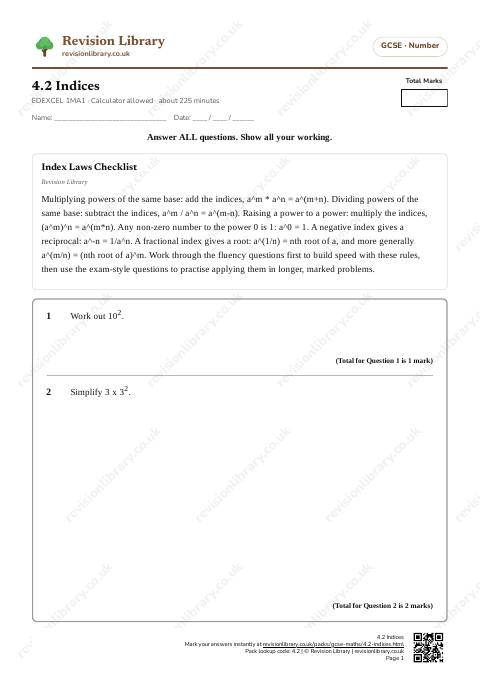
Multiplying powers of the same base: add the indices, a^m * a^n = a^(m+n). Dividing powers of the same base: subtract the indices, a^m / a^n = a^(m-n). Raising a power to a power: multiply the indices, (a^m)^n = a^(m*n). Any non-zero number to the power 0 is 1: a^0 = 1. A negative index gives a reciprocal: a^-n = 1/a^n. A fractional index gives a root: a^(1/n) = nth root of a, and more generally a^(m/n) = (nth root of a)^m. Work through the fluency questions first to build speed with these rules, then use the exam-style questions to practise applying them in longer, marked problems.
1
Work out 102.
(Total for Question 1 is 1 mark)
2
Simplify 3 x 32.
(Total for Question 2 is 2 marks)
3
Work out the value of each of the following.
(a)62(1)
(b)25(1)
(c)90(1)
(Total for Question 3 is 3 marks)
4
Write each of the following as a single power.
(a)4 x 4 x 4 x 4 x 4(1)
(b)7 x 7 x 7(1)
(c)2 x 2 x 2 x 2 x 2 x 2 x 2(1)
(Total for Question 4 is 3 marks)
5
Simplify each of the following, giving your answer as a single power.
(a)53 x 54(1)
(b)89 / 86(1)
(c)(32)4(1)
(Total for Question 5 is 3 marks)
6
Work out the value of 34.
(Total for Question 6 is 1 mark)
7
Work out 43 and give the answer in standard form if needed.
(Total for Question 7 is 3 marks)
8
Simplify 62 ÷ 61.
(Total for Question 8 is 3 marks)
9
Work out the value of each of the following.
(a)251/2(1)
(b)81/3(1)
(c)811/4(1)
(Total for Question 9 is 3 marks)
10
Simplify each of the following.
(a)(2x3)2(2)
(b)(5y2)3(2)
(Total for Question 10 is 4 marks)
11
Solve each of the following equations.
(a)2x = 32(2)
(b)3x+1 = 81(2)
(Total for Question 11 is 4 marks)
12
Answer each of the following.
(a)Given that 2a x 25 = 212, work out the value of a.(2)
(b)Given that (3b)2 = 310, work out the value of b.(2)
(Total for Question 12 is 4 marks)
13
Simplify fully (6x5 y3) / (2x2 y5)
(Total for Question 13 is 4 marks)
14
Which of these is equal to 5-2 ?
A) 1/25
B) -25
C) 25
D) -1/25
(Total for Question 14 is 1 mark)
15
Simplify (8a3) / (4a)
(Total for Question 15 is 2 marks)
16
Find the value of n. (7n)2 = 74
(Total for Question 16 is 2 marks)
17
Simplify 4a5c5 x 2a2c6
(Total for Question 17 is 2 marks)
18
Simplify 3k2n4 x 2k5n
(Total for Question 18 is 2 marks)
19
Simplify 4m4n5 x 5m6n
(Total for Question 19 is 2 marks)
20
Find the value of n. (2n)3 = 215
(Total for Question 20 is 2 marks)
21
Find the value of n. 3n x 33 = 37
(Total for Question 21 is 2 marks)
22
Simplify each of the following.
(a)a5 x a2(1)
(b)b9 / b4(1)
(c)(c3)3(1)
(Total for Question 22 is 3 marks)
23
Work out the value of each of the following. Give each answer as a fraction or a decimal.
(a)4-2(1)
(b)10-3(1)
(c)3-2(1)
(Total for Question 23 is 3 marks)
24
Work out the value of each of the following.
(a)80(1)
(b)3 x 40(1)
(c)(70)5(1)
(Total for Question 24 is 3 marks)
25
Simplify each of the following.
(a)p-3 x p5(2)
(b)q2 / q5(2)
(Total for Question 25 is 4 marks)
26
Simplify each of the following.
(a)(a3 x a5) / a4(2)
(b)(2c2)3 x c(2)
(Total for Question 26 is 4 marks)
27
A rectangle has a width of 32 cm and a length of 35 cm.
Diagram NOT accurately drawn
(a)Work out the area of the rectangle, giving your answer as a single power of 3.(2)
(b)A second rectangle has the same area as the rectangle in part (a). Its width is 33 cm. Work out its length, giving your answer as a single power of 3.(3)
(Total for Question 27 is 5 marks)
28
Work out the value of 100.
(Total for Question 28 is 1 mark)
29
Simplify p5 * p3.
(Total for Question 29 is 1 mark)
30
Simplify q9 / q4.
(Total for Question 30 is 1 mark)
31
Write as a single power: 32 x 33.
(Total for Question 31 is 4 marks)
32
Work out 32 * 3-1.
(Total for Question 32 is 1 mark)
33
Work out the value of each of the following.
(a)82/3(2)
(b)43/2(2)
(Total for Question 33 is 4 marks)
34
Work out the value of each of the following.
(a)16-1/2(2)
(b)27-2/3(2)
(Total for Question 34 is 4 marks)
35
Simplify fully (4n3/2 x 2n1/2) / (8n-1)
(Total for Question 35 is 3 marks)
36
Answer each of the following.
(a)Solve x2/3 = 25(3)
(b)Simplify fully (27x6)-2/3(4)
(Total for Question 36 is 7 marks)
37
Simplify 4x5 * 3x2.
(Total for Question 37 is 2 marks)
38
Simplify 20y9 / 5y3.
(Total for Question 38 is 2 marks)
39
Work out the value of 5-1. Give your answer as a fraction.
(Total for Question 39 is 1 mark)
40
Work out the value of 2-4.
(Total for Question 40 is 1 mark)
41
Simplify (r3)4.
(Total for Question 41 is 1 mark)
42
Work out and simplify fully: (23 x 22) ÷ 24.
(a)Simplify inside the brackets first.(3)
(b)Now divide by 24 and give the final answer as a power of 2 and as a whole number.(6)
(Total for Question 42 is 9 marks)
43
Simplify x3 * x-5.
(Total for Question 43 is 2 marks)
44
Write 0.00072 in standard form (a x 10n where 1 ≤ a < 10).
(Total for Question 44 is 2 marks)
45
Solve 2x = 32.
(Total for Question 45 is 2 marks)
46
Simplify (3d2)3.
(Total for Question 46 is 2 marks)
47
Simplify fully (3x4y)2 / (9x5y2).
(Total for Question 47 is 3 marks)
48
Show that 23 / 25 = 1/4
(Total for Question 48 is 2 marks)
49
Work out the value of 161/2.
(Total for Question 49 is 1 mark)
50
Work out the value of 1251/3.
(Total for Question 50 is 1 mark)
51
Show that 2n * 5n = 10n for any integer n.
(Total for Question 51 is 1 mark)
52
Evaluate 272/3.
(Total for Question 52 is 2 marks)
53
Work out the value of 49-1/2.
(Total for Question 53 is 2 marks)
54
Work out the value of 642/3.
(Total for Question 54 is 2 marks)
55
The volume of a cube is 64x12 cm³. Find an expression, in terms of x, for the length of one edge of the cube. Give your answer in its simplest form.
Diagram NOT accurately drawn
(Total for Question 55 is 3 marks)
56
Answer each of the following.
(a)Write (53)2 * 5-4 as a single power of 5.(2)
(b)Hence work out the value of (53)2 * 5-4.(2)
(Total for Question 56 is 4 marks)
57
Simplify (16 x4)3/2. Give your answer with integer coefficients and powers.
(Total for Question 57 is 3 marks)
58
Show that x2/3 / x1/6 = x1/2. State any restriction on x.
(Total for Question 58 is 3 marks)
59
Simplify (x2 y-3)2 / (x-1 y). Give your answer with positive or negative powers as appropriate.
(Total for Question 59 is 3 marks)
60
Solve 4x-1 = 8. Give your answer as a fraction or mixed number if needed.
(Total for Question 60 is 3 marks)
61
n is a positive integer. Show that (2n * 2n+1) / 22n-1 = 4 for all values of n.
(Total for Question 61 is 3 marks)
62
Simplify (2 x-1/3)3 * (4 x2/3)2. Give your answer simplified as a single term.
(Total for Question 62 is 3 marks)
63
Simplify fully (x3/4 * x1/3) / x1/2, giving your answer in the form xk where k is a fraction in its simplest form.
(Total for Question 63 is 3 marks)
Mark scheme · 4.2 Indices
A correct answer earns full marks unless the question asks for working, a method, proof or explanation.
Question 1
100 caoB1
Answer: 100
Question 2
work shown: 3 x 32 = 3 x 9 or use laws 31 x 32 = 33M1
27 caoA1
Answer: 27
Question 3
(a) 36 caoB1
(a) Answer: 36
(b) 32 caoB1
(b) Answer: 32
(c) 1 caoB1
(c) Answer: 1
Question 4
(a) 45 caoB1
(a) Answer: 45
(b) 73 caoB1
(b) Answer: 73
(c) 27 caoB1
(c) Answer: 27
Question 5
(a) 57 caoB1
(a) Answer: 57
(b) 83 caoB1
(b) Answer: 83
(c) 38 caoB1
(c) Answer: 38
Question 6
81 caoB1
Answer: 81
Question 7
calculate 43 = 4 x 4 x 4 or show methodM1
64 caoA1
if standard form required: 6.4 x 101 cao (award if student gives this form)B1
Answer: 64
Question 8
use law 62 ÷ 61 = 62-1 or show 36 ÷ 6M1
6 caoA1
accept explanation using index ruleB1
Answer: 6
Question 9
(a) 5 caoB1
(a) Answer: 5
(b) 2 caoB1
(b) Answer: 2
(c) 3 caoB1
(c) Answer: 3
Question 10
(a) 22 or x6 seenM1
(a) 4x6 caoA1
(a) Answer: 4x6
(b) 53 or y6 seenM1
(b) 125y6 caoA1
(b) Answer: 125y6
Question 11
(a) 32 = 25 seen oeM1
(a) x = 5 caoA1
(a) Answer: x = 5
(b) 81 = 34 seen oe, or x + 1 = 4M1
(b) x = 3 caoA1
(b) Answer: x = 3
Question 12
(a) a + 5 = 12 oeM1
(a) a = 7 caoA1
(a) Answer: a = 7
(b) 2b = 10 oeM1
(b) b = 5 caoA1
(b) Answer: b = 5
Question 13
3 seen (coefficient 6/2 simplified)M1
x3 seen (5-2)M1
y-2 oe (1/y2) seen (3-5)A1
3x3/y2 oe cao (fully simplified)A1
Answer: 3x3/y2
Question 14
A identified, 1/25B1
Answer: A) 1/25
Question 15
correct coefficientB1
correct power(s) of the letter(s)B1
Answer: 2a2
Question 16
applies the index law or writes both sides as powers of the same baseM1
n = 2A1
Answer: n = 2
Question 17
correct coefficientB1
correct power(s) of the letter(s)B1
Answer: 8a7c11
Question 18
correct coefficientB1
correct power(s) of the letter(s)B1
Answer: 6k7n5
Question 19
correct coefficientB1
correct power(s) of the letter(s)B1
Answer: 20m10n6
Question 20
applies the index law or writes both sides as powers of the same baseM1
n = 5A1
Answer: n = 5
Question 21
applies the index law or writes both sides as powers of the same baseM1
n = 4A1
Answer: n = 4
Question 22
(a) a7 caoB1
(a) Answer: a7
(b) b5 caoB1
(b) Answer: b5
(c) c9 caoB1
(c) Answer: c9
Question 23
(a) 1/16 oe (0.0625)B1
(a) Answer: 1/16
(b) 1/1000 oe (0.001)B1
(b) Answer: 1/1000
(c) 1/9 oeB1
(c) Answer: 1/9
Question 24
(a) 1 caoB1
(a) Answer: 1
(b) 3 caoB1
(b) Answer: 3
(c) 1 caoB1
(c) Answer: 1
Question 25
(a) p-3+5 or p2 seenM1
(a) p2 caoA1
(a) Answer: p2
(b) q2-5 seenM1
(b) q-3 oe (1/q3) caoA1
(b) Answer: q-3
Question 26
(a) a8 seen (numerator combined)M1
(a) a4 caoA1
(a) Answer: a4
(b) 8c6 seenM1
(b) 8c7 caoA1
(b) Answer: 8c7
Question 27
(a) 32 x 35 seen (area = width x length)M1
(a) 37 caoA1
(a) Answer: 37
(b) recognises length = area / width, i.e. 37 / 33 oeP1
(b) 37-3 seenM1
(b) 34 caoA1
(b) Answer: 34
Question 28
1 cao (any non-zero number to the power 0 is 1)B1
Answer: 1
Question 29
p8 caoB1
Answer: p8
Question 30
q5 caoB1
Answer: q5
Question 31
use law: add the powers 2 + 3M1
35 caoA1
or give 243 caoB1
isw - ignore subsequent working once 35 or 243 givenE1
Answer: 35 or 243
Question 32
3 caoB1
Answer:3 (32 * 3-1 = 32-1 = 31 = 3 )
Question 33
(a) 81/3 = 2 seenM1
(a) 4 caoA1
(a) Answer: 4
(b) 41/2 = 2 seenM1
(b) 8 caoA1
(b) Answer: 8
Question 34
(a) 161/2 = 4 seenM1
(a) 1/4 oe caoA1
(a) Answer: 1/4
(b) 271/3 = 3 seen, leading to 32 = 9M1
(b) 1/9 oe caoA1
(b) Answer: 1/9
Question 35
8n2 seen (numerator combined: 4x2=8, n3/2+1/2=n2)M1
n2-(-1) seen (dependent on first M1, dividing by n-1)M1
n3 caoA1
Answer: n3
Question 36
(a) (cube root of x)2 = 25 oeM1
(a) cube root of x = 5 or -5 seenM1
(a) x = -125 or x = 125 cao (both required)A1
(a) Answer: x = -125 or x = 125
(b) x-4 seen (6 x -2/3)M1
(b) 271/3 = 3 seen, leading to 272/3 = 9M1
(b) 27-2/3 = 1/9 (dependent on second M1)M1
(b) 1/(9x4) oe caoA1
(b) Answer: 1/(9x4)
Question 37
coefficient 12 or index x7 seenM1
12x7 caoA1
Answer: 12x7
Question 38
coefficient 4 or index y6 seenM1
4y6 caoA1
Answer: 4y6
Question 39
1/5 oeB1
Answer: 1/5
Question 40
1/16 oeB1
Answer: 1/16
Question 41
r12 caoB1
Answer: r12
Question 42
(a) use 23 x 22 = 23+2M1
(a) 25 caoA1
(a) or 32 caoB1
(a) Answer: 25 or 32
(b) use law 25 ÷ 24 = 25-4M1
(b) 21 caoA1
(b) show numerical division 32 ÷ 16 or 21 = 2M1
(b) 2 caoA1
(b) both forms given or clear final answerB1
(b) isw - ignore subsequent working once final answer shownE1
(b) Answer: 21 = 2
Question 43
subtract exponents: 3 - 5 = -2M1
x-2 caoA1
Answer: x-2
Question 44
move decimal point 4 places to the right to get 7.2M1
7.2 x 10⁻⁴ caoA1
Answer: 7.2 x 10⁻⁴
Question 45
recognise 32 = 25 or take logsM1
x = 5 caoA1
Answer: 5
Question 46
33 = 27 seen, or index d6 seenM1
27d6 caoA1
Answer: 27d6
Question 47
(3x4y)2 = 9x8y2 oe seenM1
dividing coefficients and subtracting indices correctly, e.g. 9/9 = 1, x8-5, y2-2M1
x3 oe caoA1
Answer: x3
Question 48
23 / 25 = 2-2 oe seenM1
= 1/4 csoA1
Answer: 1/4 (shown)
Question 49
4 caoB1
Answer: 4
Question 50
5 caoB1
Answer: 5
Question 51
2n * 5n = (2*5)n = 10n csoC1
Answer:10n (Because 2n * 5n = (2*5)n = 10n.)
Question 52
interpret 272/3 = (cube root of 27)2 or (272)1/3M1
9 caoA1
Answer:9 (since cube root of 27 is 3, 32 = 9)
Question 53
491/2 = 7 seen, or 1/491/2 oeM1
1/7 oe caoA1
Answer: 1/7
Question 54
641/3 = 4 seenM1
16 caoA1
Answer: 16
Question 55
cube root of 64 = 4 seenM1
cube root of x12 = x4 seen (12 / 3)M1
4x4 oe caoA1
Answer: 4x4 cm
Question 56
(a) (53)2 = 56 seenM1
(a) 52 cao (from 56 * 5-4 = 56-4)A1
(a) Answer: 52
(b) ft, uses the result from part (a), 52, or fully recalculatesM1
(b) 25 caoA1
(b) Answer: 25
Question 57
use (ab)k = ak bk and 163/2 = (161/2)3 = 43M1
x4 * 3/2 = x6M1
64 x6 caoA1
Answer: 64 x6
Question 58
subtract exponents: 2/3 - 1/6 = 4/6 - 1/6 = 3/6M1
3/6 simplifies to 1/2M1
x1/2 cao; state x > 0 for real principal roots (division by x1/6 requires x ≠ 0)A1
Answer:x1/2 (Valid for x > 0 when interpreting fractional powers as principal real roots, since x1/6 in the denominator cannot be zero.)
Question 59
apply power of a product: (x2 y-3)2 = x4 y-6M1
divide by x-1 y gives x4-(-1) y-6-1 or equivalentM1
x5 y-7 caoA1
Answer: x5 y-7
Question 60
write 4 and 8 as powers of 2: 4x-1 = (22)x-1 = 22x-2, 8 = 23M1
Put this topic and others into one printable pack.
Open the Pack Builder
Worksheets are written for Revision Library and come with a full mark scheme; a few English packs quote an out-of-copyright text, and name it on the page. Exam board names and specification codes say which qualification a pack suits: we are not affiliated with, endorsed by or approved by any exam board, and no past-paper question is reproduced here. Rights queries: hello@revisionlibrary.co.uk