Revision Library
Choose a subject
Menu

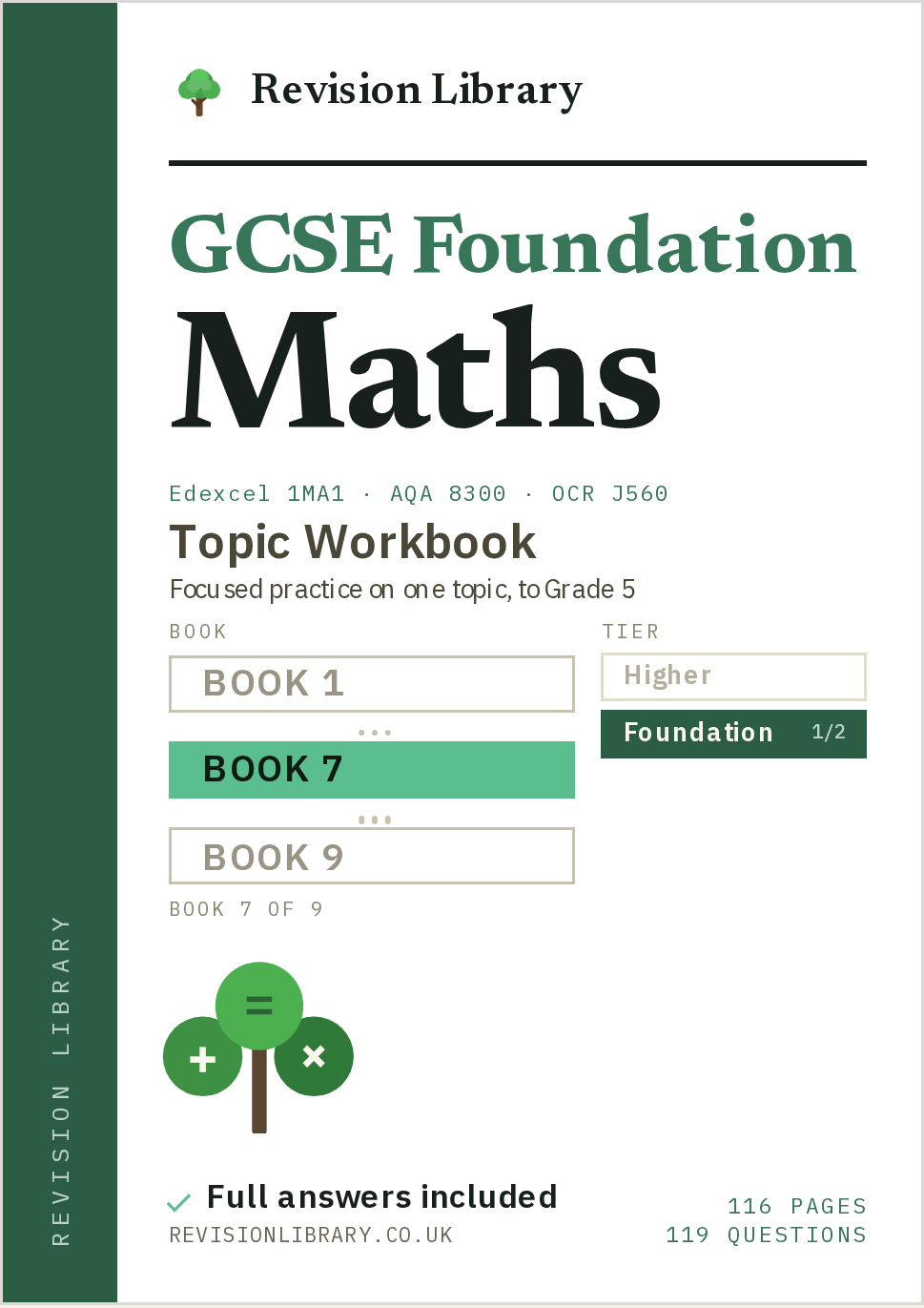
GCSE Maths Foundation Topic Workbooks · Book 7 of 9

GCSE Maths Foundation Topic Workbook 7

Loci and Construction, Bearings, Plans and Elevations and 5 more

Level
GCSE Foundation · Edexcel 1MA1 · AQA 8300 · OCR J560
Series
GCSE Maths Foundation Topic Workbooks, book 7 of 9
Suitable for
Years 10-11, AQA / Edexcel / OCR

Foundation tier rewards accuracy on the topics that come up every year far more than it rewards breadth. Each volume takes a run of related topics in curriculum order and gives you the fluency practice first, then the exam-style questions on the same material, so a weak topic gets rebuilt rather than revised around.

FreePDF download · 2027 edition · 116 A4 pages
  • One file, prints straight to A4
  • No account, no password

Workbooks like this one, with 8 topics, 119 questions and mark schemes at the back, are usually printed and sold by publishers. This one is one of 558 free PDFs on the shelf.

Pages
116 A4 pages
Chapters
8 worksheet chapters
Questions
119 · 398 marks
Answers
From page 102
Working time
About 8h 30m

What is inside

8 chapters · answers from p102

Each chapter starts with a page showing its marks and a suggested time, followed by the questions. The mark schemes for all 8 chapters are at the back, so the book works for homework, a timed test or revision.

  1. 01Loci and Construction12 questions · 41 marks · about 50 min Topic guide: Loci and Constructionp3
  2. 02Bearings17 questions · 43 marks · about 55 min Topic guide: Bearingsp9
  3. 03Plans and Elevations14 questions · 47 marks · about 60 min Topic guide: Plans and Elevationsp21
  4. 04Spheres and Cones15 questions · 51 marks · about 65 min Topic guide: Spheres and Conesp36
  5. 05Sector Areas and Arc Lengths14 questions · 54 marks · about 70 min Topic guide: Sector Areas and Arc Lengthsp50
  6. 06Similar Shapes (Lengths)15 questions · 58 marks · about 75 min Topic guide: Similar Shapes (Lengths)p64
  7. 07SOHCAHTOA (Trigonometry)14 questions · 54 marks · about 70 min Topic guide: SOHCAHTOA (Trigonometry)p76
  8. 08Exact trig values18 questions · 50 marks · about 65 min Topic guide: Exact trig valuesp91
  9. AnswersMark schemes for every chapterp102

Each chapter is drawn from one of our worksheet packs. Follow a chapter title for the full pack on its own page, or browse every GCSE Maths pack. Every book on the shelf is a complete printable workbook of up to 120 A4 pages.

Explore this volume

GCSE Maths Foundation Topic Workbook 7 includes Loci and Construction (from page 3); Bearings (from page 9); Plans and Elevations (from page 21); Spheres and Cones (from page 36); Sector Areas and Arc Lengths (from page 50); Similar Shapes (Lengths) (from page 64); SOHCAHTOA (Trigonometry) (from page 76); Exact trig values (from page 91).

Worked question 10 - Loci and Construction

Open the included worksheet

A triangular field ABC has AB = 90 m, BC = 70 m and angle ABC = 65 degrees. A fence post is to be placed so that it is (i) equidistant from sides AB and BC, and (ii) exactly 60 m from vertex A.
(a)Using a scale of 1 cm to 10 m, construct triangle ABC accurately.(1)
(b)Using a ruler and compasses only, construct the locus of points equidistant from AB and BC, and the locus of points 60 m from A. Hence find and label the position(s) of the fence post, X (and Y if there is more than one position).(4)

Answer and mark scheme

Question 10

CreditAnswer or working
C1(a) triangle ABC constructed with AB = 9 cm, angle ABC = 65 degrees (within 2 degrees), BC = 7 cm, all within 2 mm
C1(b) angle bisector of angle ABC constructed correctly using compass arcs, drawn as a ray extended well beyond the triangle
C1(b) arc of radius 6 cm (60 m) centred on A drawn, crossing the bisector ray
B1(b) both intersection points located correctly (approximately 4.0 cm and 11.1 cm from B along the bisector, within construction tolerance) and labelled X and Y
B1(b) correct conclusion that two positions exist, because the arc crosses the bisector ray at two points
  • (a) Answer: Triangle ABC drawn with AB = 9 cm, angle B = 65 degrees, BC = 7 cm.
  • (b) Answer: Two positions satisfy both conditions: approximately 40 m and 111 m from B along the bisector of angle B (accept 38 to 43 m and 108 to 115 m by construction tolerance); both lie exactly 60 m from A.
Question 12 - Loci and Construction

Open the included worksheet

A radio transmitter is at point T, on a bearing of 060 degrees from a port P, and 20 km from P. The transmitter's signal can be picked up up to 16 km away. A ship sails from P on a bearing of 100 degrees. Use a scale of 1 cm to 4 km.
(a)Draw the positions of P and T, the ship's path from P, and the boundary of the transmitter's range.(3)
(b)Use your diagram to find the distance, to the nearest km, over which the ship is within range of the transmitter.(1)

Answer and mark scheme

Question 12

CreditAnswer or working
C1(a) P and T plotted correctly, 5 cm apart, with T on a bearing of 060 degrees from P (within 2 degrees)
C1(a) ship's path drawn as a ray from P on a bearing of 100 degrees (within 2 degrees), at least 10 cm long
C1(a) circle of radius 4 cm (16 km) drawn accurately, centred on T
B1(b) answer awrt 19 km (accept 17 to 21 km, allowing for scale-drawing tolerance)
  • (a) Answer: P and T plotted 5 cm apart on a bearing of 060 degrees; the ship's path drawn on a bearing of 100 degrees from P; a circle of radius 4 cm centred on T.
  • (b) Answer: Approximately 19 km (accept 17 to 21 km from an accurate scale drawing).

Question 4 - Loci and Construction

Open the included worksheet

A rectangular garden PQRS has PQ = 10 m and QR = 6 m, with P, Q, R, S labelled in order going around the rectangle. Using a scale of 1 cm to 1 m, draw the rectangle. A tree is to be planted so that it is (i) within 7 m of corner P, and (ii) nearer to side QR than to side PS. Construct the necessary loci and shade the region of the garden where the tree could be planted.

Answer and mark scheme

Question 4

CreditAnswer or working
C1rectangle PQRS drawn accurately to scale, 10 cm by 6 cm, correctly labelled
C1circle (or arc) of radius 7 cm centred on P drawn accurately
C1the line equidistant from QR and PS constructed correctly (a straight line parallel to QR and PS, 5 cm from each, using the perpendicular bisector method on a segment of PQ)
B1correct region shaded, satisfying both conditions (inside the circle radius 7 cm centred on P, and on the QR side of the midline), cao
  • Answer: The shaded region is the part of the garden inside the circle of radius 7 m centred on P that also lies on the QR side of the line 5 m from P (parallel to QR and PS).

Question 15 - Spheres and Cones

Open the included worksheet

A large cone has base radius 10 cm and perpendicular height 15 cm. A smaller, similar cone of radius 4 cm and height 6 cm is removed from the vertex end, leaving a frustum. Work out the volume of the frustum. Give your answer correct to 3 significant figures.
Diagram NOT accurately drawn
10 cm 4 cm 6 cm 15 cm

Answer and mark scheme

Question 15

CreditAnswer or working
M1recognises the small cone is similar to the large cone, e.g. identifies scale factor 4/10 or 6/15 (= 0.4)
M11/3 x π x 102 x 15 oe (large cone volume = 500 π)
M11/3 x π x 42 x 6 oe (small cone volume = 32 π)
M1subtracts small cone volume from large cone volume (dep)
A1awrt 1470
  • Answer: 1470 cm3 (3 sf)

Question 10 - Spheres and Cones

Open the included worksheet

A cone has base radius 6 cm and slant height 10 cm. Calculate the total surface area of the cone (the curved surface area plus the area of the circular base). Give your answer correct to 3 significant figures.
Diagram NOT accurately drawn
10 cm 6 cm

Answer and mark scheme

Question 10

CreditAnswer or working
M1π x 6 x 10 oe (curved surface area = 60 π)
M1π x 62 oe (base area = 36 π)
A1awrt 302
  • Answer: 302 cm2 (3 sf)

Question 8 - Plans and Elevations

Open the included worksheet

The diagram shows a flat solid made from three 1 cm cubes on a 2 by 2 grid (one grid position is empty).
1 1 1 0 Row 1 (back) Row 2 (front) Col 1 Col 2 F Numbers show height (in 1 cm cubes) at each position. 0 = no cube. Arrow F shows the front-view direction.
(a)Which of these is the correct plan of the solid?(1)
  • A) a 2 by 2 square
  • B) an L-shape made of 3 unit squares (the Row 2, Column 2 square is missing)
  • C) a 1 by 3 rectangle
  • D) a T-shape made of 4 unit squares
(b)Even though the plan is an L-shape, the front elevation of this solid is a plain 2 cm by 1 cm rectangle, with no gap visible. Give a reason why.(1)

Answer and mark scheme

Question 8

CreditAnswer or working
B1(a) B cao
B1(b) correct reason, e.g. Column 2 still has a cube in Row 1, so that column still shows height 1 from the front; the missing cube in Row 2 is hidden behind it, oe
  • (a) Answer: B
  • (b) Answer: The empty grid position is hidden behind a cube in the other row of the same column, so the front elevation still shows full height across both columns.

Question 7 - Plans and Elevations

Open the included worksheet

The diagram shows a solid built from 1 cm cubes standing on a grid. The numbers show how many cubes are stacked at each position.
Col 1 Col 2 Col 3 1 1 1 1 1 2 Row 1 (back) Row 2 (front) S F
(a)Draw the front elevation of the solid, as viewed from arrow F.(2)
(b)Draw the side elevation of the solid, as viewed from arrow S.(2)

Answer and mark scheme

Question 7

CreditAnswer or working
B1(a) correct heights per column: 1, 1, 2 (left to right)
B1(a) correct overall shape: 3 squares wide with a single extra square on top of the right-hand column
B1(b) correct heights per row (depth position): back = 1, front = 2
B1(b) correct overall shape: 2 squares wide with the front column one square taller than the back column
  • (a) Answer: A profile 3 squares wide with heights (left to right) 1, 1, 2 unit squares.
  • (b) Answer: A profile 2 squares wide with heights (back to front) 1, 2 unit squares.

GCSE Maths Foundation Topic Workbooks runs to 9 volumes

Book 7 of 9 · 1,011 pages in the set

Each book is a separate free PDF.

Volume 1

114 pp · 256 Qs

Addition and Subtraction, Multiplication and Division, Writing, Simplifying and Ordering Fractions and 12 more

Volume 2

113 pp · 208 Qs

Estimating, Percentage Change, Indices and 10 more

Volume 3

109 pp · 154 Qs

Inequalities, Forming and Solving Equations, Sequences (Nth Term) and 6 more

Volume 4

107 pp · 174 Qs

Simultaneous Equations, Solving Simultaneous Equations Graphically, Gradient of a Line and 9 more

Volume 5

112 pp · 151 Qs

Compound Interest and Depreciation, Real Life and Distance Time Graphs, Writing a Ratio as a Fraction or Linear Function and 7 more

Volume 6

116 pp · 133 Qs

Area and Circumference of Circles, Transformations, Area of Compound Shapes and 6 more

Volume 7 · this book

116 pp · 119 Qs

Loci and Construction, Bearings, Plans and Elevations and 5 more

Volume 8

112 pp · 126 Qs

Vectors, Systematic Listing, Probability (Foundation) and 6 more

Volume 9

112 pp · 108 Qs

Bar Charts, Stem and Leaf, Pie Charts and 4 more

More GCSE Foundation books

Want a different mix of topics?

Sitting an exam soon? Build a GCSE Maths mock paper or print a ready-made one.