Fractional and negative indices are power laws that write roots and reciprocals using index notation: a negative power means one over the positive power, and a fractional power means a root (given by the denominator) raised to a power (given by the numerator). These rules allow expressions like 82/3 or 5-2 to be evaluated and simplified without a calculator.
Remember that a0 = 1 for any non-zero number a, and a-n = 1/(an), so a negative power flips the base into a fraction and makes the power positive.
For a unit fractional power, a1/n means the nth root of a: a1/2 is the square root, a1/3 is the cube root, and so on.
For a general fractional power am/n, take the nth root of a first, then raise the result to the power m, since root first is usually easier with smaller numbers.
Combine negative and fractional powers by applying the rules in order: deal with the fraction (root and power) first, then take the reciprocal for the negative sign.
When simplifying expressions with letters, apply the normal index laws (add powers when multiplying, subtract when dividing, multiply when raising a power to a power) even when the powers are fractions or negative.
Check your final answer is in the form requested, for example as a single fraction, or in the form k an with the constant k separated from the power of a.
Worked example
Work out the value of 8-2/3. Give your answer as a fraction.
First deal with the fractional power: 81/3 = 2, the cube root of 8.
Raise this to the power 2: 22 = 4, so 82/3 = 4.
Apply the negative power by taking the reciprocal: 8-2/3 = 1/4.
Revision Library
revisionlibrary.co.uk
HIGHER
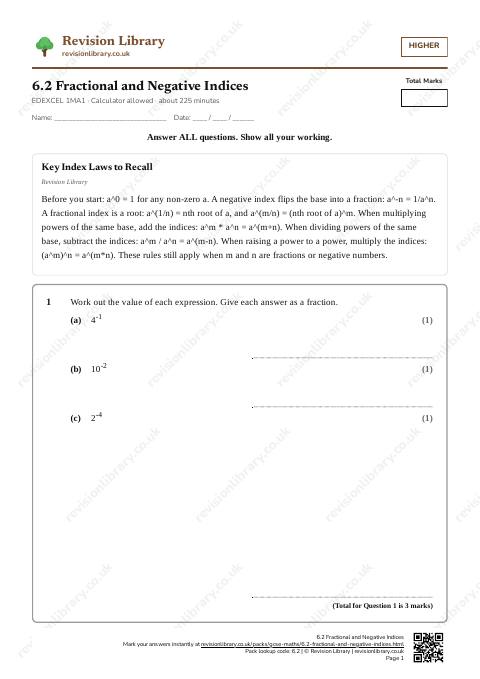
6.2 Fractional and Negative Indices
EDEXCEL 1MA1 · Calculator allowed · about 225 minutes
Before you start: a^0 = 1 for any non-zero a. A negative index flips the base into a fraction: a^-n = 1/a^n. A fractional index is a root: a^(1/n) = nth root of a, and a^(m/n) = (nth root of a)^m. When multiplying powers of the same base, add the indices: a^m * a^n = a^(m+n). When dividing powers of the same base, subtract the indices: a^m / a^n = a^(m-n). When raising a power to a power, multiply the indices: (a^m)^n = a^(m*n). These rules still apply when m and n are fractions or negative numbers.
1
Work out the value of each expression. Give each answer as a fraction.
(a)4-1(1)
(b)10-2(1)
(c)2-4(1)
(Total for Question 1 is 3 marks)
2
Work out the value of:
(a)641/2(1)
(b)81/3(1)
(c)811/4(1)
(Total for Question 2 is 3 marks)
3
Work out the value of:
(a)4-1/2(2)
(b)9-3/2(2)
(Total for Question 3 is 4 marks)
4
Work out the value of each expression.
(a)251/2(1)
(b)641/3(1)
(c)321/5(1)
(Total for Question 4 is 3 marks)
5
Solve the equations:
(a)x1/2 = 7(1)
(b)x2/3 = 25(2)
(Total for Question 5 is 3 marks)
6
Show that 9-1/2 x 34 = 27
(Total for Question 6 is 3 marks)
7
Work out the value of 27-2/3. Give your answer as a fraction.
(Total for Question 7 is 3 marks)
8
Work out the value of 274/3.
(Total for Question 8 is 2 marks)
9
Work out the value of 2-4. Give your answer as a fraction.
(Total for Question 9 is 2 marks)
10
Work out the value of (4/9)-2/2. Give your answer as a fraction or integer.
(Total for Question 10 is 3 marks)
11
Simplify (4x6)1/2.
(Total for Question 11 is 2 marks)
12
Work out the value of 6-1. Give your answer as a fraction.
(Total for Question 12 is 2 marks)
13
Write cube root of x2 in the form xn, where n is a fraction or integer.
(Total for Question 13 is 2 marks)
14
Solve 25x = 1/125.
(Total for Question 14 is 3 marks)
15
Work out the value of 1253/3.
(Total for Question 15 is 2 marks)
16
Work out the value of 41/2.
(Total for Question 16 is 1 mark)
17
Work out the value of 9-3/2. Give your answer as a fraction.
(Total for Question 17 is 3 marks)
18
Simplify (9x4)-1/2.
(Total for Question 18 is 2 marks)
19
Work out the value of 4-4. Give your answer as a fraction.
(Total for Question 19 is 2 marks)
20
Solve 4x = 1/16.
(Total for Question 20 is 3 marks)
21
Work out the value of 812/2.
(Total for Question 21 is 2 marks)
22
Work out the value of 811/4.
(Total for Question 22 is 1 mark)
23
Simplify (25x2)1/2.
(Total for Question 23 is 2 marks)
24
Work out the value of (16/81)-1/4. Give your answer as a fraction or integer.
(Total for Question 24 is 3 marks)
25
Work out the value of 7-4. Give your answer as a fraction.
(Total for Question 25 is 2 marks)
26
Write 1/(x √x) in the form xn, where n is a fraction or integer.
(Total for Question 26 is 2 marks)
27
Work out the value of 162/4.
(Total for Question 27 is 2 marks)
28
Solve 3x = 9.
(Total for Question 28 is 2 marks)
29
Simplify (4x2)1/2.
(Total for Question 29 is 2 marks)
30
Work out the value of (2/3)-2. Give your answer as a fraction.
(Total for Question 30 is 2 marks)
31
Write cube root of x in the form xn, where n is a fraction or integer.
(Total for Question 31 is 2 marks)
32
Work out the value of (25/9)-3/2. Give your answer as a fraction or integer.
(Total for Question 32 is 3 marks)
33
Work out the value of 1254/3.
(Total for Question 33 is 2 marks)
34
Work out the value of 91/2.
(Total for Question 34 is 1 mark)
35
Work out the value of (81/16)-2/4. Give your answer as a fraction or integer.
(Total for Question 35 is 3 marks)
36
Simplify (125x3)1/3.
(Total for Question 36 is 2 marks)
37
Simplify, leaving your answer in index form:
(a)x5 x x-2(1)
(b)y3 / y-4(1)
(c)(m-2)3(1)
(Total for Question 37 is 3 marks)
38
Work out the value of 5-3. Give your answer as a fraction.
(Total for Question 38 is 2 marks)
39
Write fourth root of x in the form xn, where n is a fraction or integer.
(Total for Question 39 is 2 marks)
40
Work out the value of (16/81)-3/4. Give your answer as a fraction or integer.
(Total for Question 40 is 3 marks)
41
Work out the value of 493/2.
(Total for Question 41 is 2 marks)
42
Work out the value of 641/3.
(Total for Question 42 is 1 mark)
43
Simplify (64x6)1/3.
(Total for Question 43 is 2 marks)
44
Work out the value of 4-2. Give your answer as a fraction.
(Total for Question 44 is 2 marks)
45
Which of the following is equal to 1/(x3)?
A) x-3
B) x3
C) -x3
D) x1/3
(Total for Question 45 is 1 mark)
46
Work out the value of:
(a)82/3(2)
(b)253/2(2)
(c)16-1/4(2)
(Total for Question 46 is 6 marks)
47
Simplify fully:
(a)(x4 y-2) / (x-1 y3)(2)
(b)Write (2a3)-2 in the form k an, stating the values of k and n.(2)
(Total for Question 47 is 4 marks)
48
Solve the equation 2x = 1/32
(Total for Question 48 is 2 marks)
49
Work out the value of each expression.
(a)82/3(2)
(b)163/4(2)
(c)253/2(2)
(Total for Question 49 is 6 marks)
50
Simplify each expression fully.
(a)(8x6)1/3(2)
(b)(9x4)1/2(2)
(c)(x3)-2 * x4(2)
(Total for Question 50 is 6 marks)
51
Simplify fully (a1/2 x a5/2) / a2. Give your answer in the form an.
(Total for Question 51 is 3 marks)
52
A cube-shaped storage box has volume V = 512 cm³. The side length of the cube is given by l = V1/3.
Diagram NOT accurately drawn
(a)Work out the side length, l, of the cube.(1)
(b)The total surface area of a cube is given by A = 6l2. Work out the total surface area of the box, stating the correct units.(2)
(Total for Question 52 is 3 marks)
53
Show that 271/3 * 4-1/2 = 3/2
(Total for Question 53 is 3 marks)
54
Simplify (16x8)3/4 fully.
(Total for Question 54 is 3 marks)
55
Simplify (x-2/3)-3. Give your answer as a single power of x.
(Total for Question 55 is 2 marks)
56
Solve the equations:
(a)2x = 32(1)
(b)3x = 1/9(2)
(c)5x = 1/√5(2)
(Total for Question 56 is 5 marks)
57
Solve the equations. Give each answer as a fraction.
(a)4x = 8(2)
(b)9x = 1/3(2)
(Total for Question 57 is 4 marks)
58
Simplify (x4)1/2 / x-3. Give your answer as a single power of x.
(Total for Question 58 is 3 marks)
59
Simplify √x3 / x1/4. Give your answer as a single power of x.
(Total for Question 59 is 3 marks)
60
Solve 25x = 53x-2
(Total for Question 60 is 3 marks)
61
Solve (1/8)x = 16
(Total for Question 61 is 3 marks)
62
Given that 2a = 8 and 2b = 32, find the value of 2a-b. Give your answer as a fraction.
(Total for Question 62 is 3 marks)
63
Simplify (2n)1/2 * 21-n fully. Give your answer in the form 2k, where k is an expression in n.
(Total for Question 63 is 3 marks)
Mark scheme · 6.2 Fractional and Negative Indices
A correct answer earns full marks unless the question asks for working, a method, proof or explanation.
Question 1
(a) 1/4 caoB1
(a) Answer: 1/4
(b) 1/100 oeB1
(b) Answer: 1/100
(c) 1/16 caoB1
(c) Answer: 1/16
Question 2
(a) 8 caoB1
(a) Answer: 8
(b) 2 caoB1
(b) Answer: 2
(c) 3 caoB1
(c) Answer: 3
Question 3
(a) 41/2 = 2 seen, or 1/(41/2) writtenM1
(a) 1/2 oe (0.5) caoA1
(a) Answer: 1/2 (0.5)
(b) 91/2 = 3 and 33 = 27 (or 93/2 = 27) seenM1
(b) 1/27 oe caoA1
(b) Answer: 1/27
Question 4
(a) 5 caoB1
(a) Answer: 5
(b) 4 caoB1
(b) Answer: 4
(c) 2 caoB1
(c) Answer: 2
Question 5
(a) x = 49 caoB1
(a) Answer: x = 49
(b) x1/3 = 5 (from √25 = 5), or x = 253/2 seenM1
(b) x = 125 caoA1
(b) Answer: x = 125
Question 6
9-1/2 = 1/3 oeM1
34 = 81 seenM1
cso: (1/3) x 81 = 27 shown, dependent on both method marksA1
Answer: 27 (shown)
Question 7
271/3 = 3 seenM1
32 = 9, i.e. 272/3 = 9 seenM1
1/9 oe caoA1
Answer: 1/9
Question 8
271/3 = 3 or 274 then rootM1
81 caoA1
Answer: 81
Question 9
reciprocal used, e.g. 1/24 or (1/2)4M1
1/16 caoA1
Answer: 1/16
Question 10
reciprocal for the negative powerM1
takes the 2nd rootM1
9/4 caoA1
Answer: 9/4
Question 11
(4)1/2 = 2 or (x6)1/2 = x3M1
2x3 oeA1
Answer: 2x3
Question 12
reciprocal used, e.g. 1/61 or (1/6)1M1
1/6 caoA1
Answer: 1/6
Question 13
correct use of a fractional or negative indexM1
x2/3 oeA1
Answer: x2/3
Question 14
writes both sides as powers of 5: (52)x = 5-3M1
2x = -3M1
x = -3/2A1
Answer: x = -3/2
Question 15
1251/3 = 5 or 1253 then rootM1
125 caoA1
Answer: 125
Question 16
2 caoB1
Answer: 2
Question 17
reciprocal for the negative powerM1
takes the 2nd rootM1
1/27 caoA1
Answer: 1/27
Question 18
(9)1/2 = 3 or (x4)1/2 = x2M1
1/(3x2) oeA1
Answer: 1/(3x2)
Question 19
reciprocal used, e.g. 1/44 or (1/4)4M1
1/256 caoA1
Answer: 1/256
Question 20
writes both sides as powers of 2: (22)x = 2-4M1
2x = -4M1
x = -2A1
Answer: x = -2
Question 21
811/2 = 9 or 812 then rootM1
81 caoA1
Answer: 81
Question 22
3 caoB1
Answer: 3
Question 23
(25)1/2 = 5 or (x2)1/2 = xM1
5x oeA1
Answer: 5x
Question 24
reciprocal for the negative powerM1
takes the 4th rootM1
3/2 caoA1
Answer: 3/2
Question 25
reciprocal used, e.g. 1/74 or (1/7)4M1
1/2401 caoA1
Answer: 1/2401
Question 26
correct use of a fractional or negative indexM1
x-3/2 oeA1
Answer: x-3/2
Question 27
161/4 = 2 or 162 then rootM1
4 caoA1
Answer: 4
Question 28
writes both sides as powers of 3: (31)x = 32M1
x = 2A1
Answer: x = 2
Question 29
(4)1/2 = 2 or (x2)1/2 = xM1
2x oeA1
Answer: 2x
Question 30
reciprocal used, e.g. 1/(2/3)2 or (3/2)2M1
9/4 caoA1
Answer: 9/4
Question 31
correct use of a fractional or negative indexM1
x1/3 oeA1
Answer: x1/3
Question 32
reciprocal for the negative powerM1
takes the 2nd rootM1
27/125 caoA1
Answer: 27/125
Question 33
1251/3 = 5 or 1254 then rootM1
625 caoA1
Answer: 625
Question 34
3 caoB1
Answer: 3
Question 35
reciprocal for the negative powerM1
takes the 4th rootM1
4/9 caoA1
Answer: 4/9
Question 36
(125)1/3 = 5 or (x3)1/3 = xM1
5x oeA1
Answer: 5x
Question 37
(a) x3 caoB1
(a) Answer: x3
(b) y7 caoB1
(b) Answer: y7
(c) m-6 caoB1
(c) Answer: m-6
Question 38
reciprocal used, e.g. 1/53 or (1/5)3M1
1/125 caoA1
Answer: 1/125
Question 39
correct use of a fractional or negative indexM1
x1/4 oeA1
Answer: x1/4
Question 40
reciprocal for the negative powerM1
takes the 4th rootM1
27/8 caoA1
Answer: 27/8
Question 41
491/2 = 7 or 493 then rootM1
343 caoA1
Answer: 343
Question 42
4 caoB1
Answer: 4
Question 43
(64)1/3 = 4 or (x6)1/3 = x2M1
4x2 oeA1
Answer: 4x2
Question 44
reciprocal used, e.g. 1/42 or (1/4)2M1
1/16 caoA1
Answer: 1/16
Question 45
A (x-3) caoB1
Answer: A) x-3
Question 46
(a) 81/3 = 2 seenM1
(a) 4 caoA1
(a) Answer: 4
(b) 251/2 = 5 seenM1
(b) 125 caoA1
(b) Answer: 125
(c) 161/4 = 2 seenM1
(c) 1/2 oe (0.5) caoA1
(c) Answer: 1/2 (0.5)
Question 47
(a) one index correctly found: x5 or y-5M1
(a) x5 y-5 oe (e.g. x5 / y5) caoA1
(a) Answer: x5 y-5 (i.e. x5 / y5)
(b) 2-2 = 1/4 and/or a-6 seenM1
(b) k = 1/4 and n = -6, both correctA1
(b) Answer: k = 1/4, n = -6
Question 48
1/32 written as 2-5 or 32 = 25 seenM1
x = -5 caoA1
Answer: x = -5
Question 49
(a) 81/3 = 2 foundM1
(a) 4 caoA1
(a) Answer: 4
(b) 161/4 = 2 foundM1
(b) 8 caoA1
(b) Answer: 8
(c) 251/2 = 5 foundM1
(c) 125 caoA1
(c) Answer: 125
Question 50
(a) 81/3 = 2 and x6 raised to power 1/3 gives x2, both foundM1
(a) 2x2 caoA1
(a) Answer: 2x2
(b) 91/2 = 3 and x4 raised to power 1/2 gives x2, both foundM1
(b) 3x2 caoA1
(b) Answer: 3x2
(c) (x3)-2 = x-6 foundM1
(c) 1/x2 oe (x-2)A1
(c) Answer: x-2 (= 1/x2)
Question 51
numerator combined: a1/2 + 5/2 = a3M1
indices subtracted: a3 - 2M1
a (i.e. a1) caoA1
Answer: a (a1)
Question 52
(a) 8 (cm) caoB1
(a) Answer: 8 cm
(b) 6 x 82 (= 384) seen, ft from (a)M1
(b) 384 cm², correct units requiredA1
(b) Answer: 384 cm2
Question 53
271/3 = 3 shownB1
4-1/2 = 1/2 shownB1
3 * 1/2 = 3/2 shown, cso (dependent on both B marks)A1
Answer: 3/2 (shown)
Question 54
163/4 = 8 foundM1
x8 raised to power 3/4 gives x6M1
8x6 caoA1
Answer: 8x6
Question 55
indices multiplied: (-2/3) x (-3)M1
x2 caoA1
Answer: x2
Question 56
(a) x = 5 caoB1
(a) Answer: x = 5
(b) 1/9 written as 3-2M1
(b) x = -2 caoA1
(b) Answer: x = -2
(c) 1/√5 written as 5-1/2M1
(c) x = -1/2 oeA1
(c) Answer: x = -1/2
Question 57
(a) both sides written as powers of 2: 22x = 23M1
(a) x = 3/2 oeA1
(a) Answer: x = 3/2
(b) both sides written as powers of 3: 32x = 3-1M1
(b) x = -1/2 oeA1
(b) Answer: x = -1/2
Question 58
(x4)1/2 = x2 foundM1
indices combined: 2 - (-3)M1
x5 caoA1
Answer: x5
Question 59
√x3 written as x3/2M1
indices subtracted: 3/2 - 1/4M1
x5/4 oe (accept x1.25)A1
Answer: x5/4
Question 60
25 written as 52M1
indices equated: 2x = 3x - 2M1
x = 2 caoA1
Answer: x = 2
Question 61
both sides written as powers of 2: 1/8 = 2-3, 16 = 24M1
Put this topic and others into one printable pack.
Open the Pack Builder
Worksheets are written for Revision Library and come with a full mark scheme; a few English packs quote an out-of-copyright text, and name it on the page. Exam board names and specification codes say which qualification a pack suits: we are not affiliated with, endorsed by or approved by any exam board, and no past-paper question is reproduced here. Rights queries: hello@revisionlibrary.co.uk