Revision Library
Choose a subject
Menu
Science
Need a new topic?
Missing a topic, found a bug, or want something added?

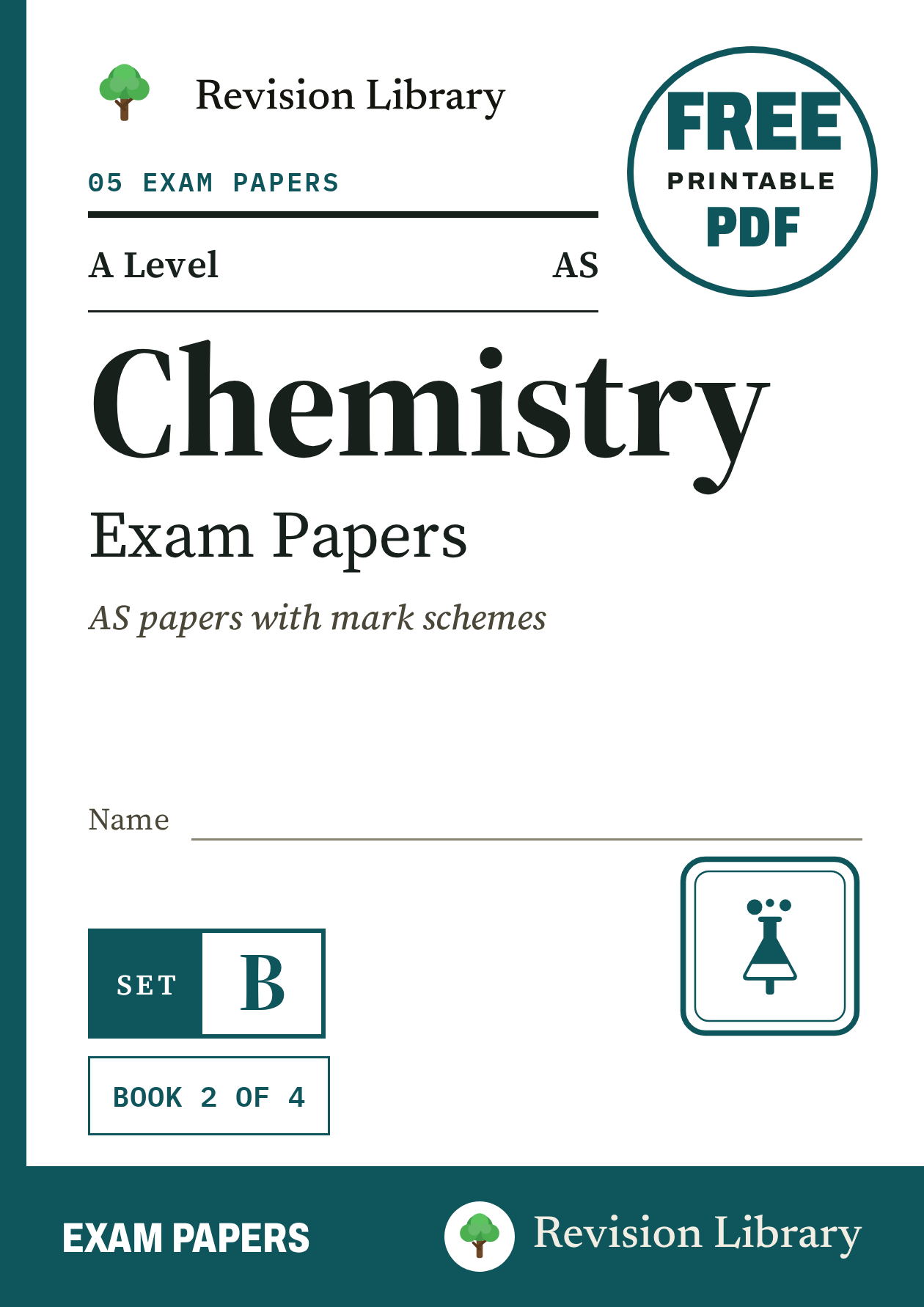
Book 2 of 4

A Level Chemistry Exam Papers Set B

AS Paper 4: Rates and Practical Chemistry, AS Paper 5: Energetics and Equilibrium and AS Paper 6: Full AS Review

Level
A Level · Edexcel 9CH0 · AQA 7405 · OCR H432
Series
A Level Chemistry Exam Papers, book 2 of 4
Suitable for
Years 12-13, AQA / Edexcel / OCR
FreePDF download · 2027 edition · 65 A4 pages
  • One file, prints straight to A4
  • No account, no password

3 papers, mark schemes at the back. This set is one of 558 free PDFs on the shelf.

Pages
65 A4 pages
Papers
3 papers
Questions
60 · 240 marks
Answers
From page 48

What is inside

3 papers · answers from p48

Each paper starts with a page showing its marks and a suggested time, followed by the questions. The mark schemes for all 3 papers are at the back, so you can sit each paper as a mock and mark it afterwards.

  1. 01AS Paper 4: Rates and Practical Chemistry16 questions · 60 marksp3
  2. 02AS Paper 5: Energetics and Equilibrium19 questions · 80 marksp14
  3. 03AS Paper 6: Full AS Review25 questions · 100 marksp30
  4. AnswersMark schemes for every paperp48

Each paper is drawn from one of our worksheet packs. Follow a paper title for the full pack on its own page, or browse every A Level Sciences pack. Every book on the shelf is a complete printable workbook of up to 120 A4 pages.

Explore this volume

A Level Chemistry Exam Papers Set B includes AS Paper 4: Rates and Practical Chemistry (from page 3); AS Paper 5: Energetics and Equilibrium (from page 14); AS Paper 6: Full AS Review (from page 30).

Worked question 9 - AS Paper 4: Rates and Practical Chemistry

The mass spectrum of an unbranched ester of general formula CnH2nO2 shows a molecular ion peak at m/z = 88.

Deduce its molecular formula and suggest a possible structure.

Answer

Mr = 14n + 32, hence 14n + 32 = 88; n = 4 so C4H8O2; valid unbranched ester structural formula, e.g. CH3CH2COOCH3, CH3COOCH2CH3, or HCOOCH2CH2CH3.

Mark scheme

M1for Mr = 14n + 32, hence 14n + 32 = 88
A1for n = 4 so C4H8O2
B1for valid unbranched ester structural formula, e.g. CH3CH2COOCH3, CH3COOCH2CH3, or HCOOCH2CH2CH3

Question 16 - AS Paper 4: Rates and Practical Chemistry

6 marks

In an industrial process, 5.00 tonnes of iron(III) oxide, Fe2O3 (Mr = 160), is reduced with excess carbon monoxide.

Fe2O3 + 3CO -> 2Fe + 3CO2

If the reaction has a percentage yield of 92.0%, calculate the mass of iron, in tonnes, actually produced. (Ar of Fe = 56.0)

Answer

5.00 tonnes = 5.00 x 10^6 g. n(Fe2O3) = 5.00 x 10^6/160 = 31250 mol, giving 62500 mol Fe at 100% yield. Theoretical mass = 62500 x 56.0 = 3.50 x 10^6 g = 3.50 tonnes. Actual mass = 3.50 x 0.920 = 3.22 tonnes.

Mark scheme

M1for converting 5.00 tonnes to 5.00 x 10^6 g and calculating n(Fe2O3) = 5.00 x 10^6 / 160 = 31250 mol; accept a consistent direct mass-ratio method
M1for the mole ratio Fe2O3 : Fe = 1 : 2, so theoretical n(Fe) = 62500 mol
M1for theoretical mass of Fe = 62500 x 56.0 = 3.50 x 10^6 g, converting g to tonnes
A1for theoretical mass = 3.50 tonnes
M1for actual mass = theoretical mass x (92.0/100)
A1for actual mass = 3.22 tonnes

Question 13 - AS Paper 4: Rates and Practical Chemistry

4 marks

Explain why the thermal stability of Group 2 carbonates increases down the group, in terms of ionic radius and polarising power.

Answer

cation radius increases down Group 2; same +2 charge spread over larger radius gives lower charge density and polarising power; carbonate electron cloud is distorted less, so C-O bonds are weakened less; more heat is required for decomposition, giving greater thermal stability.

Mark scheme

B1for cation radius increases down Group 2
B1for same +2 charge spread over larger radius gives lower charge density and polarising power
B1for carbonate electron cloud is distorted less, so C-O bonds are weakened less
B1for more heat is required for decomposition, giving greater thermal stability

Question 5 - AS Paper 4: Rates and Practical Chemistry

3 marks

Write an equation for the reaction of strontium with dilute hydrochloric acid, and state how the rate of this reaction compares with the same reaction using magnesium, giving a reason for the difference.

Answer

Sr + 2HCl -> SrCl2 + H2; Sr reacts faster than Mg; greater radius/shielding lowers energy needed to lose outer electrons in Sr.

Mark scheme

B1for Sr + 2HCl -> SrCl2 + H2
B1for Sr reacts faster than Mg
B1for greater radius/shielding lowers energy needed to lose outer electrons in Sr

Question 19 - AS Paper 5: Energetics and Equilibrium

6 marks

Benzene is converted into phenylamine in two steps: first by nitration to form nitrobenzene, then by reduction to form phenylamine.

State the reagents and conditions needed for each step, and identify the type of reaction occurring at each stage.

Answer

concentrated nitric acid plus concentrated sulfuric acid; warm around 50-55 degrees C for controlled mononitration; electrophilic substitution; Sn/HCl or Fe/HCl then alkali to liberate free amine; accept H2 with a suitable metal catalyst and appropriate conditions; reflux for metal/acid reduction; accept suitable heating/pressure for catalytic hydrogenation. The second transformation is reduction to phenylamine.

Mark scheme

B1for concentrated nitric acid plus concentrated sulfuric acid
B1for warm around 50-55 degrees C for controlled mononitration
B1for electrophilic substitution
B1for Sn/HCl or Fe/HCl then alkali to liberate free amine; accept H2 with a suitable metal catalyst and appropriate conditions
B1for reflux for metal/acid reduction; accept suitable heating/pressure for catalytic hydrogenation
B1for step 2 reaction type: reduction

Question 15 - AS Paper 5: Energetics and Equilibrium

5 marks

An organic compound X has molecular formula C3H6O2. Its infrared spectrum shows a broad absorption at 2500-3300 cm-1 and a strong absorption at 1710 cm-1.

Its 1H NMR spectrum shows three signals with relative peak areas 3:2:1, and the signal at the highest chemical shift (11-12 ppm) is not split by any neighbouring protons.

Deduce the structure of X, explaining your reasoning.

Answer

broad acid OH plus carbonyl IR indicates COOH; 11-12 ppm signal is the acid OH; exchangeable OH is not resolved into neighbour splitting; 3:2:1 areas correspond to CH3, CH2, COOH proton; CH3CH2COOH, propanoic acid, matches formula and all observations.

Mark scheme

B1for broad acid OH plus carbonyl IR indicates COOH
B1for 11-12 ppm signal is the acid OH
B1for exchangeable OH is not resolved into neighbour splitting
B1for 3:2:1 areas correspond to CH3, CH2, COOH proton
B1for CH3CH2COOH, propanoic acid, matches formula and all observations

Question 11 - AS Paper 5: Energetics and Equilibrium

4 marks

The mass spectrum of a branched alcohol, C4H10O, shows a molecular ion peak at m/z = 74 and a major fragment peak at m/z = 59.

Suggest a structure for the alcohol and explain the loss of mass corresponding to the fragment at m/z = 59.

Answer

plausible branched alcohol such as (CH3)3COH or (CH3)2CHCH2OH; no unique isomer claimed; mass loss = 74 - 59 = 15; loss of CH3 radical, not methyl cation when observed fragment is positive; remaining C3H7O+ has m/z 59 and retains the positive charge; accept a chemically defensible oxygen-containing fragment explanation.

Mark scheme

B1for plausible branched alcohol such as (CH3)3COH or (CH3)2CHCH2OH; no unique isomer claimed
M1for mass loss = 74 - 59 = 15
B1for loss of CH3 radical, not methyl cation when observed fragment is positive
B1for remaining C3H7O+ has m/z 59 and retains the positive charge; accept a chemically defensible oxygen-containing fragment explanation

Question 5 - AS Paper 6: Full AS Review

3 marks

A sample of anhydrous copper(II) sulfate, CuSO4 (Mr = 159.5), has a mass of 3.19 g.

Calculate the amount, in mol, of CuSO4 present, and hence the amount, in mol, of Cu2+ ions in the sample.

Answer

n(CuSO4) = 3.19/159.5 = 0.0200 mol. There is one Cu2+ per formula unit, so n(Cu2+) = 0.0200 mol.

Mark scheme

M1for n(CuSO4) = mass / Mr = 3.19 / 159.5
A1for n(CuSO4) = 0.0200 mol
B1for n(Cu2+) = 0.0200 mol, since each formula unit of CuSO4 contains one Cu2+ ion

Question 19 - AS Paper 6: Full AS Review

4 marks

Explain why the thermal stability of Group 2 carbonates increases down the group, in terms of ionic radius and polarising power.

Answer

cation radius increases down Group 2; same +2 charge spread over larger radius gives lower charge density and polarising power; carbonate electron cloud is distorted less, so C-O bonds are weakened less; more heat is required for decomposition, giving greater thermal stability.

Mark scheme

B1for cation radius increases down Group 2
B1for same +2 charge spread over larger radius gives lower charge density and polarising power
B1for carbonate electron cloud is distorted less, so C-O bonds are weakened less
B1for more heat is required for decomposition, giving greater thermal stability

A Level Chemistry Exam Papers runs to 4 volumes

Book 2 of 4 · 243 pages in the set

Each set is a separate free PDF with its own mark schemes at the back.

Volume 1

57 pp · 52 Qs

AS Paper 1: Core Skills, AS Paper 2: Reactions and Periodicity and AS Paper 3: Structure and Analysis

Volume 2 · this book

65 pp · 60 Qs

AS Paper 4: Rates and Practical Chemistry, AS Paper 5: Energetics and Equilibrium and AS Paper 6: Full AS Review

Volume 3

59 pp · 54 Qs

A Level Paper 1: Redox and Periodicity, A Level Paper 2: Thermodynamics and Rates, A Level Paper 3: Acids and Bases and Equilibrium

Volume 4

62 pp · 68 Qs

A Level Paper 4: Organic Chemistry and Analysis, A Level Paper 5: Structure, Redox and Organic Chemistry and A Level Paper 6: Full A Level Review

More A Level books

A Level Biology Exam Papers Set A

64 pp · 49 Qs

AS Paper 1: Molecules, Cells and Exchange, AS Paper 2: Transport and Genetics, AS Paper 3: Molecules and Genetics and Plant Transport

Want a different mix of topics?