Revision Library
Choose a subject
Menu
Science
Need a new topic?
Missing a topic, found a bug, or want something added?

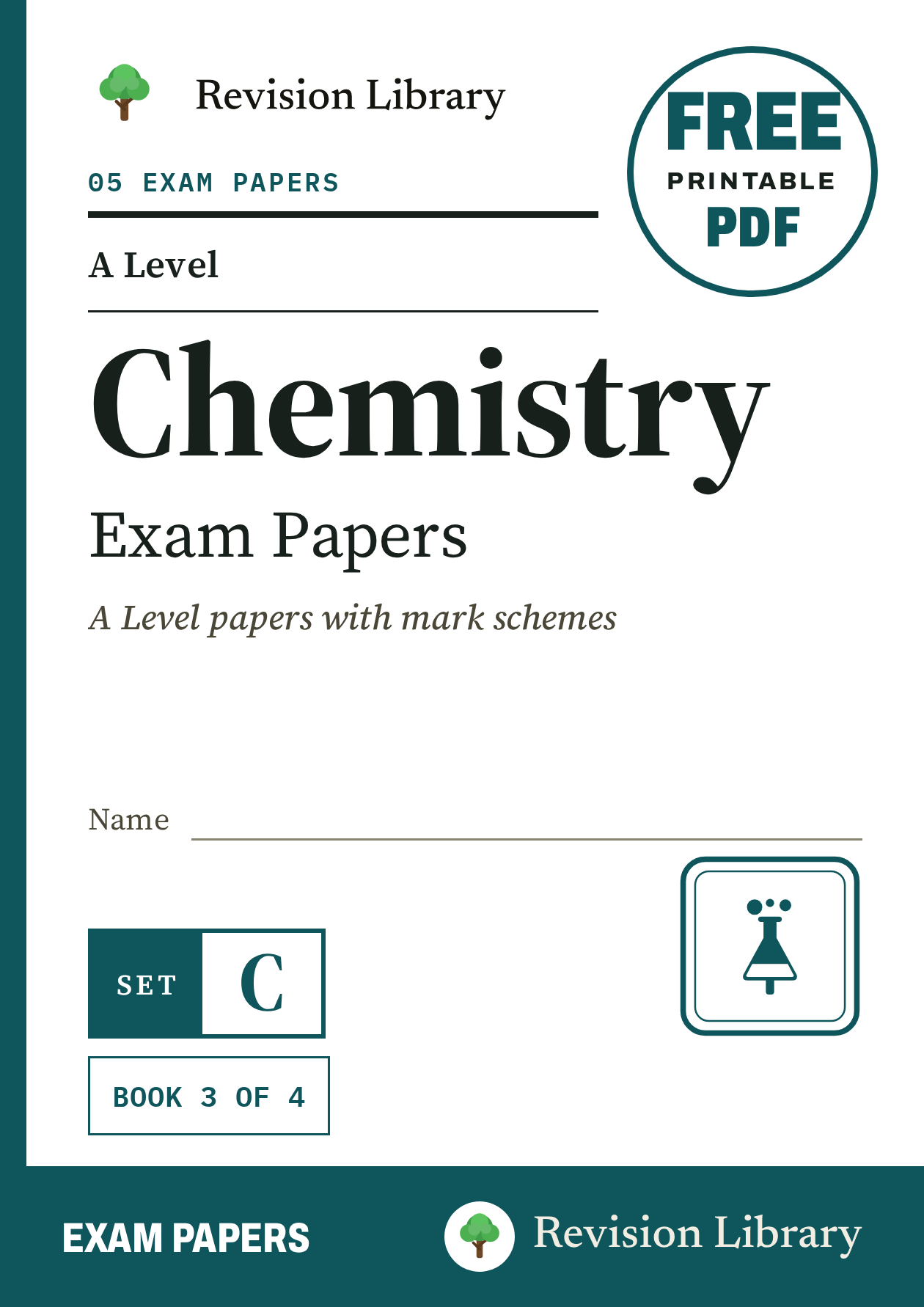
Book 3 of 4

A Level Chemistry Exam Papers Set C

A Level Paper 1: Redox and Periodicity, A Level Paper 2: Thermodynamics and Rates, A Level Paper 3: Acids and Bases and Equilibrium

Level
A Level · Edexcel 9CH0 · AQA 7405 · OCR H432
Series
A Level Chemistry Exam Papers, book 3 of 4
Suitable for
Years 12-13, AQA / Edexcel / OCR
FreePDF download · 2027 edition · 59 A4 pages
  • One file, prints straight to A4
  • No account, no password

3 papers, mark schemes at the back. This set is one of 558 free PDFs on the shelf.

Pages
59 A4 pages
Papers
3 papers
Questions
54 · 200 marks
Answers
From page 44

What is inside

3 papers · answers from p44

Each paper starts with a page showing its marks and a suggested time, followed by the questions. The mark schemes for all 3 papers are at the back, so you can sit each paper as a mock and mark it afterwards.

  1. 01A Level Paper 1: Redox and Periodicity17 questions · 60 marksp3
  2. 02A Level Paper 2: Thermodynamics and Rates16 questions · 60 marksp15
  3. 03A Level Paper 3: Acids, Bases and Equilibrium21 questions · 80 marksp26
  4. AnswersMark schemes for every paperp44

Each paper is drawn from one of our worksheet packs. Follow a paper title for the full pack on its own page, or browse every A Level Sciences pack. Every book on the shelf is a complete printable workbook of up to 120 A4 pages.

Explore this volume

A Level Chemistry Exam Papers Set C includes A Level Paper 1: Redox and Periodicity (from page 3); A Level Paper 2: Thermodynamics and Rates (from page 15); A Level Paper 3: Acids, Bases and Equilibrium (from page 26).

Worked question 6 - A Level Paper 1: Redox and Periodicity

Explain briefly why the first ionisation energy of neon is greater than that of every other element in Period 2.

Answer

Neon has the greatest nuclear charge in Period 2. Shielding changes little because electrons enter the same principal shell, so neon has the smallest atomic radius and the strongest attraction to its outer electrons. Removing one requires the most energy.

Mark scheme

B1for neon having the greatest nuclear charge of any Period 2 element
B1for neon having the smallest atomic radius in Period 2, with little change in shielding across the period
B1for neon's outer electrons therefore being held most strongly, so removing one needs the most energy

Question 16 - A Level Paper 1: Redox and Periodicity

5 marks

Sodium chloride has a melting point of 801 deg C, while aluminium chloride sublimes at 178 deg C.

Explain this difference in terms of ionic bonding and polarisation.

Answer

Al3+ is smaller and more highly charged than Na+, so has greater charge density and distorts the Cl- electron cloud more strongly. This polarisation gives Al-Cl bonding substantial covalent character. NaCl has strong electrostatic attractions throughout a giant ionic lattice; AlCl3 sublimes to molecular Al2Cl6 vapour at a much lower temperature. Solid AlCl3 need not be described as simple molecular.

Mark scheme

B1for Al3+ having a much higher charge density (smaller ionic radius and higher charge) than Na+
B1for the small, highly charged Al3+ ion polarising (distorting) the electron cloud of the chloride ion
B1for this polarisation giving the Al-Cl bond significant covalent character, so AlCl3 is not a simple giant ionic lattice
B1for NaCl remaining predominantly ionic, with strong electrostatic attraction throughout a giant ionic lattice
B1for sublimation of covalent AlCl3 producing molecular Al2Cl6 vapour at a much lower temperature than melting the strongly bound NaCl ionic lattice; do not require or credit a claim that solid AlCl3 consists of discrete molecules

Question 12 - A Level Paper 1: Redox and Periodicity

4 marks

State the structural requirements for hydrogen bonding to occur between two molecules, and use them to explain why methanol, CH3OH, can hydrogen bond with water but methane, CH4, cannot.

Answer

Hydrogen bonding requires H bonded directly to N, O or F, producing a strong dipole with a sufficiently positive H, and a lone pair on N, O or F of another molecule. Methanol and water both have O-H donor bonds and oxygen lone pairs, so they can hydrogen bond with each other. Methane has neither such an H nor an appropriate lone pair, so it cannot.

Mark scheme

B1for a hydrogen atom covalently bonded directly to N, O or F as the hydrogen-bond donor
B1for a lone pair on N, O or F of the neighbouring molecule as the hydrogen-bond acceptor
B1for methanol and water having O-H donor bonds and oxygen lone pairs, allowing hydrogen bonding between them
B1for methane lacking both an H-N/O/F donor bond and a suitable lone-pair acceptor, so it cannot hydrogen bond with water

Question 11 - A Level Paper 1: Redox and Periodicity

2 marks

Iron(II) ions are oxidised by acidified potassium manganate(VII) solution.

Using the half-equations Fe2+ -> Fe3+ + e- and MnO4- + 8H+ + 5e- -> Mn2+ + 4H2O,

construct the overall ionic equation for the reaction.

Answer

multiplying iron oxidation by 5 gives 5Fe2+ -> 5Fe3+ + 5e-; combining and cancelling electrons gives 5Fe2+ + MnO4- + 8H+ -> 5Fe3+ + Mn2+ + 4H2O.

Mark scheme

M1for multiplying iron oxidation by 5 gives 5Fe2+ -> 5Fe3+ + 5e-
A1for combining and cancelling electrons gives 5Fe2+ + MnO4- + 8H+ -> 5Fe3+ + Mn2+ + 4H2O

Question 16 - A Level Paper 2: Thermodynamics and Rates

6 marks

Use a Born-Haber cycle and the data below to calculate the lattice enthalpy of formation of magnesium chloride, MgCl2.

Enthalpy of formation of MgCl2(s) = -641 kJ/mol; enthalpy of atomisation of Mg(s) = +148 kJ/mol;

1st ionisation energy of Mg = +738 kJ/mol; 2nd ionisation energy of Mg = +1451 kJ/mol;

enthalpy of atomisation of Cl2(g), per mole of Cl atoms, = +122 kJ/mol; electron affinity of Cl = -349 kJ/mol (per mole of Cl).

Answer

Born-Haber cycle: deltaHf = atomisation(Mg) + IE1 + IE2 + 2 atomisation(Cl) + 2 EA(Cl) + lattice formation. The Mg terms total 148 + 738 + 1451 = 2337; chlorine atomisation is 244 and electron affinities total -698 kJ/mol. Known terms sum to 2337 + 244 - 698 = 1883 kJ/mol, so lattice formation = -641 - 1883 = -2524 kJ/mol.

Mark scheme

M1for setting up a correct Hess's law cycle relating deltaHf to the sum of the other enthalpy terms plus the lattice enthalpy
M1for using 2 x atomisation of Cl = 2 x 122 = 244 kJ/mol
M1for using 2 x electron affinity of Cl = 2 x (-349) = -698 kJ/mol
M1for atomisation of Mg + 1st IE + 2nd IE = 148 + 738 + 1451 = 2337 kJ/mol
A1for combining all five known terms to give a total of 1883 kJ/mol
A1for lattice enthalpy = -641 - 1883 = -2524 kJ/mol

Question 14 - A Level Paper 2: Thermodynamics and Rates

6 marks

Use a Born-Haber cycle and the data below to calculate the lattice enthalpy of formation of calcium oxide, CaO.

Enthalpy of formation of CaO(s) = -635 kJ/mol; enthalpy of atomisation of Ca(s) = +178 kJ/mol; 1st ionisation energy of Ca = +590 kJ/mol; 2nd ionisation energy of Ca = +1145 kJ/mol;

enthalpy of atomisation of O2(g), per mole of O atoms, = +249 kJ/mol; 1st electron affinity of O = -141 kJ/mol; 2nd electron affinity of O = +798 kJ/mol.

Answer

Born-Haber cycle: deltaHf = atomisation(Ca) + IE1 + IE2 + atomisation(O) + EA1 + EA2 + lattice formation. Ca terms = 178 + 590 + 1145 = 1913; O terms = 249 - 141 + 798 = 906 kJ/mol. Known terms total 2819 kJ/mol, so lattice formation = deltaHf - 2819 = -635 - 2819 = -3454 kJ/mol.

Mark scheme

M1for setting up a correct Hess's law cycle relating deltaHf to the sum of the other enthalpy terms plus the lattice enthalpy
M1for using atomisation of Ca + 1st IE + 2nd IE = 178 + 590 + 1145 = 1913 kJ/mol
M1for using atomisation of O + 1st EA + 2nd EA = 249 + (-141) + 798 = 906 kJ/mol
A1for combining all six known terms to give a total of 2819 kJ/mol
M1for lattice enthalpy = deltaHf - 2819
A1for -3454 kJ/mol

Question 5 - A Level Paper 2: Thermodynamics and Rates

4 marks

0.500 g of propan-1-ol, C3H7OH (Mr = 60.0), is completely combusted and all the heat released is used to heat 100 g of water.

The standard enthalpy of combustion of propan-1-ol is -2020 kJ/mol. Calculate the temperature rise of the water. (specific heat capacity of water = 4.18 J g-1 K-1)

Answer

n(propan-1-ol) = 0.500/60.0 mol. q = (0.500/60.0) x 2020 = 16.833333... kJ = 16833.333... J. deltaT = q/(mc) = 16833.333.../(100 x 4.18) = 40.3 deg C to 3 significant figures.

Mark scheme

M1for n(propan-1-ol) = 0.500 / 60.0 = 0.00833 mol
M1for q = (0.500/60.0) x 2020 = 16.8333... kJ, retaining unrounded values
M1for deltaT = q / (m x c) = 16833.3... / (100 x 4.18), converting kJ to J
A1for deltaT = 40.3 deg C to 3 significant figures

A Level Chemistry Exam Papers runs to 4 volumes

Book 3 of 4 · 243 pages in the set

Each set is a separate free PDF with its own mark schemes at the back.

Volume 1

57 pp · 52 Qs

AS Paper 1: Core Skills, AS Paper 2: Reactions and Periodicity and AS Paper 3: Structure and Analysis

Volume 2

65 pp · 60 Qs

AS Paper 4: Rates and Practical Chemistry, AS Paper 5: Energetics and Equilibrium and AS Paper 6: Full AS Review

Volume 3 · this book

59 pp · 54 Qs

A Level Paper 1: Redox and Periodicity, A Level Paper 2: Thermodynamics and Rates, A Level Paper 3: Acids and Bases and Equilibrium

Volume 4

62 pp · 68 Qs

A Level Paper 4: Organic Chemistry and Analysis, A Level Paper 5: Structure, Redox and Organic Chemistry and A Level Paper 6: Full A Level Review

More A Level books

A Level Biology Exam Papers Set A

64 pp · 49 Qs

AS Paper 1: Molecules, Cells and Exchange, AS Paper 2: Transport and Genetics, AS Paper 3: Molecules and Genetics and Plant Transport

Want a different mix of topics?