Revision Library
Choose a subject
Menu
Maths
Need a new topic?
Missing a topic, found a bug, or want something added?

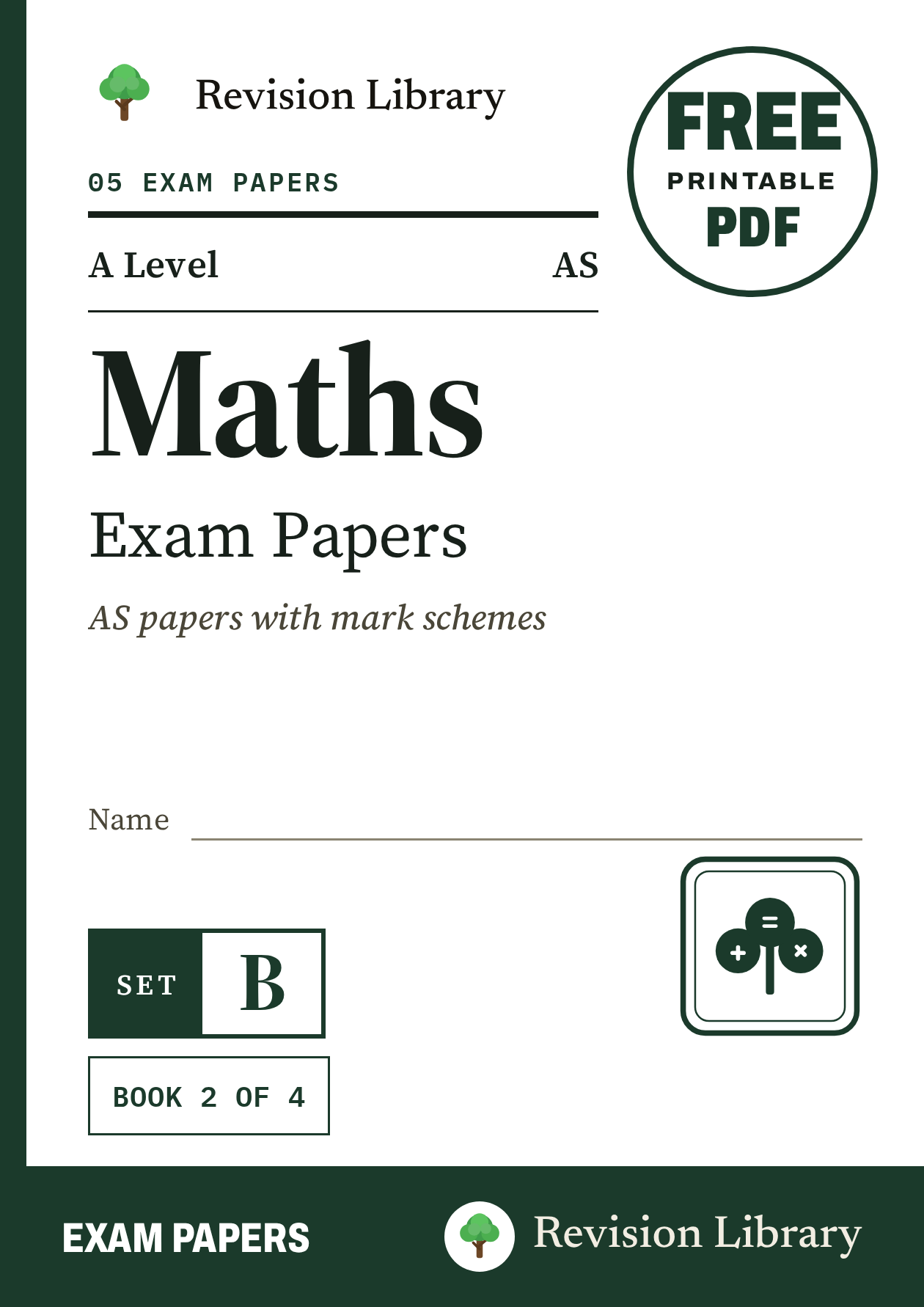
Book 2 of 4

A Level Maths Exam Papers Set B

AS Paper 4: Mechanics Focus, AS Paper 5: Mixed Pure and Applied and AS Paper 6: Full Course Review

Level
A Level · Edexcel 9MA0 · AQA 7357 · OCR H240
Series
A Level Maths Exam Papers, book 2 of 4
Suitable for
Years 12-13, AQA / Edexcel / OCR
FreePDF download · 2027 edition · 65 A4 pages
  • One file, prints straight to A4
  • No account, no password

3 papers, mark schemes at the back. This set is one of 558 free PDFs on the shelf.

Pages
65 A4 pages
Papers
3 papers
Questions
56 · 240 marks
Answers
From page 52

What is inside

3 papers · answers from p52

Each paper starts with a page showing its marks and a suggested time, followed by the questions. The mark schemes for all 3 papers are at the back, so you can sit each paper as a mock and mark it afterwards.

  1. 01AS Paper 4: Mechanics Focus19 questions · 80 marksp3
  2. 02AS Paper 5: Mixed Pure and Applied13 questions · 60 marksp19
  3. 03AS Paper 6: Full Course Review24 questions · 100 marksp31
  4. AnswersMark schemes for every paperp52

Each paper is drawn from one of our worksheet packs. Follow a paper title for the full pack on its own page, or browse every A Level Maths pack. Every book on the shelf is a complete printable workbook of up to 120 A4 pages.

Explore this volume

A Level Maths Exam Papers Set B includes AS Paper 4: Mechanics Focus (from page 3); AS Paper 5: Mixed Pure and Applied (from page 19); AS Paper 6: Full Course Review (from page 31).

Worked question 7 - AS Paper 4: Mechanics Focus

Using the small angle approximation cos(x) = 1 - (x^2)/2, valid for small values of x in radians, show that (1 - cos(x))/x^2 is approximately 1/2 for small nonzero x.

Answer

(1 - cos(x))/x^2 is approximately 1/2 for small x, since 1 - cos(x) = (x^2)/2 using the small angle approximation

Mark scheme

M1for substituting the approximation cos(x) = 1 - (x^2)/2
A1for 1 - cos(x) = (x^2)/2
M1for dividing by x^2
A1for (1 - cos(x))/x^2 approximately 1/2 for small nonzero x in radians, using the given approximation

Question 15 - AS Paper 4: Mechanics Focus

4 marks

Prove that (2n + 1)^2 - (2n - 1)^2 is a multiple of 8 for every integer n.

Answer

Proof: (2n + 1)^2 - (2n - 1)^2 = 2 x 4n = 8n, a multiple of 8 for every integer n.

Mark scheme

M1for applying the difference of squares identity to form the difference and sum factors, or for correctly expanding both squares
A1for factors 2 and 4n, or correct expanded squares 4n^2 + 4n + 1 and 4n^2 - 4n + 1
M1for multiplying the factors or subtracting expansions to obtain 8n
A1for explaining that 8n is a multiple of 8 because n is an integer

Question 5 - AS Paper 4: Mechanics Focus

4 marks

A cyclist decelerates uniformly from 15 m/s to rest in 12 seconds.

Find the deceleration, and find the distance travelled while decelerating.

Answer

deceleration = 1.25 m/s^2; distance = 90 m

Mark scheme

M1for using a = (v - u)/t
A1for a = -1.25 m/s^2 (a deceleration of 1.25 m/s^2)
M1for using s = (u + v)/2 x t
A1for s = 90 m

Question 4 - AS Paper 4: Mechanics Focus

4 marks

Without using a calculator, find dy/dx for y = 5x^4 - 3/x^2 + 6, writing 3/x^2 as 3x^-2 before differentiating.

Answer

dy/dx = 20x^3 + 6/x^3

Mark scheme

M1for rewriting 3/x^2 as 3x^-2
M1for differentiating each term
A1for the 20x^3 term
A1for dy/dx = 20x^3 + 6/x^3

Question 3 - AS Paper 6: Full Course Review

2 marks

A resultant force of 36 N gives a body an acceleration of 4 m/s^2.

Find the mass of the body.

Answer

9 kg

Mark scheme

M1for using F = ma
A1for m = 9 kg

Question 14 - AS Paper 6: Full Course Review

4 marks

A scatter diagram for 10 pairs of data on hours revised (x) and test score (y) has product moment correlation coefficient r = 0.82.

Interpret this value in context, and state, giving a reason, whether it would be appropriate to use the regression line of y on x to predict the score of a student who revised for 15 hours, given that the data ranges from 2 to 12 hours of revision.

Answer

r = 0.82 shows strong positive correlation; predicting for 15 hours would be extrapolation and unreliable, since it is outside the data range 2 to 12 hours.

Mark scheme

B1for strong positive correlation between hours revised and test score
B1for explaining in context that test scores tend to increase as revision hours increase
B1for stating that prediction at 15 hours is not appropriate or is unreliable
B1for explaining that 15 is outside the observed range 2 to 12, so this extends beyond the data; the word extrapolation and a separate limitation statement are not required

Question 7 - AS Paper 6: Full Course Review

4 marks

A bag contains 5 red and 3 blue counters. A counter is drawn at random, its colour is noted, and it is then replaced. A second counter is then drawn.

Find the probability that both counters are the same colour.

Answer

17/32

Mark scheme

M1for P(both red) = (5/8)(5/8)
M1for P(both blue) = (3/8)(3/8)
A1for the two probabilities 25/64 and 9/64
A1for the total 34/64 = 17/32

Question 11 - AS Paper 5: Mixed Pure and Applied

6 marks

A particle P moves in a straight line so that its displacement s metres from a fixed point O at time t seconds (t >= 0) is given by s = t^3 - 9t^2 + 24t.

Find the velocity and acceleration of P as functions of t, find the times at which P is instantaneously at rest, and find the total distance travelled by P in the first 5 seconds.

Answer

v = 3t^2 - 18t + 24 m/s; a = 6t - 18 m/s^2; at rest at t = 2 s and t = 4 s; total distance in first 5 s = 28 m

Mark scheme

M1for differentiating to find v = 3t^2 - 18t + 24
A1for differentiating to find a = 6t - 18
M1for setting v = 0 and solving to get t^2 - 6t + 8 = 0
A1for t = 2 and t = 4
M1for evaluating s at t = 0, 2, 4, 5 (s = 0, 20, 16, 20) and using these to find the distance travelled in each interval
A1for total distance = 28 m

Question 3 - AS Paper 5: Mixed Pure and Applied

4 marks

A cyclist decelerates uniformly from 15 m/s to rest in 12 seconds.

Find the deceleration, and find the distance travelled while decelerating.

Answer

deceleration = 1.25 m/s^2; distance = 90 m

Mark scheme

M1for using a = (v - u)/t
A1for a = -1.25 m/s^2 (a deceleration of 1.25 m/s^2)
M1for using s = (u + v)/2 x t
A1for s = 90 m

A Level Maths Exam Papers runs to 4 volumes

Book 2 of 4 · 236 pages in the set

Each set is a separate free PDF with its own mark schemes at the back.

Volume 1

53 pp · 50 Qs

AS Paper 1: Algebra and Trigonometry, AS Paper 2: Calculus and Vectors and AS Paper 3: Statistics Focus

Volume 2 · this book

65 pp · 56 Qs

AS Paper 4: Mechanics Focus, AS Paper 5: Mixed Pure and Applied and AS Paper 6: Full Course Review

Volume 3

55 pp · 47 Qs

A Level Paper 1: Pure Foundations, A Level Paper 2: Calculus and Vectors and A Level Paper 3: Statistics and Hypothesis Testing

Volume 4

63 pp · 55 Qs

A Level Paper 4: Mechanics, Forces and Moments, A Level Paper 5: Mixed Applications and A Level Paper 6: Full Course Review

More A Level books

Want a different mix of topics?

Sitting an exam soon? Build a A Level Maths mock paper or print a ready-made one.